
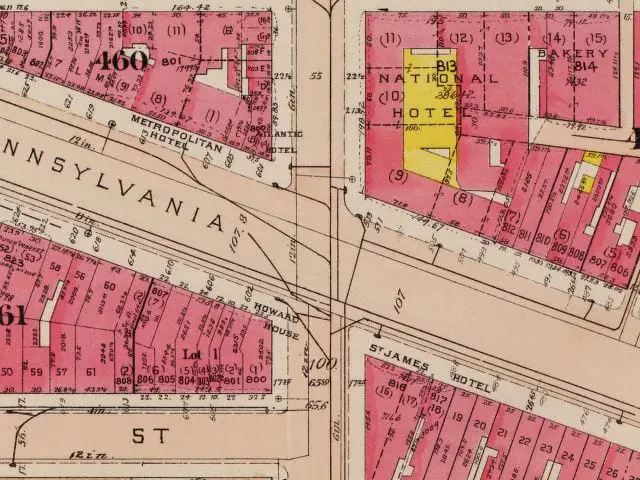
For more than a century, the stretch of Pennsylvania Avenue between 3rd Street and 7th Street NW was Washington’s hotel row. Stagecoaches dropped off congressmen at the door, presidents took the oath of office in the parlors, and the bar fights of national politics played out under crystal chandeliers. By 1942 all of it was rubble.
This is the story of three of those buildings: the National Hotel at 6th and Pennsylvania, Brown’s Indian Queen Hotel directly across the street, and the Southern Hotel a few blocks east at 311 Pennsylvania. The first hosted every president from Jackson to Lincoln. The second seated John Tyler when he was sworn in. The third served Black travelers in a city that had quietly drawn a color line through its hotel registers.
None of them is standing.
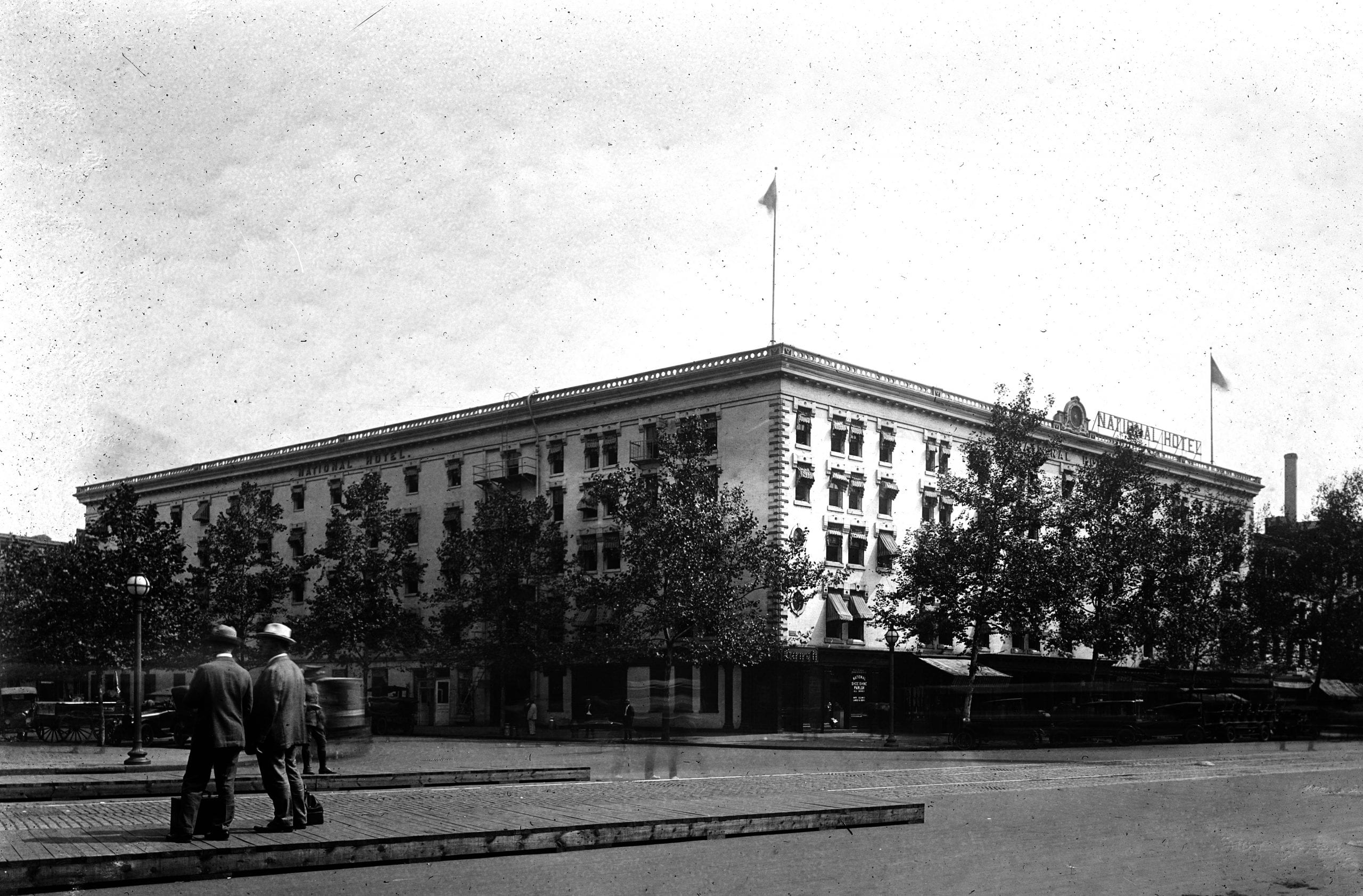
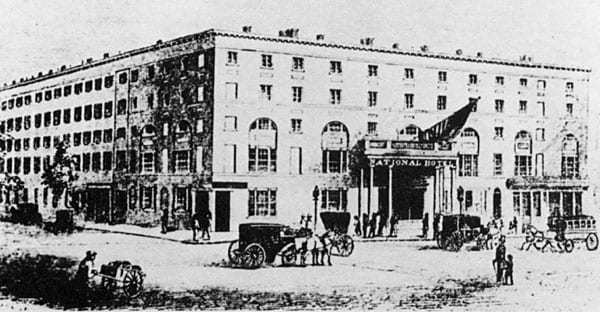
The National Hotel, 1827 to 1942
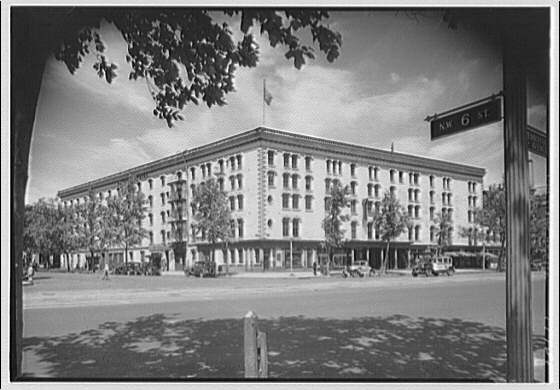
The National sat at 6th and Pennsylvania Avenue NW, on the spot where the Newseum later opened in 2008 and closed again on December 31, 2019. The building today belongs to Johns Hopkins University, which is converting it into the Bloomberg Center.
But for 115 years before any of that, it was the National Hotel. And for stretches of the 19th century, it was the most politically loaded address in town that didn’t have a flag on the roof.
John Gadsby opened the place in 1827. He came over from Alexandria, where he had run Gadsby’s Tavern, the establishment George Washington used to stop into.
When business slowed in Alexandria, Gadsby crossed the river, picked the site, and had an English architect design the building. The Calvert family, who owned the ground and traced their blood back to Lord Baltimore, gave him a long lease.
The hotel was originally called Gadsby’s, and it carried that name until 1844, when Gadsby sold out and the Willard family took over. Yes: that Willard family.
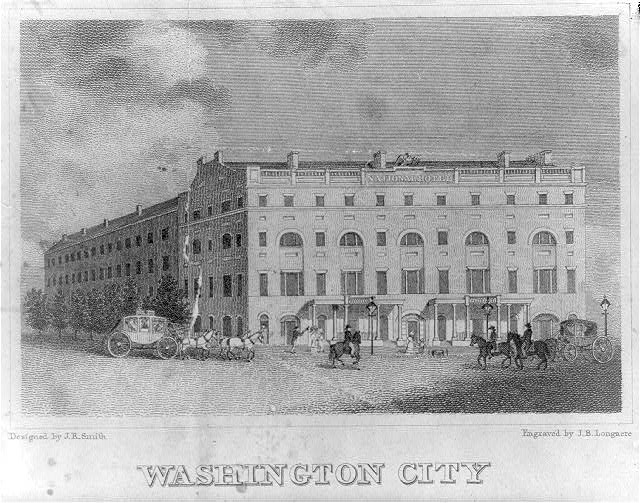
Gadsby was a hotelier, and he was also a slave trader. The White House Historical Association has documented his role as one of the President’s-Neighborhood enslavers who supplied the political class of the early republic. The same man who poured port for cabinet members owned the people serving it.
Under Willard management, the place got bigger. In 1852 the Calverts spent $45,000 on an expansion: $19,000 to remodel the old building, $26,000 for additions. The new room count was 356. By 1865 the hotel was sleeping 1,100 guests at a time.
The Washington Post’s long obituary of the building, published January 5, 1930, reads like an inventory of pre-Civil War America:
A tragedy soon will be enacted in this city the like of which Washington has seldom, if ever, seen before. The famous old National Hotel is to be razed. It is one of the oldest hostelries in America, having been in continuous operation since 1827, when John Gadsby came from Alexandria to open it…. Apart from the Capitol and the White House, there is no building in the city so historic as this. For more than half a century the history of the Nation was made there. Within its walls great political contests that affected the destiny of the Nation were mapped out, and here the most infamous crime in American history, the assassination of Lincoln, was planned. Every President from Jackson to Lincoln was a guest there, and there lived Henry Clay; there he died.
Every president from Jackson to Lincoln. Inside one building.
Henry Clay’s Last Suite
Clay’s death at the National happened on June 29, 1852. He had left his Kentucky home, Ashland, on November 1, 1849, and had been keeping rooms at the hotel ever since whenever Congress was sitting.
The WaPo reconstruction is precise about which rooms:
Although his health was sensibly declining, Clay came on to Washington in December, 1851, for the last session of Congress he was ever to attend, taking his old suite, No. 32, in the National. It was as famous in his day as the “Amen Corner” in the Fifth Avenue in Tom Platt’s day, or Room No. 5, Andrew Johnson’s suite, in the old Maxwell House in Nashville.
Clay died in suite No. 32 with his son Thomas at his side. He had attended the Senate sessions of his final year irregularly. One important speech, then home to Ashland and back.
That alone would justify a plaque. The story of the National Hotel piles up plaques.
President Polk and his vice president, George M. Dallas, stayed at the hotel during the run-up to Polk’s 1845 inauguration. While there, Dallas was challenged to a duel and accepted. Polk used his good offices to talk the parties down. Dallas lived to be minister to Great Britain and to Russia.
The National Hotel Disease
In late January 1857, the National Hotel had something other than a duel to manage. People started getting sick.
The outbreak began among guests who ate in the dining room. The bar’s customers were spared.
Symptoms were vicious: persistent diarrhea, sudden prostration, intense colic, swollen tongues, vomiting that came on after the diarrhea ceased. Many of the sickened victims continued to feel symptoms after they left Washington.
By some accounts, 400 people were stricken. Nearly three dozen died.
James Buchanan, the president-elect, had checked in on January 25, 1857 with eight companions. The sickness hit him on inauguration eve. He delivered his March 4 address anyway, despite barely being able to stand.
Buchanan’s nephew, Eliot Eskridge Lane, who had been set to serve as the new president’s personal secretary, did not pull through. Neither did three congressmen who had also dined at the hotel: Representative John G. Montgomery of Pennsylvania, who died in April 1857; Representative John A. Quitman of Mississippi, a former Mexican-American War general, who died in July 1858; and former Representative David F. Robison of Pennsylvania, who lingered until June 1859.
Major George McNeir of Washington, age 64, died after taking dinner at the National during the first wave. Dr. Jas J. Waring performed the only autopsy.
The mayor and the Board of Health pulled together a committee. A sewer builder discovered an open sewer line in the southwest corner of the hotel that connected into the Sixth Street sewer. Gas was issuing through the opening, the builder reported, rapidly enough to put out a candle flame.
Conspiracy theories ran. The Philadelphia Times found a physician who blamed arsenic in the water. An exterminator had laid out arsenic to kill rats, and a poisoned rat was later discovered in the water tank.
The radical-abolitionist-poisoning rumor stuck around in the papers for months. Modern medical historians have since concluded that the actual cause was almost certainly dysentery, spread through a primitive sewage system whose pipes had cracked during that winter’s freeze-thaw cycles.
The president-elect was poisoned by his own toilet pipes. The nephew died. Three congressmen died. And the hotel kept booking guests.
John Wilkes Booth, Room 228
Eight years later, the National’s guest book caught a name that would put it in every history of Lincoln’s assassination.
John Wilkes Booth’s room at the National was No. 228. He arrived on Wednesday, November 9, 1864, stayed two nights, left, came back on November 14 for two more nights, and was in and out across the months that followed. His last day at the hotel was April 8, 1865, six days before he shot the president at Ford’s Theatre.
The 1930 Post piece quotes Ben Perley Poore’s 1887 reminiscences on what kind of guest Booth was:
convivial in his habits, sprightly and genial in conversation. He made many friends among the young men of his own age, and he was a favorite among the ladies at the National.
Convivial. Sprightly. Genial. A favorite among the ladies. This is how the man who would kill a president presented at breakfast.
Booth shared his room with rotating company. One frequent roommate was the actor John Edward McCullough, an Irish-born tragedian who had played opposite both Edwin Forrest and Booth’s older brother Edwin.
Booth had appeared in The Apostate at Ford’s Theatre on March 18, 1865 as a benefit performance for McCullough. Other recorded roommates included John P. Wentworth of California and a Mr. McArdle.
George Atzerodt and David Herold, two of Booth’s co-conspirators, were both seen visiting Room 228 in the weeks leading up to the assassination. The 1930 Post obituary of the building names that detail almost in passing.
The Lincoln plot, in the popular memory, is staged at Mary Surratt’s boarding house. It was also staged here. Mary Surratt’s place is now a Chinese restaurant. Room 228 is air.
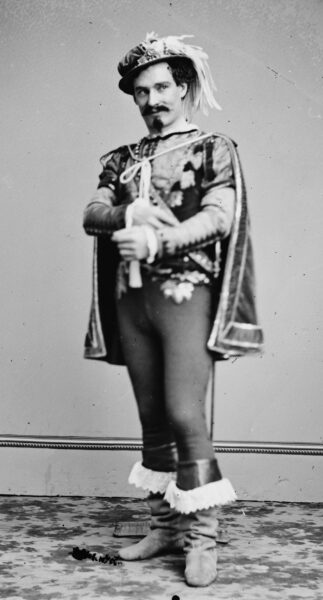
About McCullough himself. The 1930 WaPo article, picking up an older newspaper tradition, says McCullough met a tragic end: murdered by a fellow actor at the National Theatre and buried in a cellar beneath the stage, where he is said to haunt the place still.
That part is theater lore. McCullough actually died on November 8, 1885, of general paresis (advanced syphilis), at a Philadelphia asylum. The buried-in-the-cellar version is enduring National Theatre ghost-story material, not history.
The End
The hotel had a fire in 1921 and never fully recovered its reputation. In 1929 the city of Washington bought the building from the Calvert family for $580,000 to make way for what was being planned as the District’s new civic center on the north side of Pennsylvania Avenue. The hotel stopped serving guests in 1931, then sat as a government office building. Demolition came in 1942.
The 1930 Post piece is essentially a eulogy. The most quoted line is the one in the lede: a tragedy will be enacted in this city. The civic center never materialized in quite the form anyone imagined. The Newseum, which sat on the spot from 2008 to 2019, has been replaced by Johns Hopkins. The building is now glass and steel where there used to be 1,100 beds and Henry Clay’s death suite.
Brown’s Indian Queen Hotel and the Metropolitan, 1810s to 1933
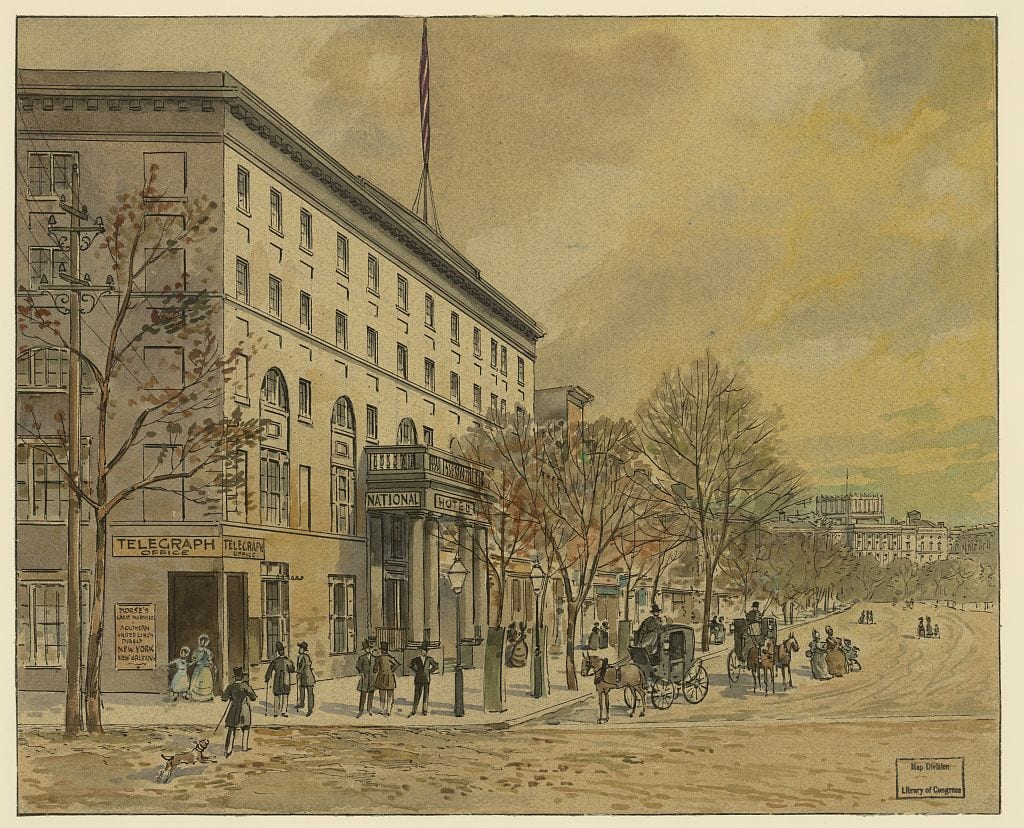
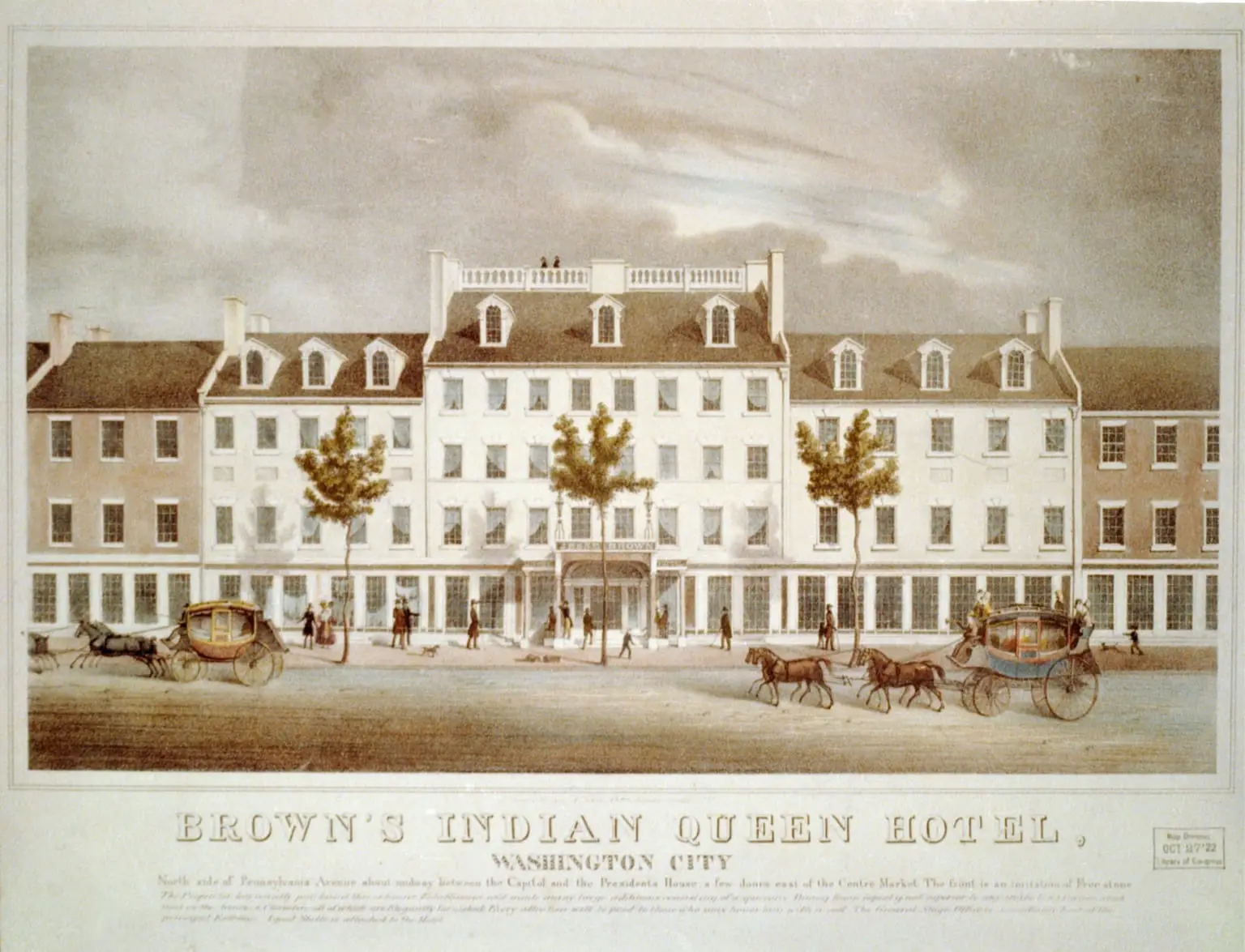
Cross 6th Street going north and you would have been at Brown’s Indian Queen Hotel, later renamed the Metropolitan. The hotel sat on the north side of Pennsylvania Avenue, midway between the Capitol and the White House, “a few doors east of the Centre Market.” The Centre Market itself was at 7th and Pennsylvania, and closed for good on January 1, 1931, a year and change after the National’s sale. Today the rough Metropolitan-and-Centre-Market footprint is occupied by the National Archives.
The Davis Hotel and the Star-Spangled Banner
The site has been a hotel since 1805. The first establishment was Woodward’s Centre Tavern, with water piped in from a nearby spring.
A line of operators followed: Solomon Meyer, Robert Underwood, Nicholas L. Queen, George W. Lindsay, John Davis, David McKeowin. They built and absorbed buildings on the lot in various combinations.
As Davis’ Hotel the place hosted the 1817 inaugural ball for James Monroe. According to a long-standing claim, “The Star-Spangled Banner” was sung for the first time at this tavern in December 1814, during a dinner held in honor of Secretary of the Navy William Jones, who was resigning his office. The claim has its disputants, but it has stuck for two centuries.
Jesse Brown Takes Over
In 1821, Jesse Brown bought the operation. He was Maryland-born, from Havre de Grace, and had run the City Hotel in Alexandria. He renamed the establishment the Indian Queen Tavern, possibly after a hotel of the same name kept by David Arrell on Market Street in Alexandria.
Brown went all in on the branding. A large painted wooden carving of a stylized Native American woman fronted the building. A wooden sign carried the motto “good entertainment for man and beast.” A bell sat on a tall pole at the footwalk. Brown’s enslaved staff rang it at mealtime; the sound could be heard along Pennsylvania Avenue from Four and a Half Street to Ninth.
The Indian Queen became Washington’s stagecoach hub. The Baltimore and Philadelphia coaches departed the courtyard each morning. Three times a week a coach pulled out for the National Road, bound for Frederick, Cumberland, and Pittsburgh.
Native American treaty delegations stayed there too. The Choctaw chief Pushmataha was a guest during one of his Washington negotiations. Then so was Sam Houston in 1830, checking in as a Cherokee Nation ambassador, years before Texas existed as a state and Houston existed as its senator.
Charles Dickens dropped in during his 1842 American tour. He worked the Indian Queen into the Washington scenes of Martin Chuzzlewit.
Ben Perley Poore, the long-running Washington correspondent whose 1887 memoirs are a primary source for half this story, remembered Brown personally preparing what Poore called a “foaming eggnog” in a punch bowl that was said to have once belonged to George Washington. He served it on July 4th and Washington’s Birthday.
The Jackson-Calhoun Toast
On April 13, 1830, the Democratic Party held a banquet at the Indian Queen to mark Thomas Jefferson’s birthday. President Andrew Jackson was the highest-ranking guest. He was at war with his vice president, John C. Calhoun, over the doctrine of nullification, the South Carolina-led theory that a state could refuse to obey a federal law.
David Crockett was among the congressmen who came up in the world from Mrs. Ball’s across the street and moved into the Indian Queen during his third House term, when the Whigs began funding him as a possible presidential candidate.
When the toasts came, Jackson stood up, locked eyes with Calhoun, and said:
Our Union: it must be preserved!
Calhoun rose and answered:
Our Union: next to our liberty, most dear! May we always remember that it can only be preserved by distributing equally the benefits and the burdens of the Union.
The next toast was by Secretary of State Martin Van Buren, the diplomat in the room. He went with:
Mutual forbearance and reciprocal concessions. Through their agency our Union was founded. The patriotic spirit from which they emanated will forever sustain it.
Three decades later, the question of whether the Union could be preserved would settle itself with 750,000 dead. The Indian Queen had its dinner cleared and the dishes washed.
John Tyler Is Sworn In
On April 6, 1841, William Henry Harrison had been dead for two days. His vice president, John Tyler, took the oath of office in his rooms at the Indian Queen. Tyler became the first vice president elevated by the death of a sitting president. The transition is now routine. In 1841 it was a constitutional question, and the swearing-in took place in a hotel.
The Marble Hotel and the Cornerstone Time Capsule
Jesse Brown died in 1847 at age 74. His sons, Tillotson P. Brown and Marshall Brown, took over.
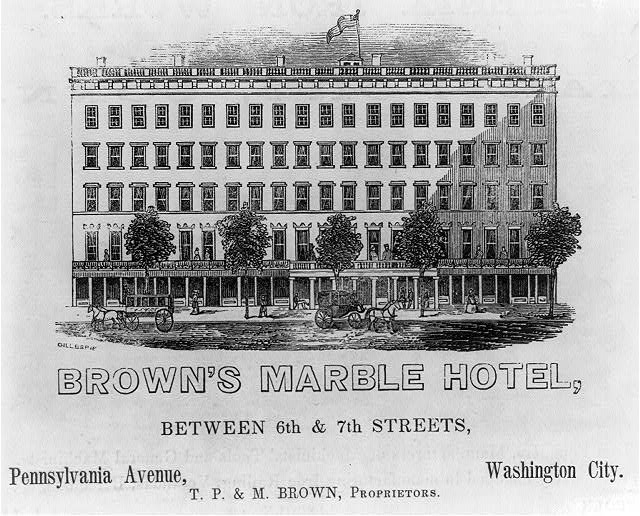
The old wooden building was torn down in 1850. A new “Brown’s Marble Hotel” rose on the spot, designed by the Philadelphia architect John Haviland. The marble came from Maryland and, by tradition, was left over from the construction of the U.S. Capitol.
The cornerstone was laid in May 1851. Inside the time capsule the Brown sons sealed up an extraordinary list of objects. Per the Daily Republic’s contemporary account:
Items deposited in the time capsule in the cornerstone included grains of gold brought by John Walker from California, a copy of the Declaration of Independence and “Rev. C.M. Butler’s Thanksgiving Sermon,” and “pennies by the old colored servants, put in for ‘good luck,’ and to ‘the memory of their old master.'”
California gold, the Declaration, a Thanksgiving sermon, and pennies from the enslaved staff of the recently-dead Jesse Brown. That is a complete portrait of America in 1851 in one masonry joint.
Southern Congressmen, Juleps, and the Metropolitan
The reborn marble hotel kept the Brown name until 1862, when a new operator leased the building and renamed it the Metropolitan Hotel. The Brown family sold their remaining stake entirely in 1865.
Under both names, the place had a reputation: it was where Southern congressmen stayed when in Washington. Virginia Clay-Clopton, the Alabama-born wife of Senator Clement Clay, captured the feel of the place in her 1904 memoir A Belle of the Fifties:
It was the rendezvous of Southern Congressmen, and therefore was “very agreeable and advantageous,” as my husband wrote of it…. Indeed, the foundations of its good reputation were laid while it was yet the Indian Queen’s Tavern, renowned for its juleps and bitters. It was an unimposing structure even for Pennsylvania Avenue, then but a ragged thoroughfare, and, as I have said, notable for the great gaps between houses; but the cuisine of Brown’s Hotel, as, until a few years ago, this famous house continued to be known, was excellent.
A ragged thoroughfare. Great gaps between houses. That’s what one of Washington’s most respected establishment hotels looked from the lobby in the 1850s.
The Metropolitan limped through the Gilded Age and the Progressive Era, fading from prominent to dingy. It was razed in 1933.
Some of the bricks ended up in a new Georgian-style house on Massachusetts Avenue. The lot became a bus station. By the 1960s it was a Barney’s restaurant.
A two-bay corner fragment of the marble facade survived until 1984, when the last of it came down. The Indian Queen sign, the painted Native woman, the eggnog bowl said to have been Washington’s, all gone before most of us were born.
The Southern Hotel, 311 Pennsylvania Avenue NW
Walk east on Pennsylvania Avenue. Cross 4th Street. Cross 3rd. You would arrive at 311 Pennsylvania Avenue NW. The Southern Hotel stood there.
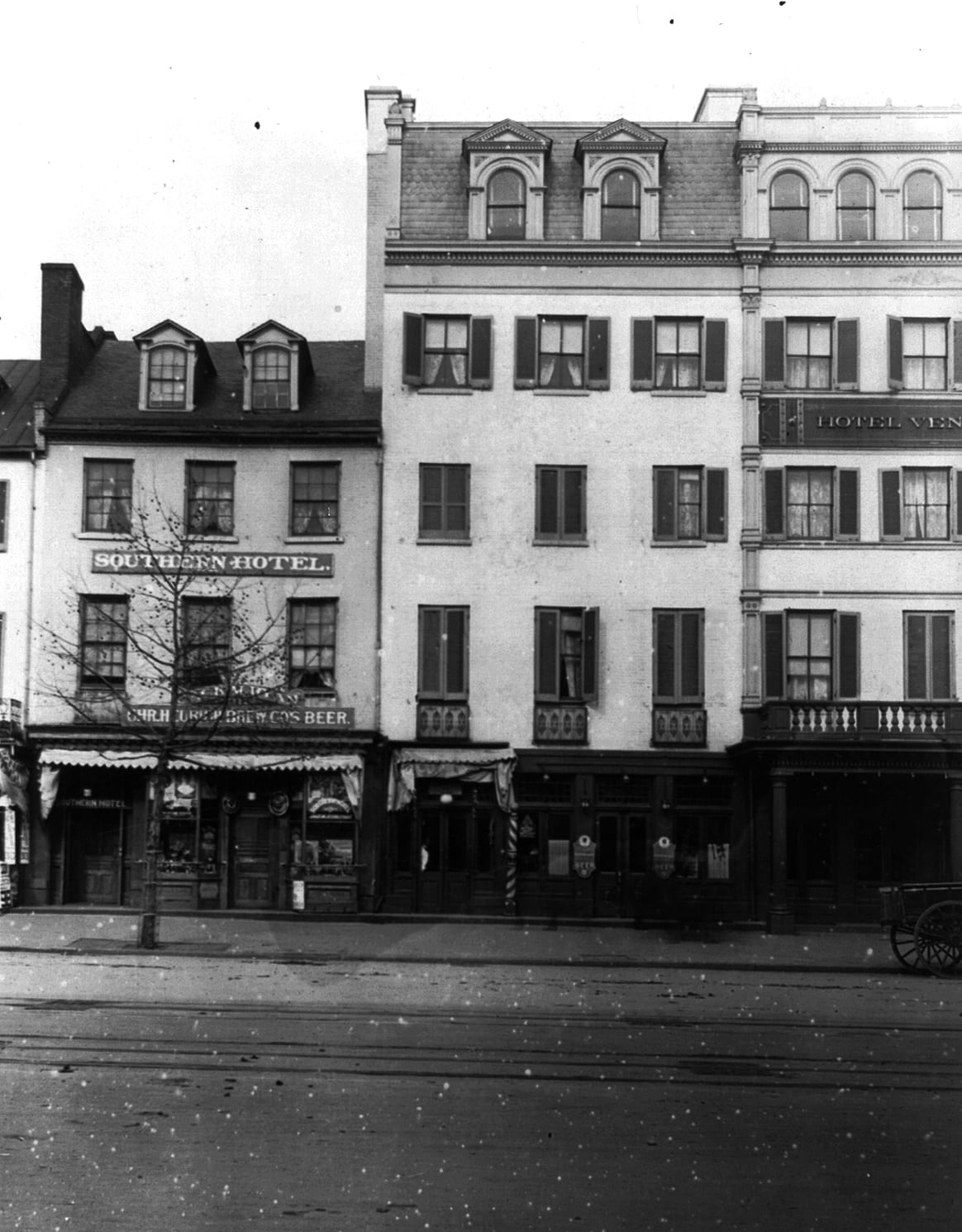
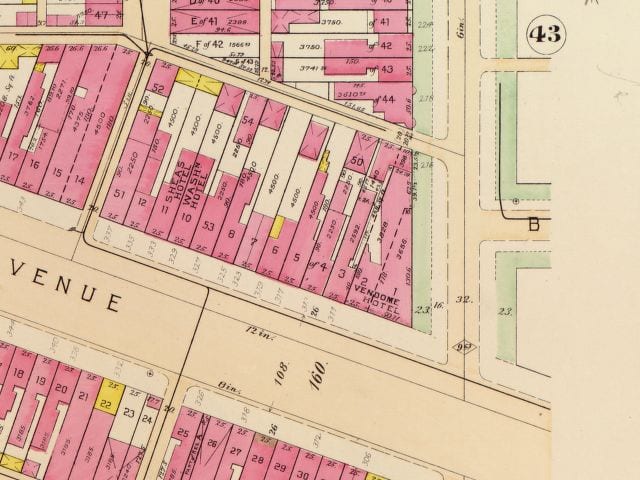
The Southern was a hotel for African Americans, the catalog record at the Library of Congress lists it as “Negro hotel (Southern Hotel)”. The photograph in the LOC record dates to 1899. The 1903 map shows the building on a block with several other hotels, with the Vendome Hotel sitting on the corner of Pennsylvania and 3rd.
The hotels of the National and Brown’s stretch of the avenue, like every white-owned hotel of consequence in Washington, did not accommodate Black travelers. The Southern was where Black businessmen, Black ministers, Black fraternal lodges holding national meetings, and Black families on the way to or through Washington stayed.
What is most worth knowing about this particular photograph, though, is how it came to be in the Library of Congress.
The Southern Hotel image is part of the Daniel Murray Collection. Daniel A. P. Murray (1852 to 1925) was the Library of Congress’s first African American assistant librarian, a bibliographer, a documenter of Black American intellectual life. In 1900, he and his colleagues were given the assignment of building an exhibit on African American achievement for the Exposition Universelle in Paris.
The exhibit, called the “Exhibit of American Negroes,” was organized in part by W. E. B. Du Bois. It contained books, photographs, statistics on Black education and property ownership, and the famous data visualizations Du Bois designed.
The exhibit won a Grand Prix at the fair.
The Southern Hotel photograph was one of the pictures Murray’s team chose to put in front of European viewers as evidence of how African American life looked in the nation’s capital at the turn of the 20th century. A working hotel. Black-owned, Black-staffed, Black-patronized. On Pennsylvania Avenue.
The Southern’s eventual fate is harder to pin down than the National’s or the Metropolitan’s. The block was reshaped repeatedly through the federal-buildings expansion of the early 20th century and then again by the Pennsylvania Avenue redevelopment campaigns. The hotel is gone. So is the Vendome on the corner.
What Was Lost on Pennsylvania Avenue
Three buildings, one stretch of one street, one century of American politics.
The composite below is a photolithograph from somewhere between 1882 and 1900, lining up eight of the city’s working hotels in a single frame. The National Hotel and the Metropolitan (formerly Brown’s) are both on the print, side by side with the Willard, the Ebbitt, the Riggs, the St. James, the Arlington, and the Baltimore and Potomac depot. Most of them are also gone. A few survive in some form: the Hay-Adams went up on the Hay and Adams house lots in 1928, the Raleigh ran on Pennsylvania Avenue for 71 years before it came down, the Hotel Harrington on 11th Street is still operating after more than a century, and the Cairo’s height-act fight rewrote the rules for how tall any building in the city is allowed to be.
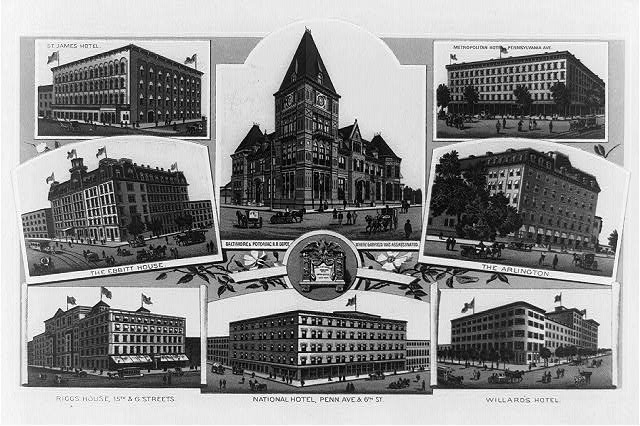
The three on this list left less behind. The National Hotel’s footprint is the Newseum building. Brown’s Marble Hotel’s footprint is the National Archives complex. The Southern Hotel’s footprint is part of the federal Pennsylvania Avenue redevelopment grid.
None of them is named on a street sign. None of them is plaqued.
What did they have? Henry Clay’s last suite, the room where Booth slept the week he killed the president, the dining room where 36 people died from sewer gas, the parlor where John Tyler was sworn in as president, the banquet hall where Andrew Jackson stared down John C. Calhoun and named the Union, and the lobby where Black travelers found a bed when no white hotel in town would rent them one.
That is what Pennsylvania Avenue lost.
More on National Hotel disease here:
http://history.house.gov/HistoricalHighlight/Detail/36247?ret=True
http://blogs.weta.org/boundarystones/2013/09/11/five-star-malady
And the hotel’s ultimate fate here:
http://www.streetsofwashington.com/2009/11/national-hotel.html
There was a great article on Monday 8 Oct 1855 in the Evening Star about “The National Hotel” to go over the National
Hotel, from top to bottom, inspecting carefully
the improvements of all conceivable descriptions that have been made in in multifarious arrangements and accoutrements. I stumbled across this while searching out my family,My 3rd great grand uncle Southey Spalding Parker & his cousin William Spalding who owned a house painting company at 190 PA ave & apparently painted the National Hotel! “Outside Painting By Parker & Spalding, Of Washington” … full article is on the far left … http://chroniclingamerica.loc.gov/lccn/sn83045462/1855-10-08/ed-1/seq-3/#date1=10%2F08%2F1855&index=2&date2=10%2F08%2F1855&searchType=advanced&language=&sequence=0&lccn=sn83045462&words=&proxdistance=5&rows=20&ortext=&proxtext=&phrasetext=&andtext=&dateFilterType=range&page=1