
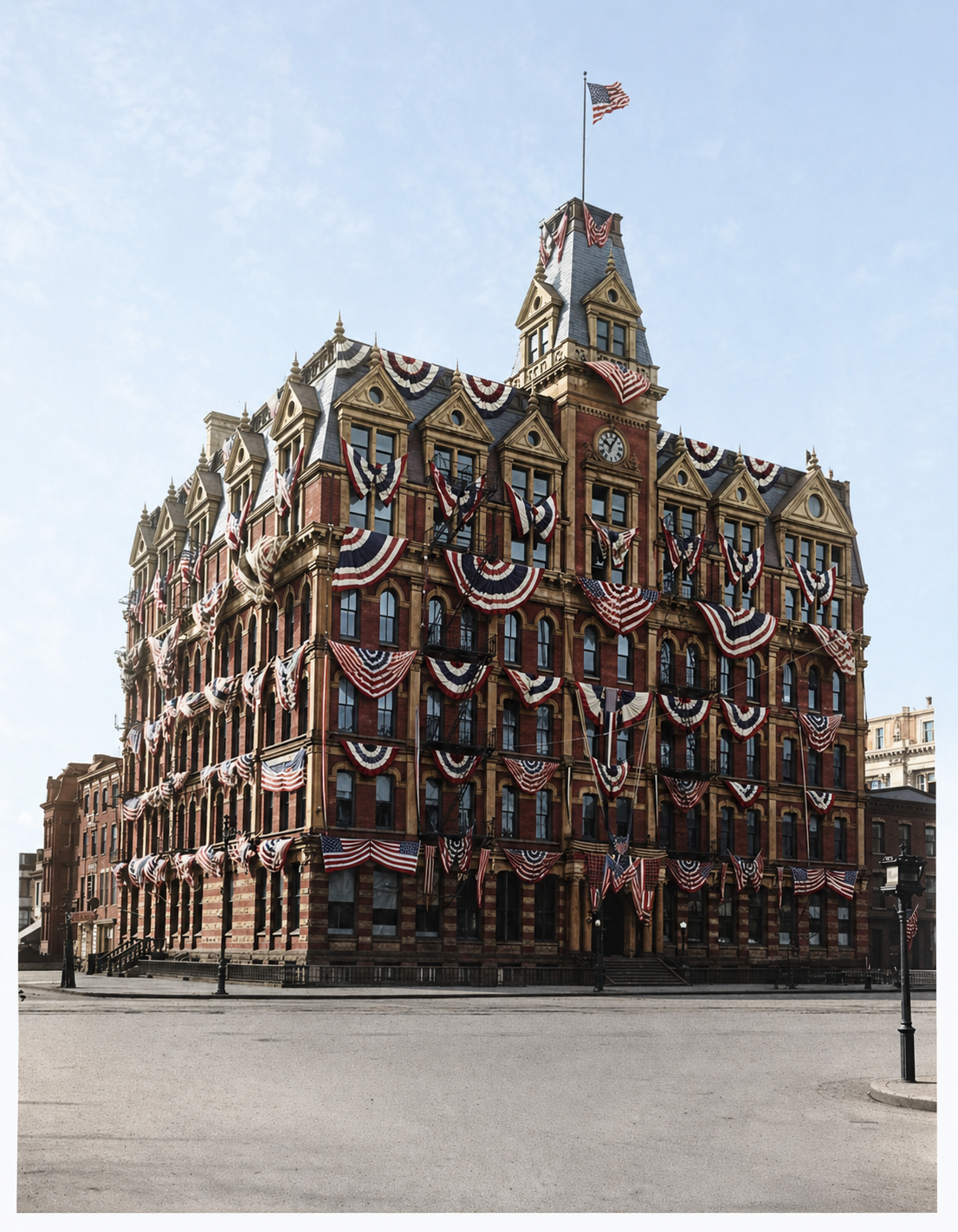
We colorized this one.
Count the flags on this building. Every floor. Every window. Bunting draped across every cornice, every arch, every ledge. This is the Southern Railway Building at 13th Street and Pennsylvania Avenue NW, dressed for what the Library of Congress says was probably a presidential inaugural. We ran the original black-and-white Library of Congress photo through an AI colorizer, and suddenly the red brick and the gold trim and all those flags hit completely differently.
The federal government bought this building in 1929 and knocked it down for Federal Triangle.
Here’s the full story.
The Richmond and Danville Roots
The company that built this place wasn’t born as Southern Railway. It started as the Richmond and Danville Railroad, running trains from Washington down through the Carolinas, Georgia, and Alabama. By the 1880s the Richmond and Danville had stretched all the way to Atlanta and Birmingham, with its Washington headquarters right here on Pennsylvania Avenue.
Then came the Panic of 1893. The railroad went bankrupt, J.P. Morgan stepped in, merged it with the East Tennessee, Virginia and Georgia, and on July 1, 1894, Southern Railway was born. Morgan kept the headquarters at 13th and Pennsylvania. Being a few blocks from the Capitol and the Treasury, on the grand ceremonial boulevard of the republic, was exactly where a major American railroad wanted to be.
By the mid-1920s, Southern Railway was running 6,791 miles of track across 13 states. They had 2,200 employees at the DC location alone, with an annual payroll of over $4 million.
This was not a small operation.
A Solid, Imposing Thing
The original structure went up in 1871 in the Second Empire style for the Richmond and Danville. Second Empire was fashionable for serious commercial buildings in that era: mansard roof, heavy cornices, an air of permanence. They expanded it in 1893 and again in 1899.
The Library of Congress photograph shows the building at its fullest extent, dressed in flags, Pennsylvania Avenue presumably packed below. It is a solid, imposing thing. You can see why the railroad was proud of it.
What the photograph does not show is what was about to happen.
April 23, 1916
On April 23, 1916, the building burned.
The original structure that the Richmond and Danville had built in 1871 was destroyed by fire. Forty-five years of railroad headquarters, gone.
Southern Railway did not walk away. They rebuilt on the same site. A new building went up, federal agencies moved in as tenants, and operations continued. But the company’s days at 13th Street were now numbered.
The Federal Machine
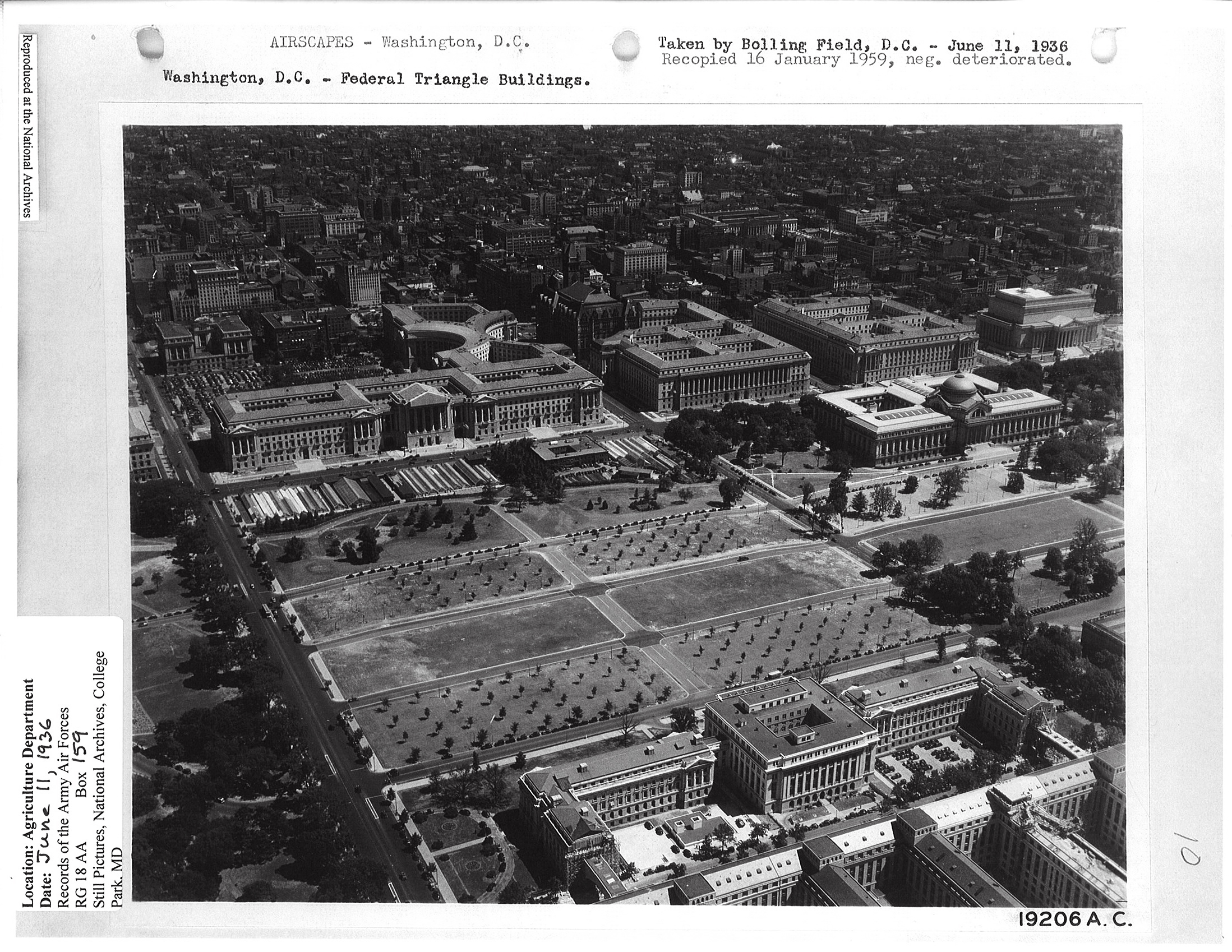
The McMillan Commission had been pushing for a grand federal office complex along Pennsylvania Avenue since 1902. Congress finally moved in 1926, authorizing a massive construction program that would produce the seven enormous buildings we now know as Federal Triangle: the National Archives, the Department of Justice, the Department of Commerce, the Internal Revenue Service building, and more. Seven buildings. Seventy acres. Built through the early and mid-1930s. They called it one of the greatest building projects ever undertaken.
Pennsylvania Avenue was not empty when they decided all this. It was packed with private businesses, government-leased offices, old commercial buildings, and markets.
The government moved methodically. In February 1927, the Commission of Fine Arts placed a ban on all non-federal construction in the area. Center Market began relocating in July 1927. One by one, properties were bought out. A five-alarm fire had torn through a candy factory on this same stretch of the Avenue in 1925. Now the whole block was about to come down by design.
$2,680,000 and We Need You Out
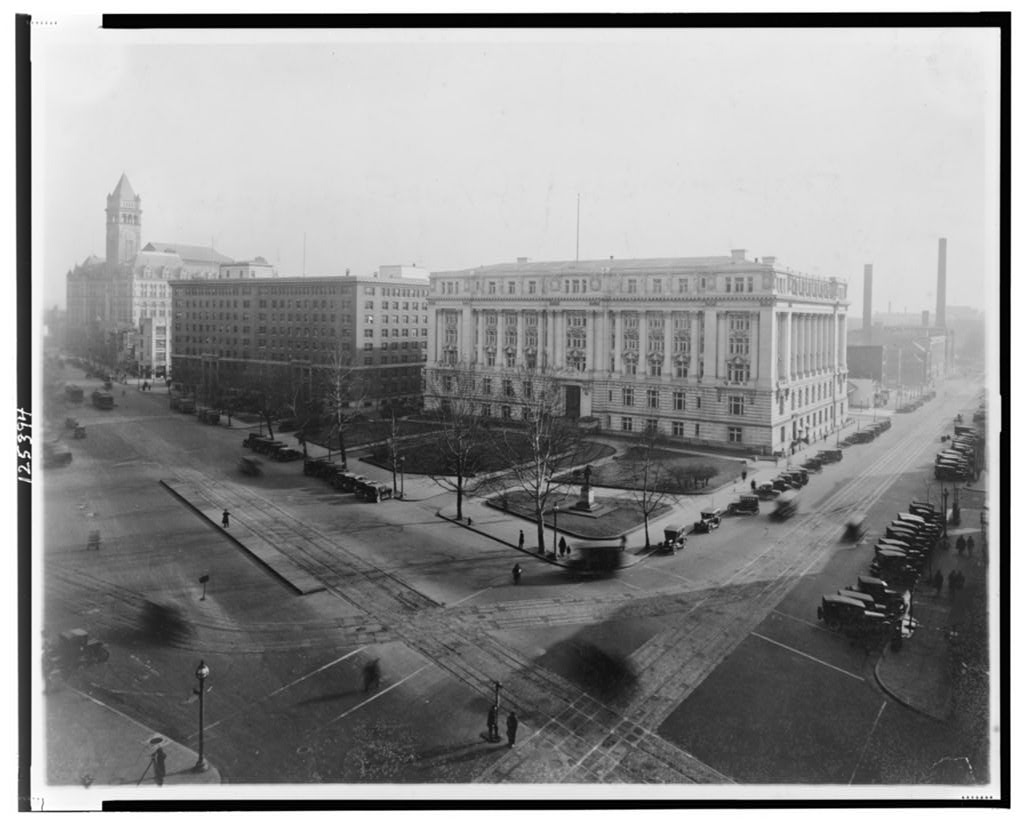
Southern Railway’s rebuilt building at 13th and Pennsylvania was one of the last holdouts on the block. Before the government even purchased it outright, the building was already housing federal agencies as tenants.
Congress authorized $2,680,000 to buy the Southern Railway Building in February 1928. The transaction was finalized in 1929. That’s roughly $45 million in today’s money for one office building on a street that was about to be completely unrecognizable.
To put the number in perspective: Southern Railway turned around and used more than $1.6 million of those proceeds to buy an 11-parcel site at 15th and K Streets for their new headquarters.
What Replaced It All
Federal Triangle was largely complete by 1936.
Walk that stretch of Pennsylvania Avenue today and there is nothing from before. The Ronald Reagan Building and International Trade Center, completed in 1998, stands at 1300 Pennsylvania Avenue NW, right on the site of the Southern Railway Building. It was the last piece of Federal Triangle to be built, its completion marking the full realization of a project that began in the late 1920s.
Federal Triangle demolished dozens of buildings, erased DC’s first Chinatown, and buried Pennsylvania Avenue’s commercial past under marble and limestone. We’ve written about the federal government pulling a similar move in Southwest DC a generation later, clearing an entire neighborhood for L’Enfant Plaza. Federal Triangle was an earlier and even grander version of the same playbook.
Southern Railway was one of many casualties. But it wasn’t the end of Southern Railway in Washington.
Where the Railroad Went
Washington architect Waddy Butler Wood designed their new headquarters at 15th and K Streets. The building went up in 1928 and 1929: eleven stories of Stripped Classical style with early Art Deco touches, limestone and granite facing a steel and concrete frame. Wood said the design was inspired by the Acropolis of Athens.
The cornerstone ceremony on December 20, 1928 was conducted with full Masonic ceremony. Grand Master James T. Gibbs of the Grand Lodge of the District of Columbia officiated. The trowel and gavel used were the same ones George Washington had used when he laid the cornerstone of the U.S. Capitol.
If Southern Railway was being forced off Pennsylvania Avenue, they were going to leave a mark on K Street.
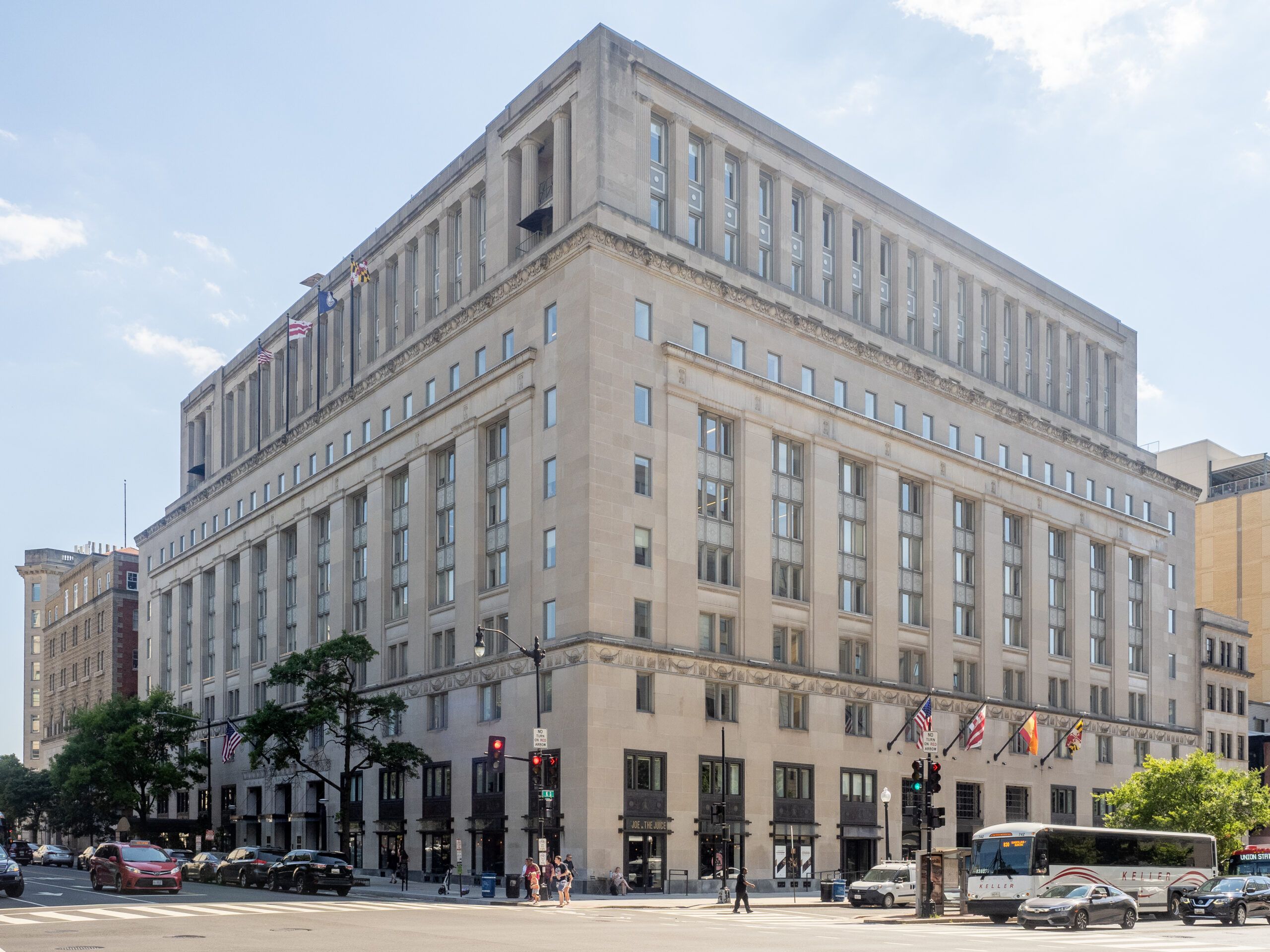
Southern Railway occupied that building until 1982, when the company merged with the Norfolk and Western Railway to form Norfolk Southern. The new company moved its headquarters to Norfolk, Virginia. The 1500 K Street building became privately owned and has been home to multiple tenants since.
But it is still standing. The building at 1500 K Street was listed on the National Register of Historic Places in 2016.
The one on Pennsylvania Avenue is not.
For more on the railroads that shaped Washington, have a look at our post on what Union Station looked like in 1963. And the 1918 aerial mosaic of Washington shows the city before Federal Triangle changed the skyline entirely.