
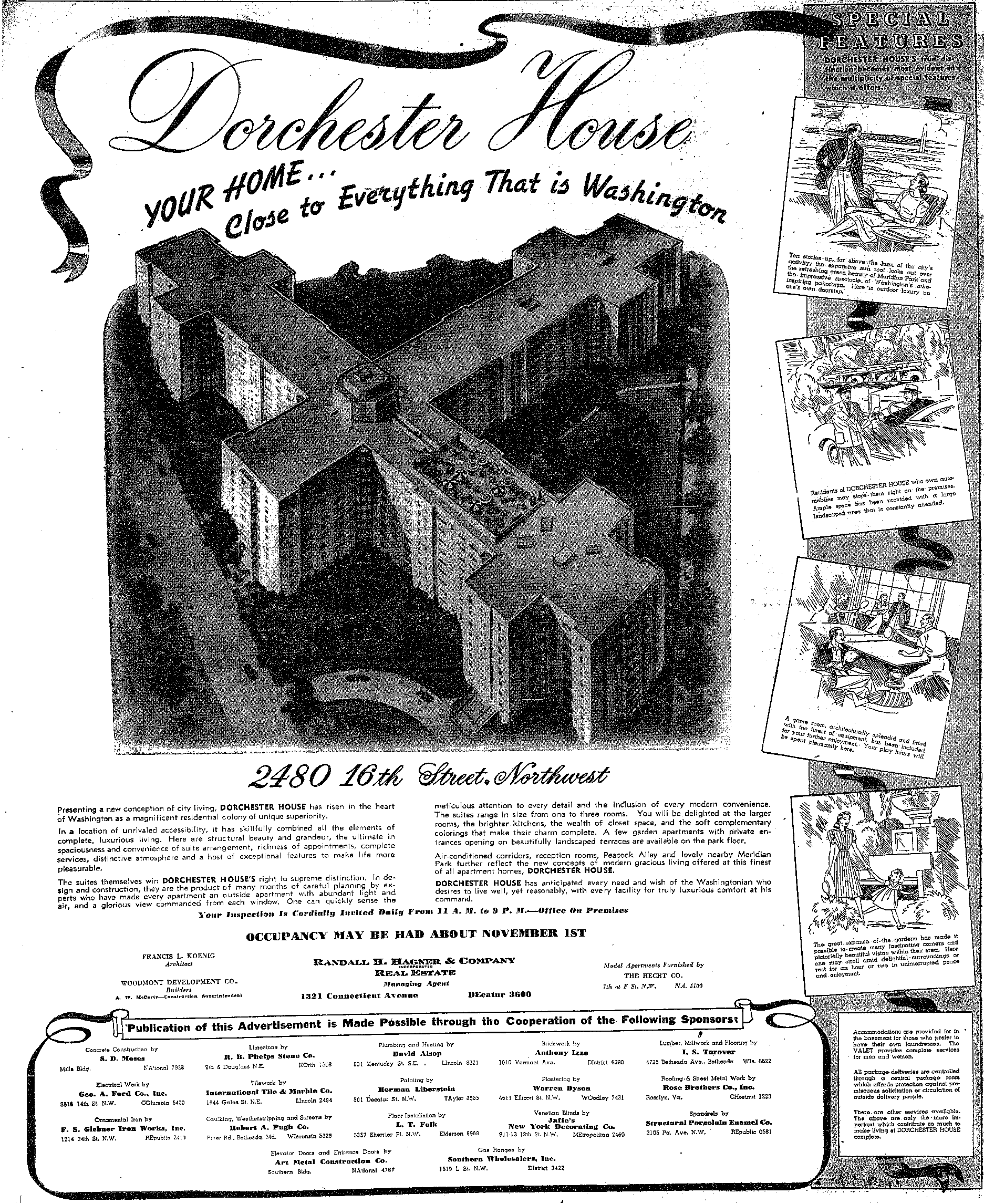
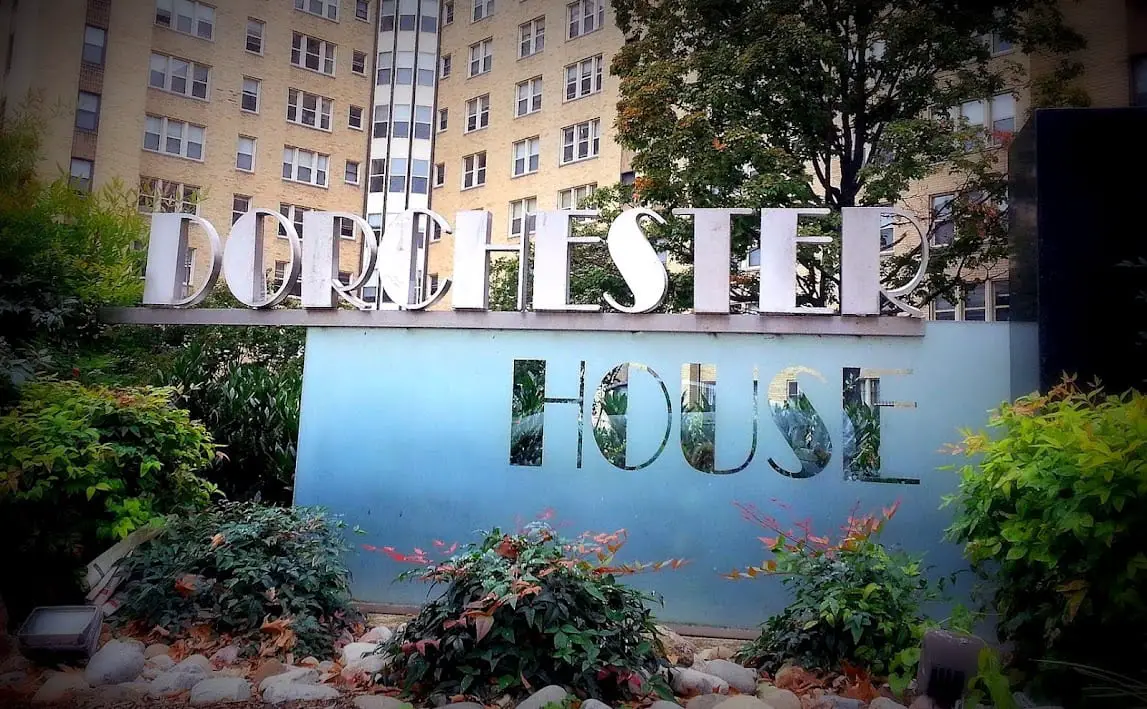
We came across this 1941 advertisement for Dorchester House, the massive Art Deco building at 2480 16th St. NW across from Meridian Hill Park. Whoever wrote the ad called it “a magnificent residential colony of superior quality.”
Three months after it ran, John F. Kennedy moved in.
One of the Three Largest in Washington
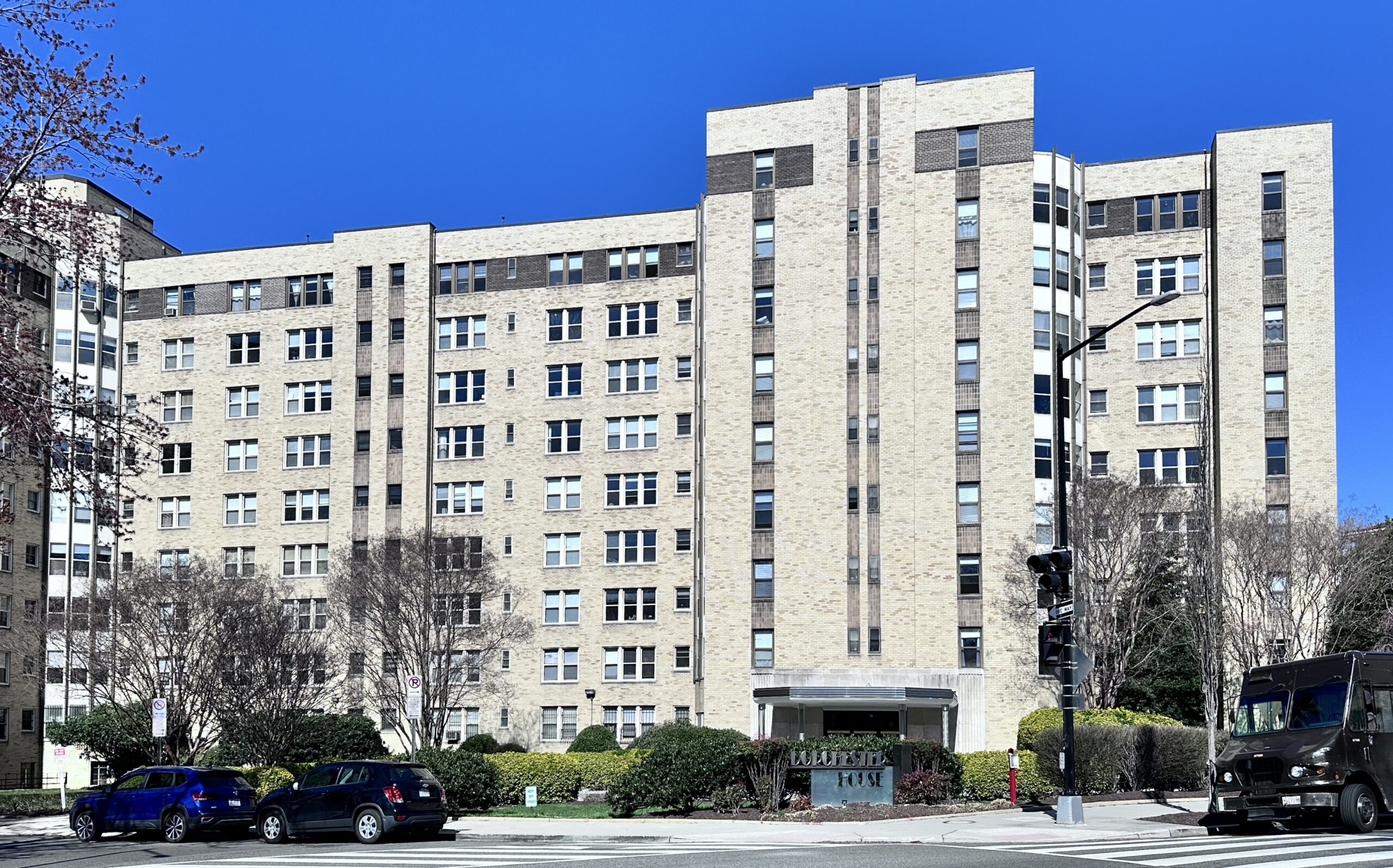
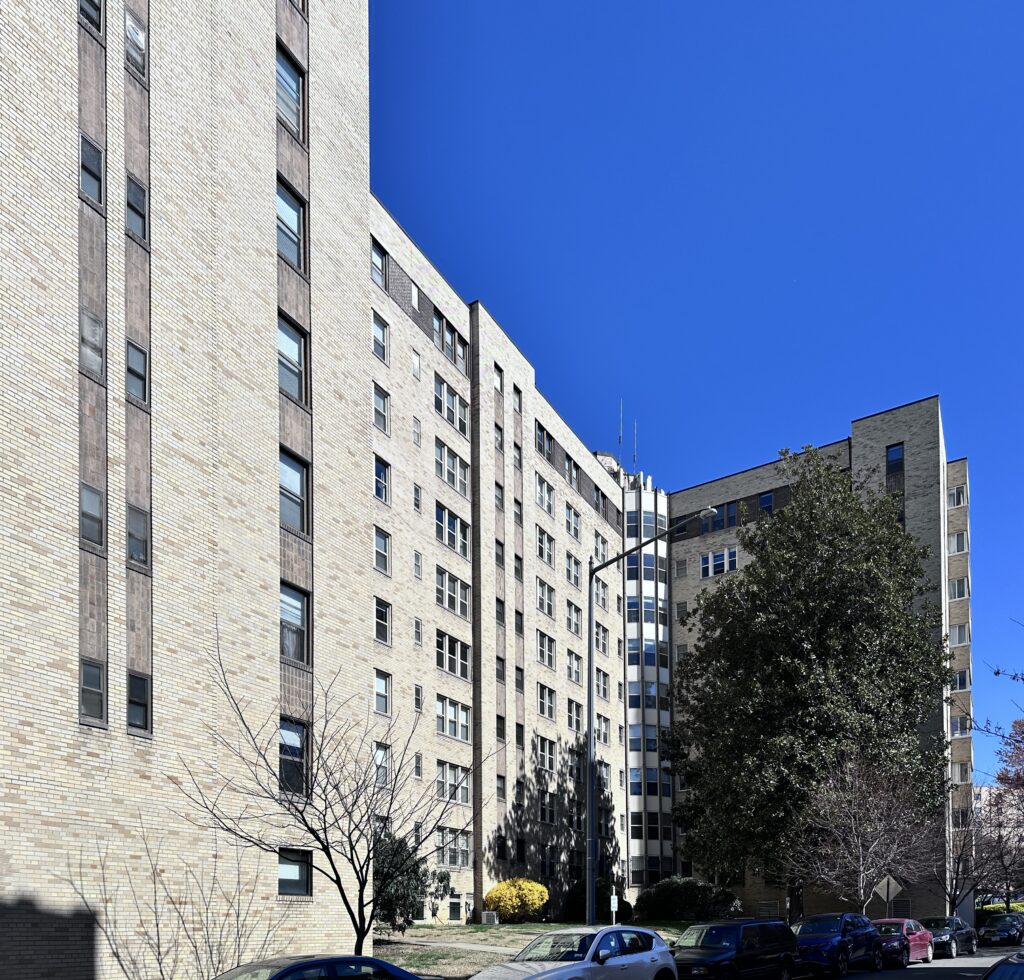
Dorchester House finished construction in the fall of 1941 after just nine months of building. Architect Francis L. Koenig designed the structure in a T-shape to pack the maximum number of units onto the site, landing at 394 apartments capable of housing around 1,000 tenants. That made it one of the three largest apartment houses in Washington at the time.
The streamlined buff-brick facade is pure Art Deco. When the building opened, its amenities included a uniformed doorman, on-site parking, air-conditioned public hallways, and a rooftop deck with sweeping views across the city. For DC in 1941, that was a serious pitch. The ad knew it.
If you want to see what the competition was advertising at the same time, we have a collection of old DC apartment listings worth a scroll.
JFK’s Three Months in Apartment 502
Kathleen Kennedy was already there. The future president’s sister, known as “Kick,” had come to Washington to work as a reporter for the Washington Times-Herald. When her brother Jack arrived in October 1941 to take a post at the Office of Naval Intelligence, he moved into apartment 502 with her.
He was 24.
He also lasted exactly three months. Kennedy transferred to Charleston, South Carolina in January 1942 and did not return to Washington until 1946, when he won a seat in the House of Representatives. The JFK Library lists apartment 502; some sources say 542. We are going with the Library.
Kick and Jack were not the only notable residents during the war years. Secretary of Labor Frances Perkins lived at Dorchester House, along with a reported dozen members of Congress. The building that promised superior quality was delivering it, at least by the guest list.
Every Dog’s Day, April 30th, 1945
By March 1945, some residents had complained about their neighbors’ dogs. We do not know which dog triggered the complaints, but real estate agent Randall Hagner & Co. had heard enough. On March 23rd, letters went out to every dog owner in the building: dispose of the pet or vacate by April 30th.
Nobody, including building management, was even sure how many dogs lived there. The Washington Post’s March 30th, 1945 article put it at “13, 17, or 30.”
That “every dog will have his day,” is being proved by the 13, 17, or 30 dogs whose owners, living at the modernistic and highly fashionable Dorchester Apartment House, 2480 16th st. nw., have received an ultimatum either to dispose of their pets or vacate the premises by April 30.
No one, not even the owners of the building, tenants, or Randall Hagner & Co., real estate agents for the property, seem to know just how many doggies live there. But it seems that a few of the pups either barked too loudly, scampered too much on the expensive carpeting in the hallway or were not entirely housebroken, and so Hagner & Co. termed the pets a “nuisance” to the other 400 tenants and wrote letters on March 23 that either the pets or the tenants had to go.
So far not one of the dogs or dog-owners have made an attempt to move.
Also: it is March 1945. The war in Europe had about six weeks left. Priorities, apparently.

A Fire in the Chair, February 1949
Every building with this much history has its tragedies. This one belongs to Mary Gooch.
Mrs. John Hite Gooch was 69 years old, wife of the general agent of the Louisville & Nashville Railroad, living alone in apartment 706 on the seventh floor. On a Tuesday morning in February 1949, her daughter called at 10 a.m. She was fine.
At 11:45 a.m., an alarm sounded throughout the building.
Mrs. John Hite Gooch, 69, wife of the general agent of the Louisville & Nashville Railroad, was burned to death about noon yesterday in an armchair in her seventh-floor apartment at the Dorchester House.
Mrs. Gooch, who was alone, was apparently dead in the flaming chair near the living room window of her apartment, No. 706, when firemen arrived. They tossed the overstuffed chair from an open window to a patio seven flights below where the flames were extinguished.
The fire was virtually confined to the armchair in which Mrs. Gooch was sitting, according to Detective Sergt. John L. Sullivan. It charred a patch less than two feet square in the floor of the living room, and merely scored an adjacent wall and the ceiling.
Part of the burned armchair had a cigarette hole in it, according to Sullivan. He said a stool near the chair contained cigarettes, a lighter and a holder.
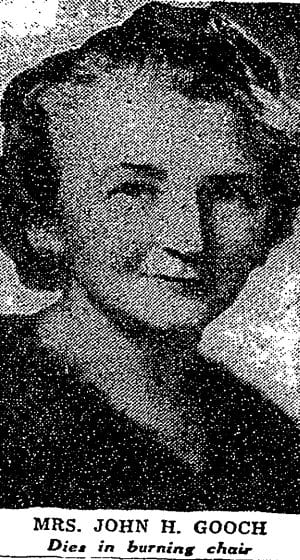
A blaze completely confined to one armchair, seven floors up, the rest of the apartment untouched. It is one of the stranger deaths we have come across in these building files.
The $500 Robbery, June 1965
Twenty years later, 75-year-old Hattie Griffin was living on the eighth floor when two men knocked on her door. One asked, “Are you Hattie?” When she said yes, he told her: “If you don’t want to get hurt, do as we say.” He produced a revolver.
The pair pushed inside and demanded money. Griffin said she had none. They pushed her toward a cedar closet, where she handed over $500. The men then bound her with adhesive tape, locked her in the bathroom, and ransacked the apartment.
Mrs. Griffin freed herself and called police. She described the two as white men, both about 5 feet 10, roughly 160 pounds, around 27 or 28 years old.
Whether they were ever caught, the record does not say.
For Sale. Sort Of.
In 1979, the owners of Dorchester House announced they intended to sell. The buyer was Brenneman Associates, a firm that specialized in converting apartment buildings to condominiums. The asking price was $11 million, a figure tenants suspected was tied to the adjacent Kalorama skating rink next to the building’s parking lot.
There were 15 owners, including the Gewirz family. There were also a lot of tenants who had no interest in being converted out of their homes.
The tenants organized. They raised $200,000 as a down payment and made an offer. The owners said no. They raised $500,000. The owners said no again.
Tenant leader Leamon Grier told the Washington Informer in 1986 that the whole seven-year standoff was a “master plan” to displace the building’s Black residents and replace them with higher-income white tenants. That year, he walked a reporter through the building to show what deferred maintenance looked like up close: carpet held down by tape, plaster spread over cracks, stoves that were exploding, no heat.
Those conditions had legal consequences. Tenant Benoit Brookens had filed the first formal rent challenge actions in 1979, and those complaints ground through the District’s Rental Housing Commission for five years. On May 24th, 1984, the Commission awarded tenants a $1 million rent refund.
Bernard Gewirz, one of the owners, disputed all of it. “This building is constantly maintained, constantly repainted,” he told the Informer.
The carpet tape and the plaster cracks suggested otherwise.
Dorchester House is still there, still renting. The buff-brick Art Deco facade has not changed.
A magnificent residential colony of superior quality, eighty-some years on.
Love it, especially the little illustrated call out ads for the “special features” . I wonder what the game room is like now.
I find it really interesting how much focus there seems to be on the landscaping and design of the common space, rather than the actual apartments. You wouldn’t see anyone commenting on the landscaping of the parking lot these days, but that can really make a difference in how a place feels.
Oh my goodness, I lived in the Dorchester House in my early 20ties and I loved it. I rented a huge studio apartment for $219.00 a month. Yes, that’s right – $219.00 a month. I can’t imagine what that apartment rents are now. My studio was large enough for a sofa bed and coffee table, dining room table, desk and bookcase with lots of room left over. Although the kitchen was super small, the closet and bathroom was like a large dressing room with two additional closets inside of it. You could close the outer closet door, shower and get dressed without your guests seeing you. Every morning I used to run laps in Meridian Hill Park. Back then I’d run past crack addicts, dead bodies and almost every morning some guy would flash his Johnson at me. When I moved out in 1996 my rent was $452 with $50 extra for parking and another fee for my air conditioner. With rent that low I was able to put myself through college on a legal secretary’s salary. It also meant that I didn’t need to have an endless string of roommates. It was my first apartment after moving away from my parents who lived in Columbia Heights. The location is so central to everything. Especially the law firms and administrative jobs that were so numerous in the K Street and DuPont Circle areas in the 1980’s. I used to walk to work and catch the subway to night school. My apartment was large and cozy and most of the time I couldn’t wait to get home. In the basement there was a dry cleaners and a useless convenience store. The only thing worth buying there was a Washington Post. Everything else was moldy and out of date. Once I bought a box of cereal and when I opened it little flying insects flew out! The washers and dryers were in the basement as well, but you had to walk a gallant of cockroaches that were as big as baby shoes to get to them. However, the rooftop deck made up for a lot of negatives, especially on the Fourth of July. There were lots of great people of all ages living there – we had a real sense of community and we cared for each other. During some of D.C.’s worst blizzards when cabin fever set in – we hung out in the lobby or went from apartment to apartment chit-chatting, eating and exchanging books. The Dorchester House holds a lot of good memories. I lived there until 1996 when I brought a row house and returned to Columbia Heights.