I’d describe it as an experimental travelogue that’s maybe a bit too arty for it’s own good, but nevertheless captures some Ghosts of DC:
tracking shot of northside 900 block F Street NW, including the Dor-Ne Corset Shoppe
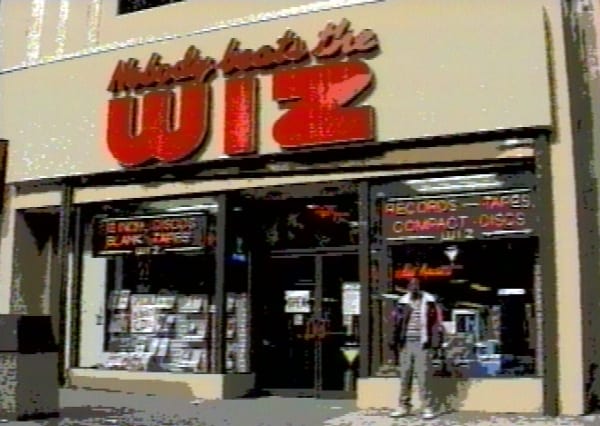
The Wiz Records on F Street
Fort Stevens Liquor Store on upper Georgia Ave.
Melody Records on Dupont Circle
Murrays Steaks
Globe posters
My video originally aired on the local PBS station WETA-TV, but has been sitting in my “basement archives” for 20 years. BTW, I’m the guy who made the cult-documentary HEAVY METAL PARKING LOT.
Feel free to post the Youtube link. I’ve included a few stills to use on your website.
This is the best contribution thus far by a member of the GoDC community. This is from Tom H. in Bethesda, and when I first saw it, I was blown away at how professional it looked. Thanks Tom!
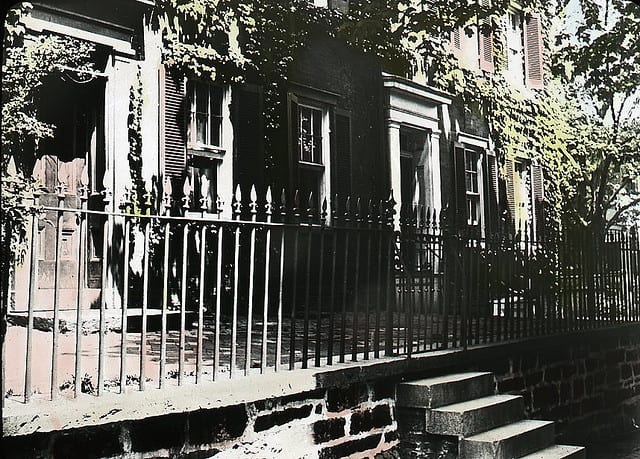
The video is a fascinating history of the gun barrel fence in Georgetown, made from 364 reclaimed Washington Navy Yard muskets.
Georgetown’s gun barrel fence
To complement this wonderful video, we dug up an article published in the Washington Herald on Sunday, June 25th, 1911.
Surmounting a crumbling retaining wall of age-worn stone which stands in front of three of the oldest houses in historic Georgetown is an iron fence which boats a more interesting history than the majority of fencing.
If you will examine the iron uprights standing close together, you will discover that near the top of each one is a projection, which apparently performs no office as a part of the fence. Research into the history of this partition of iron reveals the reason for the projections and many things besides.
Way back in 1814, when Washington was threatened by the invasion of British troops, which were hovering about the ancient hamlet of Bladensburg, Md., foraging and destroying property, the United States government had not the unlimited resources it now possesses.
So when the Capital City of the nation was in imminent peril of being destroyed by the hostile troops the authorities here appealed for help to the public-spirited citizens of the locality. Most of the wealth of the District of Columbia was then centered in Georgetown, as at that time it was one of the most important ports of entry of the Southern Atlantic seaboard. There were great shops and mills there in those days. Merchants of Georgetown had thriving business in the Westt [sic] India trade, importing molasses, coffee, sugar, and rum in large quantities. Among the foremost of these big merchants and landowners was Reuben Daw, whose posterity still figure conspicuously in the assessor’s book of Georgetown realty.
Reuben Daw and a number of others immediately advanced money for the defense of the Capital against the invading forces, asking no security from their government. When Washington was invaded by British troops under Col. Ross, shortly after the battle of Bladensburg, when the Americans, under Maj. Barry, were defeated and the Capital burned, the funds advanced by the Georgetown citizens did much good.
When the war of 1812 was over the government was nearly bankrupt and was in no position to repay debts for which no security was held. But the Secretary of the Navy, the commandant of the navy yard, or some officer in authority who was cognizant of the sacrifices made by the Georgetown citizens realized that something should be done for them. There was little that could be done, but it was finally decided to let those who so desired go to the navy yard and take anything in the way of castings that they could use.
Reuben Daw took advantage of this opportunity and asked for a consignment of antiquated flintlock muskets which were rusting in a neglected pile in an old warehouse. He received permission to remove them and took them to Georgetown.
About that time Mr. Daw built the mansion that still stands in Georgetown on P street, between Twenty-eighth and Twenty-ninth streets. Removing the stocks from the old guns, he had plates forged at one end and made them into the fence which still stands in front of the three houses just beyond Twenty-eighth street.
The small projections mentioned are the corroded remains of the sights at the ends of the gun barrels.
The barrels make an unusually serviceable fence, as the length of time they have stood testifies. They are in as good condition to-day as when they were put up, and it would take a good deal of force to knock the old fence down.
In different parts of Georgetown old iron castings may be seen which came from the navy yard in 1814 or 1815. Window gratings, boot scrapers, stair rails and many other contrivances were fashioned out of the junk taken from the navy yard, and on more than one piece of iron about Georgetown may be seen the coat-of-arms of the United States.
Nearly every on of the castings is directly traceable to the war of 1812, and when one of them is seen it may be taken as mute testimony of the patriotism of the original owner of the property.
Now this a great story. I’m sure the next time you’re walking the brick-lined streets of Georgetown, you’ll be even more observant of these marks of hidden history, connecting us back to the War of 1812.
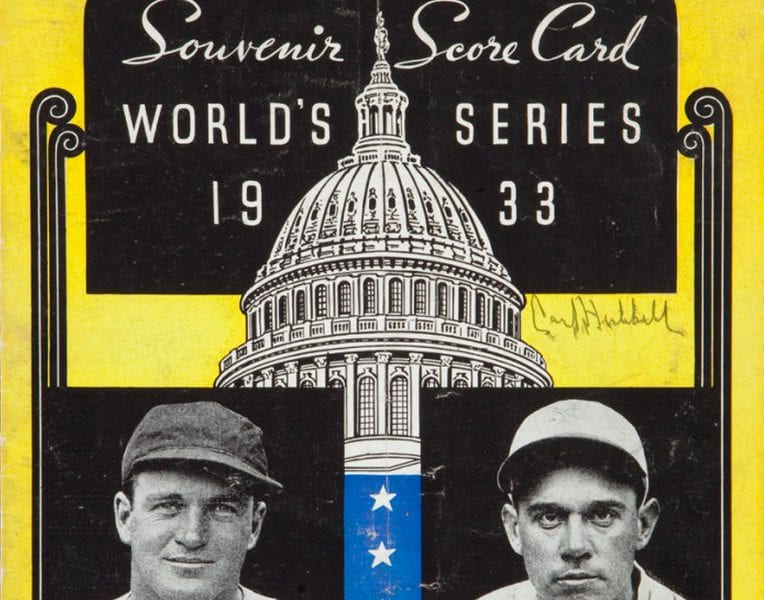
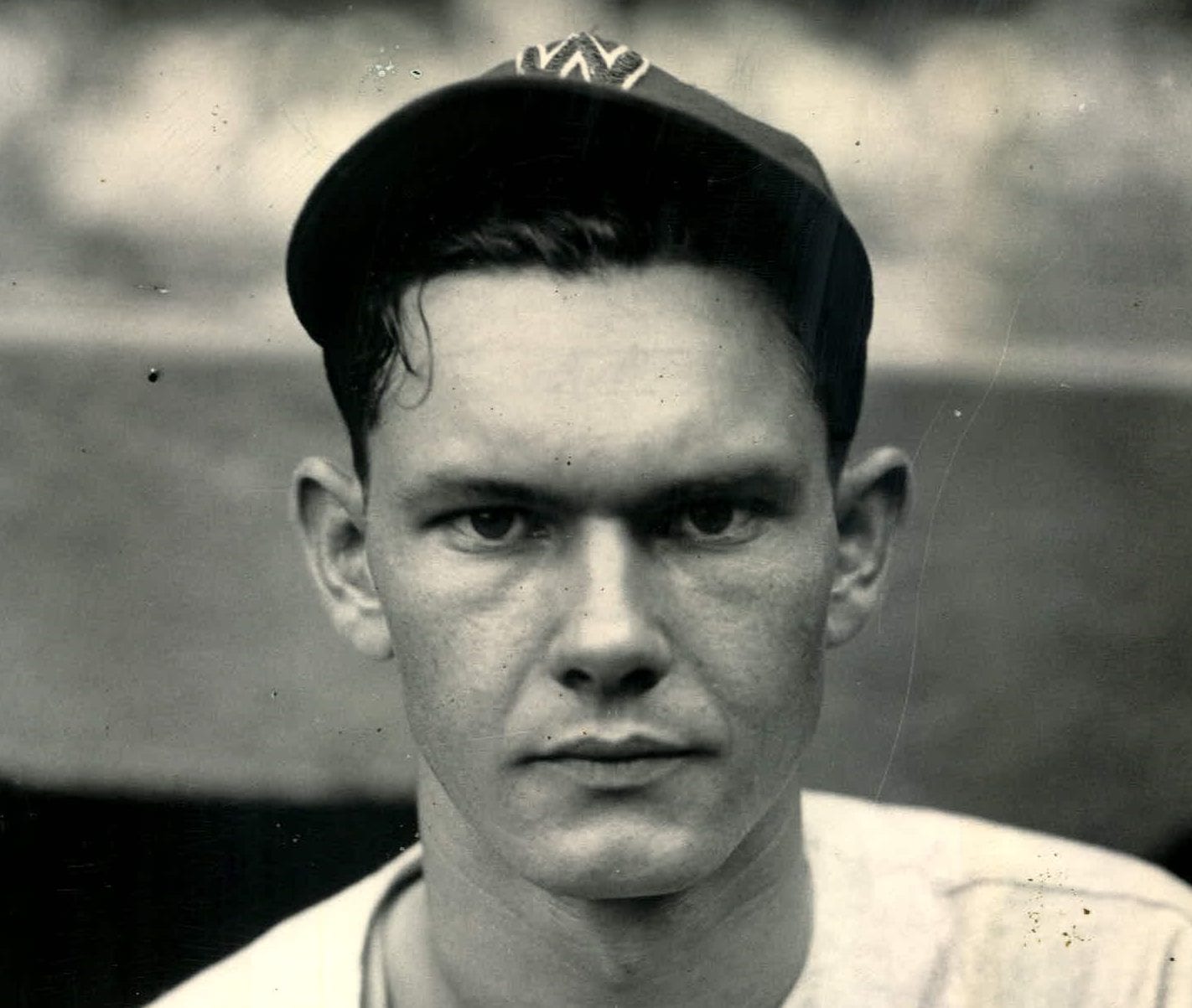
Remembering Buddy Lewis, the Washington Senator and World War II veteran who served 11 seasons in D.C. and flew 350 missions over Europe to fight Nazi Germany. Learn about this heroic player, who passed away at the age of 94.
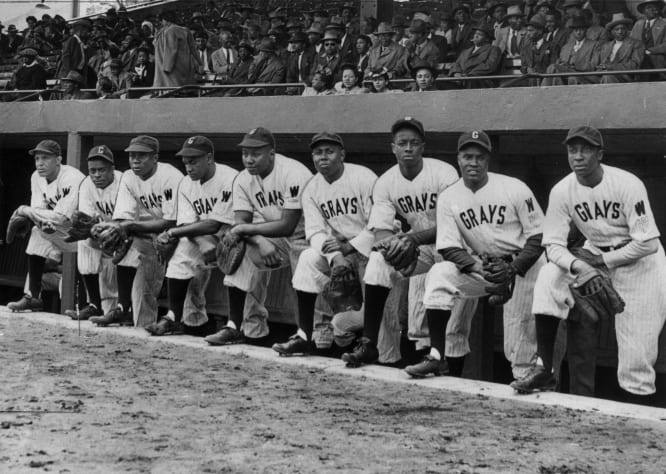
This is awesome, with a few appearances from former Mayor Anthony Williams (nice bow tie dude!). If you’re a baseball fan and a history fan, watch the whole thing. It’s an excellent history on the Homestead Grays, the Negro League baseball team that was founded in Pittsburgh and eventually closing out their existence occupying Griffith Stadium.
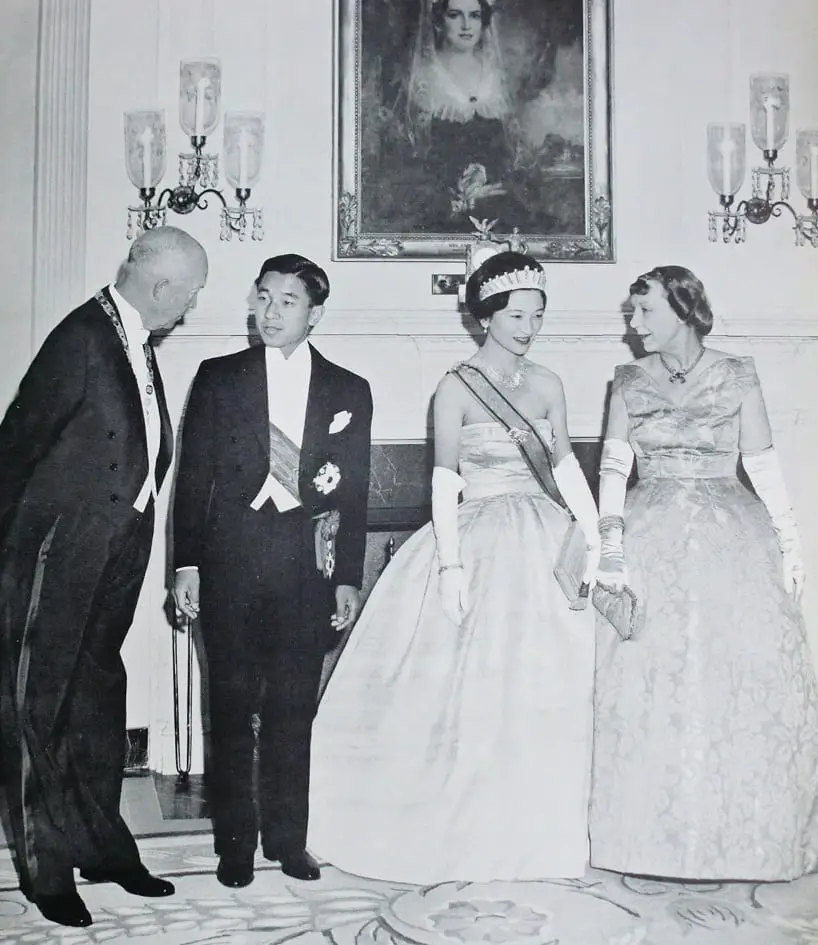
Check out this great photo, dug up from the Smithsonian’s website.
In September of 1960, the U.S. and Japan were celebrating 100 years of diplomatic relations. Crown Prince Akihito and Princess Michiko traveled to Washington at the end of the month to celebrate the occasion with an official state visit.
An amusing article was published in the Washington Post on September 28th of that year, detailing the state dinner at the White House.
Japan’s Crown Prince Akihito and Princess Michiko actually stopped traffic inside the White House last night as President Eisenhower‘s 4-year-old granddaughter Mary Jean was detoured down another corridor in her battery-powered miniature Thunderbird convertible.
Shortly before the royal couple’s arrival for the state dinner in their honor, Mary Jean was happily utilizing the wide marble-floored halls for driving practice, skillfully avoiding potted plants and dodging the shins of uniformed security sentries. As the hour neared for formality to commence, the preoccupied girl was dispatched elsewhere to play by a message relayed down from her parents, Lt. Col. and Mrs. John Eisenhower, who were upstairs dressed to join the other 88 guests.
…
Though Mary Jean’s 5-mile-an-hour auto looks luxurious, to her it’s a long-awaited secondhand hand-me-down. It belonged first to big brother David, who long ago graduated to a stripped-down soapbox derby type vehicle that zooms around the White House grounds at 15-miles-an-hour.
…
“We’ve been looking forward to your coming,” FIrst Lady Mamie Eisenhower told Princess Michiko during a personally conducted tour of the White House. At one point early in the evening, both women smiled at an obvious difference in Eastern and Western viewpoint. “This is quite old–the 1700s,” said Mrs. Eisenhower, indicating a yellow silk Philadelphia Chippendale chair in the Oval Room.
“Old in our country, that is,” she corrected herself, “not in yours.”
Both old and priceless of course. I’m surprising Governor Romney didn’t break that one as well during his clumsy visit.
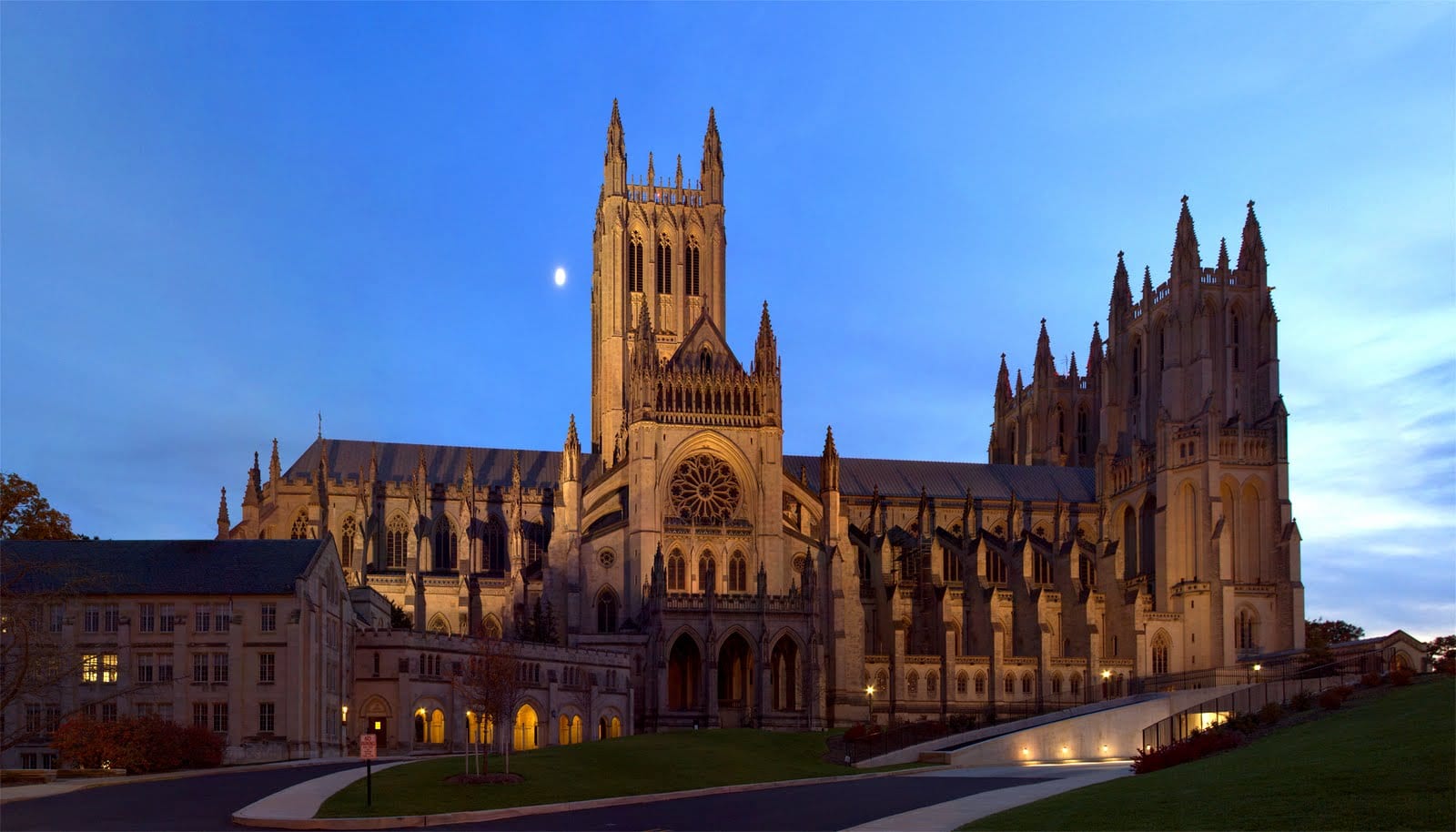
On August 23, 2011, one of the most spectacular buildings in Washington was badly damaged by the earthquake that shook our city. So much so, that the repairs are going to cost millions of dollars and keep it under scaffolding for several years.
If you love this building like we do, consider donating a few bucks to help restore this national treasure. You can give money online, so it’s effortless.
And since we love this building so much, we want to highlight to tremendous history of the place with a “Three Things…” post. Also, a shout out goes to GoDCer Laura for suggesting this too. Three things won’t do justice to the place, but here are some fascinating stories about the place for you to share with your friends.
1. Thousands come see Martin Luther King, Jr.’s final Sunday Sermon
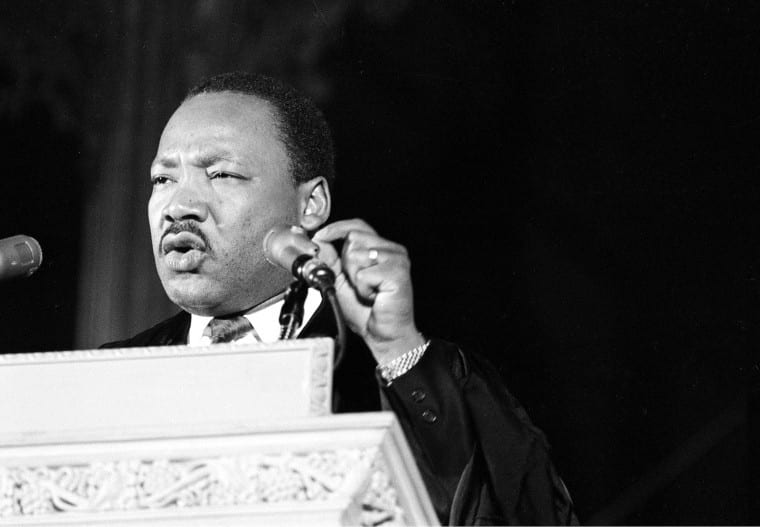
Martin Luther King Jr. at Washington National Cathdral – March 31st, 1968 (Associated Press)
The great civil rights leader, Martin Luther King, Jr., gave his final Sunday Sermon at Washington’s National Cathedral. On Sunday, March 31st, 1968, a crowd of several thousand people packed into the Cathedral to hear him speak. Little did they know that their revered leader would be taken down by an assassin’s bullet that Thursday.
The Washington Post highlighted his sermon the following day.
The Rev. Dr. Martin Luther King Jr. came to Washington yesterday and made an apparent effort to rebuild support for his planned April 22 Poor People’s campaign here, shaken last week when his Memphis demonstration erupted with violence.
Speaking to an overflow audience of more that 4000 at National Cathedral, Dr. Kin declared again his intention to bring 3000 poor people to Washington this month for “a nonviolent demonstration.”
“There will be a Poor People’s Campaign,” Dr. King told his predominantly white audience at the Cathedral.
…
“I don’t like to predict violence,” he added, “but if nothing is done between now and June to raise ghetto hope, I feel this summer will not only be as bad, but worse than last year.”
…
He told cathedral morning worshipers that the U.S. spends $50,000 to deal death to a Vietcong soldier in Vietnam, while spending only $53 for every poor person in this country.
Reading his words with hindsight, it’s sad to realize how true his words were about violence. And the magnitude of the violence, sparked by his assassination, forever changed the fabric of urban America. The commercial corridors of Washington — 7th St. NW, H St. NE and U St. — all became bombed out war zones as a result of the 1968 riots. Many of the areas are still slowly coming back to life with through economic revival and urban renaissance.
This is one of those amazing pieces of footage that you can watch over and over. It’s fascinating.
On Wednesday, February 6th, 1924, the nation mourned as the funeral procession for the late President Woodrow Wilson slowly made it’s way from his Kalorama home to Washington National Cathedral. Countless thousands of people lined the route, braving the bleak winter weather to catch one last glimpse of the 28th president.
The Washington Post had this piece the following day.
The nation stood at salute yesterday while the body of Woodrow Wilson was conveyed to the Cathedral of SS. Peter and Paul, and there laid in the crypt of Bethlehem Chapel with appropriately simple ceremony. The minds of millions, in many lands, attended the funeral of the late President, and reviewed the many incidents of his eventful life. His name is known to the remotest parts of the earth. Wherever it is known it is linked with the universal aspiration for peace. As the exhausted body was laid away the thoughts of multitudes softened toward the memory of Mr. Wilson, emphasizing the good which he had accomplished, and granting to him full honor for his faithful effort to make the world better.
The choice of a burial place for the late President is approved on every hand. Future ages will adorn and hallow the pile that is rising on Mount St. Alban. Many of America’s great sons will find their graves in that sacred edifice. Wilson, the pioneer of world peacemaking, broken by effort and dying with hope unfulfilled, may be joined hereafter by another famous American whose efforts will be blessed with success. The knowledge acquired by consideration and test of Mr. Wilson’s plan is not useless, granting that the league of nations in unacceptable to the United States. The nations have learned much, and by knowing what to avoid they will the sooner find the path to universal permanent peace. Experiment was necessary. Upon the ruins of one experiment after another the edifice of peace will stand, if it is ever erected at all.
…
Mr. Wilson’s long illness and his fortitude in meeting an adverse stroke of fate earned for him the kind regard and admiration of all Americans. Mrs. Wilson was universally applauded for her splendid example of wifely devotion, which eased the last days of her distinguished spouse. The country cherishes the memory of its departed son, and recites with pride the great role he played in the world’s affairs.
President Wilson was to be the first of many distinguished Americans to be buried in Washington National Cathedral. It was to be our Westminster Abbey, yet sadly, that plan never seemed to take hold.
3. Thousands mourn the death of the greatest pitcher of all time: Walter Johnson
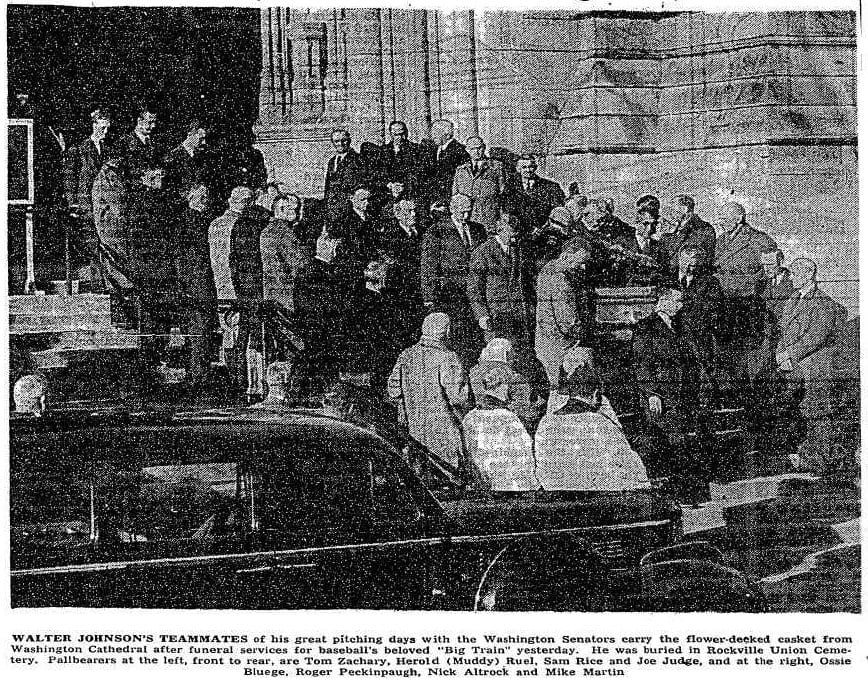
Do you get the feeling that we love Walter Johnson, hero of the early Washington Senators? Thousands came out to Washington National Cathedral on December 13th, 1946 to pay their last respects to Walter Johnson. Johnson had battled a brain tumor, and sadly, passed away at the age of 59. Several of his teammates were pallbearers, including his catcher Muddy Ruel, first baseman Joe Judge and third baseman Ossie Bluege, outfielder Sam Rice and resident team clown, Nick Altrock.
Also in attendance was his 83-year-old mother, Minnie Johnson and two brothers Leslie and Earl.
After a simple ceremony (no eulogy was given), his body was taken to Rockville and laid to rest at Union Cemetery, next to his wife, who predeceased him by 16 years (read about their simple wedding in a Columbia Heights apartment).
Below is the Washington Post article from the next day.
Bare-headed hundreds, high personages of the baseball realm, notables of Washington’s civic life and the peanut vendors who knew the great pitcher at Griffith Stadium, stood in saddened clusters with Johnson’s family at the brief graveside services.
…
From the Cathedral, the funeral procession had moved almost bumper to bumper in blocks-long file with police escort, closing side streets to traffic for more than a mile on the Wisconsin Avenue route to Rockville.
As Dean Suter officiated from the Cathedral’s Great Choice, with the body of Johnson resting in The Crossing, draped in red velvet pall with brocaded golden cross, the white-haired mother of the famed pitcher dabbed continually at tear-filled eyes.
Family and friends almost taxed the capacity of the Cathedral’s Nave, with its nearly 1000 seats fronting The Crossing on three sides.
…
Present, too, were Stanley (Bucky) Harris, Johnson’s former manager, and George Weiss, representing the New York Yankees. Also, Jack Bentley, his pitching opponent in the famed seventh game of the 1924 Giant series that brought Washington its first World Series triumph; and Clyde Milan, Washington outfielder of Johnson’s heyday.
Bentley, what a class act. That was a day of great mourning for the city and baseball, with the loss of the pitcher that helping bring the only World Series title to this city. Is this the year when we celebrate our second?
Walter Johnson’s casket leaves Washington National Cathedral (Washington Post)
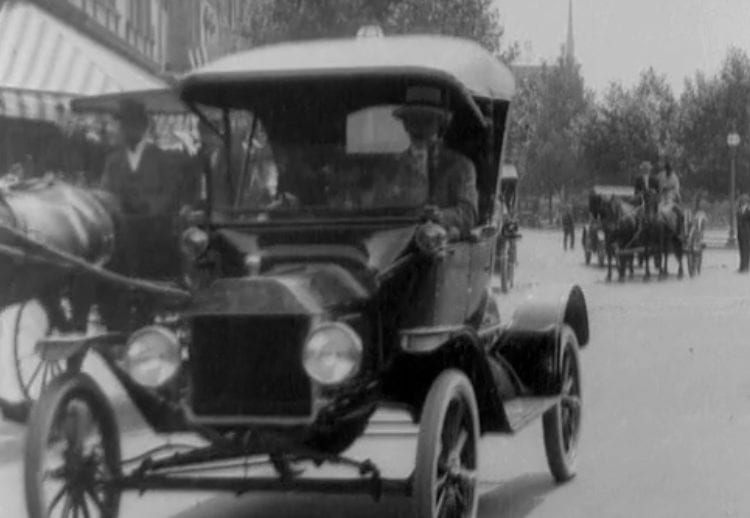
This is one of our best GoDCer contributions yet. Tom from Bethesda sent this over to share with everyone else. This was taken on Pennsylvania Ave. NW between 10th and 11th St. Watch the whole thing and marvel at how chaotic the street scene and traffic seem to be. Safety was certainly different back then.
Here is a description of the film from Tom.
This film clip was shot in July 1909 on Pennsylvania Avenue between 10th and 11thStreets facing the U.S. Capitol. Not even the Library of Congress has additional information, only that it was obtained from the Brook Foundation Collection – an offshoot of a Thomas Edison company. Copy was made from a 35mm negative. Notice the billboards. The one on the left appears to be an ad for C/B Corsets (attachment 1). The right billboard appears to show silhouette of a child and the word ‘Velvet.’ My search for billboard identification turned up nothing.
I don’t know, but would love to find out, whether this is an “actuality” or an Edison clip for a movie. It does not appear to have been a staged scene with actors. Also notice the African American woman holding a parasol and the stylishly dressed African American man crossing the street.
Anyone with information please respond. I am trying to develop an audiovisual exhibit for a museum from archives and home movies pre-1930. The LOC # is (FPB 9286) 1161224-2-1.
Amazing video Tom. Thanks for sharing!
If you guys liked this, check out two other videos we have shared, a baseball tribute and a turn-of-the-century mail carrier.