
Someone left flowers at the fence.
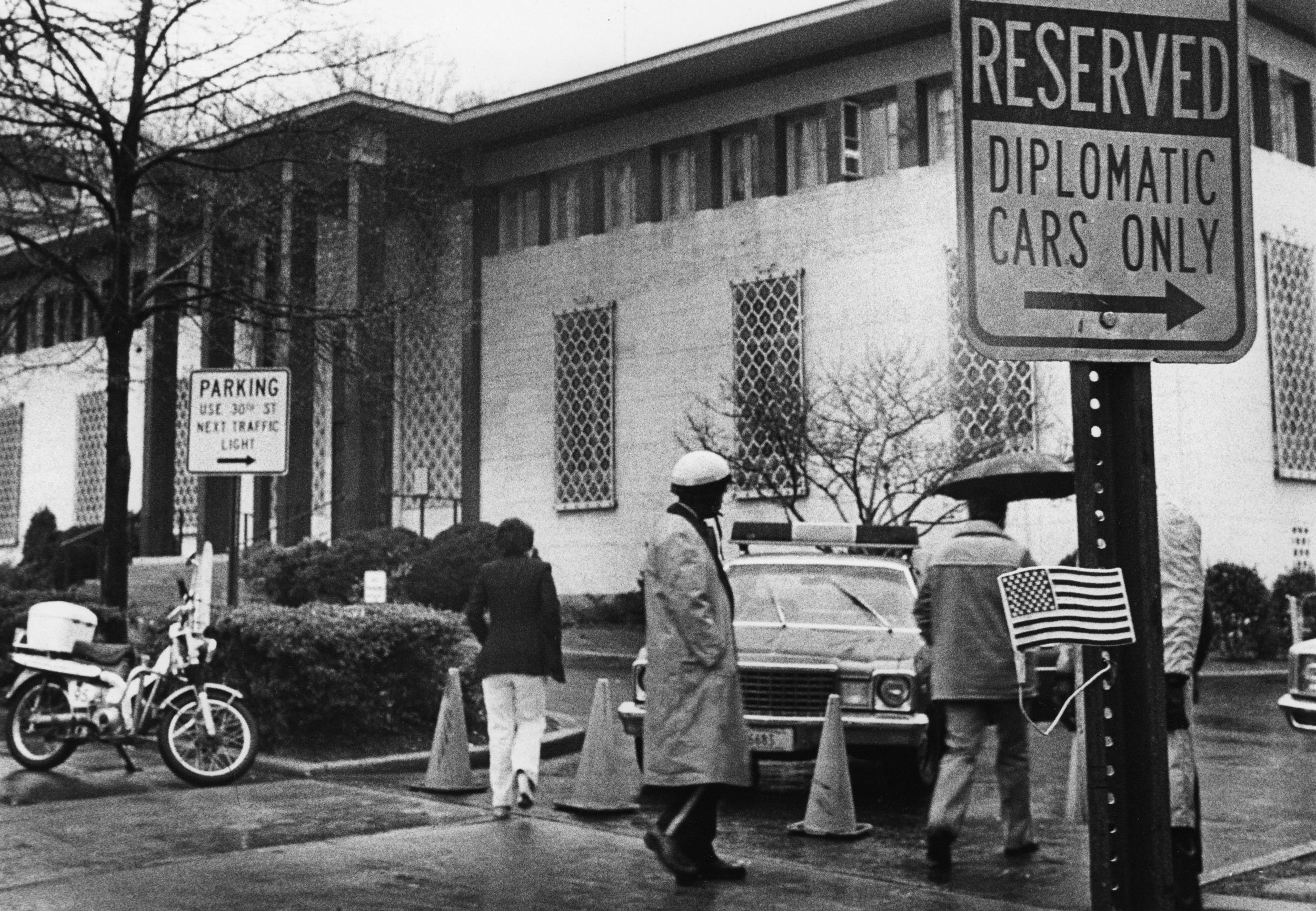
In March 2026, as American warplanes struck targets across Iran and diplomats scrambled toward a ceasefire in Islamabad, small bouquets and pre-revolution Iranian flags began appearing outside a pair of abandoned buildings on Massachusetts Avenue NW. The buildings at 3003 and 3005 have been locked and silent for 46 years. No one has worked inside them since April 10, 1980, when 14 Iranian diplomats and their families boarded a British Airways jumbo jet at Dulles with less than two hours to spare before President Carter’s expulsion deadline.
Now American and Iranian officials are sitting across a table from each other. The ceasefire expires April 22nd. And someone is leaving flowers at the fence on Embassy Row.
This is the story of those two buildings.
A Pacifist Builds a Mansion from Revolutionary-Era Bricks
Before this address belonged to Iran, it belonged to a man who believed no nation should go to war without asking its people first.
In March 1932, the novelist Kathleen Norris published an open letter in the Evening Star thanking a former congressman and diplomat named Alanson B. Houghton for proposing something radical: that no country should be able to declare war without first putting the question to a public vote. He was not some fringe idealist. He was the president of Corning Glass Works, a company he had tripled in size. He served as a congressman from New York, then as U.S. Ambassador to Germany under Harding (1922-25), and to Great Britain under Coolidge (1925-29).
And in 1934, he built himself a house at 3003 Massachusetts Avenue NW.
The Evening Star described it on May 12, 1934, under a headline that tells you everything about the man’s taste: “DWELLING ON MASSACHUSETTS AVENUE BUILT OF OLD BRICK FROM HISTORIC BUILDINGS.”
He didn’t want new bricks. He wanted bricks with a past. The walls of his Georgian Revival mansion were built from salvaged material: bricks from Clouds Mill near Alexandria, standing since 1785; bricks from a century-old mill near Laurel, Maryland; and bricks from the demolished Metropolitan Hotel, which had stood for 80 years at Pennsylvania Avenue and Sixth Street. He literally built his Washington home from the bones of the city’s own history.
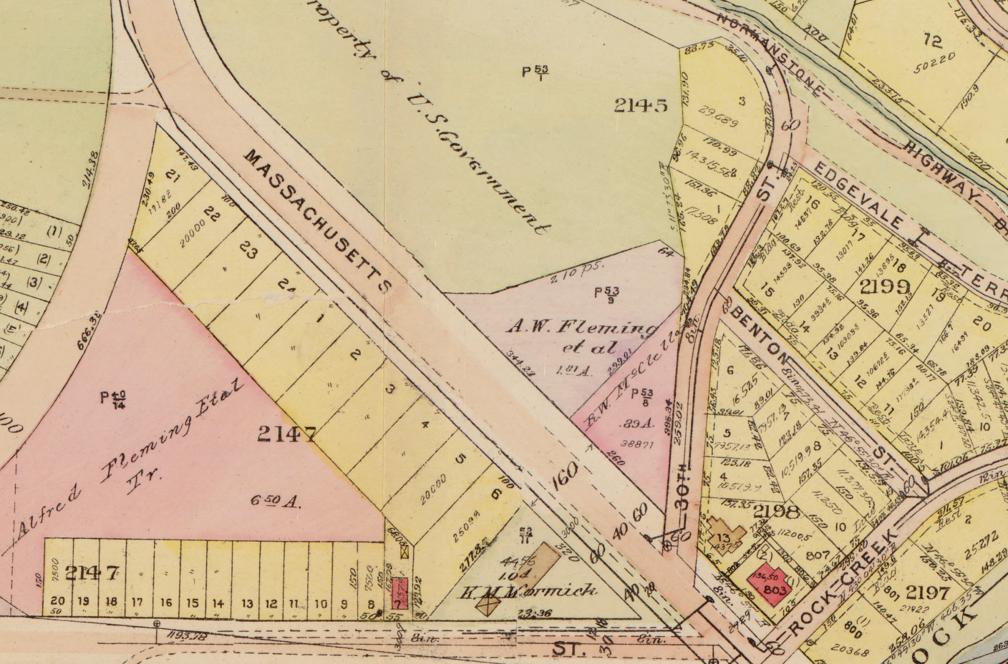
The house sat on a half-acre triangular lot, 260 feet along the avenue and 220 feet along 30th Street NW. It had more than 40 rooms, eight bedrooms, a 38-by-24-foot library hung with tapestries, a Georgian wall-fountain with a blue-tiled goldfish pool, and an air conditioning system (still a novelty in 1934). A semicircular driveway swept in from the avenue behind a double hedge of English box. The gardens were designed by landscape architect Rose Greely. Interior decoration was handled by Schuyler and Lounsbery.
The architect was Frederick H. Brooke, a detail worth pausing on. Brooke was also the on-site architect for the British Embassy directly across the avenue, designed by the legendary Sir Edwin Lutyens. Houghton, who had served as ambassador to Britain, deliberately built his house to echo the British Embassy across the avenue: blank niches, urns, tall chimneys. Two buildings on opposite sides of the street, designed by the same architect, one for the British Crown and one for the man who represented America there.
By November 1937, the Evening Star reported that he was hosting the Episcopal bishop-elect of Washington for a dinner meeting of the St. John’s Church Men’s Club. 3003 had become what it would remain for decades: a gathering place for Washington’s elite.
Houghton died on September 15, 1941. He never knew what would become of his house.
The Day Persia Became Iran
Here’s one of those coincidences that makes you wonder if addresses have their own sense of timing.
On March 22, 1935, Persia officially changed its name to Iran. On the same day, the country purchased a building next door to the mansion Houghton had finished just one year earlier. This was 3005 Massachusetts Avenue.
Persia’s diplomatic presence in Washington had been bouncing around for decades. The first Persian minister arrived in 1888. The legation moved from building to building, starting on 18th Street NW. By 1905, Gen. Morteza Khan was the new minister. By 1913, society columns were reporting on American women attending receptions at the Persian legation. In 1921, the Persian minister was hosting luncheons featuring “only Persian dishes.”
But when Persia became Iran, the country wanted a permanent home on Embassy Row. They found it at 3005.
At some point after Houghton’s death in 1941, Iran also acquired his mansion next door, turning it into the ambassador’s residence. We haven’t been able to pin down the exact date of that purchase, but by the 1960s and 1970s, the ambassador was living and entertaining at 3003 while the chancery operated out of 3005.
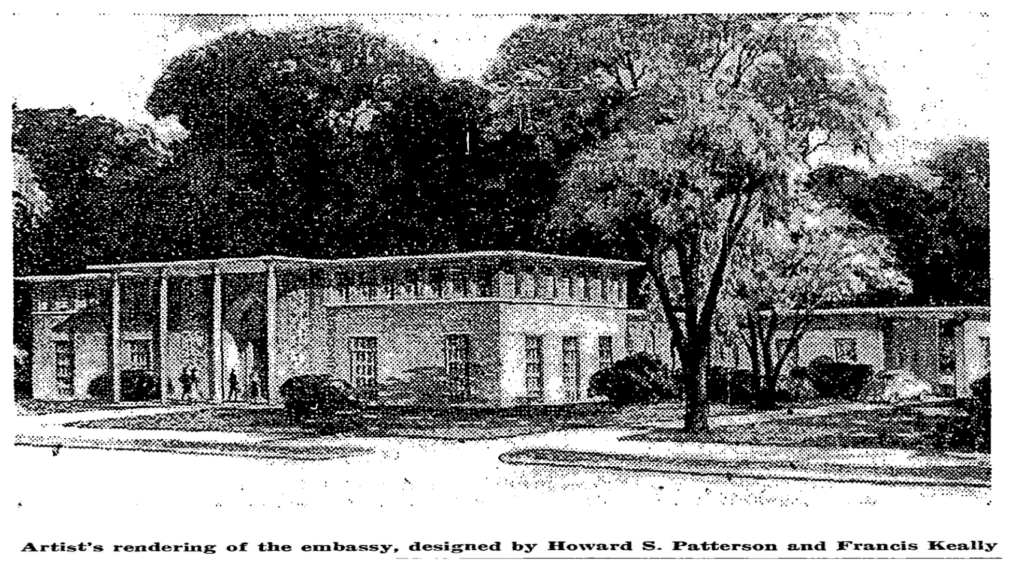
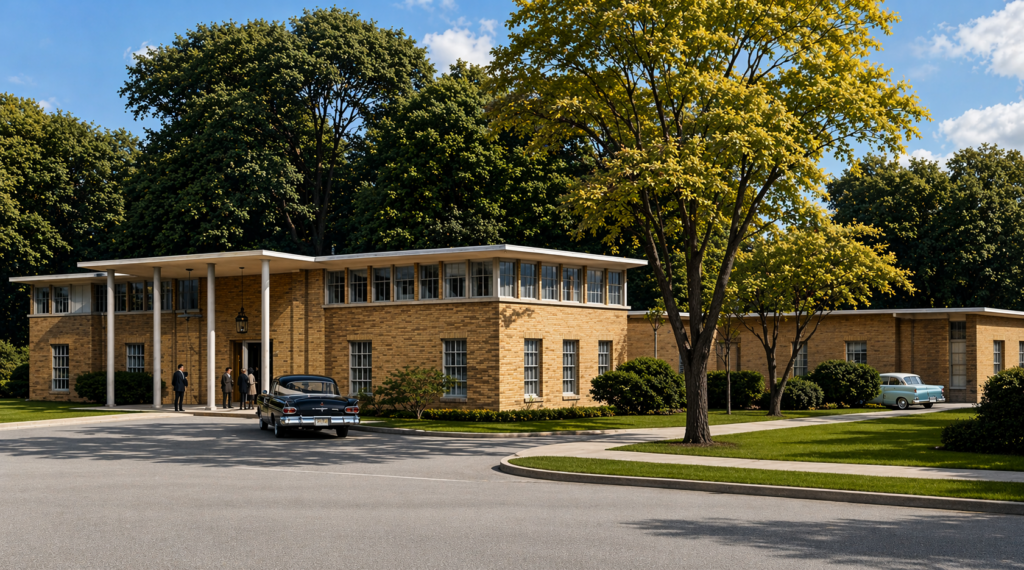
Then, on January 5, 1958, the New York Times announced something new: “Iran to Build New $1,000,000 Embassy in Washington.” The article included an artist’s rendering of a modernist chancery to be built adjacent to the existing embassy. The architects, Howard S. Patterson and Francis Keally of New York, had spent six weeks in Iran studying the country’s architecture before drawing a single plan. The result was a one-and-a-half-story brick and stone structure with a pointed arch entrance that Patterson called “typically Iranian,” delicate columns, “exquisitely colored” native tiles and mosaics, and an octagonal, glass-walled room through which visitors could observe the gardens.
The old building at 3005 would become “a secondary building.”
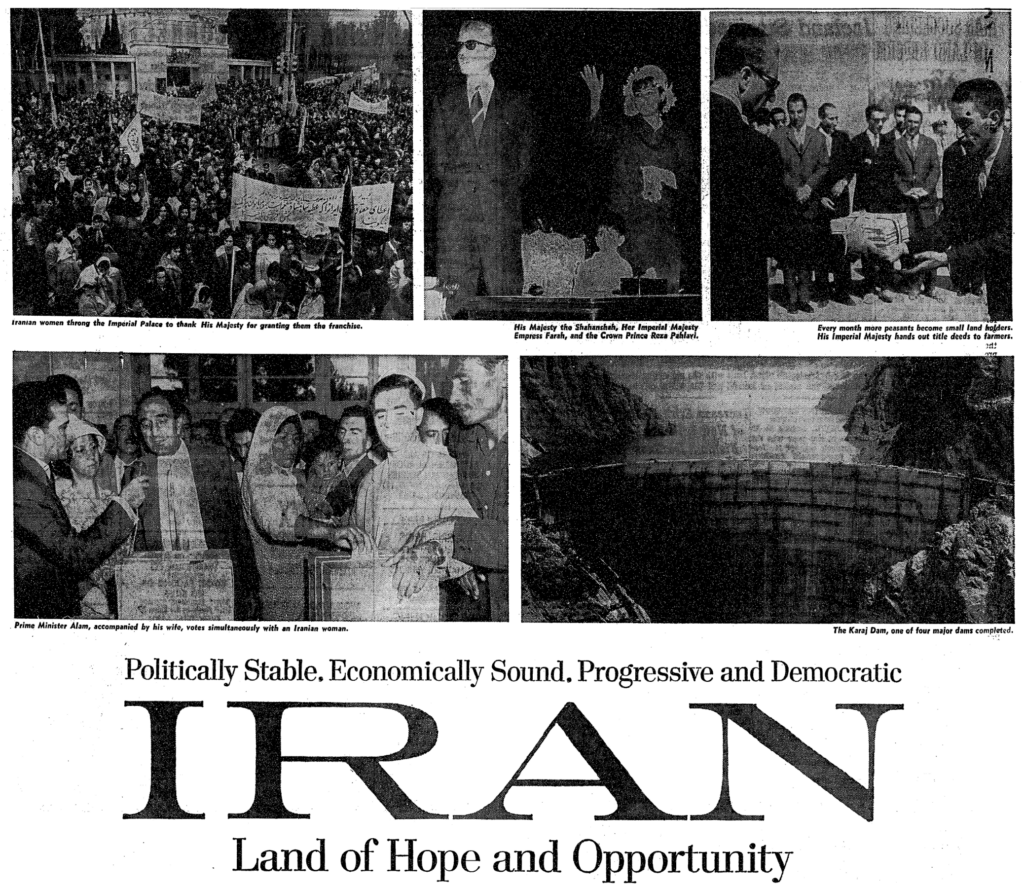
By January 10, 1964, Iran’s confidence was on full display. A full-page advertisement in the New York Times declared: “Politically Stable, Economically Sound, Progressive and Democratic: IRAN, Land of Hope and Opportunity.” It featured photographs of the Shah, Empress Farah, and the Karaj Dam. The contact address at the bottom: “Office of Press and Information, Embassy of Iran, 3005 Massachusetts Avenue, NW, Washington 8, D.C.”
Two buildings. One country. Everything was about to split in half.
The Double Life
For the next 17 years, 3003 and 3005 led a double life. Inside: the most extravagant parties Washington had ever seen. Outside: fury.
Inside: Zahedi’s Legendary Embassy Parties
Ambassador Ardeshir Zahedi’s second tour in Washington (1973 to 1979) turned the compound into something out of a novel. Dom Perignon flowed. Caspian Sea caviar was piled high. Guests formed conga lines through the long halls of the residence and danced on tabletops. Barbara Walters would later call it “the number one embassy when it came to extravagance.”
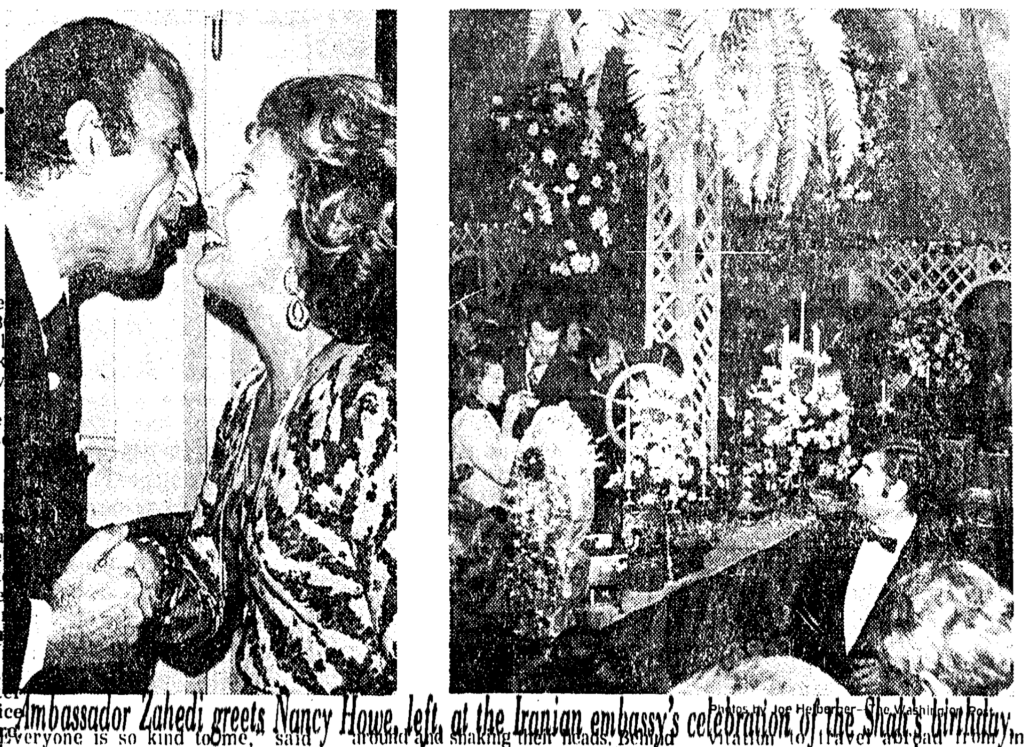
The parties were legendary. On October 28, 1975, the Washington Post’s Jeannette Smyth reported that Zahedi had thrown a birthday celebration for the Shah attended by 1,300 of his “most intimate friends.” Traffic was backed up for seven blocks, all the way to Sheridan Circle. The food included stuffed peacock, pomegranates, and figs. Guests included Barbara Walters (who arrived on the arm of OAS Ambassador Alejandro Orfila), WRC anchorman Glenn Rinker, and Nancy Howe, First Lady Betty Ford’s aide. A handwritten note from Richard Nixon was on display.
“This puts (Egyptian President) Anwar Sadat’s little do at Anderson House to shame,” said one party-goer.
A signed photograph of Nixon, dated June 5, 1975, attested to Zahedi’s loyalty: “To His Excellency Ambassador Ardeshir Zahedi, To whose loyal friendship over the past 22 years, in bad times as well as good, I shall always be grateful. Richard Nixon.”
By 1977, the Shah’s birthday party drew more than 2,000 guests. The traffic delay on the avenue lasted two hours. The D.C. police chief had to issue a public statement.
London decorator Michael Szell redesigned the chancery’s interior at Zahedi’s request. An Iranian artisan was flown to Washington to create a mirrored mosaic ceiling in what became known as the Mosaic Room. According to WETA’s Boundary Stones, “staff would light the room with candles, and the ceiling would glitter like stars.”
Outside: Student Protests and a Bomb on the Sidewalk
While champagne corks popped inside, the scene on the sidewalk was very different.
On January 24, 1962, about 40 Iranian students staged a three-hour “sit-in” in the reception lobby at 3005, chanting for the resignation of Prime Minister Ali Amini and demanding freedom for Mohammed Mossadegh. Police backed a patrol wagon to the front entrance. An embassy official threatened to have them arrested. They left shortly before 5 p.m., retreated a block away, and set up a legal picket line. The embassy declined to comment.
On December 15, 1970, more than 75 students hiked from Baltimore to the embassy, protesting death sentences allegedly given to five of their countrymen who had tried to leave Iran without passports. Their signs read “STOP KILLING IRANIAN STUDENTS.” Two were arrested and charged with disorderly conduct. Ambassador Dr. Aslan Afshar held a brief news conference and said he could not confirm the students’ allegations. He called them “professional agitators.”
And on May 13, 1978, the Washington Post reported that an “incendiary device” had been discovered at about midnight in front of the chancery. The cylindrical metal device was about seven or eight inches long, similar in appearance to a tennis ball can, with wires protruding from it. An Army bomb disposal unit was called in. A dog trained to detect explosives was sent to the scene. No suspects were identified. No notes were found. The Secret Service disarmed it at about 1 a.m.
The Revolution Comes to Massachusetts Avenue
The Iranian Revolution arrived on the avenue in fast motion across the first five months of 1979.
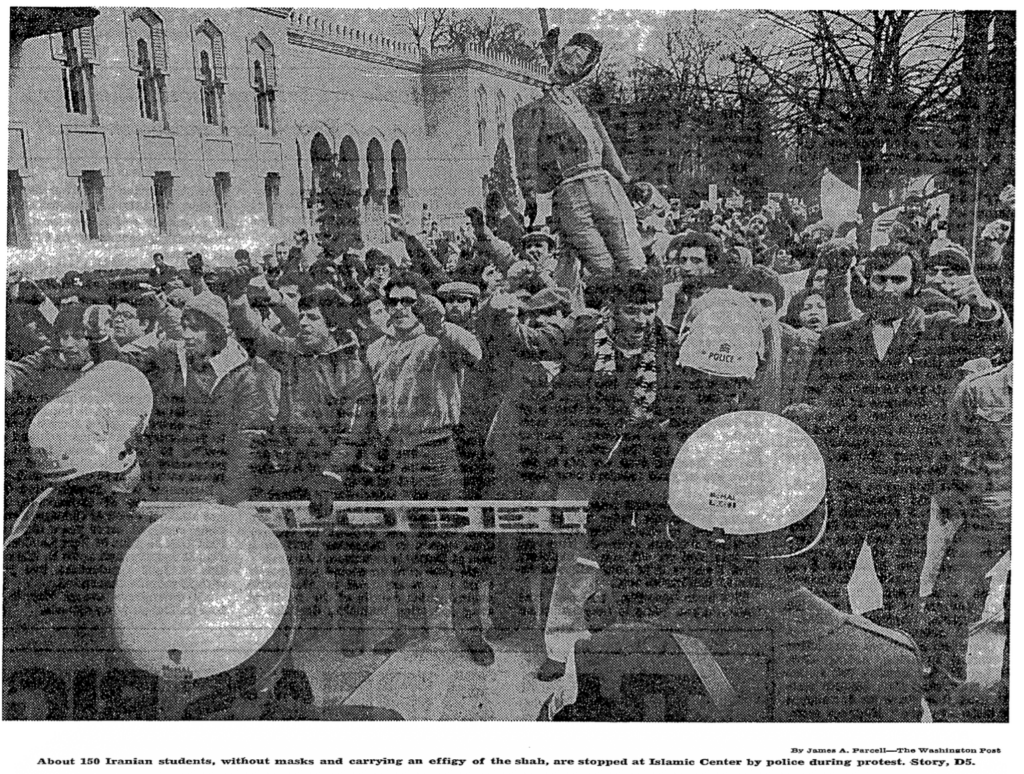
On January 6, 1979, about 150 Iranian students returned to the streets of Washington, marching from the White House to the Islamic Center at 2551 Massachusetts Avenue NW, chanting “Down, down, down with the shah!” and “Death to the shah!” They dragged an effigy “smashed by the Iranian people.” But something was different this time. For the first time, the protesters were not wearing paper masks.
The masks had been their trademark for years, a form of protection from SAVAK, the Shah’s dreaded secret police. Now, one demonstrator named Mohammed Roshanaei explained, savoring the irony, agents of SAVAK were the ones wearing masks, “to protect themselves from future retribution from the shah’s opponents.”
When the students reached the Islamic Center, their progress toward the embassy was blocked by about 40 D.C. police carrying riot sticks. No arrests were reported. But traffic along the avenue was backed up for several blocks as motorists slowed to watch.
At one point, a demonstrator tried to hand a leaflet to two well-dressed women in a passing Mercedes. The driver rebuffed the offer, shouting that she did not want “Communist literature.”
“We are not Communists,” the young student protested. “We believe in God.”
Less than a month later, on February 3, 1979, more than 75 supporters of Ayatollah Ruhollah Khomeini were arrested in front of the embassy. Fifty-six men and 20 women were charged with blocking the sidewalk. The Washington Post’s Paul Valentine described it as a “peaceful, wordless and strangely slow-motion protest” that clogged rush hour traffic along the avenue. Police threw a heavy guard around the ornate building at 3005, just west of Rock Creek Park on what had long been one of the most prestigious stretches of Massachusetts Avenue.
Inside, things were moving even faster. Military officers took control, ousting the charge d’affaires and restoring the Shah’s portrait in the lobby. Zahedi had “returned to Washington yesterday from Morocco, where the shah has been officially ‘vacationing'” during the turbulence in Iran.
Outside, the remaining protesters sat in silence on the sidewalk, huddling together to stay warm. Some periodically stood up, bowed, and kneeled in prayer, removing their shoes and socks. With nightfall, companions brought food and blankets to the group, now down to about 100.
“I don’t speak English,” one protester told a reporter. “We don’t know why we’re here.”
Another told the Washington Post: “We are here to protest the people inside the embassy because they are illegal.”
The Last Toast
And then, on May 28, 1979, the front page of the Washington Post delivered one of the most extraordinary scenes in the history of Embassy Row.
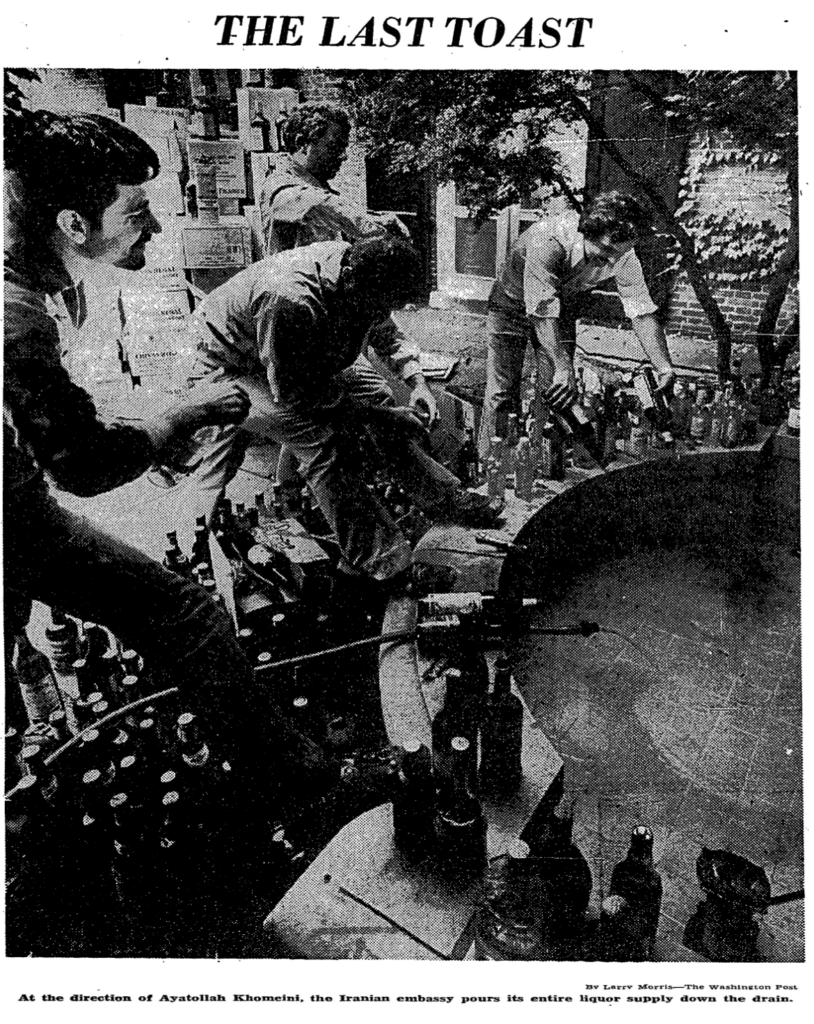
The headline, in enormous type: THE LAST TOAST.
Christopher Dickey reported:
Champagne corks were popping and the scent of martinis wafted through the air at the Iranian embassy yesterday for the first time since the shah’s people left in February and the abstemious Islamic republic took over.
But this event was in the style of Ayatollah Ruhollah Khomeini. The liquor, more than 4,000 bottles of rare wines and expensive spirits, was flowing not down the throats of guests, but down the drain.
At the direction of Khomeini himself, Zahedi’s entire liquor supply was carted from the wine cellars and liquor cabinets and emptied into a small fountain beside the terrace at 3003. The ambassador’s residence. The same house Houghton had built with Revolutionary-era bricks, including salvage from the old Metropolitan Hotel on Pennsylvania Avenue. The same fountain beside the goldfish pool.
An embassy inventory placed the wholesale value at about $22,000, but connoisseurs who were telephoned that afternoon said its retail worth could be three times that amount.
A young woman from the embassy press office watched a magnum of Dom Perignon 1970 being poured away. “It could have been auctioned off or sold back to the retailers,” she said. “But we checked with Ayatollah Khomeini (the spiritual leader of the Islamic republic) and he was the one who said it should just be disposed of… If you want to build an Islamic republic on principle then you want to start clean.”
Wine merchants reached at home expressed dismay.
“That’s incredible. What a waste,” said Ed Sands of Woodley Wine and Liquor as the inventory was read to him: 23 cases of gin, about 20 more of vodka (emptied along with 16 cases of vermouth, hence the martini smell), 23 cases of scotch, a long list of vintage wines, 20 cases of champagne that retails for $80 a magnum, and so on.
“Unbelievable,” said Sands. “Unbelievable.”
The embassy’s liquor was bought, according to a sign on the 10-foot-high stack of cases, with “money of the oppressed people of Iran.” The alcohol ban goes against Persian tradition, as the article noted. But in liquor, the Islamic holy book says, there is “great sin, and some profit, for men: but the sin is greater than the profit.”
Behind the Embassy Doors: The Hostage Crisis
Six months later, the world flipped.
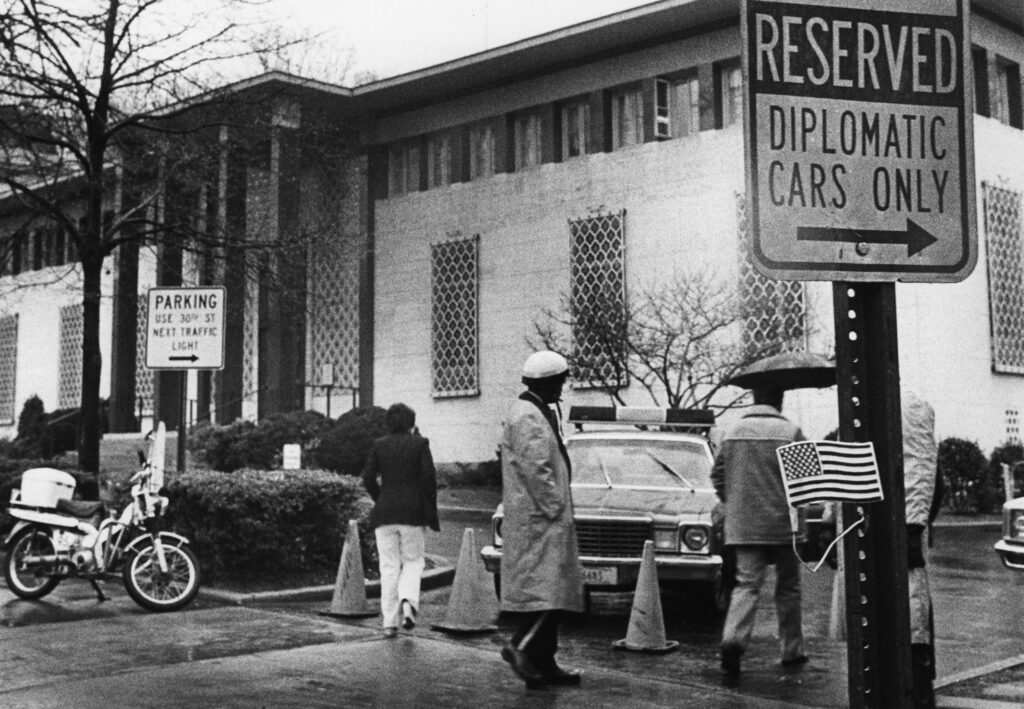
On November 4, 1979, Iranian students seized the American embassy in Tehran, taking 52 Americans hostage. The next day, the Washington Post’s Paul Valentine reported from the sidewalk outside 3005:
From outside, things looked as calm as usual yesterday at the Embassy of the Islamic Republic of Iran at 3005 Massachusetts Ave. NW.
But behind the immense dark wooden front doors, officials and aides bustled about, monitoring the tense situation in the Iranian capital.
Officials were in constant contact with both Tehran and the U.S. State Department. They had also beefed up security in and around the building following several crank calls and three bomb threats in recent days.
A small but steady trickle of visitors, most of them Iranian nationals, came to the embassy throughout the day. They waited in unadorned, sparsely furnished rooms, “rooms stripped of the sumptuous furnishings of the shah’s regime by the Moslem followers of Ayatollah Ruhollah Khomeini.”
The FBI and Secret Service confirmed the three telephoned bomb threats. An anonymous male caller said a bomb was timed to go off at 6 p.m. The D.C. Police bomb squad and the Secret Service responded by searching the building.
They found nothing.
Mansour Farhang, cultural director and scientific counselor at the embassy, described the occupation in Tehran as peaceful. The streets of Washington, which had frequently rang with the revolutionary shouts of masked Moslem and Marxist Iranian students during the Shah’s reign, were quiet. “We’ve been monitoring the situation, but so far there’s been no activity,” said Dick Bottorff, director of the mayor’s command center.
The Shutdown: Carter Expels Iran’s Diplomats
Then, on April 7, 1980, President Carter ordered the embassy closed and all Iranian diplomats expelled from the United States.
The Washington Post put it on the front page the next day: “Iran’s Embassy Here Sealed Off By Police Units.”
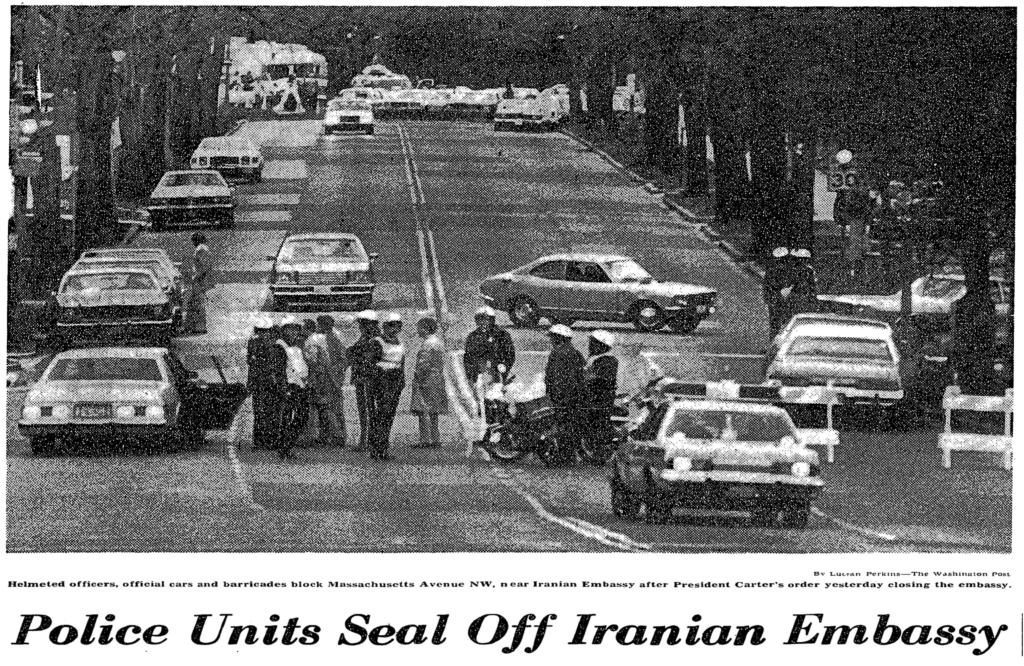
Hundreds of heavily armed law enforcement officers, many in riot helmets, swiftly sealed off the area around Iran’s embassy here yesterday in a vivid and dramatic move designed to keep watch on the 15 diplomats there and ensure their departure.
Officers barricaded the avenue above and below the embassy, from Sheridan Circle to well past the compound, turning back almost all motorists and pedestrians, declaring the five-block strip a “secure zone.” Nobody moved inside it without a police escort.
Policemen on motor scooters and in flak jackets set up curbside command posts. Dozens of FBI agents, equipped with closed-circuit television gear and sets of identification photos, manned roadblocks or watched the door, awaiting the diplomats’ emergence. Teams of four agents were assigned to follow each of the 15 remaining diplomats.
Charge d’affaires Ali Agah spoke briefly to reporters outside. He claimed he had been insulted at the State Department. But indicated he would leave.
At 3:31 p.m., a man with a briefcase entered the building. He was from the State Department, carrying the formal eviction notice. He left seven minutes later.
An unidentified man who answered the embassy telephone was asked by a reporter when the diplomats would leave. “Ask the State Department about that,” he said. “They control everything.” Then he hung up.
Across the street, a Bolivian embassy officer told colleagues: “These people [the Iranians] are heavily armed… If there should be any type of disturbance, I want you all to go inside and stay behind the wall.”
Two days later, on April 10, 1980, less than two hours before the midnight deadline, the 14 remaining diplomats and their families boarded a British Airways jumbo jet at Dulles and flew to London.
Shortly afterward, with police dogs straining at the leash and red lights from fire engines and bomb squad trucks blinking in the night, teams of heavily armed District police, FBI agents, and Secret Service technicians descended on the embassy.
All the doors were unlocked. Technicians checked doorways and baseboards for trace wires that might lead to bombs. But all they found, the Post reported, was “the calm interior of a once-ornate and lavish chancery that had been hastily vacated.”
They found some clothes, a pair of shoes, office furniture, and some shredded paper. One box that looked like it could have held a rifle was empty. There were signs that documents had been shredded and burned, but for the most part, the Iranians appeared to have been unprepared for their forced departure.
One official, sources said, sold his week-old car to a nearby embassy for about one-fourth of what he paid for it. Much of the food had been given to countrymen staying behind. Many belongings had been left as well.
The FBI said they would probably return later in the week to photograph everything inside. The photos would serve as a record of the interior’s condition at the time of closing, in the event of any claims of property theft or damage later.
The government of Iran designated Algeria to take charge of the embassy and its affairs of state, as caretaker for the estimated 300,000 Iranians then living in the United States. Algerian officials, along with some Iranian employees with nondiplomatic status, would move into the ornate building at 3005.
The doors closed. The lights went off.
Forty-Six Years of Silence
And then: nothing. For 46 years.
The State Department has maintained the buildings under Vienna Convention obligations. Across the avenue, the British Embassy that Houghton’s architect also designed still stands. The bricks from 1785 are still standing. The Mosaic Room ceiling, the one the artisan flew from Iran to create, the one that glittered like stars when the staff lit candles, is still up there somewhere behind those doors.
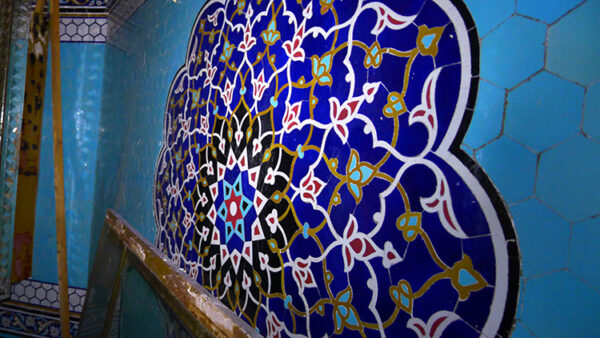
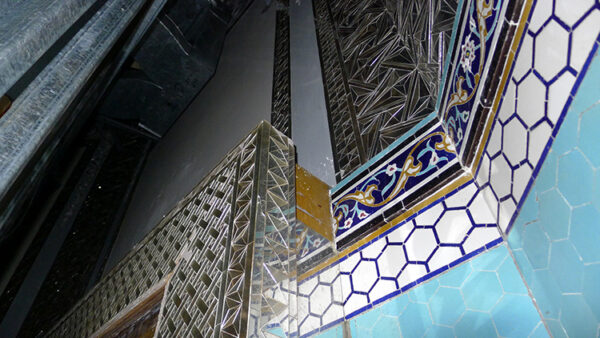
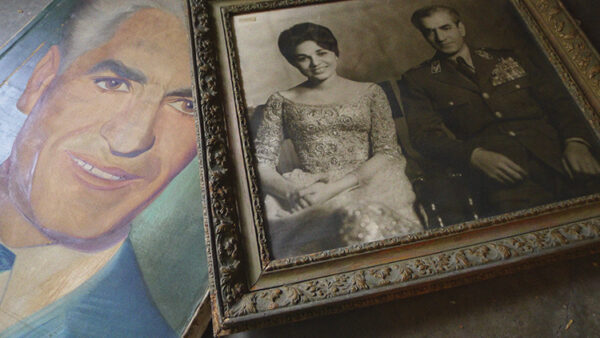
In 2013, photographer Eric Parnes gained access to the interior for the first time in more than 34 years. He found crumbling blue tiles, mirrored ceilings slowly deteriorating, and the Shah’s portrait still hanging on the wall.
Now it’s April 2026. American and Iranian officials are in direct talks, negotiating in Islamabad as a ceasefire deadline approaches. The sticking point: how long Iran should halt uranium enrichment. And on the sidewalk outside 3003 and 3005, someone has left flowers and pre-revolution Iranian flags at the fence.
Two buildings on a half-acre of Embassy Row. One built by a pacifist from Revolutionary-era bricks. The other designed by architects who spent six weeks studying Iran’s own traditions. Between them, they absorbed every chapter of the U.S.-Iran relationship across nine decades: the glittering parties, the protests, the champagne down the drain, the riot helmets, the locked doors, the silence.
The building waits.
A mile and a half down Massachusetts Avenue, the old German Embassy went through its own geopolitical rupture in 1917. Closer to downtown, the Windom House at Scott Circle made the same trip from Gilded Age mansion to foreign embassy.
Some of our stories are researched and written with help from AI, and checked by a person before they run. Here’s how we use AI.