
There’s no circle at Truxton Circle. Hasn’t been since 1947. What you’ll find today at the intersection of North Capitol Street, Florida Avenue, and Q Street NW is a busy, unglamorous crossing that gives no hint it was once a landscaped traffic circle with an ornate fountain at its center.
But the neighborhood that grew up around that vanished circle still carries the name, and the story of how it got that name reaches all the way back to the early days of the American republic and one of its most celebrated naval officers.
Long Island Boy, Privateer, Commodore
Commodore Thomas Truxtun was born on February 17, 1755, near Hempstead on Long Island, the only son of an English-born lawyer. He lost his father at a young age, and with little chance for a formal education, he joined the crew of a British merchant ship at the age of 12. He was a natural sailor. By the time he was twenty, he had already earned command of his own vessel.
The Revolutionary War interrupted that merchant career. At one point he was impressed into a Royal Navy ship and offered a midshipman’s commission. He turned it down. After being wounded in action against an American privateer, he decided he would never fight against his own countrymen again.
He spent the rest of the war commanding American privateers, including the ships Congress, Independence, Mars, and St. James. He captured British prizes throughout the conflict and was never once defeated himself.
After the war he returned to the merchant trade and built a formidable reputation. In 1786 he commanded the Canton out of Philadelphia, one of the first American vessels to trade directly with China.
He wrote a treatise on longitude and latitude, a technical manual on masting 44-gun frigates, and made the public case for why the new United States desperately needed a proper navy. He was, in short, exactly the kind of man you’d want to build one around.
One of Washington’s Original Six
In 1794, with war with France looking increasingly likely, President George Washington appointed the first six captains of the reconstituted United States Navy. Truxtun was one of them. The six were to command the six original frigates then under construction: USS United States, USS Constellation, USS Constitution, USS Chesapeake, USS Congress, and USS President. Truxtun was assigned to the Constellation, a ship he had personally overseen being built in Baltimore.
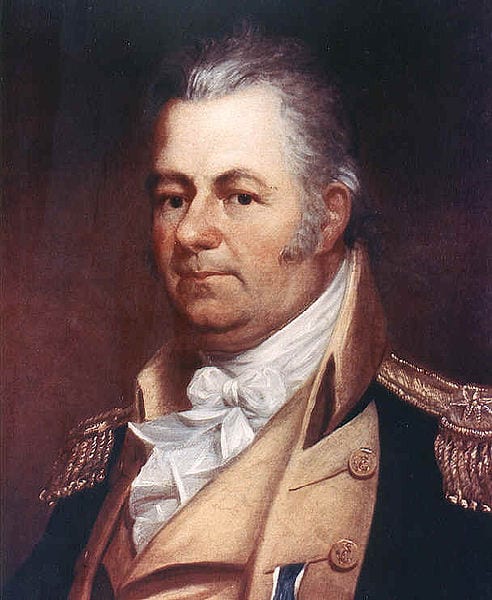
It wasn’t a smooth process. There were rank disputes among the captains, including a prolonged disagreement with Silas Talbot. But President Washington ultimately put Truxtun in command of Constellation, and that assignment would make him famous across the country.
The Quasi-War with France
By 1798 the United States was in an undeclared naval war with France. French privateers had been attacking American merchant ships relentlessly, seizing cargo and disrupting Atlantic trade. Congress authorized the Navy to fight back, and Truxtun took Constellation to the West Indies to patrol the waters between Puerto Rico and Saint Kitts, with orders to engage any French forces he found.
Also aboard was a young officer named John Rodgers, acting 1st Lieutenant, who would go on to become one of the most important naval figures of the 19th century.
February 9, 1799: The Capture of L’Insurgente
On the morning of February 9, 1799, sailing independently of his squadron, Truxtun spotted the French frigate L’Insurgente. She was rated a 32-gun vessel but actually carried 40 cannons, and her broadside outweighed Constellation’s. None of that deterred him.
He chased her through a storm and forced her into an engagement that lasted one hour and fourteen minutes. French Captain Barreau did not strike his colors until his ship was nearly a complete wreck. French losses were 29 killed and 44 wounded. Truxtun’s crew suffered one killed and two wounded.
It was the first ship-to-ship battle for the American Navy since the Revolutionary War. L’Insurgente was brought into Saint Kitts as a prize and commissioned into the U.S. Navy as USS Insurgent. American morale soared. Truxtun returned home to the kind of praise that makes a man’s name worth putting on things.
The Night Battle with La Vengeance
Less than a year later, Truxtun found an even bigger fight. On January 31, 1800, Constellation encountered the French frigate La Vengeance, a heavier ship bound for France under Capitaine de Vaisseau François Pitot and carrying passengers and valuable specie. La Vengeance tried to outrun Constellation. Truxtun wouldn’t allow it.
The two ships fought through the night and into February 1st. La Vengeance struck her colors four times during the battle, but each time Truxtun was unable to take possession of her before she raised them again.
By dawn, Constellation had been partially dismasted and was forced to make for Jamaica for repairs. La Vengeance, badly battered, limped to Curaçao. Truxtun claimed the victory, and most historians have given it to him.
When he arrived home, Congress agreed. On March 29, 1800, Truxtun was awarded the Congressional Gold Medal, becoming only the eighth person to receive what Congress calls its “highest expression of national appreciation for distinguished achievements and contributions.” Six U.S. Navy warships have been named in his honor since 1842.
The Circle Is Born
Fast-forward a century to 1900. Washington was developing rapidly, filling in the L’Enfant street grid and taming chaotic intersections across the city. A traffic circle went in at the junction of North Capitol Street, Florida Avenue, and Q Street NW.
The land at that intersection had long been associated with the Truxton family, and so the circle carried the commodore’s name. It sat at the edge of the Bloomingdale and LeDroit Park neighborhoods, in a fast-developing corner of the city.
The circle got its centerpiece in 1901. According to the Washington Post on April 23rd of that year, an ornate fountain was moved from its previous location at Pennsylvania Avenue and M Street NW to its “new site” at Truxton Circle. A subsequent account described it as one of the largest fountains in the city.
The intersection was busy enough that a police officer was stationed there full-time to direct traffic until November 1925, when a traffic signal was finally installed. The Post reported on November 14th, 1925: “Auto Signal Lights to Be Ready Dec. 15: Sixteenth Street Crossings and Truxton Circle to Be Equipped.”
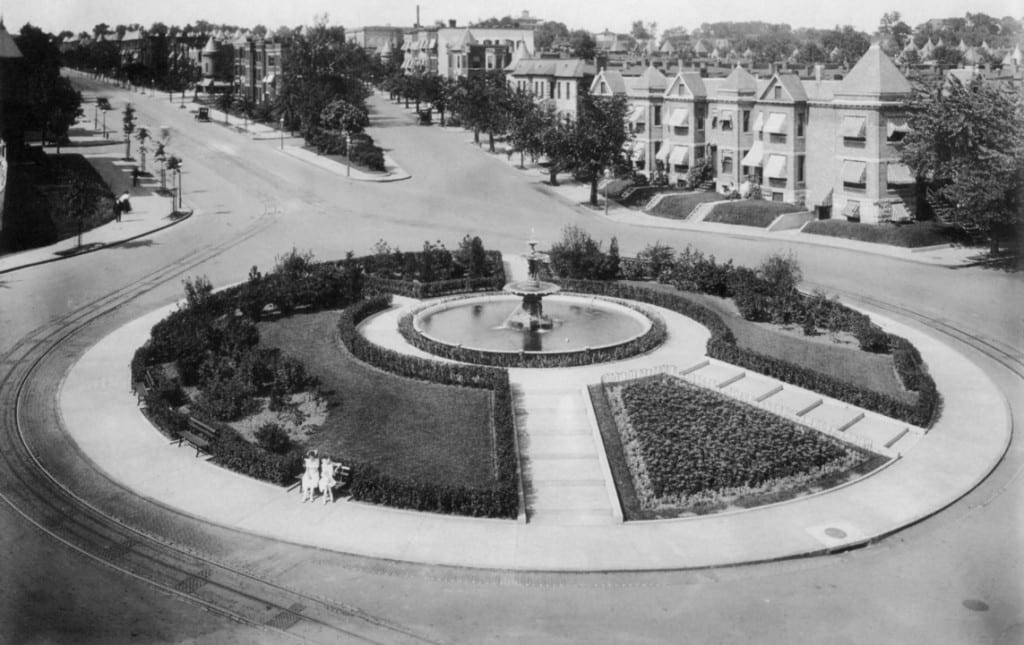
The neighborhood that grew up around the circle was dense and working-class, lined with late 19th-century rowhouses. It also contained some remarkable institutions. The Armstrong Manual Training School, where Duke Ellington graduated, sat within the neighborhood. The original Dunbar High School, the first public high school for Black students in the United States, was nearby. Today both buildings are listed on the National Register of Historic Places.
The Circle Comes Down
By the 1940s, Truxton Circle had become a genuine hazard. North Capitol Street was a major commuter artery, and the circle caused constant traffic jams and accidents. On March 24, 1947, the Evening Star ran a headline: “Truxton Circle Hazard To End This Summer.” The city had decided it had to go.
The demolition cost $500,000. The circle was torn out, North Capitol Street was straightened and widened, and the fountain was dismantled piece by piece.
Records of where the pieces went were lost in the process. Decades later, researchers finally tracked down the fountain’s remains at a dump site in Fort Washington Park, the historic military fortification just south of the city in Fort Washington, Maryland. The pieces are still there, slowly being reclaimed by nature.
What Remains
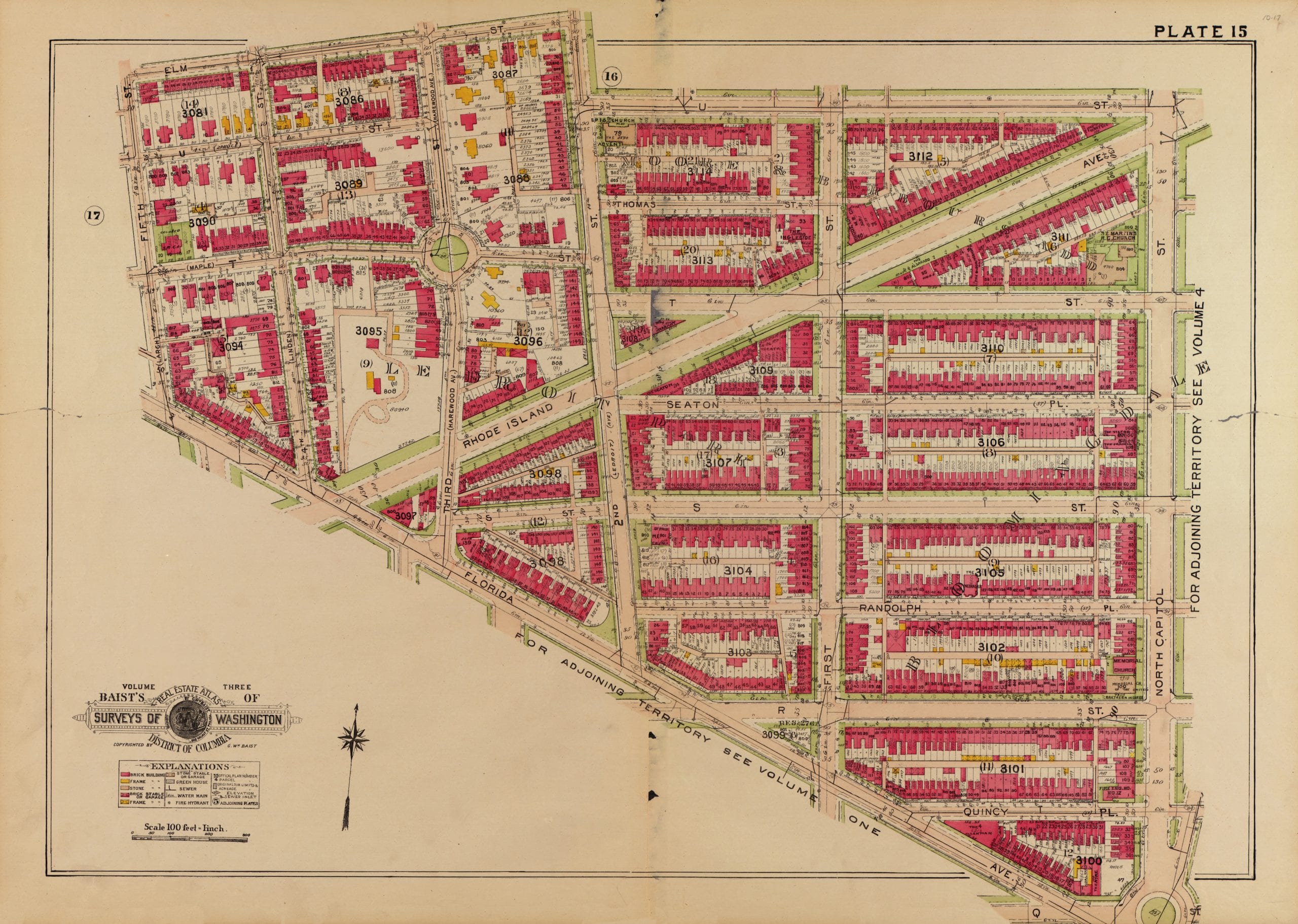
The neighborhood kept the name. Today Truxton Circle is bordered by New Jersey Avenue to the west, Florida Avenue to the north, New York Avenue to the south, and North Capitol Street to the east. It sits next to Bloomingdale and LeDroit Park to the north, Eckington to the east, and Shaw to the west. The intersection itself is just an ordinary crossing now.
But think about what that name is carrying. Every time someone says “Truxton Circle,” they’re invoking a Long Island kid who went to sea at 12, fought the British as a privateer, became one of George Washington’s original Navy commanders, captured a French frigate in a 74-minute battle, fought another French warship through the night and came out a national hero, and won one of only eight Congressional Gold Medals handed out in the 18th century.
The circle is gone. The fountain is rusting in a Maryland park. But the name holds all of that history in it, which is pretty good work for a neighborhood in Northwest D.C.
If you’re curious about other DC circles and the neighborhoods named for them, check out our piece on the history of Thomas Circle. And for more on this corner of the city, the Griffith Stadium post covers what happened to the legendary ballpark in the LeDroit Park neighborhood just up the road.
The neighborhood with the name Truxton Circle is south of where the circle used to be, and it didn’t get tagged with that name until the 80s, 1980s. If you want raw historical data about the neighborhood go to http://www.truxtoncircle.org