
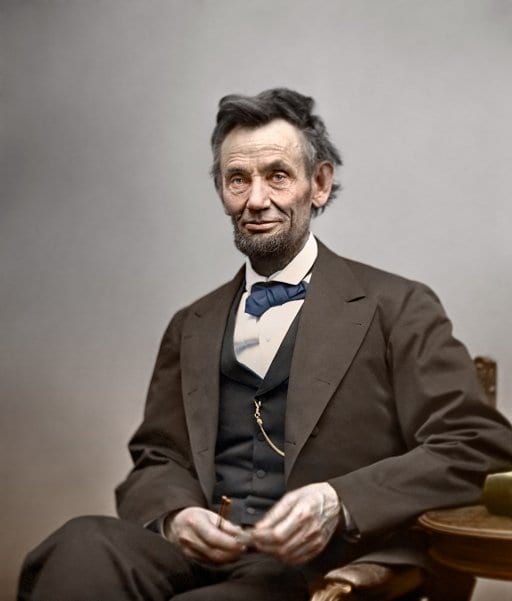
On February 5, 1865, Abraham Lincoln sat for a photographer at Alexander Gardner’s gallery on 7th Street NW in Washington. He was 55 years old. He had 68 days to live.
This is that portrait, colorized.
The Man Behind the Camera
Alexander Gardner was born in Paisley, Scotland, in 1821 and came to the United States in 1856. He found his way to Washington, joined Mathew Brady’s studio, and quickly became one of Brady’s most capable photographers. When Brady refused to give individual credit to his photographers for their work, Gardner left in 1863 to open his own gallery at 511 7th Street NW, a few blocks from the Patent Office and the Post Office building.
The gallery became the preferred studio for Washington’s wartime elite. Gardner photographed Lincoln at least six times over the course of the presidency. He was at the Capitol on March 4, 1865, a month after this sitting, to photograph the second inauguration. And when the assassination came in April, Gardner was there to document everything that followed: the conspirators in custody, the military tribunal, and the execution.
February 1865 in Washington
When Lincoln walked into Gardner’s studio that February, the Civil War was in its final months. Sherman had finished his March to the Sea. Grant had Lee pinned at Petersburg. The end was not yet official but it was visible. Lincoln had already begun drafting what would become one of the most consequential second inaugural addresses in American history, delivered 27 days after this photograph was taken.
Look at his face. He was 55, but the age he carries is not 55. When Lincoln arrived in Washington in February 1861 as president-elect, he was a vigorous if angular man. By 1865, four years of war had done what four years of war do. The lines around his eyes had deepened, his cheeks had hollowed, and the characteristic sadness that friends and colleagues remarked on had settled permanently into his features. His secretary John Hay, who knew him as well as anyone, said Lincoln was “the saddest man I ever knew.”
What Color Changes
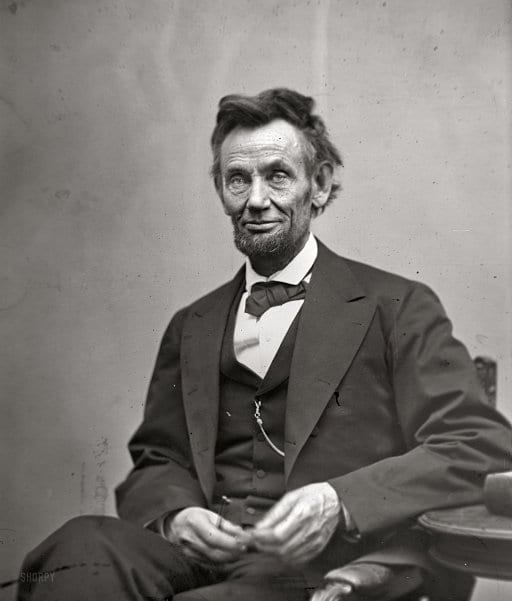
Black and white photography does something to historical figures that color undoes. The monochrome palette turns them into monuments. It creates a kind of protective distance: this was a long time ago, in a different world, among people who were fundamentally unlike us. The gray scale makes them safe to admire.
Color removes that. The specific dark brown-black of Lincoln’s coat, the warmth in his skin, the texture of the studio backdrop: suddenly this is just a person sitting in a photographer’s chair on a cold February morning. He is tired. He has a country to finish saving. He is going to deliver one of the greatest speeches in American history in less than a month, and he is going to be shot in the back of the head six weeks after that.
Color does not add drama to this image. It removes the drama of historical distance and replaces it with something harder to look away from.
What Gardner Captured Next
Gardner was at the Capitol steps on March 4, 1865, when Lincoln delivered the second inaugural. The surviving photographs from that day show the crowd, the unfinished grounds, and the new dome barely completed above them. If you look carefully at the inauguration photograph, Lincoln is visible at the podium. It is one of the most remarkable documentary photographs of the 19th century.
On April 14, Lincoln was shot at Ford’s Theatre. He died the following morning. Gardner photographed the conspirators held at the Washington Navy Yard, including Lewis Powell, the man who had simultaneously attempted to murder Secretary of State William Seward at his home on Lafayette Square. On July 7, Gardner set up his camera at the Old Arsenal, now Fort McNair at Greenleaf Point in Southwest DC, and photographed the hanging of four conspirators: Mary Surratt, Powell, David Herold, and George Atzerodt.
Gardner spent the rest of his career in Washington. He died in 1882 and is buried at Glenwood Cemetery in Northeast DC, a short distance from the studio where he photographed Lincoln for the last time.
The photographs of Lincoln’s funeral procession down Pennsylvania Avenue on April 19, 1865 show what Washington looked like the week after. They are worth a look.
For the building Washington built to honor him, read our pillar: Lincoln Memorial History: Construction, Designs, the Secret Basement, and the Swamp It Was Built On.
For more on Lincoln’s wartime White House, read about Sarah Josepha Hale’s 1863 letter that convinced Lincoln to make Thanksgiving a national holiday.
Some of our stories are researched and written with help from AI, and checked by a person before they run. Here’s how we use AI.