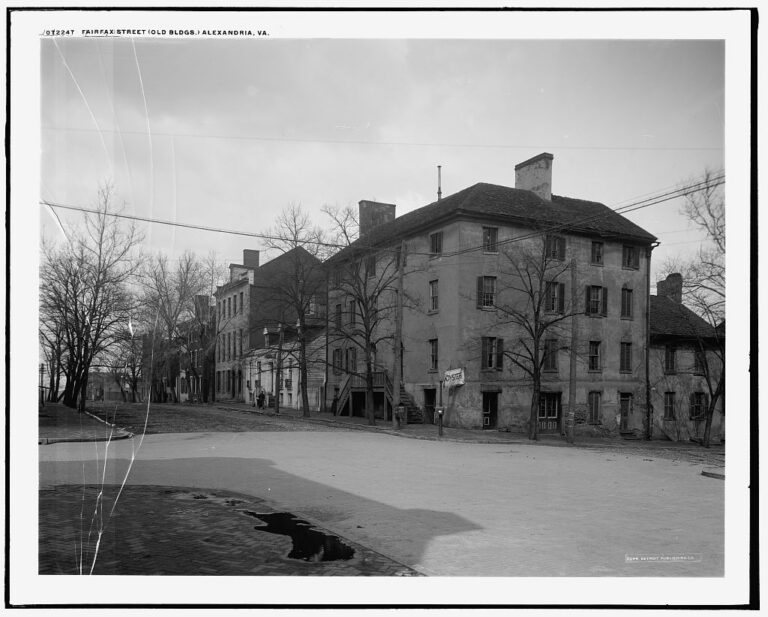

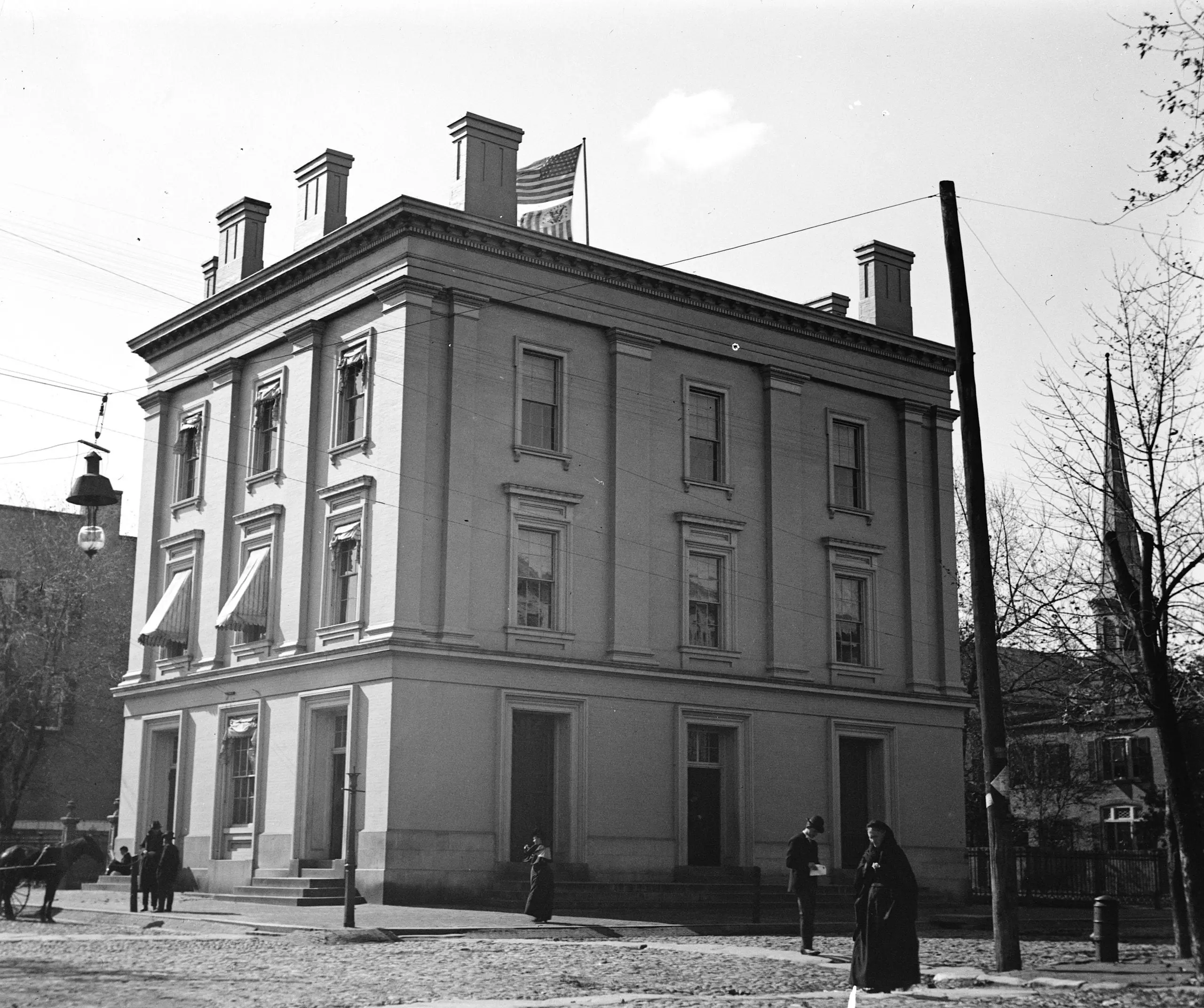
This is the Alexandria Custom House and City Post Office at the southwest corner of Prince and St. Asaph Streets, photographed around 1918. The building was 60 years old when a National Photo Company photographer pointed his camera at it. The flag on the roof had been flying almost continuously since the summer of 1861, when Union troops walked in and didn’t leave.
Twelve more years and the whole building would be gone.
A Federal Template, Dropped Into Old Town
The architect was Ammi B. Young, and he had drawn buildings like this one before.
Young was the first Supervising Architect of the U.S. Treasury Department, a position Congress created in 1852 to bring order to the sprawl of federal building projects that each local politician had previously been getting designed however he could. From a drafting room inside the Treasury, Young produced designs for custom houses, post offices, courthouses, and marine hospitals in cities up and down the east coast and out into the Midwest. He designed the Georgetown Custom House on 31st Street, which is still standing. He designed the Providence Custom House, built 1855 to 1857, which is also still standing. He designed custom houses in Mobile, Galena, Ogdensburg, Portsmouth, and Gloucester.
The Alexandria building was one of a family. The instructions from Congress were strict. Fireproof. Granite and brick. Cast iron columns and stairs inside. A consistent federal presence in every port of any size.
Young signed off on the Alexandria design in 1856. Capt. A. H. Bowman of the U.S. Corps of Engineers was the engineer in charge. The three-story building went up over the next two years on the southwest corner of Prince and St. Asaph. The first floor held the post office. The second held the customs collector. The third held the United States District Court for the Eastern District of Virginia.
It opened in 1858 with a flag on the roof and a customs collector’s scale on the second floor. The city around it was still sorting out what it was: Alexandria had been retroceded from the District of Columbia back to Virginia just eleven years earlier, in 1847, and the new Custom House was the federal government reasserting a presence in a town it had very recently let slip out of its direct jurisdiction.
Three years later, Virginia seceded.
May 24, 1861
Virginia’s secession took legal effect on May 23, 1861. The next morning, at four o’clock, Union regiments crossed the Potomac and occupied Alexandria. Colonel Elmer Ellsworth of the 11th New York Fire Zouaves was killed at the Marshall House, trying to pull down a Confederate flag from the roof of an inn at King and Pitt. He was the first Union officer killed in the war. The occupation held.
For the next four years and three months, Alexandria was a federal city inside a Confederate state. The railroads, the warehouses, and the waterfront became a logistical hub for the Army of the Potomac. Hospitals took over hotels and private homes. A contraband camp formed as enslaved people walked across the occupation line to freedom. The slave-trading pen on Duke Street, one of the largest in the antebellum South, was emptied out and its cells converted to hold Confederate prisoners.
Through all of it, the Custom House at Prince and St. Asaph stayed open. It was the federal building in a town full of civilians who would have preferred the federals leave. The post office went on processing mail. The customs collector went on collecting duties on ships at the waterfront. The district court went on trying cases, some of them the cases of Confederate sympathizers charged with treason.
After Appomattox, the garrison came down. The flag did not. The Custom House simply went on being a federal building.
The 1904 Enlargement
By 1904 the building was not enough.
Federal work in Alexandria had grown along with the city. The post office needed more counters, the customs collector needed more clerks, and the court needed more rooms. Rather than replacing the building, the Treasury doubled it.
The existing three-bay front on Prince Street stayed where it was. The wing along St. Asaph Street was extended from three bays to five, growing the footprint by roughly two-thirds. A central heating plant went in, taking over the work that had been done by the building’s paired end chimneys. From the outside, the addition matched the Young original closely enough that passersby would miss it. Look at the 1918 photograph and you can see the seam on the St. Asaph side: the two halves are almost, but not quite, identical.
The expansion bought the building another twenty-five years.
The End
The 1858 Custom House was demolished in 1930. A new post office went up at 1100 Wythe Street, several blocks north, with its cornerstone laid in February 1931 and a full city block of ground to itself. The granite and cast iron of the Young building were pulled apart and carted off. The site at Prince and St. Asaph became a parking lot.
Look at the 1918 photograph one more time before we close. The building is squat and graceful. The flag is flying. There are people on the sidewalk in the clothes of a small Virginia port still settling into the twentieth century: a woman in a long coat and hat, a man in a dark suit by the corner door, a horse-drawn carriage’s harness just visible at the left edge of the frame. The arc lamp is still on its post. A church spire rises in the background against the bare trees.
Ammi B. Young, the Vermont-born architect who drew up the building for the Treasury, died in 1874. He never saw the 1904 enlargement of his Alexandria design, and he never saw it come down either.
But for seventy-two years the flag on top of the Custom House on Prince and St. Asaph was the only American flag in Alexandria that had never been taken down.
Some of our stories are researched and written with help from AI, and checked by a person before they run. Here’s how we use AI.