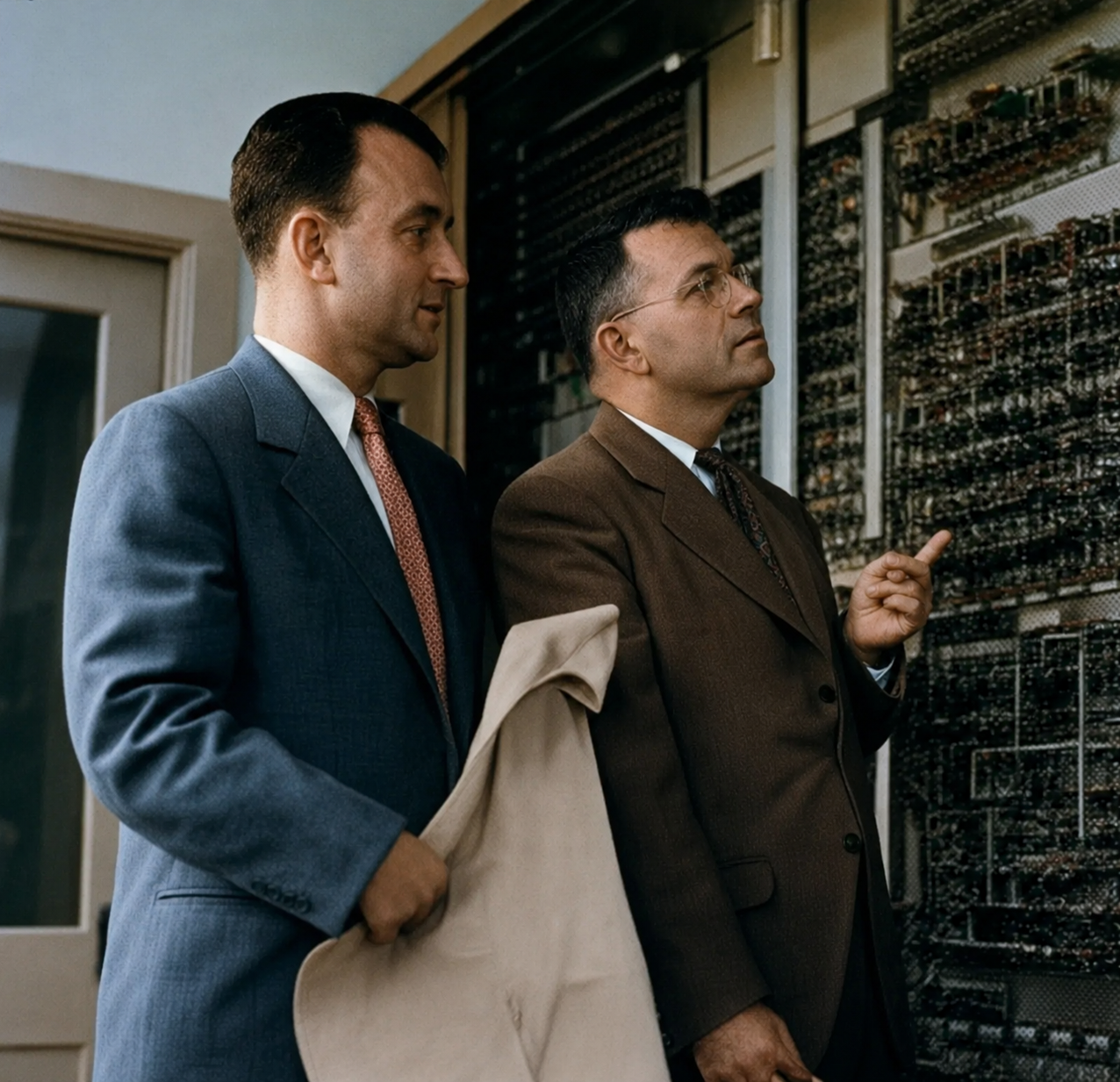
AI anxiety isn’t new. In 1949, an MIT professor turned down a corporate contract because he feared machines would replace human judgment. A year later, Washington had its own “electronic brain” on Connecticut Avenue. We’ve been having this argument for 75 years.
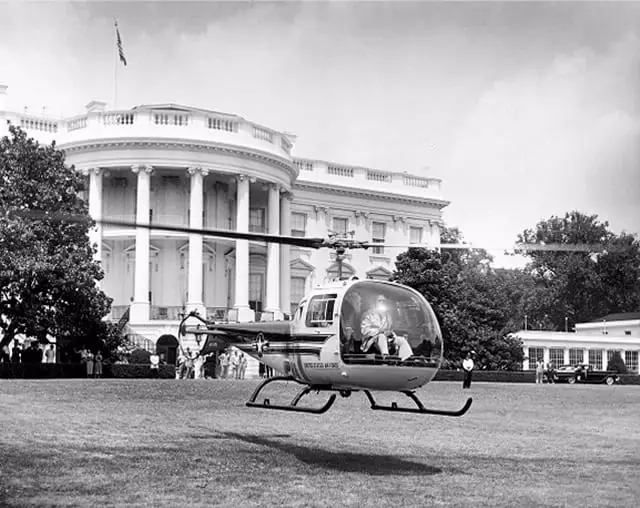
President Eisenhower needed a quick and effective way to travel from Washington to his summer home in Rhode Island. Air Force One was too large for the trip and a motorcade would take too long, causing major traffic jams.
Helicopters were relatively new in aviation and the military began conducting tests to see if one would meet the needs of the president.
Check out the video of the landing tests they performed on the White House South Lawn in 1957.
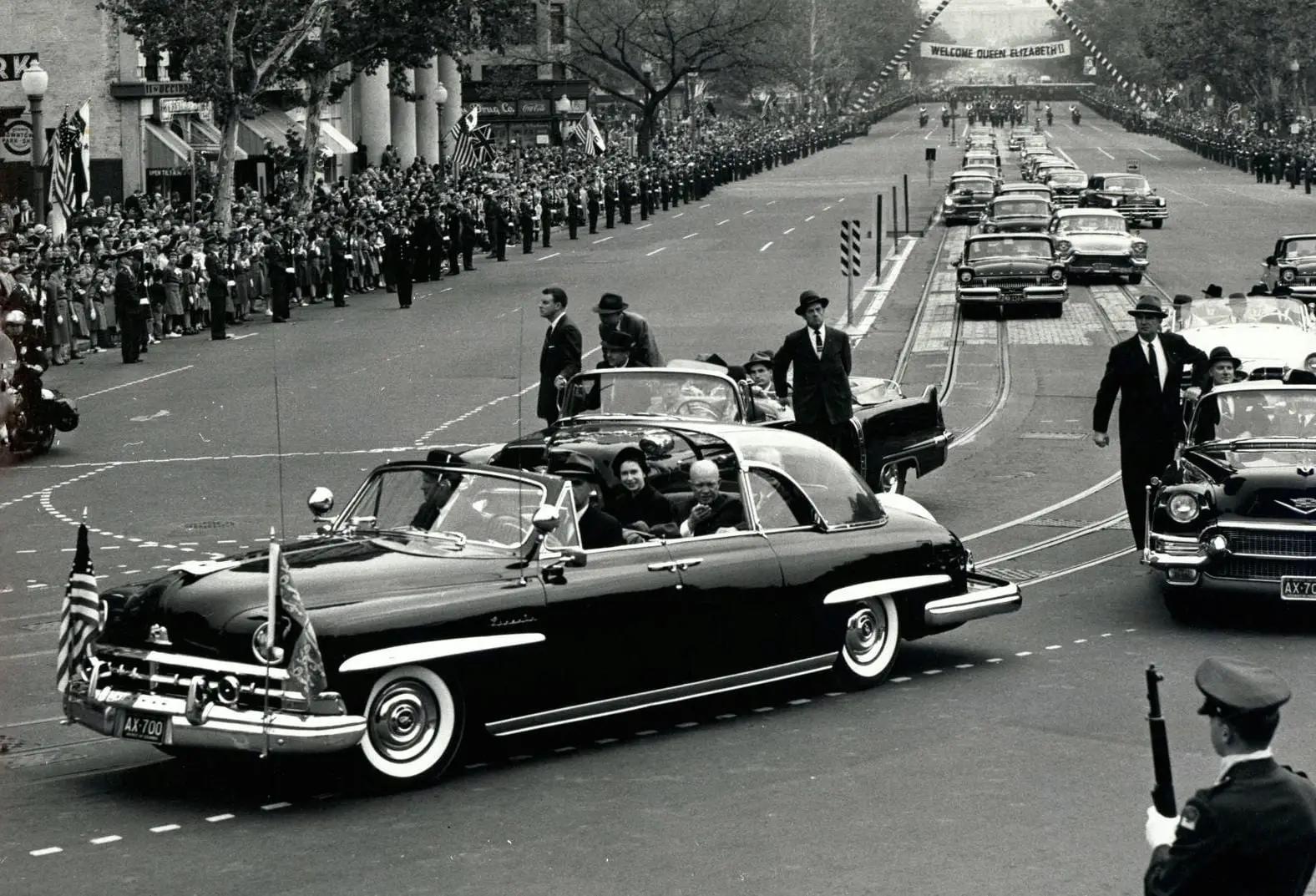
Relive a special moment in history with this wonderful old photo of President Eisenhower and Queen Elizabeth in a Lincoln Cosmopolitan in 1957. See the three photos taken that day here.
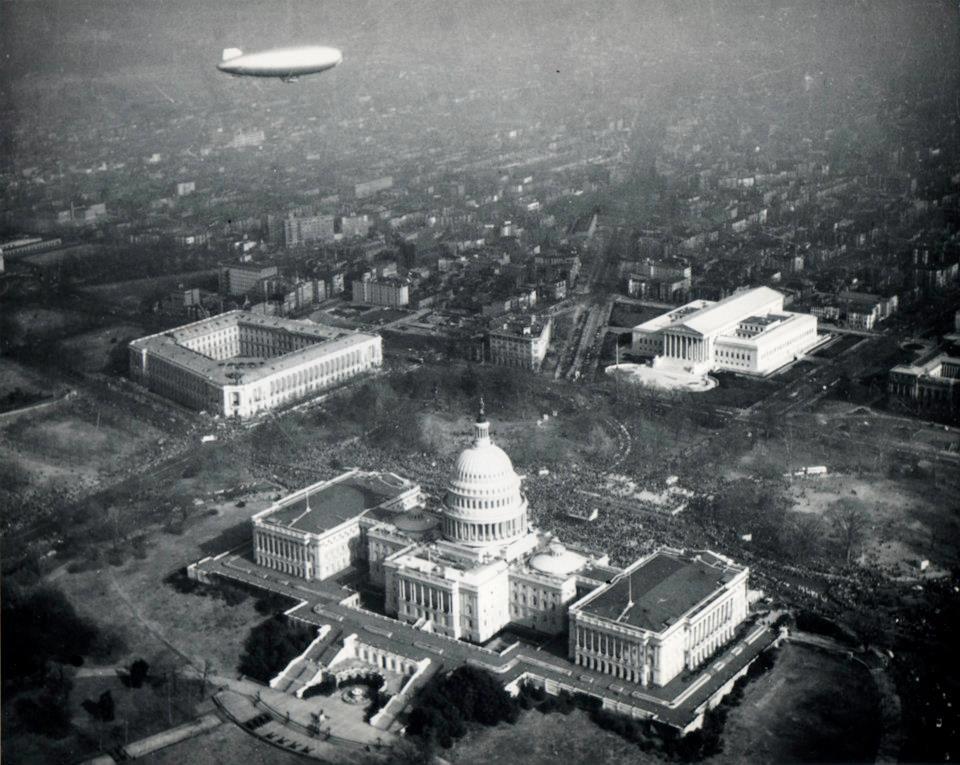
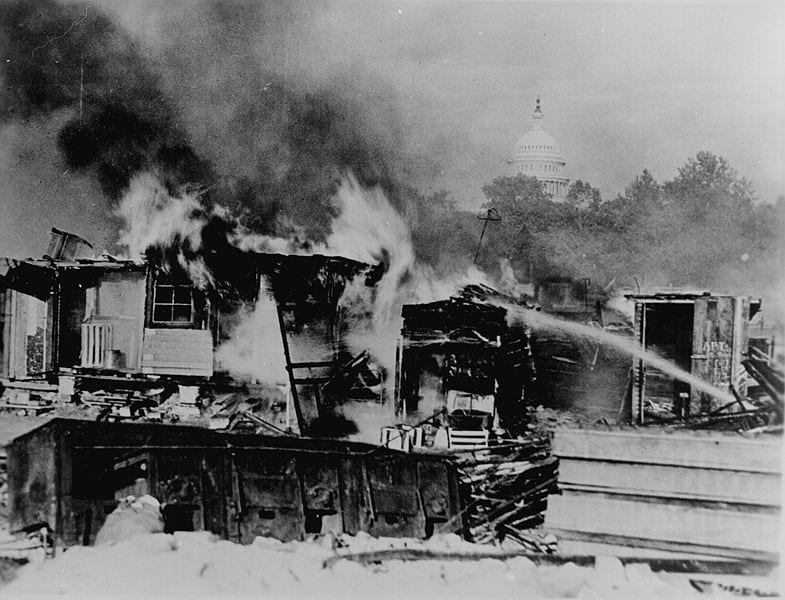
Take a trip down memory lane and explore the history of DC with these amazing photos from January 20th, 1953. See what life was like in the city decades ago with Ghosts of DC!
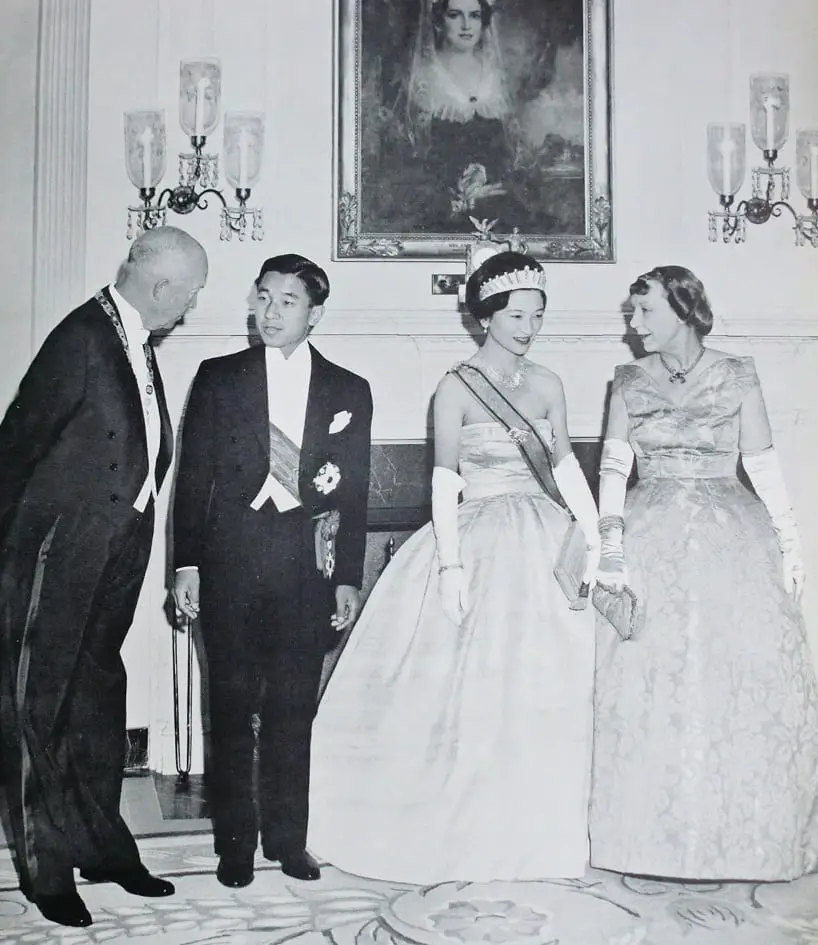
In September of 1960, the U.S. and Japan were celebrating 100 years of diplomatic relations. Crown Prince Akihito and Princess Michiko traveled to Washington at the end of the month to celebrate the occasion with an official state visit.
An amusing article was published in the Washington Post on September 28th of that year, detailing the state dinner at the White House.
Japan’s Crown Prince Akihito and Princess Michiko actually stopped traffic inside the White House last night as President Eisenhower‘s 4-year-old granddaughter Mary Jean was detoured down another corridor in her battery-powered miniature Thunderbird convertible.
Shortly before the royal couple’s arrival for the state dinner in their honor, Mary Jean was happily utilizing the wide marble-floored halls for driving practice, skillfully avoiding potted plants and dodging the shins of uniformed security sentries. As the hour neared for formality to commence, the preoccupied girl was dispatched elsewhere to play by a message relayed down from her parents, Lt. Col. and Mrs. John Eisenhower, who were upstairs dressed to join the other 88 guests.
…
Though Mary Jean’s 5-mile-an-hour auto looks luxurious, to her it’s a long-awaited secondhand hand-me-down. It belonged first to big brother David, who long ago graduated to a stripped-down soapbox derby type vehicle that zooms around the White House grounds at 15-miles-an-hour.
…
“We’ve been looking forward to your coming,” FIrst Lady Mamie Eisenhower told Princess Michiko during a personally conducted tour of the White House. At one point early in the evening, both women smiled at an obvious difference in Eastern and Western viewpoint. “This is quite old–the 1700s,” said Mrs. Eisenhower, indicating a yellow silk Philadelphia Chippendale chair in the Oval Room.
“Old in our country, that is,” she corrected herself, “not in yours.”
Both old and priceless of course. I’m surprising Governor Romney didn’t break that one as well during his clumsy visit.
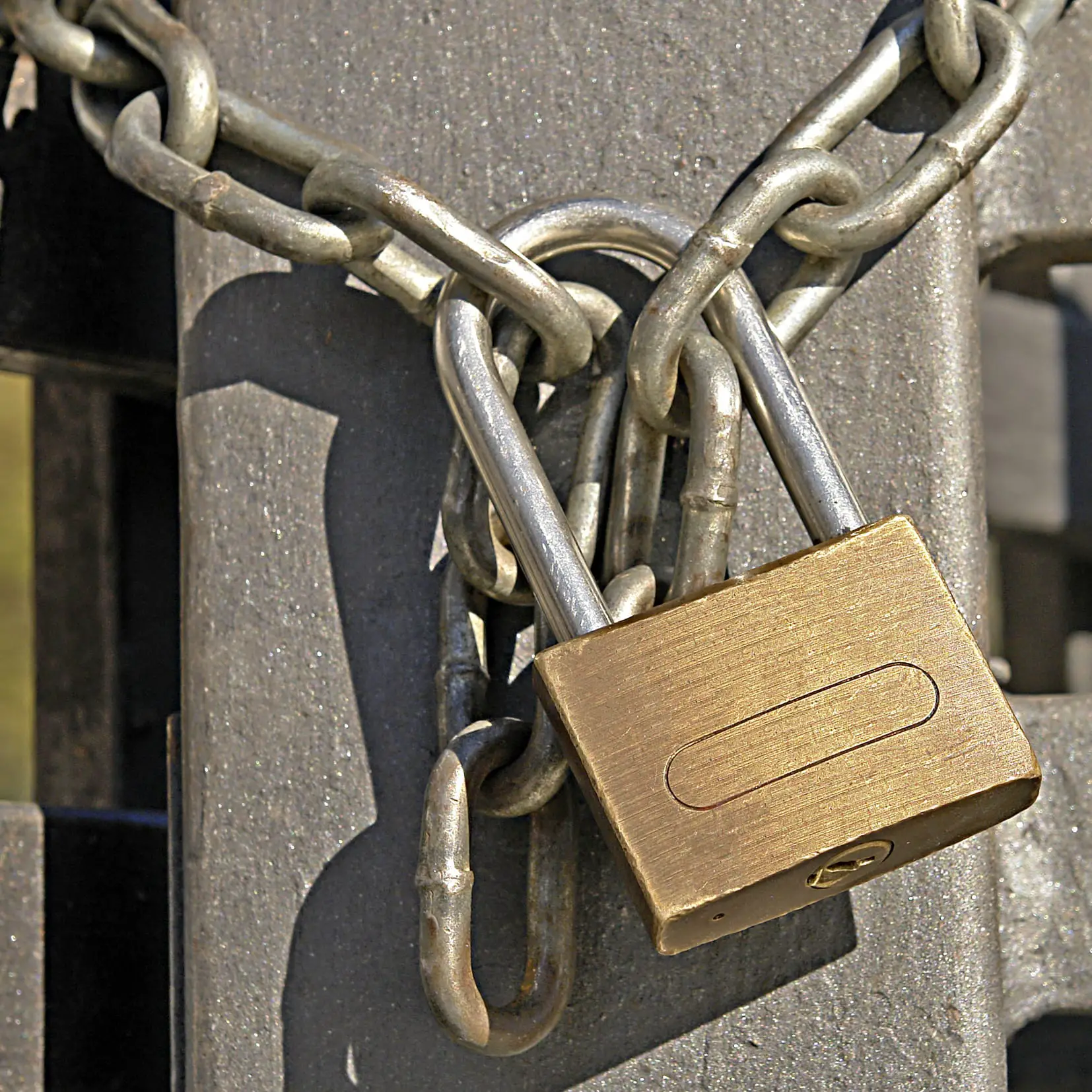
Read the amusing story of Angeline Cliett, the 19-year-old Texan who locked the White House gate in 1958. Learn why President Eisenhower took no action against her and how the situation was resolved!
The oldest surviving color videotape recording in the world was made on May 22nd, 1958. You can watch it right now. It starts in black and white, the way all television looked back then. Then, about fourteen minutes in, a man named Robert Sarnoff pushes a big button, an engineer throws the color burst switch, and the world goes color.
The occasion was the dedication of NBC’s brand new $4,000,000 television-radio center on Nebraska Avenue NW in Tenleytown. NBC had designed and built the facility, as they put it, “from the ground up for color television.” This wasn’t a retrofit. It was a purpose-built monument to a technology still in its infancy.
Eisenhower was the obvious choice to cut the ribbon. He arrived at the Nebraska Avenue studios to a crowd that included members of the Supreme Court, members of Congress, and other senior Government officials. Before he spoke, he toured the engineering facilities. What he saw apparently left an impression.
In his remarks, reported in the New York Times on May 23rd, 1958, Eisenhower said the technical facilities were “like nothing else so much as the radar room of a big battleship — entirely beyond my comprehension, but capable of exciting my imagination.”
He told the audience it was important “in these fast-moving times” that Government decisions and world events be passed to every citizen “by the very fastest kind of communications.” The ceremony, the Times noted, was televised in color nationally by NBC.
The man narrating the opening was David Brinkley, then NBC’s Washington anchor and already one of the most recognizable voices in American broadcasting. He walked viewers through Studio A while Eisenhower toured the engineering rooms with the Sarnoffs.
Both Sarnoffs were there. David Sarnoff was the founder and chairman of RCA, the parent company of NBC. His son Robert was president of NBC. It was Robert who threw the switch, hitting the button that signaled an engineer to flip the color burst switch on the RCA TK-40 studio color camera, converting the black and white picture to living color.
The studio had been using a combination of RCA Image Orthicon black and white cameras and RCA color cameras running in monochrome for the arrival and early ceremonies. When the speeches began, the color cameras took over fully.
Here is something that surprises people: the tape was not recorded in Washington at all. The live broadcast originated from the Nebraska Avenue studios, but the actual recording was made 3,000 miles away at NBC’s Videotape Central in Burbank, California.
The recording format was known as “RCA Labs Color,” a heterodyne color method developed by RCA’s research laboratories. It was a specific technical standard distinct from the Low Band Color format that SMPTE would later establish as the industry norm.
Two copies of the program were made. Robert Sarnoff mentioned during the broadcast itself that one was being presented to President Eisenhower. The other ended up in the holdings of the Library of Congress. Or so everyone thought.
Fast forward thirty years. In 1988, color television historian and engineer Ed Reitan and his collaborator Don Kent were working to restore another early NBC color tape, “An Evening with Fred Astaire,” at KTLA in Los Angeles. They needed a working 2-inch Quadruplex machine capable of playing back RCA Labs Color, which required significant technical modification. Reitan redesigned roughly ten circuit boards in an Ampex AVR-1 to recover the old format.
While that restoration was underway, UCLA film and television archivist Dan Einstein brought in the WRC-TV dedication tape from the Library of Congress. It wasn’t in good shape. “We actually DID run the original tapes back and forth to set the machine,” Kent later recalled. “Their dropouts were sometimes so bad that we weren’t really concerned about damaging them any further.”
During playback, they caught something. On camera, Sarnoff had mentioned that a copy was being sent to President Eisenhower. Einstein started digging. He found the second copy at the Eisenhower Presidential Library in Abilene, Kansas. The staff there didn’t even know what it was.
“I broke the original hold-down tape on the reel which had been put there in 1958!” Kent said.
There were still technical problems. About two-thirds through the program, the audio line failed during David Sarnoff’s speech. NBC switched to a backup telco line, but the audio quality degraded noticeably. Kent ran it through an equalizer and did what he could. A video dropout later in the tape couldn’t be repaired at all; frames were simply missing.
For their work restoring the Fred Astaire tapes in that same session, Einstein, Kent, and Reitan received an Emmy Award in 1989 for Outstanding Achievement in Engineering Development.
Ed Reitan passed away on January 6th, 2015.
The Cold War context is worth holding in mind. Eisenhower’s remarks about “almost instantaneous reaction” and “fast communications” weren’t just ceremony. In May 1958, the Soviet Union had launched Sputnik just seven months earlier. The Space Race was on. The idea that a government could speak directly to its citizens, in color, in real time, from a facility designed and built for exactly that purpose. That carried weight in a way that’s easy to underestimate today.
NBC’s Nebraska Avenue complex remained the home of the network’s Washington bureau for more than sixty years, until 2020. The building is still there. The station is still there, as NBC4 Washington.
Check out the video below. Skip to about 1:23 for the moment the color comes on.