Just before 5 o’clock on the afternoon of December 28, 1925, smoke began rolling east over Pennsylvania Avenue and piling into great gray clouds around the dome of the Capitol. The top floor of George J. Mueller’s wholesale candy plant, at 336 Pennsylvania Avenue NW, was already gone.
Within minutes it was a five-alarm fire, the kind that stops a city. Streetcars on Pennsylvania Avenue backed up for fifteen blocks. A crowd overflowed the sidewalks for more than a block to watch it burn.
And it all happened in the heart of Washington’s first Chinatown, a decade before that name moved north to H Street.
The Washington Post laid out the whole scene the next morning. Here is its account.
A Spectacular five-alarm fire in the wholesale candy plant of George J. Mueller, 336 Pennsylvania avenue northwest, shortly before 5 o’clock yesterday afternoon wrought $50,000 damage, tied up street car services for more than fifteen blocks and resulting in the injury of one fireman.
The top floor of the five-story building was enveloped in flames when firemen arrived, and it was feared that the fire, fanned by a brisk wind, would spread eastward along Pennsylvania avenue. Smoke from the fire was carried eastward by the wind, forming great clouds around the Capitol.
The much-maligned water tower, which has failed at so many big fires, was given credit for checking the fire. The tower was lofted to a position directly in front of the blaze. For an hour it hurled water into the building, the stream being pumped by four engines.
Private Joseph A. Mayhew, of No. 2 engine company, suffered severe cuts on his hand when he picked up a broken hose connection. He was treated at Emergency Hospital.
The fire, which was in that section of town known as Chinatown, was witnessed by a crowd that overflowed the sidewalks for more than a block. The Chinese occupants of the rooming houses, stores and cafes looked on anxiously through the windows.
The first alarm was turned in at 4:50 o’clock, the height of the traffic rush hour. It was after 6 o’clock before street car service on Pennsylvania avenue was resumed, and many home-going government employees and office workers were forced to walk home or hire taxi-cabs.
Fire Chief Watson went to the fire on the second alarm. On his arrival he turned in three more alarms. District Commissioner Frederick A. Fenning, who has jurisdiction over the fire and police departments, arrived on the scene early. Maj. Edwin B. Hesse, superintendent of the police, also was on hand, as were Traffic Director M.O. Eldridge, Col I.C. Moller, his assistant, and various other officials of the fire and police departments.
The cause of the fire had not been determined last night. It broke out in a supply of candy goods on the top floor. The entire building had been swept clean of trash in preparation for an inventory, according to George J. Mueller, of the candy firm, who said he was at a loss as to the cause of the fire.
The stock of candy in the building was extremely low, Mr. Mueller said, because of Christmas sales. What was there, however, is believed to have been lost.
The loss caused by the fire entirely was covered by insurance, according to Carl Mueller, secretary of the firm. The stock, he said, was covered by $25,000 insurance, the machinery by $14,000, and the building by $20,000.
The candy firm was established in 1849 by Carl Mueller, grandfather of the present owners. The fire is the second in the firm’s history. The last one, which was in another building, was started by a tramp who had been sleeping in the stable.
The buildings adjoining the candy plant – the William Lee undertaking establishment and the store of the National Mosaic Co. – were damaged considerably by water.
Fire Chief George Watson said that the principal difficulty confronting him and his men was to find places of vantage from which to fight the fire. The Mueller building is higher than either of the buildings which adjoin, and this increased the difficulty. The fire chief finally decided to battle it from the front and rear.
While the fire was at its height Chief Watson ordered three of his men to come down from a ladder on which they were directing a stream of water at the blaze. He was afraid that the ladder would collapse. So were the spectators, who were visibly relieved to see the firemen descend. The ladder was resting on a tree, which obstruction caused it to sag and lean far to one side. Water from the hose froze in the street. In addition the firemen had to contend with ice covered hose.
You have to love a fire report that finds room to insult the fire department’s own equipment. The “much-maligned water tower, which has failed at so many big fires,” is the hero of the day this time.
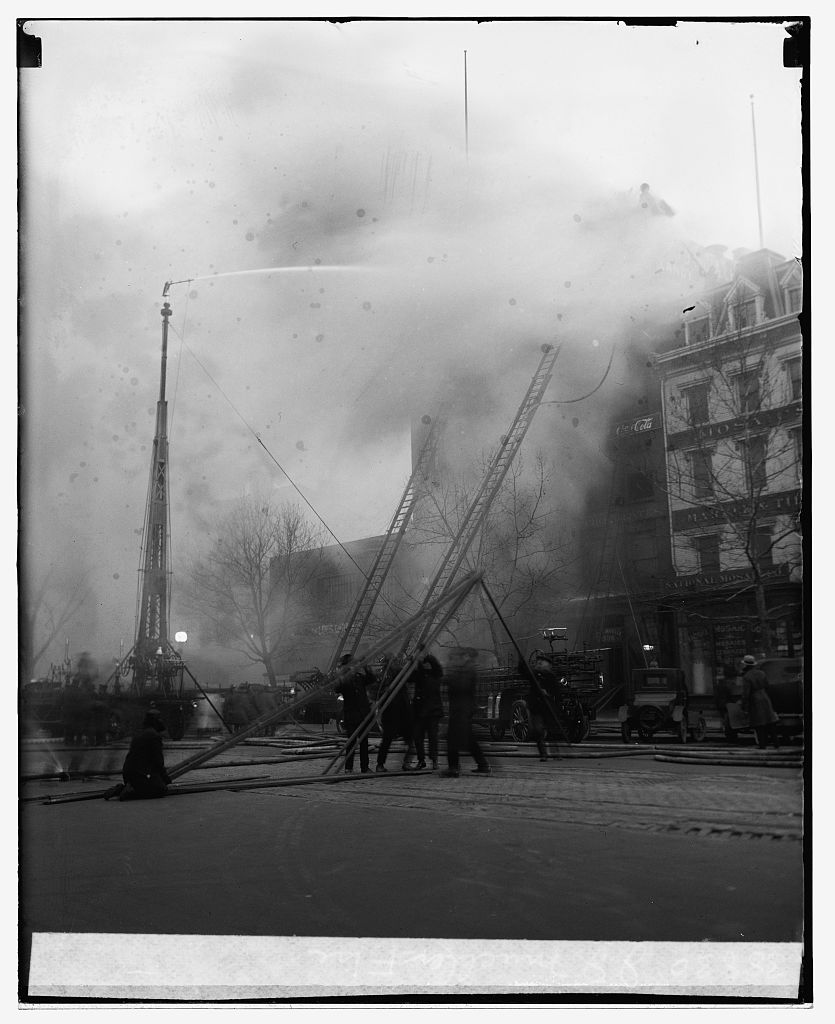
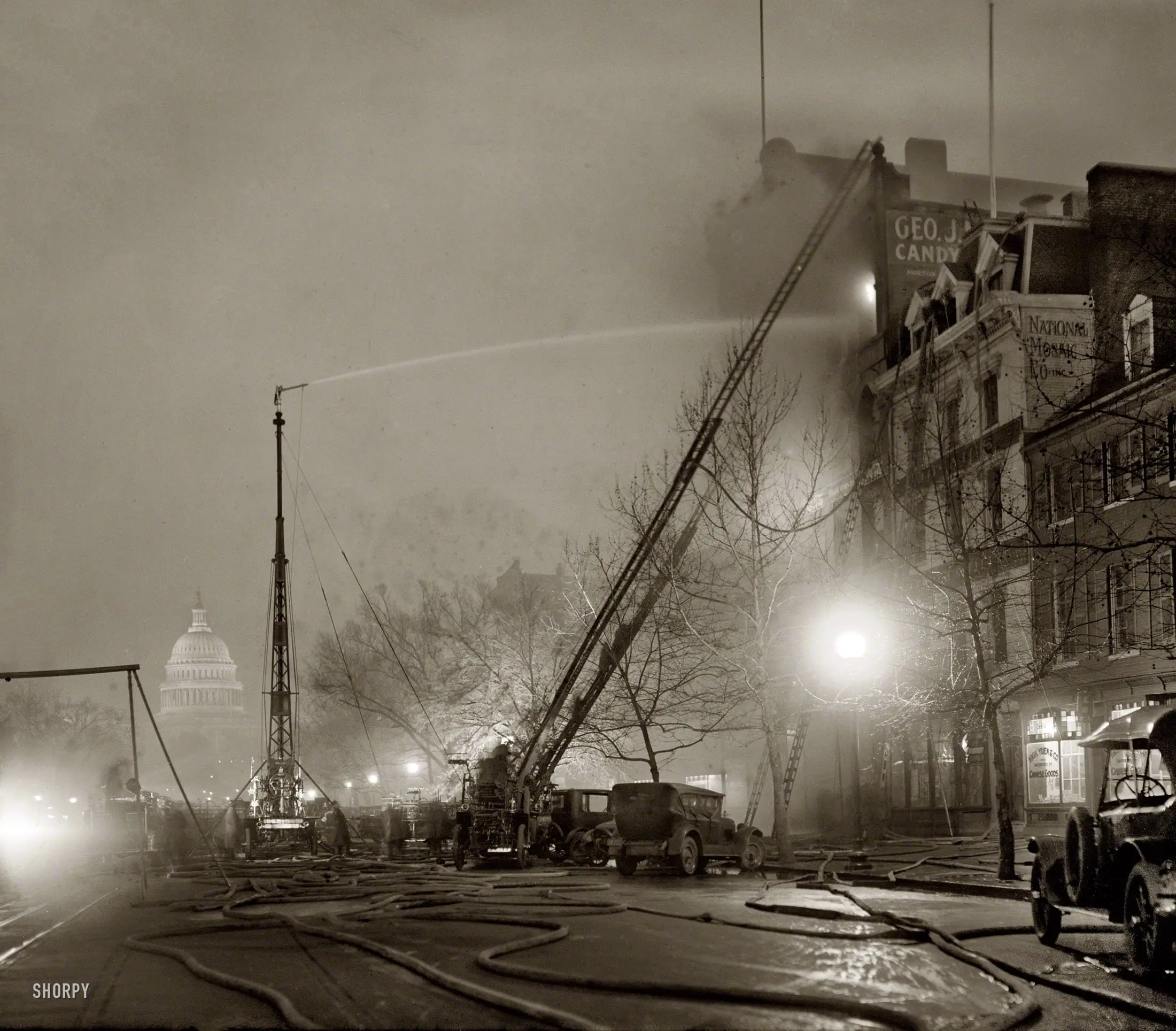
And almost all of it is right there in the photographs. There it is at the left, throwing its stream into the smoke. A long ladder leans hard against a tree, the very one Chief Watson ordered his men down from before it could buckle.
At the right is the National Mosaic Co. store, one of the neighbors that came out soaked. And in the wider view below, the smoke really does roll east toward the Capitol, exactly as the Post described it.
A few details in that report stick with you. The candy stock was nearly gone, cleaned out by Christmas sales, so the flames mostly tore through an empty building. Good timing, if any of it could be called good.
And it was not even the Muellers’ first fire. The last one, the Post noted, was started by a tramp who had fallen asleep in the stable.
That detail about Chinatown is easy to skim past, but it matters. This block of Pennsylvania Avenue was the city’s original Chinatown, a cluster of buildings on the south side of the avenue between 3rd and 4½ Streets.
The rooming houses, stores, and cafes whose residents watched the Mueller fire through their windows were the heart of that community. It did not survive the decade. In 1931 the neighborhood was pushed off the avenue to clear the way for the Federal Triangle, and the community resettled around 7th and H Streets NW, where Chinatown stands today.
Stand at the old Mueller address now and you are looking at the East Building of the National Gallery of Art.
Pennsylvania Avenue has never been short on drama. Farther up the avenue toward the White House, the Southern Railway Building at 13th Street was being bought out by the federal government around this same time, soon torn down for that same Federal Triangle.
And four years later, a few blocks north on 7th Street, the McCrory five-and-dime saw a far deadlier disaster. A boiler explosion killed six people and lifted the sidewalk forty feet into the air.
Originally my attention was caught the the National Mosaic signage but when I looked closely there is a street level store -High Yuen & Co importers in Chinese goods which really intrigued me. It was still listed in the 1927 directory at 340 Penn NW. I saw a 1907 advertisement where they were at 352 Penn NW and were selling fireworks. But even more cool are two articles.
The first is from 1909 that mentions how Lee King, Lee Lan, and Lai Yuen of 325 Penn NW were arrested for some sort of gambling ring. It seems to involve using the mail so the postal inspector was somehow involved.
http://chroniclingamerica.loc.gov/lccn/sn84026749/1909-07-03/ed-1/seq-2/
The second was from 911 and talks and opium raids. The company (then at 318 Penn NW) and a Kim Lai Yuen (at 325 Penn) seem to have been among the places raided. They seems to have sized a lot as well as discovering quite a few opium smokers were discovered. I never thought of the old DC in that way but we did have a Chinatown.
http://chroniclingamerica.loc.gov/lccn/sn83045433/1911-10-08/ed-1/seq-2/
It’s on the block where the East Building of the Nat’l Gallery of Art now stands. I drove by its former location this evening. If it wasn’t for the 1920s Dodges in the pix, I’d think I was looking at something on Capitol Hill.
It’s always amazing how much of the old DC still is here, and how much has been lost.