
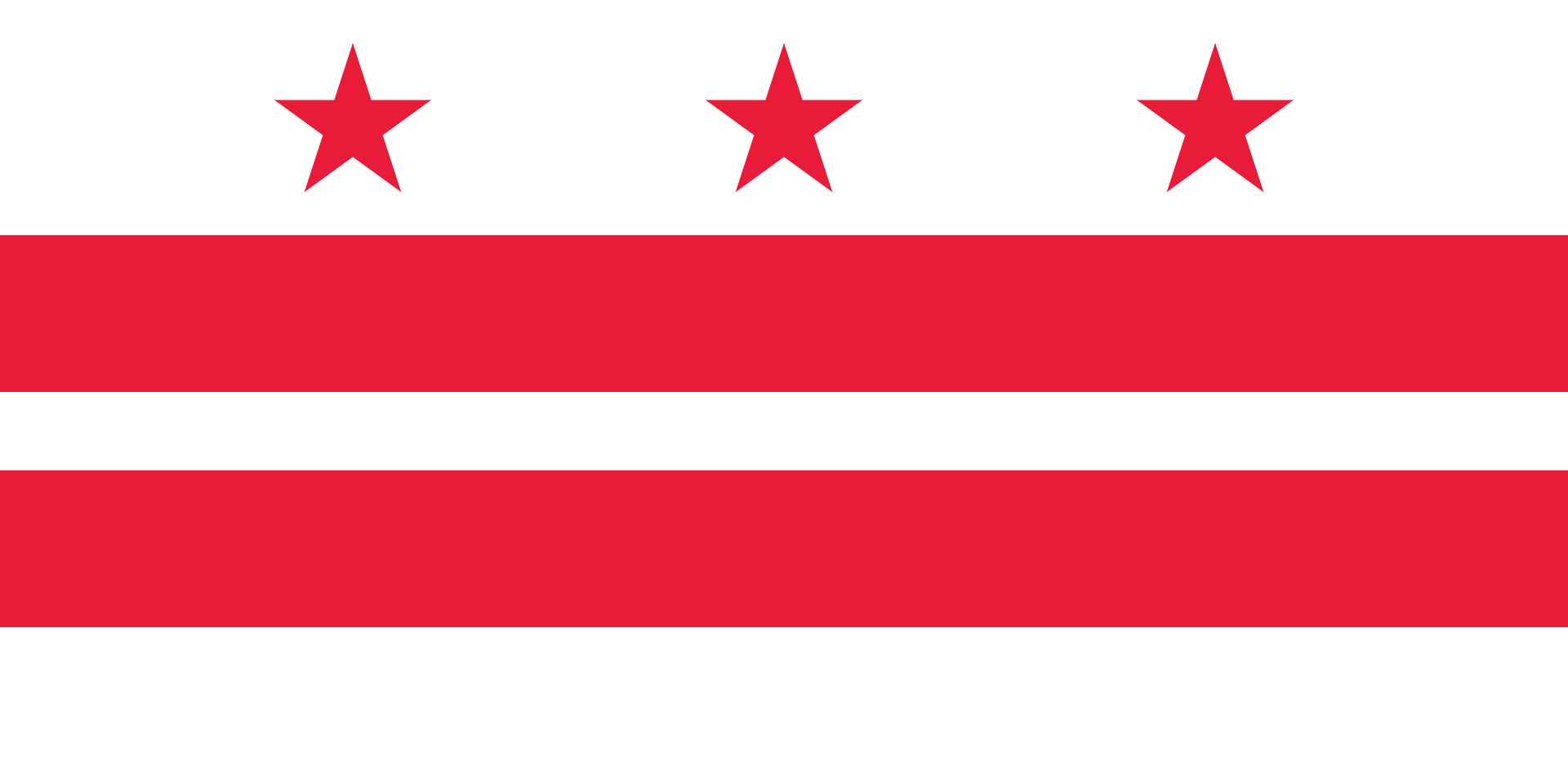
Here’s the short answer, because it’s probably what you came for. The three red stars and two red bars on the Washington, D.C. flag are not a code for the three branches of government, or the three District commissioners, or the three hills of the city, or anything else you may have been told. They were lifted, almost without a single change, straight from the coat of arms of George Washington’s family. That’s the entire design. A roughly 600-year-old English family shield, flying over the nation’s capital.
So when people ask what the three stars on the DC flag mean, it’s almost a trick question. Officially, they don’t mean anything beyond being the stars on Washington’s arms. Every neat little explanation you’ve heard got attached later. And one of the most popular versions isn’t just unproven, it’s flat-out impossible. We’ll get to that.
What the stars and bars actually mean (and the myth that can’t be true)
Let’s clear the folklore first, because there’s a lot of it.
You’ll often read that the three stars stand for the three commissioners who once governed the District. Authoritative sources, including Britannica, call that out plainly: there is no historical substantiation for it. Same goes for the charming idea that Washington’s family arms inspired the Stars and Stripes. Lovely story, no evidence.
Then there’s the version you hear most often around town: that the three stars represent the District’s three original communities. Sometimes that’s listed as Washington City, Georgetown, and Washington County, which at least describes the real jurisdictions that made up the early District. But the version that gets repeated most, the one naming Washington, Georgetown, and Alexandria, can’t possibly be right. Alexandria was handed back to Virginia in 1846, almost a full century before this flag existed. By the time anyone designed a District flag, Alexandria had not been part of D.C. for 92 years. (We told that whole strange story in our piece on the retrocession of Alexandria back to Virginia.)
So what do they mean? Honestly, nothing more than this: the designer copied George Washington’s coat of arms onto a flag, and the arms already had two bars and three stars. The meaning isn’t hidden. It’s just heraldry, and it points at one man.
Wait, does Washington, D.C. even have its own flag?
It does, and here’s the part that surprises people: it’s young. Really young. The District went without an official flag until 1938. For most of its history, the capital of the United States had no banner of its own.
That bothered a lot of locals, and not only for decorative reasons. A flag was tangled up with the bigger, older grievance that still defines the city: no self-government, no vote in Congress, no taxation without representation. One of the loudest voices was Madalin Dingle Leetch, who chaired the Correct Use of the Flag Committee for the D.C. Daughters of the American Revolution. In a January 1938 letter to the Washington Post, she made the case with some bite.
The District should have self-government, should be enfranchised, and some have resented the idea of having a flag before getting a vote. In this connection we recall the fact that George Washington did not think it was necessary to wait until after the battle of Yorktown before adopting the Stars and Stripes as our national banner.
The propriety of the District’s having a flag cannot be questioned… The District alone in the United States and its dependencies, and between 30 and 40 large cities, is without a distinguishing banner. We especially urge that all those civic-minded citizens who are laboring so hard to secure the vote for the District, join forces with us.
She got her flag later that year. The vote, as you know, is still a work in progress.
A 12th-century shield over a 20th-century city
The design the District chose reaches back astonishingly far. Heralds describe the Washington family arms in their own clipped language: argent two bars gules, in chief three mullets of the second. Translated, that’s a white shield, two horizontal red bars, and three red stars across the top. The exact same arrangement on the flag flying today.
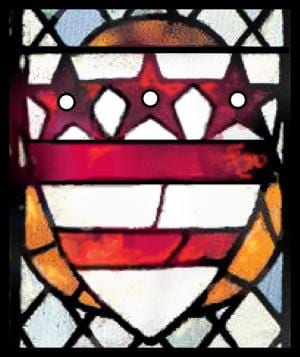
This design is genuinely medieval. It survives in 14th-century stained glass at Selby Abbey in North Yorkshire, and it’s carved above the entrance at Sulgrave Manor in Northamptonshire, the Washington family home built by Robert Washington in the 1540s. The specific version that became the D.C. flag was granted to Lawrence Washington of Sulgrave in 1592. Two of Lawrence’s grandsons later sailed for Virginia, and generations after that, the family produced a first President. So the shield was old, English, and aristocratic long before it had anything to do with a city on the Potomac.
The 14-year fight to actually fly it
Credit for the design goes to a printer named Charles A. R. Dunn. While working in the Mills Building in 1921, he sketched a District flag by copying the Washington arms exactly, no changes, then sat on it. In February 1924 he submitted his drawings to the Evening Star, which published them that March.
It went nowhere. Not everyone even wanted a District flag. The Southeast Citizens’ Association passed a resolution against the whole idea, arguing the only flag the District should fly was the Stars and Stripes. Others turned the fight into theater. At a 1924 gathering, a satirical “District flag” was unveiled to roars of laughter: a goat on a field of yellow, with a pair of handcuffs in one corner for a coat of arms. The handcuffs, the presenter explained, stood for the freedom enjoyed by the District. The yellow stood for the lemon Washington kept getting handed under its system of government.
It took until 1938 for Congress to act. By an act of June 16, 1938, it created a District Flag Commission, which threw the design open to a public contest and drew roughly 50 entries. The field narrowed to two: Dunn’s Washington-arms flag, and a busier design from a local D.A.R. chapter. On October 15, 1938, the Evening Star announced the winner. The commission had chosen the arms of George Washington, honoring, in its words, “the major elements of the emblem features of the family shield of the first President.”
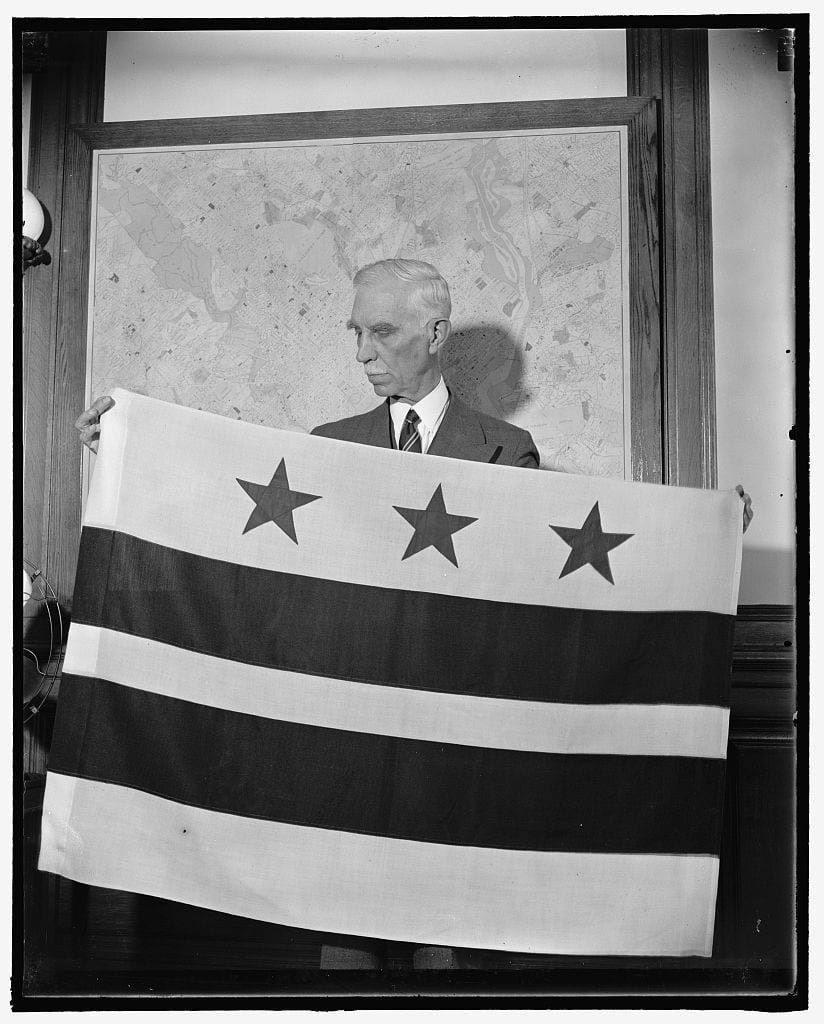
Commissioner Melvin C. Hazen, a former District surveyor, said he’d recalled seeing Washington’s coat of arms on a shield on old maps of the city. Sure enough, research turned up a 1792 map by Andrew Ellicott carrying the same heraldry. The flag flew for the first time on October 23, 1938.
From rejected to absolutely everywhere
Here’s the twist nobody in 1938 saw coming. The flag was, at first, kind of a flop. A federally appointed commission had picked it with almost no input from actual Washingtonians, and plenty of residents resented that. Some pointedly invented their own grim meanings for the stars and bars. Then the flag mostly sat there, barely used, for about 20 years.
What changed is that the city fell in love with it. In a 2004 North American Vexillological Association survey, the D.C. flag was ranked the best of 150 American city flags. (Pocatello, Idaho came in dead last, a result so brutal the city eventually redesigned.) Vexillologists love it for the same reason it works as a tattoo: it’s clean, bold, instantly recognizable, and a kid could draw it from memory.
And draw it they do. The flag is now genuinely inescapable in Washington. It’s a staple tattoo among natives. It anchors the logos of local businesses, from DC Brau to the city’s Made in DC program. Most of all, it became the banner of the long fight over the District’s status and self-government. A flag once imposed by federal appointees with no vote of their own is now the symbol Washingtonians wave while demanding exactly that vote. Madalin Dingle Leetch would have appreciated the irony.
So the next time someone confidently tells you the three stars stand for the three branches of government, you can set them straight. It’s George Washington’s family shield, medieval English heraldry, hung over the capital named for him. Somehow that’s a better story than any of the myths.
why three stars? anybody?
That’s the number of people being investigated on the DC City Council.
Funny how the article doesn’t mention this, given how it took the stained-glass window photo from this link, but the whole design itself is the Washington Family Coat of Arms.
https://en.wikipedia.org/wiki/Coat_of_arms_of_George_Washington