

On Saturday night, March 1, 1919, a Washington policewoman went to a public dance “all dolled up.”
At that dance she picked up a tip about an apartment in the Woodford, an apartment house at 506 3rd Street NW near Judiciary Square, according to the Evening Star. Early the next morning, police raided the apartment, and one of the raiders whispered a password at the door.
How great is that? She was one of the women of the police department’s Woman’s Bureau, and the Star’s story about that weekend is one of the best snapshots we’ve found of what they actually did.

A Tip From the Dance Floor
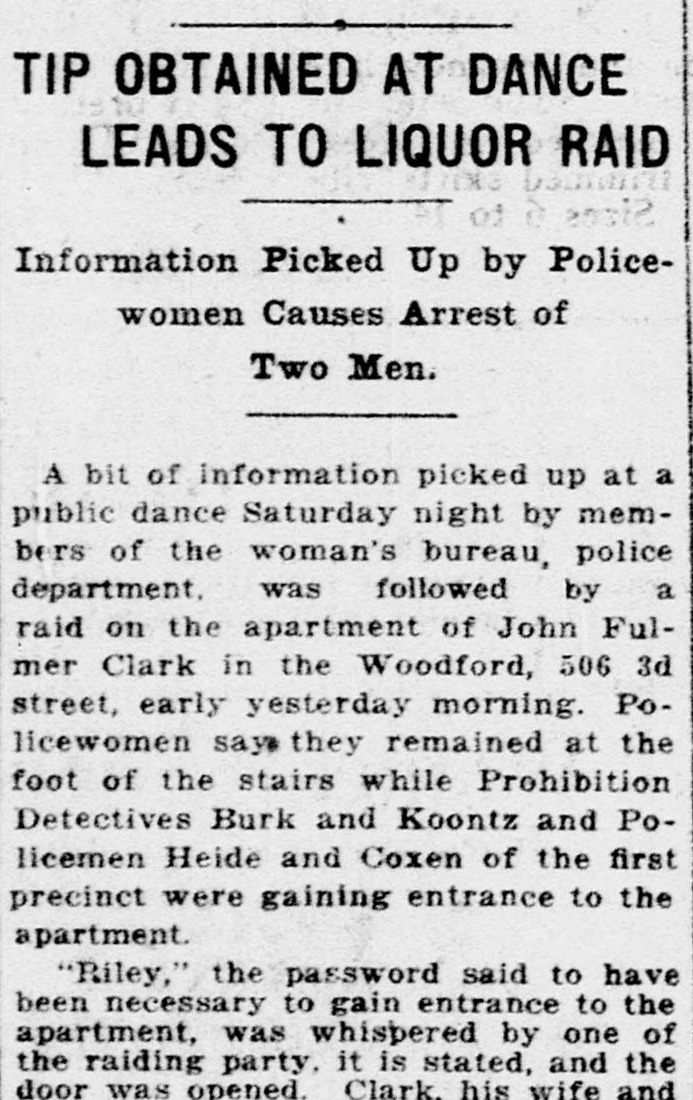
The Star ran the story on Monday, March 3, 1919, on page 4. Here’s how it opened:
A bit of information picked up at a public dance Saturday night by members of the woman’s bureau, police department, was followed by a raid on the apartment of John Fulmer Clark in the Woodford, 506 3d street, early yesterday morning.
The Star credits the tip to members of the bureau as a group. The best detail in the story, though, is about the one who went to the dance and then wasn’t there for the raid:
It was planned for three policewomen to participate in the raid, but the one who had gone to the dance “all dolled up” and obtained the information which resulted in the raid failed to materialize, having been summoned to Alexandria to conduct another investigation.
So she went to the dance and came away with the information, and then she got called to Alexandria on another investigation and missed the raid. The Star never printed her name, which is a shame.
The Password Was “Riley”
Early Sunday, March 2, 1919, the raiding party went up to Clark’s apartment. So two policewomen went along, not three, and by their own account they “remained at the foot of the stairs” while four men went in. They were Prohibition detectives Burk and Koontz and officers Heide and Coxen of the First Precinct.
Getting in took a password:
“Riley,” the password said to have been necessary to gain entrance to the apartment, was whispered by one of the raiding party, it is stated, and the door was opened.
Riley! It sounds like something out of a movie.
Inside were Clark, his wife and four other women. According to the police, a man who was also in the apartment climbed to the fire escape and made it to the ground, and he was never caught.
The raiders said they never drew their pistols, and the two policewomen said they “were not even armed.” Police carried off 17 quarts and four pints of whiskey and four quarts of wine.
Clark and Luther Robinson, a roomer, were arrested, and both men were charged with selling liquor. According to police, Robinson admitted he sold liquor to Clark, though the Star doesn’t say who Clark was accused of selling to.
Bond of $1,500 was posted for the two men to appear in Police Court. The women visiting the apartment were questioned as witnesses, and they denied drinking anything at all.
To be clear about who did what, the four men went through the door while the policewomen waited below. The women’s part was the tip, which is exactly what the Star led with: “a bit of information picked up at a public dance.”
Wait, a Liquor Raid in 1919?
You might wonder why police were raiding a Washington apartment for whiskey in early 1919. The answer is that Washington was already under prohibition.
On Nov. 1, 1917, the Star reported that the Sheppard prohibition law was in operation in the city, though it said the capital was not “bone dry,” since personal use was still allowed. That put the Woodford raid about 16 months into dry Washington, and selling liquor was the charge.
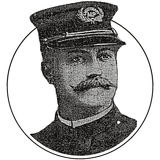
A nod to our own man in uniform. The policeman in the Ghosts of DC logo is Lt. Joshua L. Sprinkle, who joined the force in 1890. In 1892 he hauled a crowd of brawlers into the First Precinct station, the same precinct whose men went up the Woodford stairs.
Even Sprinkle got tangled up in Prohibition. He was charged in a 1923 liquor conspiracy case, which was dismissed in 1925.

Mina Van Winkle Builds a Bureau
The woman behind the Woman’s Bureau was Mina C. Van Winkle. In the Star’s words, she “was appointed as a private on October 7, 1918,” when she joined the Metropolitan Police Department.
That same year, as our post on a 1918 police recruiting ad notes, the department left the door open to a limited number of educated women.
The Star later called her “the first policewoman appointed in the District” and said she built the bureau largely through her own efforts. Her obituary said she came to Washington in 1918 to organize and direct it, and that the bureau was created while Maj. Raymond W. Pullman was superintendent of police.
She wasn’t new to public work, either. According to that same obituary, she had lived in Newark, New Jersey, where she headed a girls’ home and led the Women’s Political Union of New Jersey. The obituary added that during the war she ran the Speakers’ Bureau of the Federal Food Administration.

She moved up fast. According to the Star, Van Winkle made sergeant on Feb. 16, 1919, and lieutenant on June 9, 1920.
Even the unit’s name was still settling in those first months. In February 1919 the Star called it the “woman’s investigating section” of the police department, and by the March raid story it was the “woman’s bureau.”
That February item had Van Winkle and a fellow member, Mrs. Ophelia A. Clark, testifying for the prosecution at a Juvenile Court hearing. The paper called it the Greer bakery orphan case, and former residents of the Greer home testified too. (Ophelia Clark isn’t known to be related to the Woodford’s John Fulmer Clark.)
Dance Halls, Runaways and the House of Detention
So what did these women do all day? The police manual laid out the bureau’s job, as the Star summarized it, and it started with all delinquent children under 17, plus lost children and runaways.
Dance halls were on the list, too. The bureau was also supposed:
to make special investigations of neighborhood conditions, restaurants, hotel, rooming houses, public dance halls and other places of amusement, and assist the various police precincts in the prevention and detection of crime.

The bureau also ran the House of Detention, where women and children held by the police were housed. Van Winkle’s obituary in the Star measured her work with a number. Every year, it said, the department was called on to deal with more than 3,000 cases, though the paper didn’t make clear whether it meant the bureau or the whole police force.
Van Winkle turns up in another story of ours, about a girl’s abduction case. Delinquent kids and runaways were the bureau’s daily work, the same world as the reform school for girls that once stood on the Sibley Hospital site.
First Aid, and a Fight for Funding
The policewomen trained, too. Around January 1927, Lt. Van Winkle and officers of her bureau earned American Red Cross first aid brassards (armbands) after a course with instructor W.E. Longfellow.

Keeping the bureau alive was a fight. Her obituary said that nearly every year someone in Congress tried to cut off the bureau’s money, and that she fought back persistently to have it made permanent by law. As the obituary put it, the bureau was a creation of the District Commissioners that could be “wiped out by their order.”
She had also been president of the International Association of Policewomen, according to the obituary.
What Became of Mina Van Winkle
Illness caught up with her. On Jan. 29, 1932, the District Commissioners retired Lt. Van Winkle for physical disability, with a pension of $127.08 a month.
Sgt. Rhoda J. Milliken succeeded her as head of the bureau, according to the Star. The Star reported that Mina C. Van Winkle died at her home on Jan. 16, 1933, after more than a year of illness, and it gave her age as 52.
The Woodford itself is easy to place: a 1924 Star classified ad lists it at 506 3rd Street NW. The policewoman who went to the dance “all dolled up” stays a mystery, too … but thanks to the Star, we know the bureau’s tip came straight off a dance floor.
Lost Washington stories, in your inbox.
The newest story, plus a few from the archive.
Free. Unsubscribe anytime.
AI helped research and write this story. Here’s how we use AI.Suggest a correction