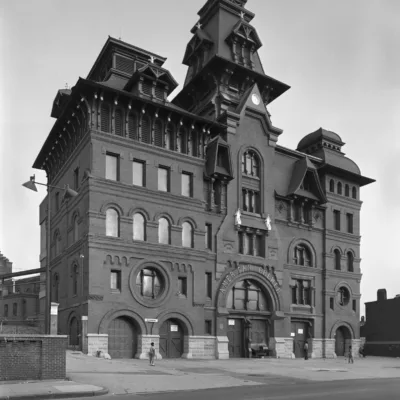

On the morning of March 8, 1928, the men of the Third Precinct were standing at roll call, just before 8 o’clock, listening to Capt. Ira Sheetz read the orders. Then the door opened and in walked Rep. Thomas L. Blanton of Texas, who asked the captain to call the men to attention because he had something to say.
Nobody had invited him, and nobody knew he was coming. Blanton pulled out a list of alleged bootleggers’ addresses and read the policemen every one that sat in their precinct. Their precinct had more addresses on his list than any other, he told them, and it was all up to Capt. Sheetz and his men.
He also let them know he could tell by looking at a man whether he was telling the truth. Then, as the Evening Star put it, “he departed as suddenly as he had come. There was no applause.”
You don’t often see a congressman barge into a station house to lecture the cops about their own beat. And this congressman had a history.
1921: The Congressman the House Nearly Expelled
In October 1921, Blanton used the Congressional Record in his fight against the printers’ union. He printed a sworn letter from Millard French, a non-union printer at the Government Printing Office, recounting a quarrel with a union printer named Levi Huber.
Blanton dashed out the worst of it himself. But as the Evening Star put it, the letter “contained many foul and indecent words and phrases, represented mostly by dashes, but with enough letters left in so as to make perfectly clear the words intended.”
The Republican leader, Rep. Franklin W. Mondell, told the House:
We can say no more of the words printed than that they are unspeakable, vile, foul, filthy, profane, blasphemous and obscene.
The House voted 314 to 1 to strike the whole speech from the Record. The one vote against was Blanton’s. Copies of the original went for as much as $5, the New York Times reported, and the reprinted edition left the letter out.
On Oct. 27, 1921, the House fell eight votes short of the two-thirds it needed to expel him. It censured him instead, 293 to 0, and Speaker Frederick H. Gillett pronounced the censure to his face.
Then, according to the Washington Herald, Blanton walked into the anteroom and fainted. When he came to, he burst into tears and let himself be led out of the Capitol.

He was the only member of the House censured between 1890 and 1979. Texas reelected him anyway.
A “Regular Saloon” at East Capitol and Fifth

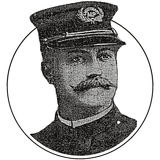
Back to 1928. Five days before the roll call, on Saturday, March 3, Blanton stood up in the House and said that Maj. Edwin B. Hesse, the superintendent of police, had been drinking in a “regular saloon.” He even named the place:
There has been brought to our attention by some of the substantial leading citizens of this District, that out there on the northeast corner of East Capitol street and Fifth street, at what is known as Simms’ Delicatessen, there is a regular saloon; and that your superintendent of police has been there at night many times to drink.
Did the superintendent of police really drink at a delicatessen on Capitol Hill? That was Blanton’s allegation, and the District Commissioners, the three appointed officials who ran DC, later cleared Hesse. But Blanton also told the House exactly how he would run the force:
If you put me in charge of enforcement of the law in this District, I would tell every one of the 1,348 policemen, ‘I am going to hold you responsible for what goes on on your beat, and if you let a single thing go on there that is against the law, I am going to have you put off the force.’
He named four “open saloons” in the Third Precinct. One, at 2035 K Street NW, sat right across from the station house, he said, “where officers in the police station can look across and see what is going on.” Five days later he walked into that station house.
The block had a history, too. On a Sanborn insurance map corrected to 1916, the building at 2010 K Street, two doors from the station, is marked “Sal.” for saloon, from the days before Prohibition.

The Hijacked Liquor Truck
The same Saturday as the speech, a House subcommittee investigating the police heard something worse. A bondsman, Joseph P. McGee, admitted that three bootleggers had met with Policeman Edward M. Taylor in McGee’s office to get back $3,000 worth of liquor Taylor was accused of stealing from their truck. It’s the same trade you’ll find in the story of another Washington rum runner.
Washington, McGee told the subcommittee, had “the crookedest police force in the United States, and that is taking in a lot of territory.”


The three bootleggers were arrested within the hour for conspiring to violate the Prohibition law. Taylor, a motorcycle policeman, had already been suspended, and he denied any part in it. If a policeman could be accused of robbing bootleggers, what was the rest of the force doing?
Hesse said he would welcome an investigation “by any unbiased body of men.” On March 14, 1928, he faced Blanton in the caucus room of the House Office Building and, the Evening Star reported, denied having “drinking habits” or going easy on gamblers and bootleggers. Gambling raids were their own kind of police drama, like the one on a gamblers’ den on E Street.
The Cop Who Sought a Former Commissioner’s Arrest
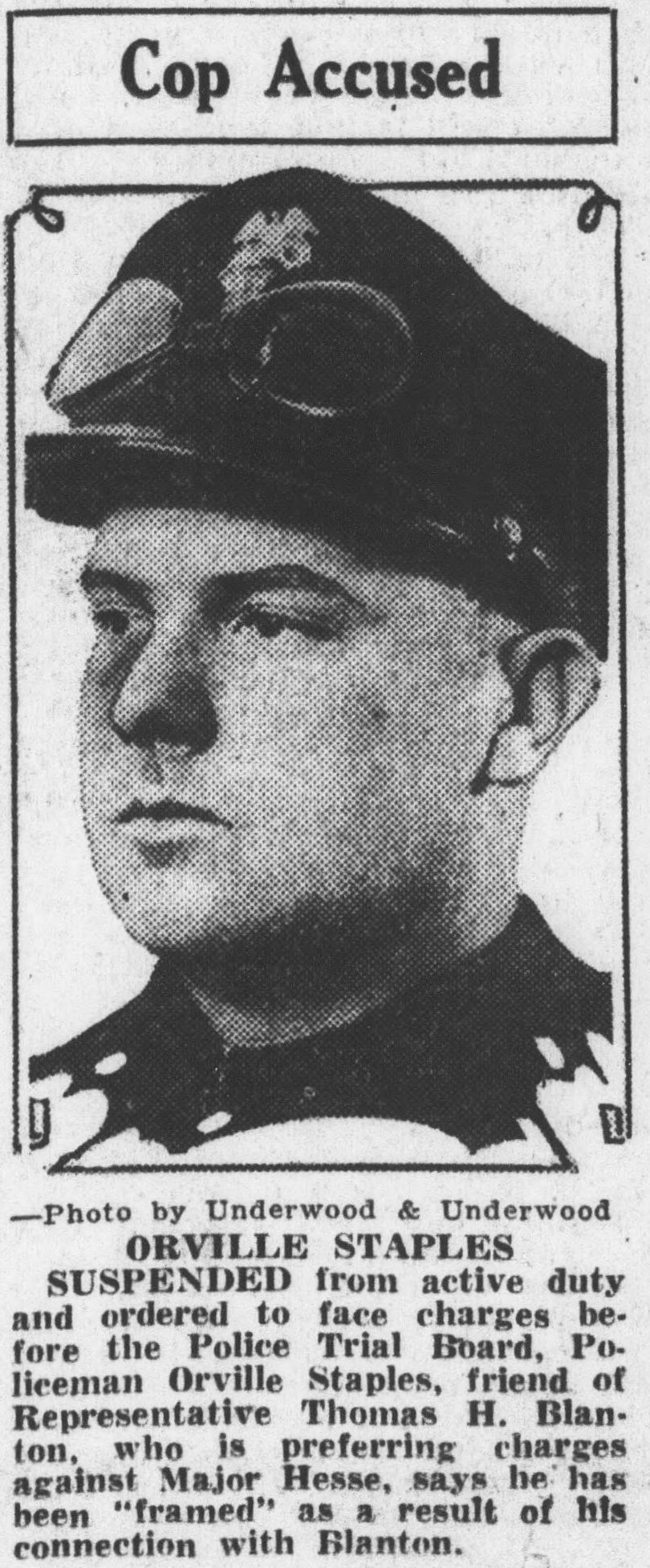
While Blanton was attacking him in the House and before the subcommittee, Maj. Hesse filed charges against a Third Precinct policeman named Orville Staples.
Staples wasn’t a stranger to Blanton, or to the newspapers. Back in 1926, he had gone after a much bigger name than any bootlegger.

According to the Washington Times on Aug. 9, 1926, Staples swore out a warrant for the arrest of former Commissioner Frederick A. Fenning, out of office by that August. The complaint said Fenning’s Packard had jammed another car into a parking space outside 1800 K Street NW so tightly it couldn’t be moved, and that it was blocking a driveway.
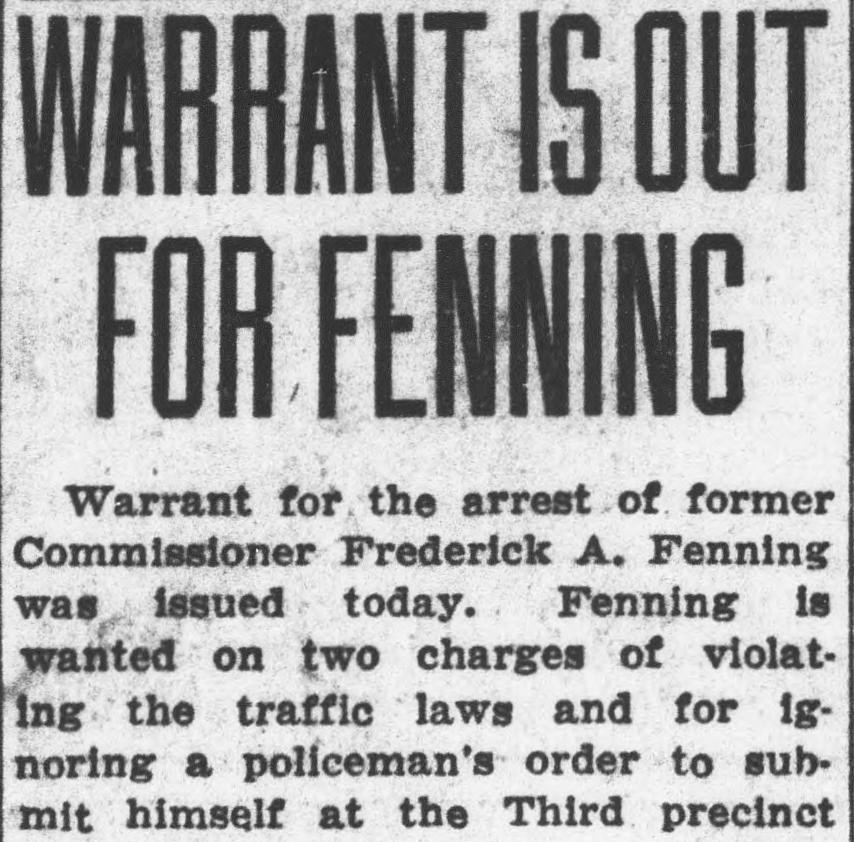
Fenning said he wasn’t the one who left it that way. On Aug. 26, 1926, the Evening Star reported, the prosecutor dropped the case, citing Fenning’s “reputation and standing in the community.”
So much for that.
In October 1926, Blanton turned up before the Police Trial Board, the department’s disciplinary board, to defend Staples on a charge of “nonpayment of a just debt.” By November 1927, Staples was calling the congressman “our very good friend,” according to the Washington Times. And when the department suspended him in March 1928, the Times noted that he was frequently referred to as “Blanton’s pet.”
Blanton for the Defense
Was Staples feeding Blanton information about his fellow officers? Blanton said the department thought so, and that was why the charges came. So he took on Staples’ defense himself.

Staples faced charges of taking bribes, selling beer, hijacking liquor and improper conduct with women. The Police Trial Board heard the case from March 26 to April 5, 1928, in a room at the Sixth Precinct station that was packed with spectators.
Blanton accused Policemen Joseph Hunt and Frederick Schenck of the Third Precinct of combing the underworld for evidence to “frame” Staples. At one point he told the room a man had threatened his life: “He said, ‘If you do that, Tom Blanton, I’ll kill you.'” The Post’s account doesn’t say who, and Blanton kept going:
But they haven’t killed me yet and I don’t intend to let them, but I’d rather be shot in the back a thousand times from ambush than to permit the prosecution to bring in perjured testimony in an effort to rob this defendant of his good name.
On the last day, the prosecutor, Assistant Corporation Counsel Robert L. Williams, quit. “This has not been a trial, nor a hearing, nor a proceeding,” he said. The whole thing, he told the board, “can not help but leave a stench in the nostrils of every decent citizen.”
When Williams said, “I respectfully ask leave to withdraw,” Blanton shot back, “You had better stay around as I am going to talk about you.” What a scene.
The trial ended on April 5, 1928, and the Post described the finish:
The turbulent ten-day trial of Policeman Orville Staples ended yesterday with Representative Thomas L. Blanton, of Texas, defense counsel, coatless and calling at the top of his leather-lunged voice for “justice” amid the wildest demonstration by spectators ever enacted at a police trial board hearing.
The crowd loved it. According to the Post, the spectators roared their approval and greeted the Texan with an “outburst of hand-clapping and feet stamping that brought a broad grin to the face of the grim-featured Blanton.”
Hesse Cleared, Staples Fired
The trial board wasn’t moved. It cleared Staples of selling “real beer” and hijacking liquor, found him guilty on the rest, and fired him.
On April 13, 1928, the District Commissioners gave Hesse “a complete clean bill of health.” Hesse went straight home to tell his wife, who was ill. Blanton declined to comment.
On May 22, 1928, the Commissioners upheld Staples’ dismissal. They upheld five specifications concerning his conduct toward women and rejected four others, including allegations that he took money from two men.
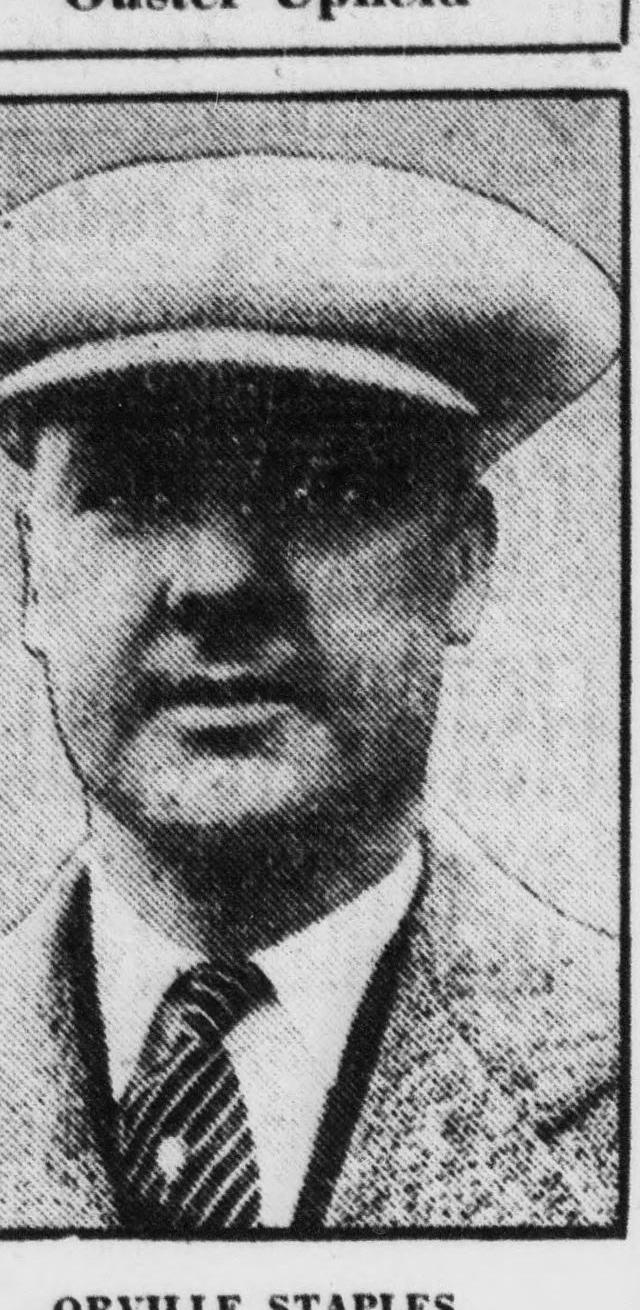
The Post put it simply: Blanton “lost his big fight with the Metropolitan Police Force of the District government.” In its May 23, 1928 edition, the Star reported that Staples “was dropped from the roster of the Metropolitan Police Force today.”
That should have been the end of it.
A Grand Jury Cries Frame-Up
On Sept. 4, 1931, a District of Columbia grand jury turned the whole case upside down. It had acted on an affidavit from former policeman Frederick Schenck, who confessed his part in causing untrue charges against Staples. By then, the Star reported, Schenck was in prison on other charges.
The grand jury reported:
We find that the testimony against Orville Staples, on which he was dismissed from the Metropolitan Police Department, was false in its entirety: that it was perjured testimony by incompetent witnesses.
The jurors blamed Policeman Joseph H. Hunt and Schenck, and recommended that Staples get his job back. Blanton’s bigger charges of corruption at the top, though, they could not substantiate “in any particular.”
It didn’t last. Justice James M. Proctor of the District Supreme Court, DC’s main trial court, ruled that the grand jury had no legal right to file its Staples report and ordered it destroyed. On Oct. 30, 1931, according to the Star, a committee of five lawyers named by the Commissioners found no evidence of a frame-up. So which version was true? The record never really settled it.
What Became of Them
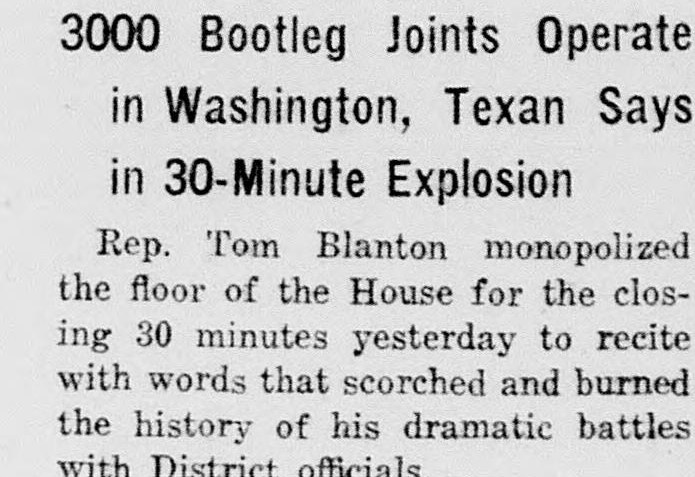
Blanton didn’t run for reelection in 1928. He ran for the U.S. Senate instead and lost the Texas Democratic primary that July, according to an AP report in the Brownsville Herald. He still had the rest of his term, and he used it. On Dec. 11, 1928, the Washington Daily News reported, he took the House floor for its closing 30 minutes and repeated his charge that there were 3,000 bootleg places in Washington and that Hesse should be fired.
He was back in the House by May 1930, after winning a special election in Texas, and promised, the Star said, to stay out of District legislation.
Hesse never did quit under fire. His obituary in the Star says he held his post until Blanton was out of the House. In March 1929 he applied to retire for disability. “I have been going rapidly down hill for the last two years,” he told the Star.
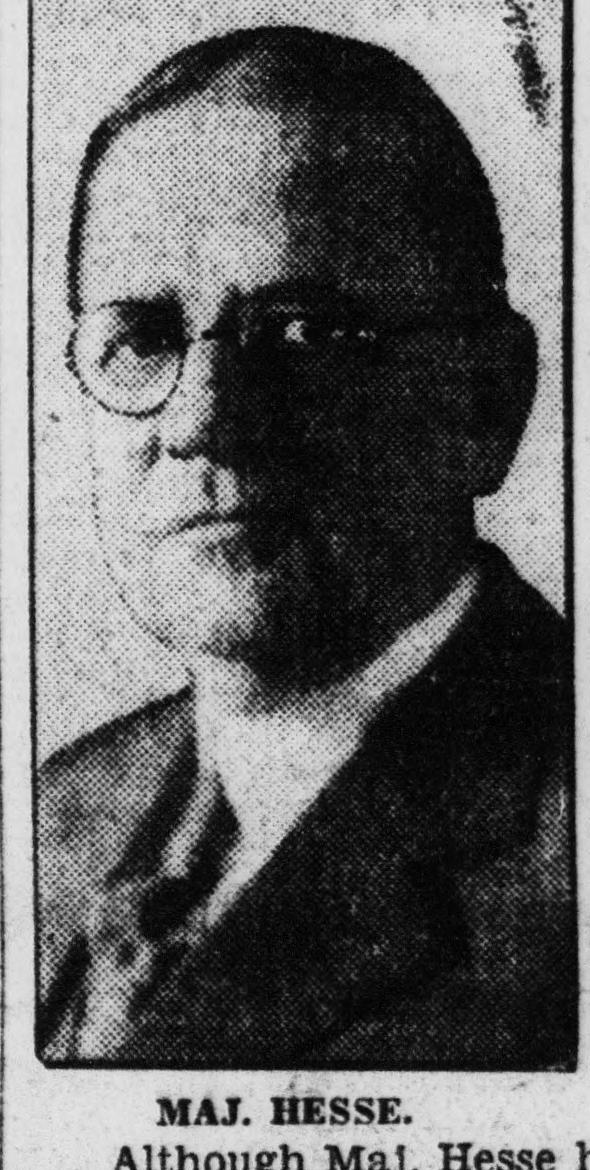
He had spent 35 years with the department, 32 of them as a civilian clerk, and was one of the few men to run it without ever wearing a uniform. A Washington native, he turns up in the 1880 census as a boy living with his parents, John C. and Marie Hesse. He died on Nov. 25, 1936, at his home at 506 A Street SE.
And Staples? According to the Evening Star, he was arrested at his home on Dec. 5, 1933, on a warrant from Middleburg, Virginia, accusing him of breaking into a store and stealing a slot machine.
On Jan. 5, 1934, the Washington Daily News reported, Orville Staples, 32, of 5309 Fifth Street NW, the “stormy petrel” of the police department, was released when Virginia authorities failed to show up to arrange extradition. He told the Star he had been “framed” by a Middleburg businessman.
The release didn’t end the case. The Washington Post reported that a Loudoun County grand jury indicted Staples on Feb. 12, 1934, on a charge of entering a Middleburg lunchroom and stealing a slot machine. I haven’t found the outcome of that charge.
And Blanton? He never let it go. On Feb. 1, 1935, he testified before a special House committee investigating crime in Washington, pushing a bill to replace police trial boards with a board of civilians. He brought up Staples again, according to the Washington Daily News.
“The powers that be kicked him off,” Blanton said. “They persecuted him until he went to the bad.”
By 1935, Staples still hadn’t regained his badge.
Liked this one? Get more tomorrow.
Lost Washington stories in your inbox most mornings: the newest, plus a few from the archive.
 Who Was Mary Dines? The Former Slave and Camp Singer Who Remembered Lincoln’s Tears
 The Nike Missiles of Fairfax County
 Inside The Big Hunt: How a 1928 Dupont Storefront Became DC’s Weirdest Bar
Free. Unsubscribe anytime.
AI assisted with writing and colorized the 1922 liquor-squad photograph. Here’s how we use AI.Suggest a correction