

On April 25, 1921, Albert Einstein visited the White House with a delegation from the National Academy of Sciences. As the group posed before a camera, President Warren Harding told him he didn’t understand his theory. According to the New York Times, he said it with a smile.
Harding wasn’t the only one stumped. The New-York Tribune reported that the reporters at the White House were too shy to interview Einstein, since none of them felt versed enough in relativity. The next day the Evening Star ran an editorial defending the President, because honestly, who did understand it?
Why Einstein Was in Washington
Einstein was in town to attend the National Academy of Sciences meeting, a three-day convention that opened at the New National Museum, today’s National Museum of Natural History, on April 25, 1921.
He had landed in New York on April 2, 1921 aboard the Rotterdam with Chaim Weizmann and a Zionist delegation. In a statement he prepared, Einstein said he had come to help win “the support, both material and moral, of American Jewry for the Hebrew University of Jerusalem.”
On the meeting’s first day, Einstein and Prince Albert I of Monaco were the Academy’s luncheon guests at the Smithsonian Institution. The Star introduced them as “Two distinguished scientists of Europe,” with the prince known for his oceanography.
In the early afternoon, members of the Academy went to the White House to be received by the President, and Einstein went with them. His wife, Elsa Einstein, came along too.

“The President Smilingly Confessed”
The New York Times story started with Congress. Relativity had recently come up in a Senate debate, where Senators Boies Penrose and John Sharp Williams said they didn’t understand it, and now it had “also vanquished President Harding.”
Here’s how the Times told the rest:
Its originator, Dr. Albert Einstein, called on Mr. Harding today with a delegation from the National Academy of Sciences. As the group posed before a camera the President smilingly confessed that he, too, failed to grasp the relativity idea.
I love that they went with vanquished. Here in Washington, the Evening Star ran much the same wording the next day.
You have to give Harding a little credit, though. Plenty of people would have nodded along and pretended.
“Who Is That Relative With Him?”
The New-York Tribune’s Washington Bureau had the most fun with the visit. Its reporter opened the story with this:
[The] tousled-headed man wearing, among other things, a green tie and a scared expression, who narrowly escaped being barred from the White House today as a suspicious character was Professor Einstein.
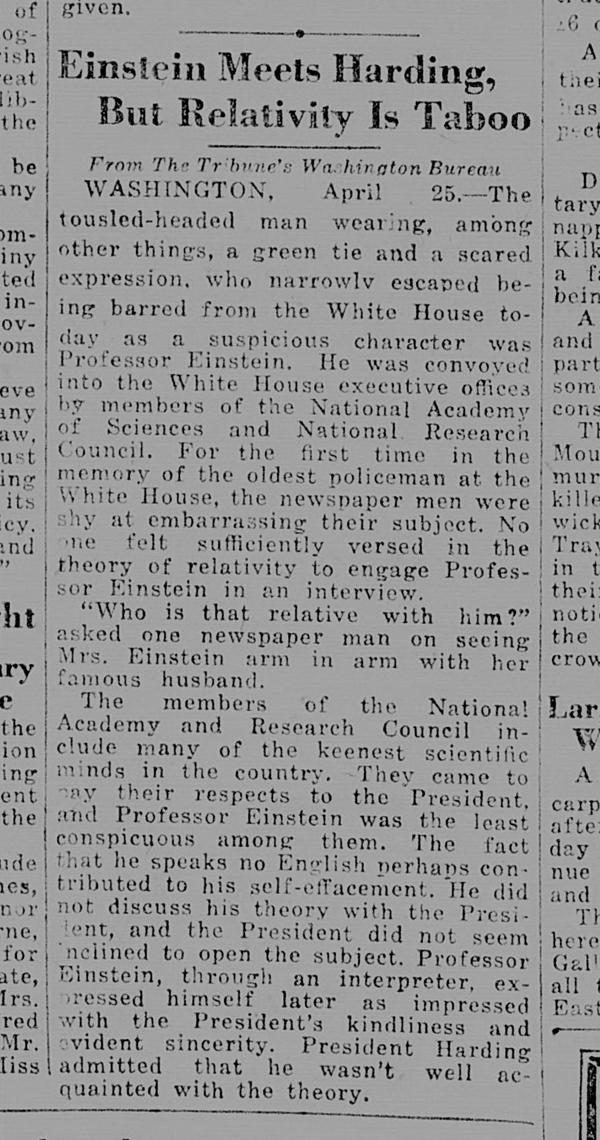
The Tribune doesn’t say who supposedly stopped Einstein or what happened, and none of the other newspaper coverage we found mentions it. Its next sentence has Academy members escorting him inside, so the “suspicious character” line may simply have been the reporter having fun with his appearance.
The same story explains those shy reporters from the top of the post:
For the first time in the memory of the oldest policeman at the White House, the newspaper men were shy at embarrassing their subject. No one felt sufficiently versed in the theory of relativity to engage Professor Einstein in an interview.
Then came the pun. One newspaper man, spotting Elsa Einstein arm in arm with her husband, asked, “Who is that relative with him?”
Groan.
You can see her on his arm in this Harris & Ewing photo, with the State, War and Navy Building behind them.

Through an interpreter, Einstein later said he was impressed by Harding’s “kindliness and evident sincerity,” according to the Tribune.
“Pardonable Ignorance”
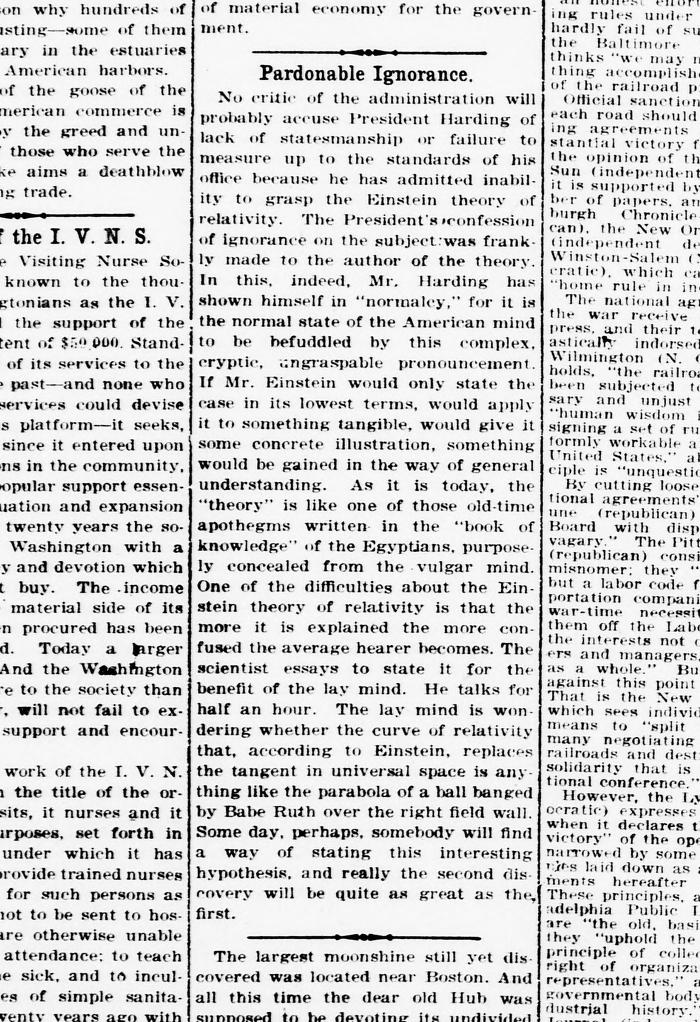
On April 26, 1921, the Evening Star came to the President’s defense with an editorial titled “Pardonable Ignorance.” A day earlier, the Star’s editorial page had already said that relativity was beyond the grasp of the uninitiated. Here’s the best line from the Star’s defense of Harding:
In this, indeed, Mr. Harding has shown himself in “normalcy,” for it is the normal state of the American mind to be befuddled by this complex, cryptic, ungraspable pronouncement.
That “normalcy” is a wink at Harding’s own word: his 1920 campaign was summed up by the phrase “return to normalcy.”
Befuddled … that about covers it. The same editorial said the lay mind was wondering whether Einstein’s curve in universal space was anything like the arc of a ball Babe Ruth banged over the right field wall. The Babe, by the way, has his own White House story.
The Washington Post got in a jab of its own on April 28, 1921, in a one-line paragraph: “For a man who has upset so much, Einstein isn’t a bit set up.”
Einstein Speaks to the Academy
When Einstein addressed the Academy in German on April 26, 1921, he skipped relativity altogether. Instead, he spoke about scientific cooperation after World War I, hoping the world “will soon again be bound together by common work,” according to the Associated Press report in the Washington Post.
The Photos on the White House Grounds
The Library of Congress dates the Harris & Ewing group photo only to 1921, but another photographer caught the same gathering on a print dated April 25. That dates the original group photo below to April 25, 1921.


Elsa’s matching clothes suggest the two photos outside the State, War and Navy Building were taken that day too.
Einstein did come back. According to an Associated Press report in the Evening Star, he and Elsa arrived on the evening of January 24, 1934 to stay overnight at the White House. They were guests of President and Mrs. Franklin Roosevelt. The next day, Roosevelt and Einstein talked about yachts in the President’s office.
Yachts! Something tells me that was an easier conversation than relativity.
Lost Washington stories, in your inbox.
The newest story, plus a few from the archive.
Free. Unsubscribe anytime.
AI helped research, write and edit this story, and colorize the featured photograph. Colors are interpretive; the image caption links to the original black-and-white photograph. Here’s how we use AI.Suggest a correction