

Harry Houdini hung head down in a straitjacket from the Albee Building at 15th and G Streets NW, above a street packed with people. It was around noon on Thursday, Jan. 12, 1922, and he would be free in minutes.
Here’s the part I had no idea about … he’d done it in Washington before. On April 19, 1916, nearly six years earlier, Houdini pulled the same kind of stunt above Pennsylvania Avenue NW.
Houdini’s Week at B. F. Keith’s
Houdini was starring at B. F. Keith’s Theater, whose Jan. 8, 1922, Washington Times ad billed him as “The Justly World-Famous Self-Liberator!” How’s that for a billing?
The ad offered $1,000 to anyone who could prove it was possible to get air while hanging upside down in his water-filled torture cell.
Joe Cook, also on the bill, had a little fun at Houdini’s expense. The Washington Daily News said Cook passed 15th and G Streets NW on Jan. 10 while a safe was being hoisted into the Home Life Insurance Co. offices.
A bystander asked if somebody was in there. “Sure,” replied Cook, “Houdini. And I’ll bet he’s stuck this time.”

Upside Down Over 15th and G
The morning of the stunt, the Washington Herald announced it in pretty dramatic terms.
Hanging in mid-air 110 feet from the ground, bound by professional attendants in a straightjacket, Houdini will today, at 12:30 o’clock, undertake to release himself and jump into a net held by firemen. This is the most hazardous feat that Houdini has ever attempted, and the wizard declares that it actually involves his life, as a single slip of one of his legs would cause his fall to the ground.
A jump into a net held by firemen? That would have been something to see.
The Evening Star’s account says he was lowered to the sidewalk, though, and the Washington Times says nothing about a net.
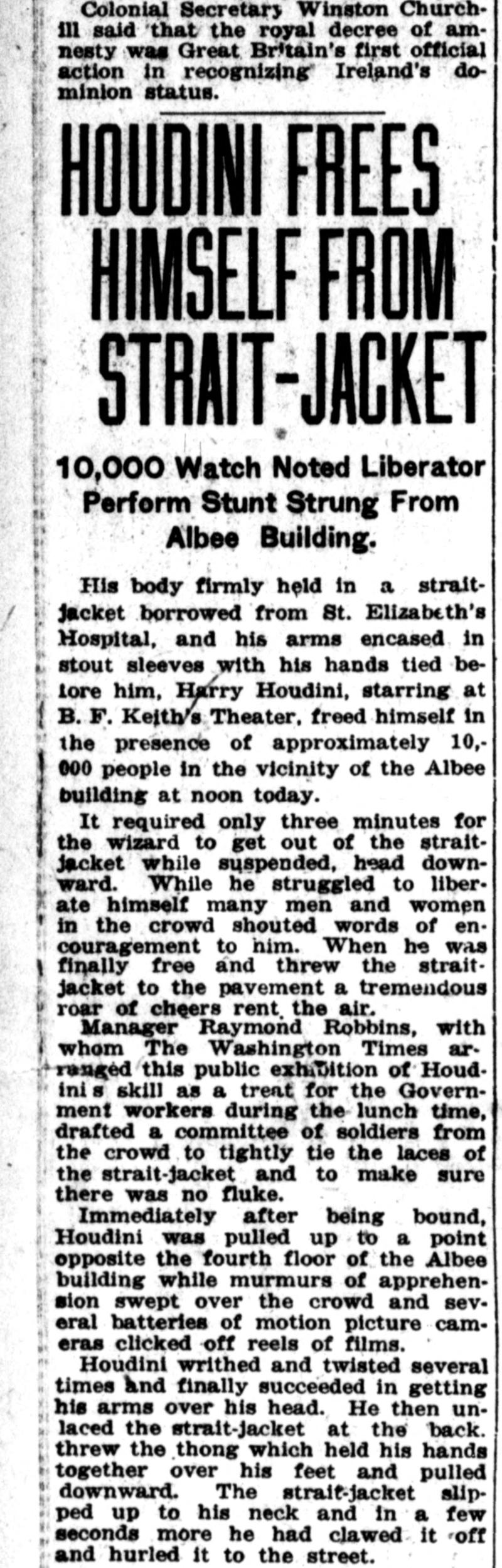
The Times said it arranged the exhibition with Keith’s manager, Roland S. Robbins, as a lunch-hour treat for government workers. It called him Raymond in its report, but the manager was Roland.
Here’s how the Evening Star described the setup:
Houdini removed his coat and collar and then a trio of attendants from the Walter Reed Hospital placed the straitjacket on him. His feet were shackled and fastened to a block and fall, and he was hoisted into the air head downward.
The Times said the jacket came from St. Elizabeths, the psychiatric hospital in Southeast Washington. Robbins recruited soldiers from the crowd to tie its laces tightly and “make sure there was no fluke.”
So how high up was he? The Star said 100 feet, and the Herald had promised 110, but the building itself was only 95 feet to its highest roof.
The Times placed Houdini opposite the fourth floor, roughly halfway up the eight-story building. It described “murmurs of apprehension” sweeping over the crowd. The Star counted a score of cameramen snapping away, and the Times said several batteries of motion picture cameras were rolling film.

Three Minutes, Head Down
The Times described Houdini writhing and twisting until he got his arms over his head, then unlacing the jacket at the back. He threw the thong holding his hands together over his feet and pulled downward.
Here’s the payoff, in the paper’s own words:
The strait-jacket slipped up to his neck and in a few seconds more he had clawed it off and hurled it to the street.
Clawed it off and hurled it to the street … I love that.
Men and women shouted encouragement while he struggled, and when he threw the jacket down, “a tremendous roar of cheers rent the air.” The Times said it took three minutes; the Star gave three and a half.
The Star reported thousands of spectators and police reserves from the First Precinct handling the crowd. The Times estimated 10,000 people, though it had arranged the show itself.
Then He Met the President
In the same Jan. 12 column, the Star reported that Houdini and Mrs. Houdini were introduced to President Harding after a cabinet meeting. Joseph Mitchell Chapple, editor of the National Magazine, made the introduction.
Hanging upside down over a city street and meeting the president, both in the same column of the Evening Star. Not a bad news day.
He’d Done It Before, in 1916
The Washington Times reported the earlier escape, on Wednesday, April 19, 1916, as a hanging: “More than 15,000 persons saw Harry Houdini hanged today in front of The Times building.” Don’t worry, it wasn’t that kind of hanging, since the Times’s own headline had him “Hanging Head Down.”
That day, Houdini and Keith’s manager Robbins needed police help just to get through the crowd outside the Munsey Building, where the Washington Times was published. Police Captain Peck brought Houdini to the platform.
“That’s worse than getting out of a straitjacket,” Houdini said when he reached it. What a line.
Asylum attendants strapped him in, and he was hoisted to the fourth-story windows, according to the Evening Star. The Star’s reporter clearly enjoyed this part:
Upside down, with the blood bulging his temples, the man who has never failed to release himself from a straight-jacket proceeded to show that the one put on him today could hold him no better than any other that has failed to confine him.
He squirmed the jacket up and over his head, dropped it onto the platform and spread his arms “in spread-eagle fashion.” The Star said he was free in a little more than a minute; the Times gave 2 minutes and 30 seconds.
The Times said the cheers could be heard for blocks. Here’s its description of the street:
Pennsylvania avenue and E street, from Thirteenth to Fourteenth streets, were literally jammed. Human beings were packed as tight and close as sardines in a can.
Sardines in a can! The Times put Houdini on its front page beside President Wilson’s ultimatum to Berlin.

If the 1916 crowd was worse than the straitjacket, what did Houdini make of the Times’s 10,000 spectators at 15th and G Streets NW in 1922?
Lost Washington stories, in your inbox.
The newest story, plus a few from the archive.
Free. Unsubscribe anytime.
AI helped research and write this story. Here’s how we use AI.Suggest a correction