
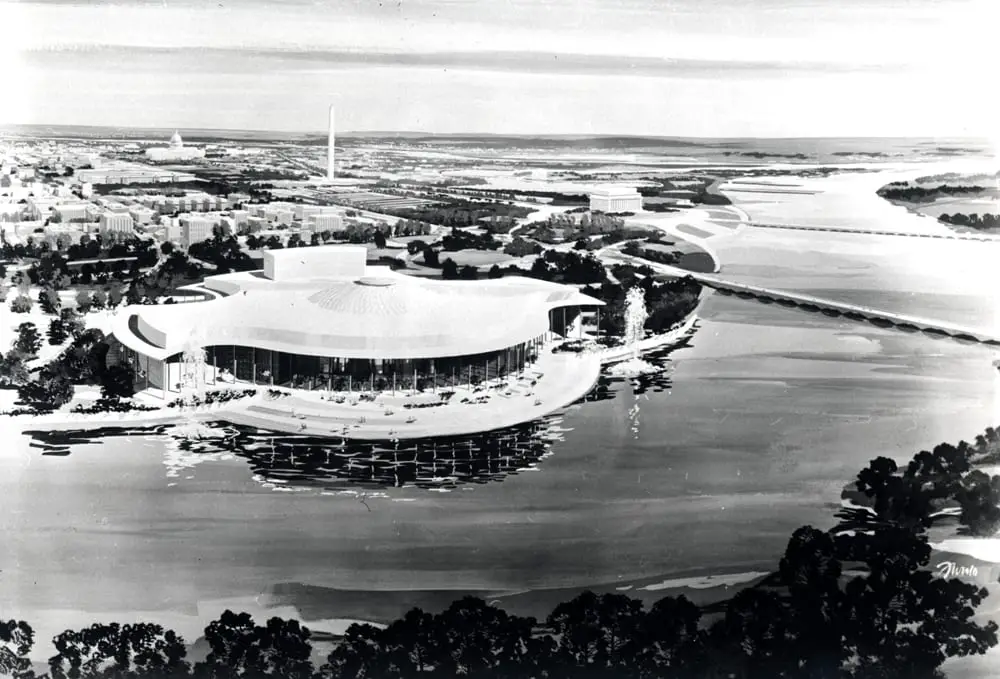
Check out this great find. The Kennedy Center’s history starts with a building that never existed. Before it was a marble box on the Potomac, it was supposed to be a curving, domed clamshell with steps running right down into the river.
Architect Edward Durell Stone drew it in 1959, when the project was still called the National Cultural Center. It never got built, and the reasons why are worth knowing now that the building Stone did get built is closed.
A Cultural Center, 25 Years in the Making
The idea goes back to 1933, when Eleanor Roosevelt discussed ways to create jobs for unemployed actors during the Great Depression.
It took a while. In 1950, Congressman Arthur George Klein of New York introduced a bill to plan and build a cultural center. It included a provision barring discrimination against performers or audiences.
On September 2, 1958, President Eisenhower signed the National Cultural Center Act. The law designated a site in Foggy Bottom near the Potomac, but it came with a catch: the building had to be paid for with private donations, raised within five years.
Edward Durell Stone’s 1959 Design
Stone, fresh off his acclaimed U.S. Embassy in New Delhi, unveiled his design on November 22, 1959.
Everything radiated from a round Grand Salon, 75 feet high under a glass dome. Terraced steps would have reached 180 feet out into the Potomac.
It was also expensive. Stone estimated $61 million to build it, and the full price ran closer to $75 million.
The river was a problem too. The Army Corps of Engineers warned that a terrace jutting into the Potomac could narrow the channel and cause flooding and ice jams upstream. There wasn’t enough land to slide the whole design back from the water.
Fundraising stalled as well. By August 1961 the clamshell was effectively dead, and the board formally retired it that November.
From a Box to a Memorial
In September 1961, President Kennedy brought in Broadway producer Roger L. Stevens to chair the board, with Jacqueline Kennedy and Mamie Eisenhower as honorary co-chairs. Stevens asked Stone for something simpler.
Jacqueline Kennedy unveiled the model of the second design at The Elms in Newport on September 11, 1962. It lined up three performance halls side by side behind a long riverside foyer. It was estimated at $30 million.
That’s essentially the building you know today.
After Kennedy was assassinated, Congress turned the project into his memorial. On January 23, 1964, President Johnson signed the law renaming it the John F. Kennedy Center for the Performing Arts and adding $15.5 million in federal matching funds.
Johnson broke ground on December 2, 1964. The center opened on September 8, 1971, with the premiere of Leonard Bernstein’s Mass.

Next door, the curvy Watergate went up at the same time. More on the Kennedy Center: here’s another 1967 view of both buildings rising, and the story of the Kennedy Center Metro stop that was never built.

Why Is the Kennedy Center Closed?
Fifty-five years after it opened, Stone’s building is in the news again. President Trump became chair of the board in February 2025. In December 2025, the board voted to add his name to the building.
In March 2026, the board voted to close the center for a two-year renovation. In May, U.S. District Judge Christopher Cooper ruled that only Congress can rename the center and paused the closure. The lettering came down in June.
On September 4, 2026, plaster fell from the Grand Foyer ceiling. No one was hurt. On September 15, the same day Cooper again barred the name, the board voted to close the main building for about two years, keeping the REACH open.
Trump has said the renovation won’t begin until an appeals court rules on the name, and has said the building could be “ripped down.” The court now requires 30 days’ notice before any major physical change.
For the first time, the Kennedy Center Honors are moving out. The 49th Honors are set for December 7 at Capital One Arena.
We dug this one up with help from AI and checked it against the original records below. Here’s how we use AI.