
Before Merriweather Post Pavilion and Wolf Trap were the two lawns every Washington concertgoer knows, they were rivals. Both were meant to be the summer home of the National Symphony Orchestra, and in 1966 Maryland congressmen fought Wolf Trap in the House. One of them put it in writing: Columbia’s new pavilion, which hadn’t even been built yet, shouldn’t have to compete with it.
I’ve spent plenty of summer nights on both of those lawns, and I never once thought of the two places as having anything to do with each other. But they started out fighting over the same orchestra.
A summer home for the symphony
In the mid-1960s the National Symphony needed a new summer stage. Since 1935 it had played six weeks of summer concerts on a barge at the Watergate steps along the Potomac, but 1965 turned out to be the last season. Jetliners were about to start flying in and out of National Airport, right over the river, and the music couldn’t compete with the roar. The Kennedy Center was coming, but its concert hall would be too small to make summer concerts pay.
James Rouse had an answer. He was building Columbia, his new planned city in Howard County, and he wanted a big cultural draw to bring people out to see it. His point man was Wallace Hamilton, his company’s director of institutional planning, and in February 1965 Hamilton had lunch with Robert Rogers, the orchestra’s manager. According to Hamilton’s own notes, from that lunch on he never doubted Columbia would get the National Symphony.
The orchestra unveiled the plan at a press conference with Rouse on November 18, 1965. The Washington Post described a $300,000 tent amphitheater with 3,000 seats and room for 3,000 more on the grass, and a model made of white duck that rose and fell in peaks “like a mountain range.” Rogers said a 20-year lease had been signed, and the first season was expected in 1967.
Here’s the twist. In 1964, before Hamilton ever sat down with Rogers, Catherine Filene Shouse had offered the orchestra her own land. Shouse was a department store heiress. Her father, Lincoln Filene, and her uncle Edward ran Filene’s in Boston, the store that gave the world Filene’s Basement. She joined the National Symphony’s board in 1949 and was its vice president from 1951 to 1968. She owned a farm in Fairfax County called Wolf Trap.
According to the Park Service’s history of Wolf Trap, Robert Rogers took her offer to the orchestra’s board, and the board turned it down because the farm “was not accessible enough for their purposes.”
So the orchestra passed on a farm in Fairfax County as too hard to reach, then signed up for a field in Howard County.
The Wolf Trap episode
Shouse didn’t give up. In December 1964 she took the idea to Interior Secretary Stewart Udall, and by early 1966 she had agreed to give the farm to the federal government as a park for the performing arts, along with about $1.7 million to build an amphitheater on it. The Senate passed the Wolf Trap bill without opposition on June 30, 1966.
In Columbia, news of Shouse’s gift landed like a bombshell. Here was a board member of the very orchestra that had just signed with Rouse, giving land to the government for an outdoor music venue a lot like the one Rouse was about to build. Hamilton called it “The Wolf Trap Episode.”
Rouse’s people had to be careful not to offend Shouse, so they lobbied quietly. In a confidential memo dated June 1, 1966, Hamilton floated asking Maryland’s senators for federal money for Columbia’s pavilion too. On July 15 he reported that Rep. George Fallon of Baltimore was working to get the Wolf Trap bill lost in the House.
That same day, a House subcommittee took up the bill. Members wondered whether the area could support another cultural center, with the Kennedy Center on the way and big plans in Columbia. Rep. Rogers C. B. Morton of Maryland told them he worried that “suddenly we might have more facilities than we have talent.” But unlike his Maryland colleagues, he then said nobody could be against the bill and moved to approve it.
Fallon wasn’t so torn. In a letter to Rep. Wayne Aspinall of Colorado, chairman of the House Interior and Insular Affairs Committee, reported in the Post on July 25, 1966, he said developing Wolf Trap Farm
“could only have the effect of dividing a small market . . . Columbia, operating on a private enterprise basis, ought not to be subject to competition from the Government where there can be no showing of public demand unmet.”
There it was, in black and white. A Maryland congressman was asking the House to protect a pavilion in Columbia that didn’t exist yet.
The bill reached the House floor on September 19, 1966, under a procedure that needed a two-thirds vote. The opposition was led by Iowa’s H. R. Gross and Maryland’s Charles Mathias. Gross worried about the cost of a future road connection to the Dulles access highway. Mathias complained that opponents hadn’t gotten enough notice of the hearing and doubted Wolf Trap was in the right spot.
Fallon rose too, and said Shouse’s gift had “too many strings attached to it.”
Virginia’s Joel Broyhill answered the access worries with a line that’s hard to read today without smiling. Wolf Trap was only a “few feet” from the Beltway interchange, he said, and “will be the most accessible area in the entire metropolitan region.” The Park Service’s own historian later noted that those few feet were actually more than two and a half miles.
A majority voted for the bill, but not two-thirds. It failed, 195 to 105, and the next morning’s Post headline read “House Rejects Wolf Trap Farm Gift.”
It didn’t stay dead long. By October 8, the Post reported that Mathias was “further considering” his vote. On October 10 the bill came back up under a rule that needed only a majority, with Gross and Mathias absent, and it passed without opposition. Hamilton suspected someone on the Wolf Trap side had something to do with Mathias missing the vote.
President Lyndon Johnson signed it on October 15, 1966, creating Wolf Trap Farm Park, the first national park for the performing arts.
Looking back, Hamilton wrote that Columbia “should never have touched this issue with a ten foot pole,” though at the time it had seemed very urgent. The fight won Columbia nothing, and it risked offending one of the orchestra’s own board members.
Opening night in the mud
Columbia got there first. The tent idea gave way to a permanent roof, and construction started on March 17, 1967. The pavilion was up in about ten weeks. The architects were the firm of Gehry, Walsh and O’Malley, and yes, that’s Frank Gehry, decades before Bilbao. The Baltimore Sun put the cost at $650,000, with 3,000 seats under the roof and room for thousands more on the grass.
Rouse had also landed a name. After a few flattering letters from him, Marjorie Merriweather Post, the cereal heiress, agreed to let the pavilion carry hers.
When she died in 1973, the Washington Post wrote that the National Symphony “had no more generous angel,” and that she’d given the orchestra several million dollars over the years. Whether any of it went toward the pavilion is murky. Later accounts say it was named in anticipation of a donation, and nobody seems to have found proof that one arrived.
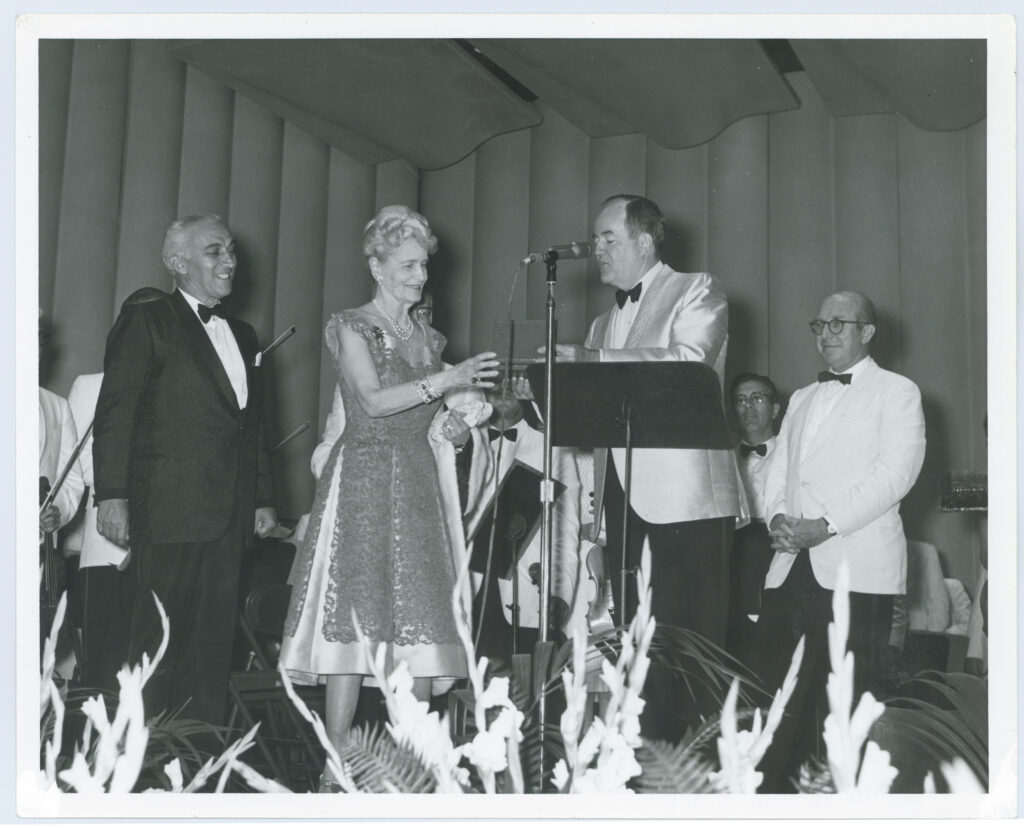
The pavilion opened on July 14, 1967, with the National Symphony and pianist Van Cliburn. Vice President Hubert Humphrey came out to dedicate it, and he presented Mrs. Post and Rouse with permanent tickets to the summer festival.
The rain had started an hour before the concert, and it was a downpour by showtime. The Sun reported that about 2,500 people walked through “driving rain and thick mud” from distant parking lots to get there, and the black-tie supper dance planned for afterward was postponed.
The building got rave reviews anyway. New York Times critic Harold Schonberg called it an architectural and acoustical success, which Gehry later remembered as the first national attention he ever got.
Rock groups and PTAs
The trouble was money. That first season, with the symphony, ballet and a Russian music and dance festival, was a financial disaster.
The second summer, in 1968, the orchestra still controlled the bookings, and pop music came in. The pavilion’s first pop act, the Cowsills, played on August 7, 1968, billed in the Baltimore Sun as presented by the National Symphony, and Jimi Hendrix came nine days later. Judy Collins, Simon and Garfunkel and the Doors played that summer too.
The orchestra’s bookings could get political, too. That same summer it approved a campaign rally at the pavilion for George Wallace, the segregationist governor of Alabama, which set off protests in the new town.
After the 1968 season, a Rouse official looked at the concession sales and summed it up in a memo: “Rock groups may not please PTAs, but they sure as hell make a lot of money.”
We’ve written about Janis Joplin playing Merriweather in 1969, three weeks before Woodstock. That’s the direction things were heading.
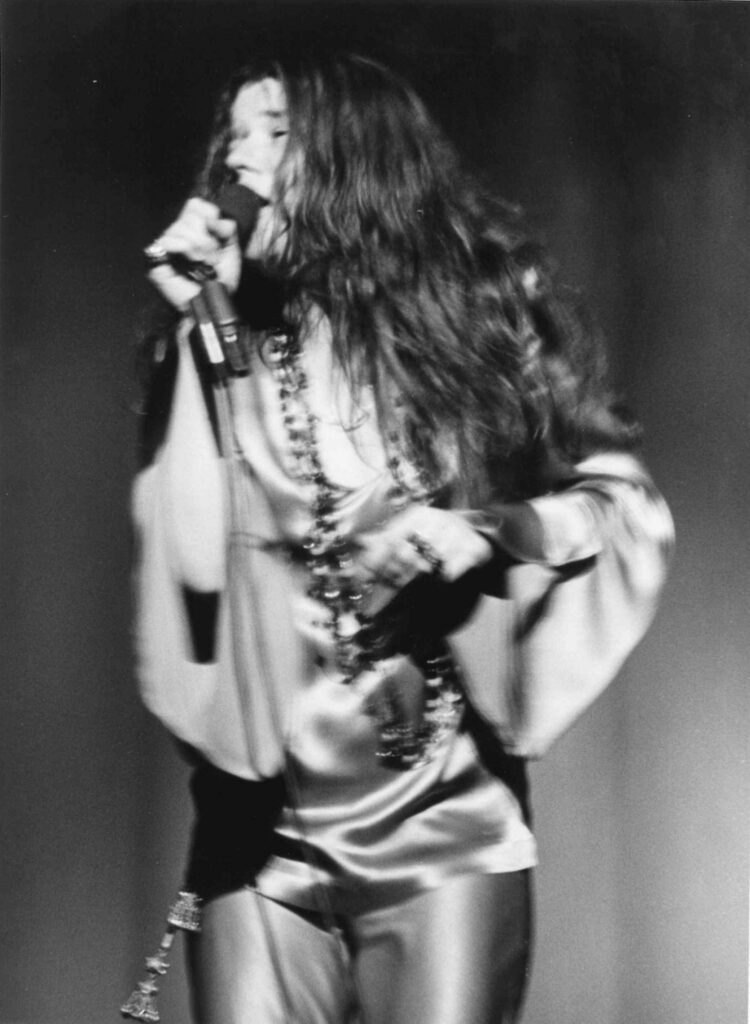
Meanwhile the National Symphony was struggling. Its musicians went on strike for six weeks in the fall of 1969, and in June 1970 it wasn’t clear the orchestra could afford a summer season at all before it announced it would play Merriweather after all.
Wolf Trap opens
While Columbia was learning to love rock and roll, Wolf Trap was slowly getting built.
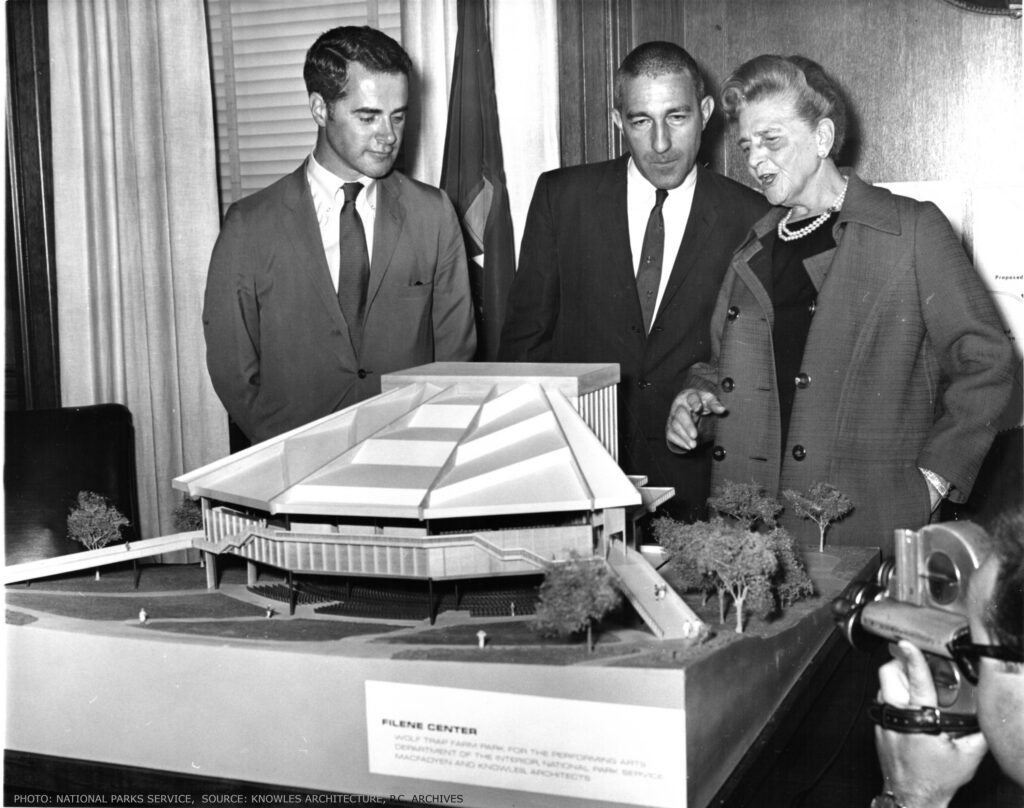
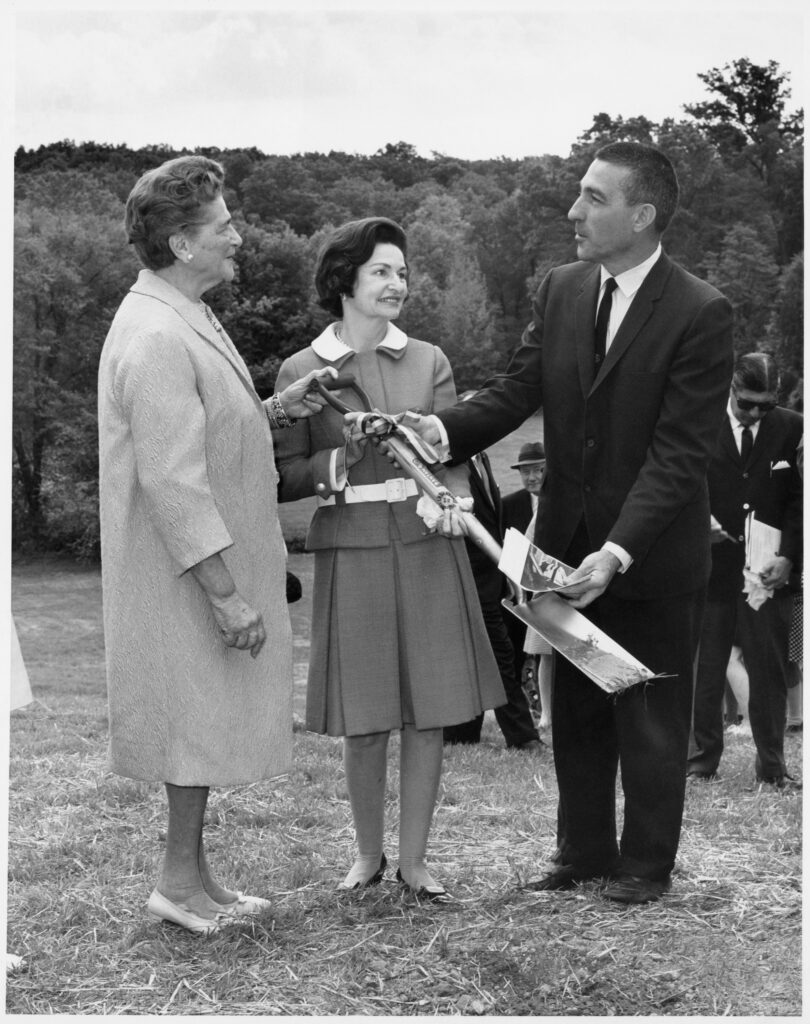
Lady Bird Johnson and Udall broke ground on May 22, 1968. The New York architects John MacFadyen and Edward Knowles designed the Filene Center, a tall wooden shed named for Shouse’s parents, with about 3,500 seats under cover and room for 3,000 more on the lawn.
On March 13, 1971, less than four months before opening night, an arsonist set the unfinished building on fire. About 60 percent of it burned, and repairs ran around $650,000, the same price as the entire pavilion in Columbia.
It opened on schedule anyway, on July 1, 1971, with a 14-page punch list still unfinished. Julius Rudel conducted the National Symphony, First Lady Pat Nixon was in the crowd, and the soloist was Van Cliburn, who had also played Merriweather’s opening night four years earlier.
And the man who was there to accept the Filene Center on behalf of the federal government that night was the new Secretary of the Interior, Rogers C. B. Morton. That’s the same Maryland congressman who had worried in 1966 that the region might end up with more facilities than talent.
That summer the National Symphony still played Merriweather, but only as one act on a bill with Red Skelton, Burt Bacharach, Harry Belafonte, Judy Collins and Jack Benny. So much for that 20-year lease. From Wolf Trap’s opening night on, the orchestra’s summer home was Wolf Trap, and it has played there every summer since. Its 2026 season at Wolf Trap ran to 14 shows.
Two lawns, two personalities
From there the two places went their separate ways, which is pretty much how they still feel.
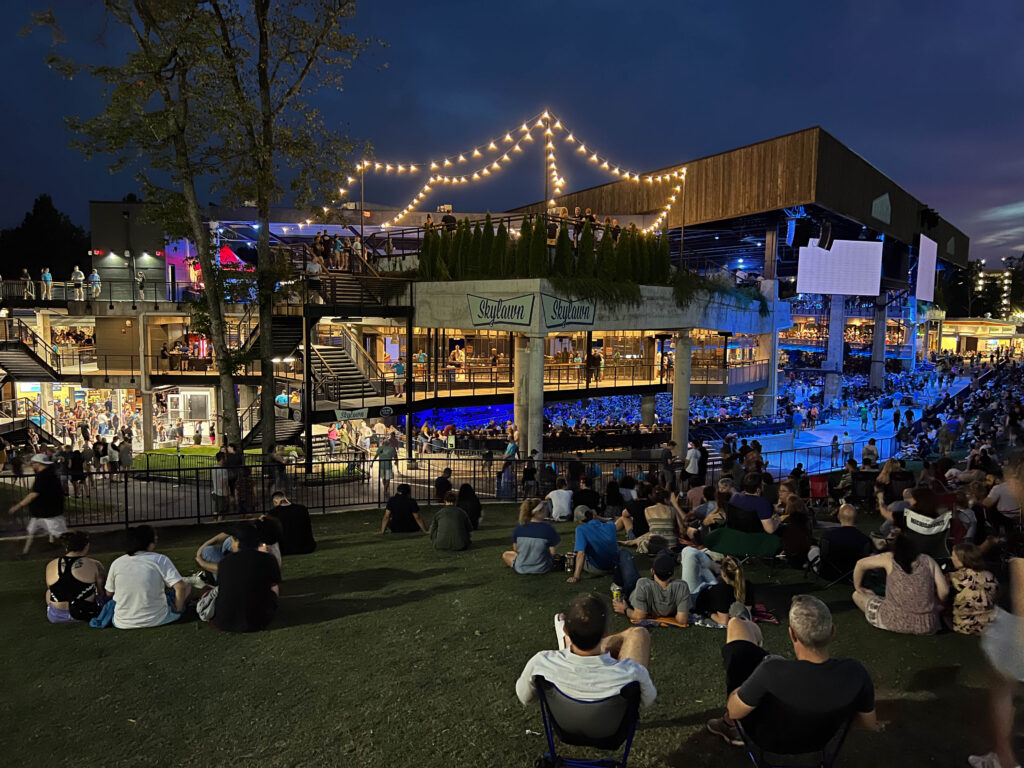
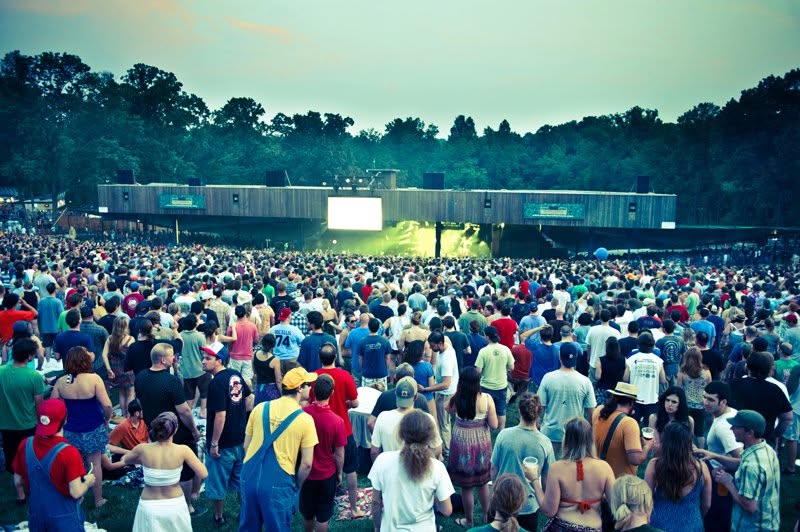
Merriweather became a rock venue, sometimes a rowdy one. After gate-crashers broke through the fences in the summer of 1970, management briefly stopped booking hard rock. In February 1972, Howard County began requiring a permit for any concert with more than 3,000 people, and the county could weigh a performer’s history of violence.
In 1974, Columbia’s general manager, Michael Spear, banned rock outright for a season. The Baltimore Symphony spent its summers there from 1974 through 1981, and after that the orchestra era was over for good.
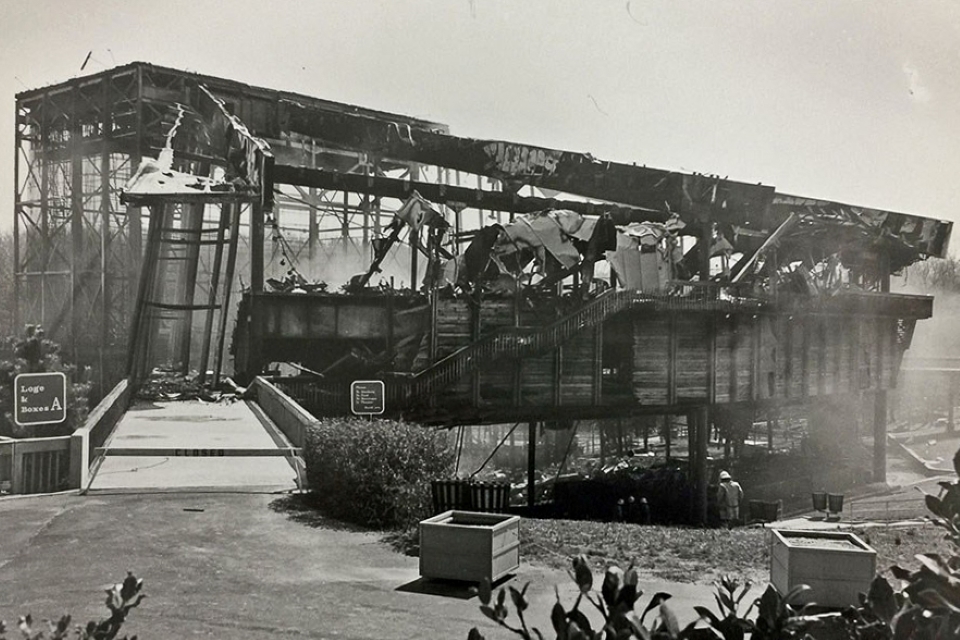
Wolf Trap stayed a park. The original Filene Center burned to the ground on April 4, 1982, and Shouse rallied donors to rebuild it. The new one, which looks a lot like the first, reopened in 1984 with the National Symphony and Plácido Domingo.
The headliners
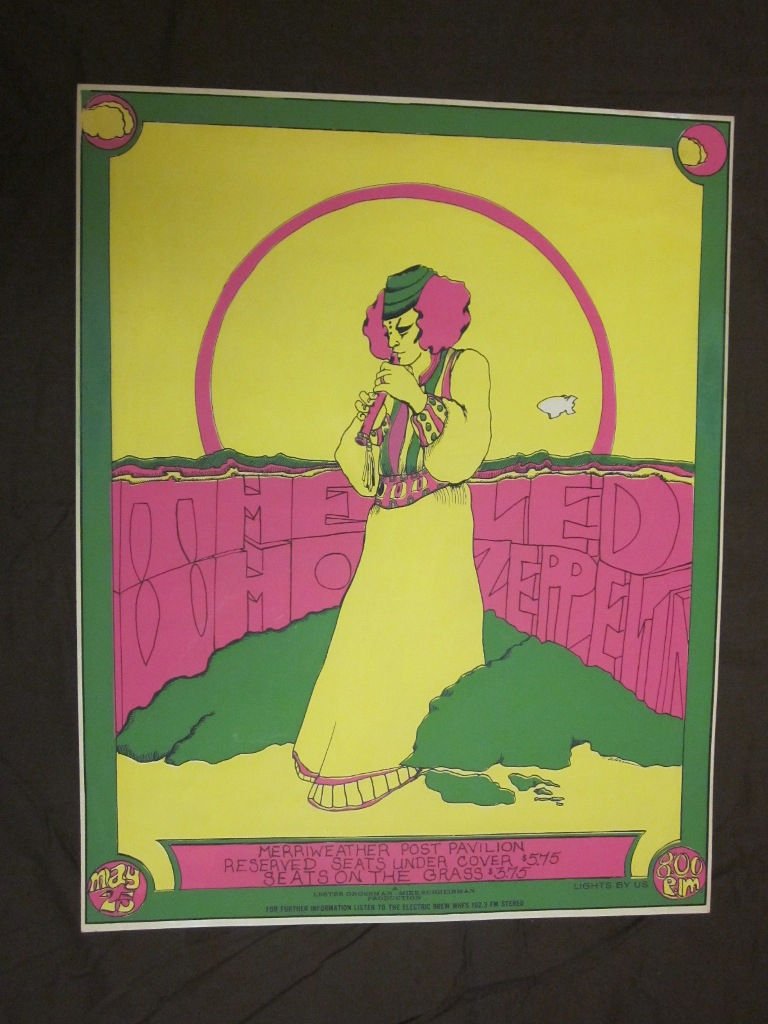
Merriweather’s guest list from those years is a little ridiculous. On May 25, 1969, Led Zeppelin opened for The Who, the only time the two bands ever shared a bill. Zeppelin’s set ran so long that a Who crew member pulled the plug on them so The Who could get on, and the ticket misspelled Led Zeppelin’s name. Six years later, Zeppelin was filling the Capital Centre.
Pink Floyd played Merriweather on June 20 and 21, 1973, on the Dark Side of the Moon tour, on a summer calendar that also had Stevie Wonder, Miles Davis, Muddy Waters and the Beach Boys.
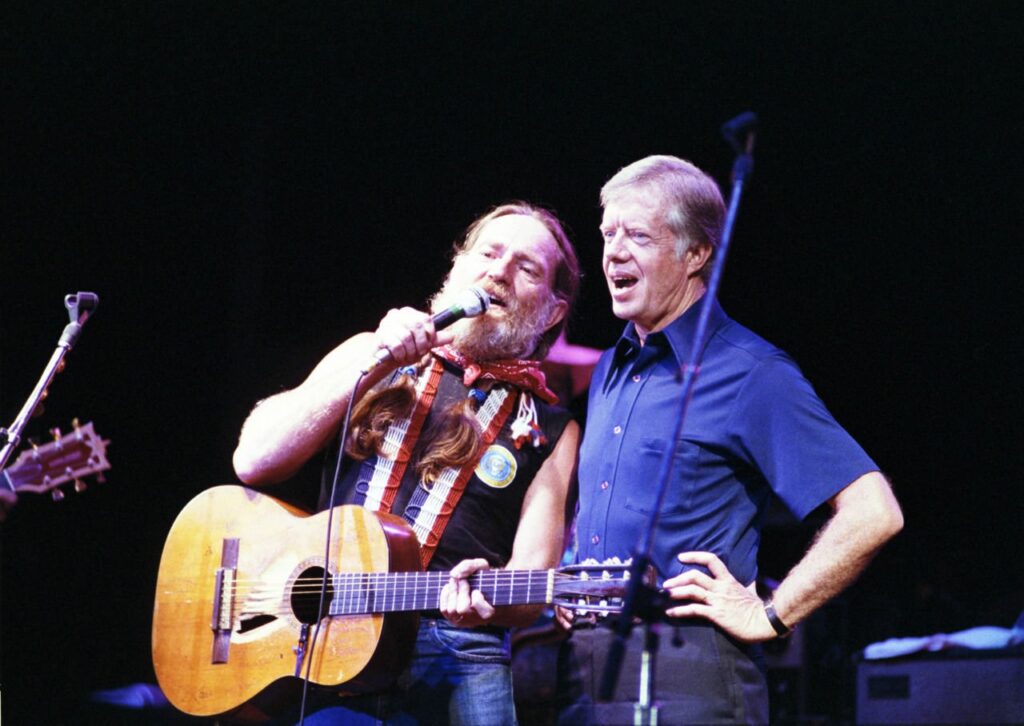
Even a sitting president got in on it. While he was in the White House, Jimmy Carter came up onstage at Merriweather with Willie Nelson.
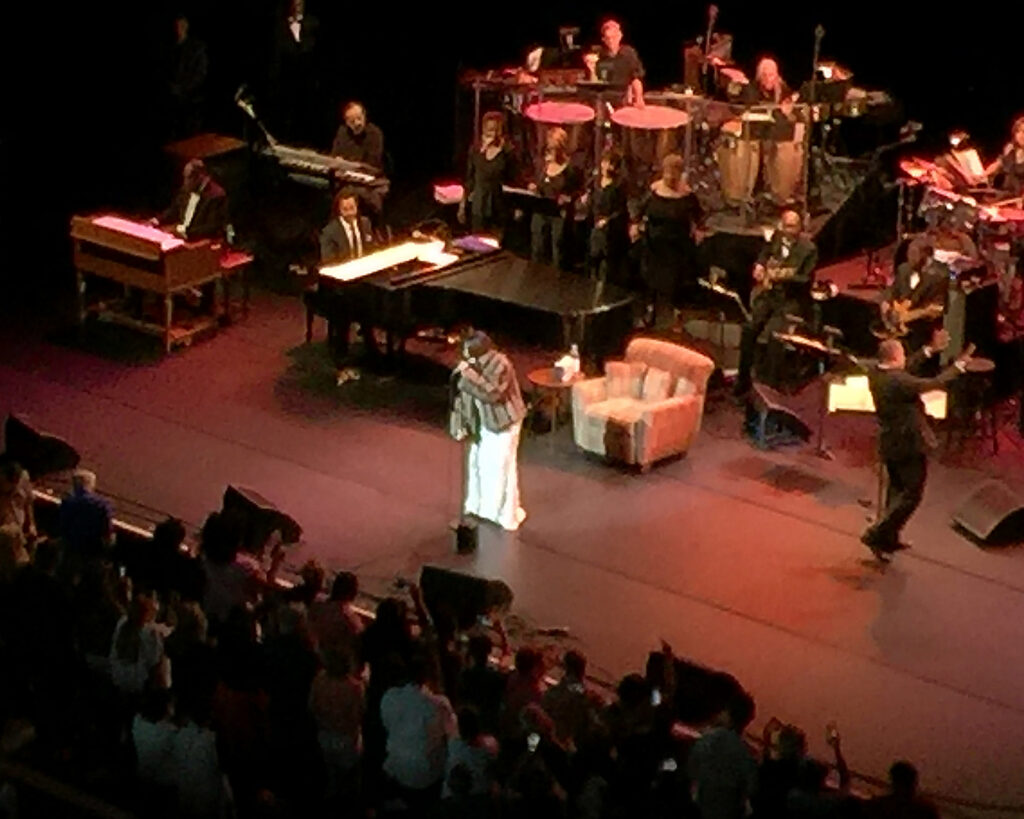
Wolf Trap leaned toward the classier end. Aaron Copland conducted the National Symphony in his own music there in 1977, and Leonard Bernstein celebrated his 60th birthday there with the orchestra in 1978. Ella Fitzgerald, Ray Charles, Aretha Franklin, Bob Dylan and Dolly Parton all played the Filene Center over the years, and in June 2018 Lady Gaga walked out as a surprise guest to sing with Tony Bennett.
My two lawns
I saw Phish at Merriweather a few times, including shows in August 1998 and June 2011. Over at Wolf Trap, I caught the Black Crowes, back in 2008 if I remember right, on a lawn that felt more like a picnic than a rock show.
And the third big shed out there, Nissan Pavilion in Bristow (renamed Jiffy Lube Live in 2010), didn’t come along until 1995. That’s a whole different story.
We dug this one up with help from AI and checked it against the original records below. Here’s how we use AI.