
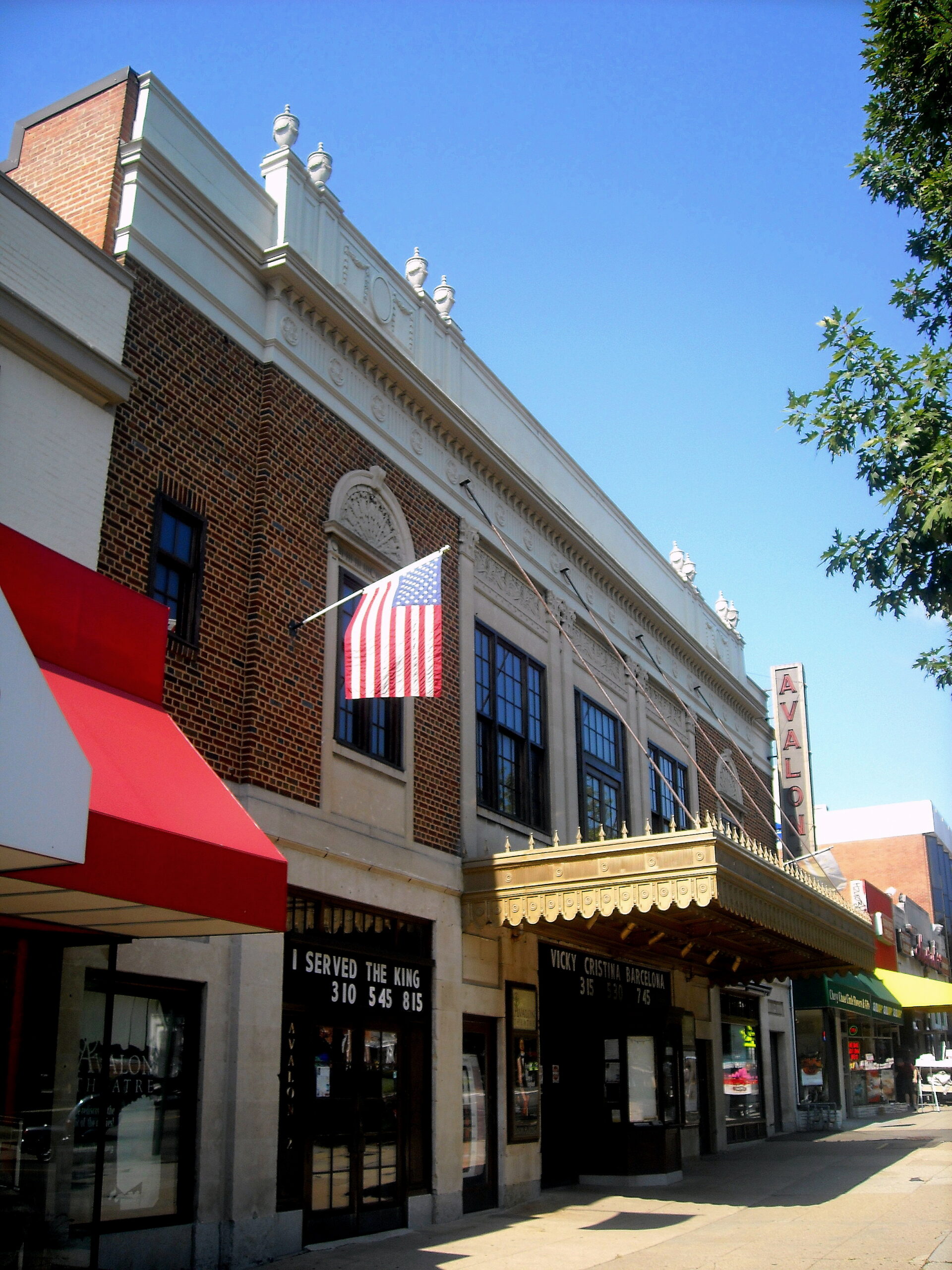
The Avalon Theatre still runs films on upper Connecticut Avenue in 2026, which sounds like an unremarkable sentence until you notice how many old DC movie houses did not make it. The Tivoli went dark. The MacArthur was gutted for a CVS. The Uptown, up the road in Cleveland Park, sat shuttered for years. The Avalon at 5612 Connecticut Avenue NW is the last of its kind in the city, a neighborhood theater that has been showing pictures since 1923.
It only made it because the neighbors refused to let it die.
A theater for a streetcar suburb
In the early 1920s, Chevy Chase DC was still filling in. Senator Francis Newlands had platted the suburb in the 1890s at the far end of the Connecticut Avenue streetcar line, and by the postwar boom the blocks were thickening with middle-class families who wanted a movie house closer than downtown. (An earlier 1907 map of the neighborhood shows how much was still open land.) A group of local investors incorporated the Chevy Chase Amusement Company, capitalized at $125,000, and pitched the neighborhood on a theater that would seat roughly twelve hundred people.
The company’s president was Emanuel J. Stutz, and his 1922 pitch to the neighborhood read like a civic vow.
Shall be managed according to the wishes of the community, and to exhibit the finest pictures that the motion picture art can produce.
Emanuel J. Stutz, Chevy Chase Amusement Company, 1922
Stutz appeared before civic groups up and down Connecticut Avenue selling stock at 8 percent dividend. The offering ran through the Chevy Chase Amusement Company’s office at the Chevy Chase Savings Bank Building on the corner of Connecticut Avenue and McKinley Street.
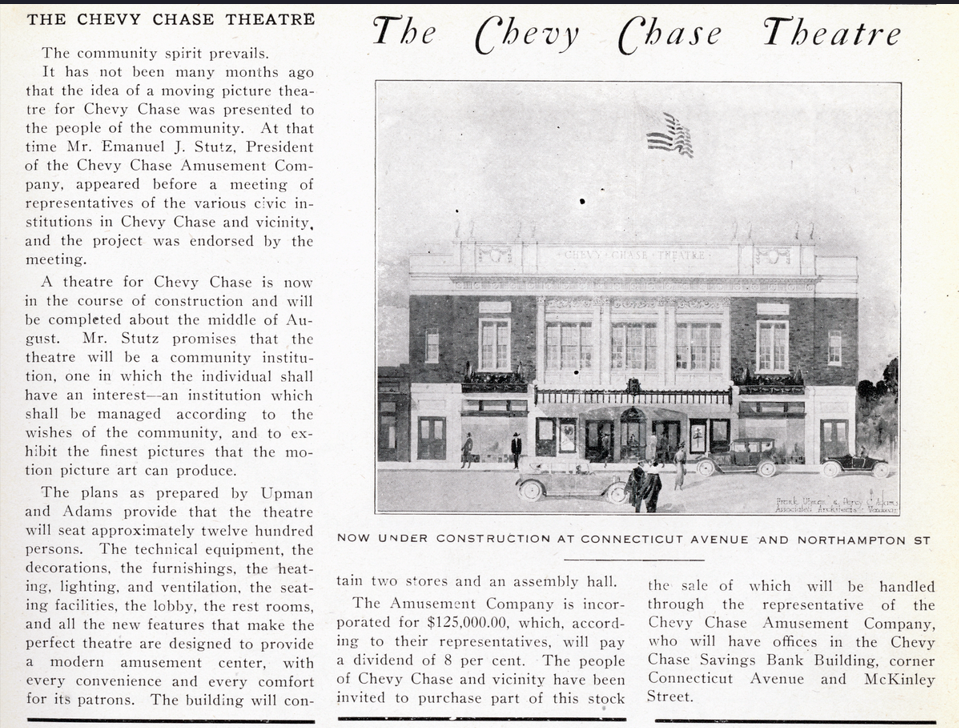
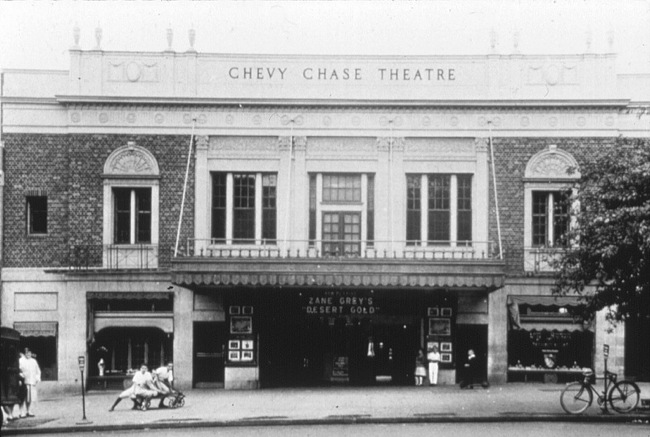
Stutz hired the Washington firm of Frank Upman and Percy C. Adams, and the two produced a two-story Classical Revival building with a broad marquee spanning the ground floor. Corinthian limestone pilasters framed a tripartite second-story window over the marquee. A metal entablature ran the full width with a frieze of stylized flowers pressed between vertical grooves that read almost like hieroglyphs. Two one-story commercial storefronts flanked the central entrance. Upstairs, a music school leased space.
The design promised more than the budget could deliver. Money ran out before construction wrapped, and the balcony the architects had drawn was never built. The upstairs shell was walled off, its future undecided.
Opening night, February 28, 1923
The Chevy Chase Theatre opened on Wednesday, February 28, 1923. The first feature was The Prince and the Pauper, a silent adaptation of the Twain novel starring the Hungarian child actor Tibor Lubinszky.
Val Scannell sat at the console of a brand new Robert Morton three-manual pipe organ and played the film’s score. All 1,200 seats were on one flat floor. The stage behind the screen was shallow, six feet or so, sized for an emcee or a choir rather than a full production.
The pastors down the street complained almost immediately about Sunday showings. Stutz brushed them off. People were buying tickets. A local Baptist congregation, for its part, quietly rented the auditorium for Sunday services in the theater’s early years. The Chevy Chase Theatre was already, as the Washington Post called it at opening, an experiment in “making the theater a community asset.”
Becoming the Avalon
In July 1926, the local exhibitor Harry Crandall partnered with Philadelphia’s Stanley Company of America and bought the Chevy Chase Theatre. Crandall already ran a chain of Washington houses, and the Stanley circuit was the country’s second-largest exhibitor. Three years later, in 1929, the theater was absorbed into the newly formed Stanley Warner combine, wired for sound, and rechristened the Avalon.
The rename was the fashion of the moment. Neighborhood houses with hometown-sounding names were switching to something a little grander, a little more Arthurian. Warner’s picture The Singing Fool, with Al Jolson, was among the first talkies to run under the new marquee. The Robert Morton organ went quiet not long after.
In 1937, Warner gave the Avalon an Art Deco makeover, following the fashion set by the brand new Uptown Theater down in Cleveland Park. Air conditioning went in the same year. Before that, in the pre-refrigeration summers, the crew stacked blocks of ice below the auditorium and blew fans across them, which was as close to cool air as a movie house got in 1930s Washington.
Middle age, and Mercury on the ceiling
The Pedas brothers, Ted and Jim, bought the Avalon in the late 1960s and folded it into their Circle Theatres chain. On January 26, 1971, they opened Avalon 2 in the long-vacant upstairs shell, a small 200-seat room that the Washington Post would later compare to “watching a movie in a coffin.” The main auditorium kept its 660 seats and its shallow silent-era stage. Boys in Scout uniforms got in free on Saturdays.
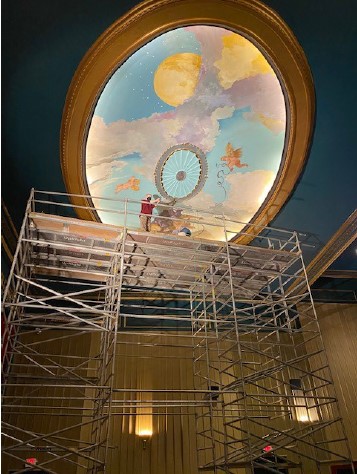
In 1985, the Pedas brothers gave the main auditorium a serious renovation. New sound, a bigger screen, and, high up in the central dome, a fresco by the muralist Diana Westring: the god Mercury casting a reel of film across the clouds to a waiting cherub. The mural is still up there. It has been restored twice, most recently in 2021.
Cineplex Odeon bought the Circle chain in late 1987. Almost immediately, the company opened a shiny six-screen multiplex at Wisconsin Avenue Cinemas and shifted the Avalon to arthouse programming to avoid competing with itself. In 1996, Cineplex sold the building to a private landlord, John Kyle of Bethesda. In 1998, Cineplex Odeon merged with Loews. The corporate consolidation that had been squeezing out neighborhood houses across the city closed around the Avalon.
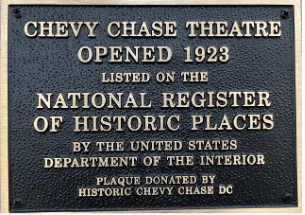
That same year, 1996, the DC Historic Preservation Review Board added the theater to the DC Inventory of Historic Sites, and the National Park Service added it to the National Register of Historic Places. The exterior was legally protected. The inside was not.
March 2001: closed
Loews Cineplex filed for bankruptcy protection early in 2001. The list of theaters it planned to shed included the Avalon. It closed in March. Within days, Loews crews were inside the building pulling out the 665 seats, the screen, the projection and sound equipment, and anything else portable. The stripping was thorough enough that a Washington Post columnist visiting a few months later found rainwater seeping through a hole in the ceiling and bare brick where the screen had been.
Marc Fisher wrote a column on March 24, 2001 with the headline “Curtains For a Landmark In the Dark.” He recalled bringing his wife to see Quills a few weeks earlier and being met at the door by a hand-lettered sign that read “No Heat. Boiler Out.” They watched the movie in their overcoats. The Avalon had been running on fumes for a while.
By September 2001, the developer Doug Jemal had signed a lease with the building’s owner and was drawing up plans to convert the Avalon into retail space. In a corner of the neighborhood, at 28 years’ residence and counting, Bob Zich was calling the owner in Bethesda and asking whether anyone was seriously trying to save it.
The save
Zich, a retired director of electronic programs at the Library of Congress, gathered a handful of Chevy Chase neighbors in his living room in October 2001. The group named itself the Friends of the Avalon. They pulled in an early roster of volunteers, filed for nonprofit status with help from Congresswoman Eleanor Holmes Norton’s office, and started asking harder questions than Jemal had expected.
On April 3, 2002, they held a public organizing meeting across the street at the Chevy Chase Community Center. They worried nobody would come. More than 200 people showed up, standing-room only. The filmmaker Aviva Kempner rose from the audience, reached into her purse, pulled out a dollar bill for every year of the theater’s life, and set the stack in Zich’s hands. The room emptied its pockets. The Friends walked out that night with $2,200.
Every Saturday for months afterward, Zich and his wife Joanne staffed a solicitation table on the sidewalk in front of the boarded theater. They took visitors inside to see the wreckage. The table brought in about $1,000 a week. An envelope arrived one afternoon with $14.37 from a group of neighborhood kids who had sold their toys.
Doug Jemal, watching the community effort intensify, warmed to it. He met with the group, now renamed the Avalon Theatre Project, in March 2002 and gave them a deadline: raise $100,000 by late June and produce a workable business plan, and he would put the retail conversion on ice.
They cleared the bar with $50,000 to spare. Councilmember Adrian Fenty had put a $50,000 line item in the DC budget. The Baltimore-based Blaustein Foundation matched it. Private donors kicked in another $100,000.
Councilmember Kathy Patterson brokered a Spring 2002 sit-down that pulled Jemal, the Williams administration, and the Project into the same room and produced a deal on concessionary rent. GTM Architects donated their services to restore the facade and the lobby, uncovering the original historic marquee under a decade of modernization. The interior designers Donetta George, Cynthia Mancini, and Melissa Cohen laid out the new lobby. The independent exhibitor Paul Sanchez agreed to run the projection side of the operation.
Total raised for the reopening ran to about $200,000 from the community alone, and roughly $750,000 when the DC grants, foundation money, and donated services were counted. The theater got a new roof, a rebuilt boiler, a new vault to replace the one that had been sinking under the sidewalk out front, new seats, new screens, and new digital sound.
Reopening night, April 2003
The lights came back up on Tuesday, April 22, 2003 with Filmfest DC’s kids programming, and the official gala reopening followed the next night, Wednesday April 23, with an invitation-only screening of John Malkovich’s directorial debut The Dancer Upstairs. Commercial programming resumed on Friday, May 9 with Stone Reader and Cet Amour-La.
A few blocks west, Broad Branch Market at 5608 Broad Branch Road is another local institution its neighbors kept alive.
Avalon 1 came back with 428 luxury seats, a 41-by-19 foot screen, and 14 surround-sound speakers. Avalon 2 upstairs came back with 165 seats and a 20-by-9 foot screen. Both auditoriums had digital sound from day one. Zich told the Washington Post on the eve of the reopening that “the theater’s more glorious now than it has been its whole life, even when it was the Chevy Chase Theatre in the 1920s.”
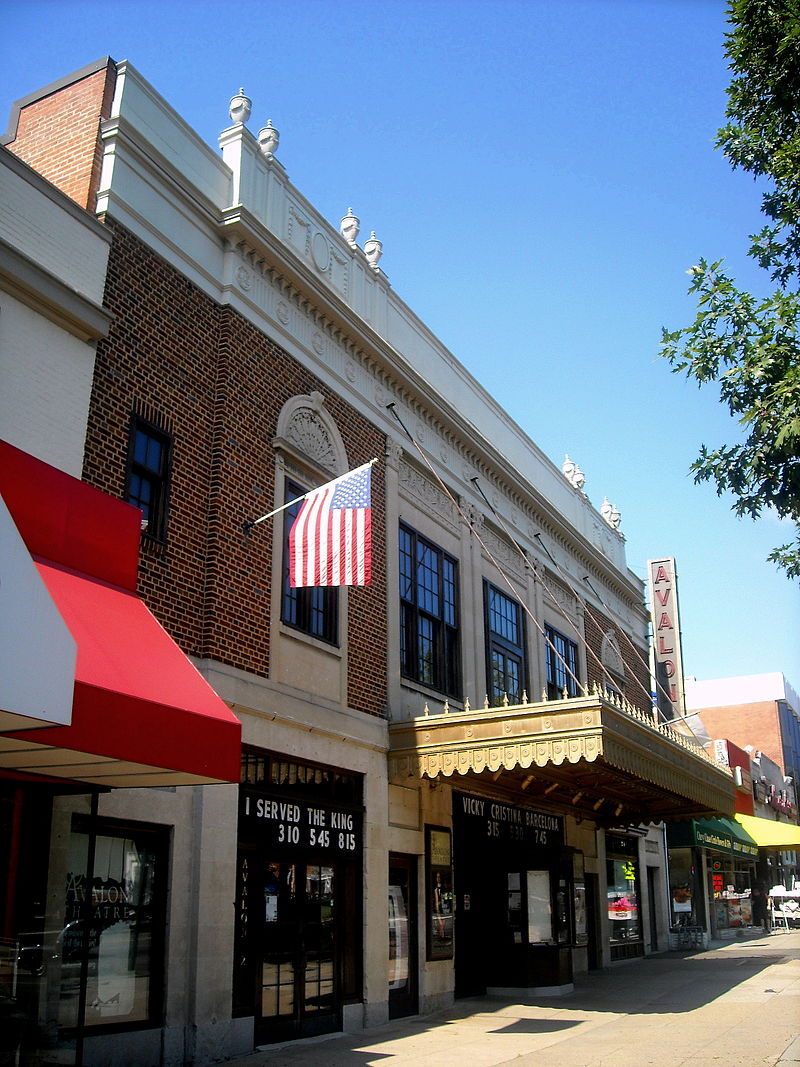
In 2006, the Avalon Theatre Project bought the building outright. In 2013, both auditoriums went digital and the Project installed an elevator to the upstairs theater along with fully accessible restrooms. In 2021, the Mercury mural was restored again. In 2024, the exterior was repainted in period-appropriate colors.
A century in, and still open
The Avalon marked its 100th year in 2023 with a “100 Years of Cinema Magic” film series, one landmark picture from every decade since 1923. It was also the twentieth anniversary of the reopening.
Bill Oberdorfer, who was on the Zich living-room roster in 2001, is still executive director. Andy Mencher still runs programming. The theater screens first-run studio pictures, foreign and independent film, a Wednesday Signature Series, and Cinema Classroom, which brings 1,500 DC public and charter school students to free screenings every year, buses included.
Bob Zich, the retired librarian who called the owner in Bethesda in the summer of 2001, stepped down as chair in September 2004 after brain surgery. He lived to see the theater flourish. The Avalon Theatre Project he helped found now owns the building, employs a staff, and keeps the lights on with membership dues, ticket sales, and the same neighborhood generosity that filled a tin cup with $2,200 one April evening in 2002.
Stand on the sidewalk in 2026 and the marquee is still glowing above Connecticut Avenue. The Chevy Chase Theatre plaque is bolted to the wall beside the box office. Somewhere overhead, Mercury is still tossing a film reel to a cherub. A hundred and three years and counting.
We dug this one up with help from AI and checked it against the original records below. Here’s how we use AI.