
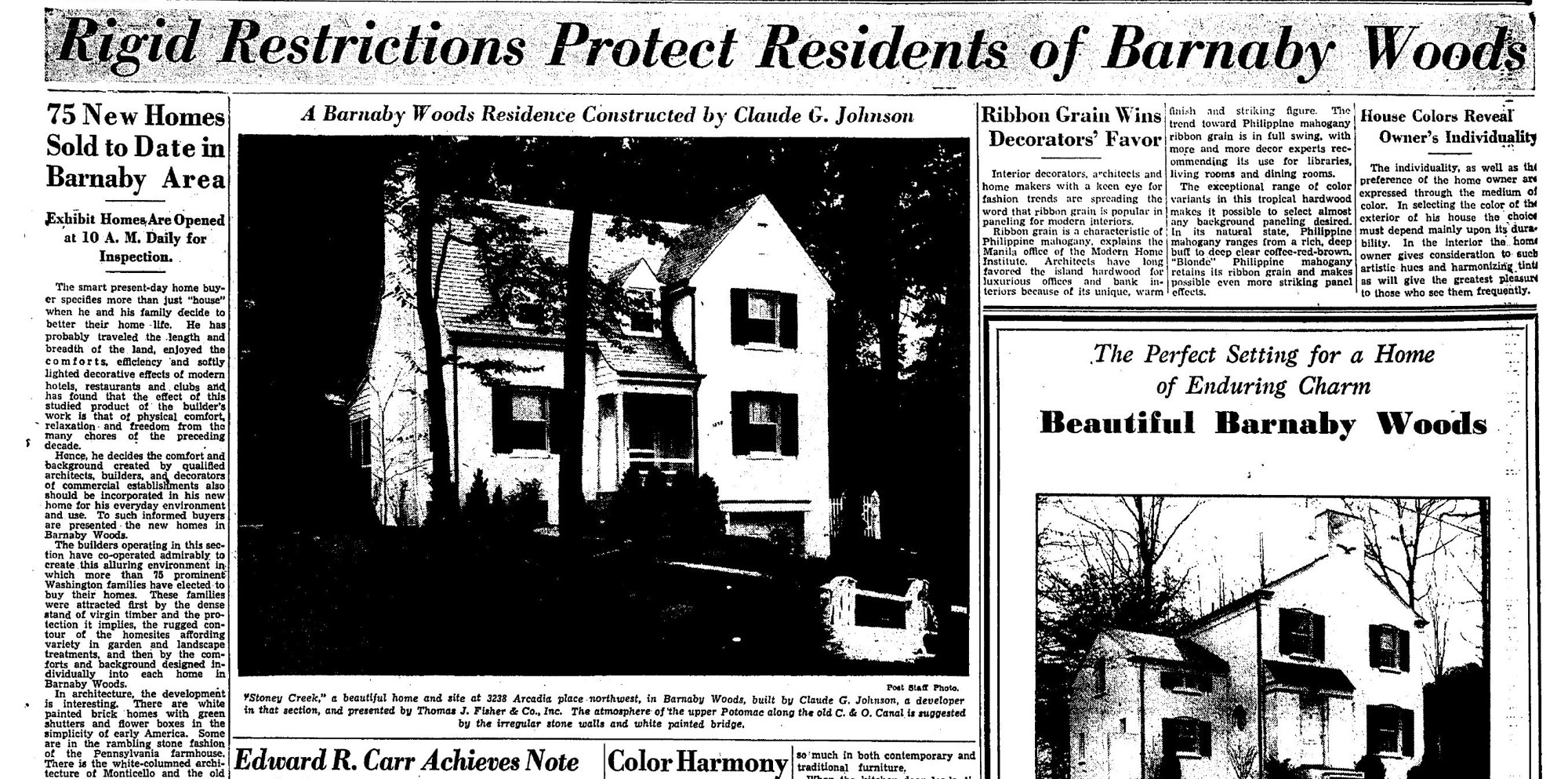
On April 18, 1937, the Washington Post told home buyers what made Barnaby Woods, the new colonial-style neighborhood off Western Avenue in Chevy Chase, D.C., a safe bet:
Careful architectural and social restrictions guarantee each home buyer in this community a sound investment.
Washington Post, April 18, 1937
Some of the architectural rules are easy to find. A minimum house cost and a fence rule are written into the deeds. The social restrictions are harder. We went looking for them in the neighborhood’s land records.
In the Barnaby Woods deeds and plats we read, they aren’t written down. But a few blocks away, one of its own builders put his in writing. His 1941 deeds barred “negroes” and “any person of the Semitic Race.”
This one’s for a few friends of mine who live in Barnaby Woods.
The Barnaby Tract
Start with the name. Barnaby Street was on the map by 1905, about three decades before the Barnaby Woods Development Company.
In June 1905, the Pinehurst Park Company recorded a subdivision called Pinehurst, between Western Avenue and Barnaby Street. Its president, Archibald M. McLachlen, signed the plat. The note on it says the company was subdividing “part of the Barnaby Tract and Parkers Survey.”
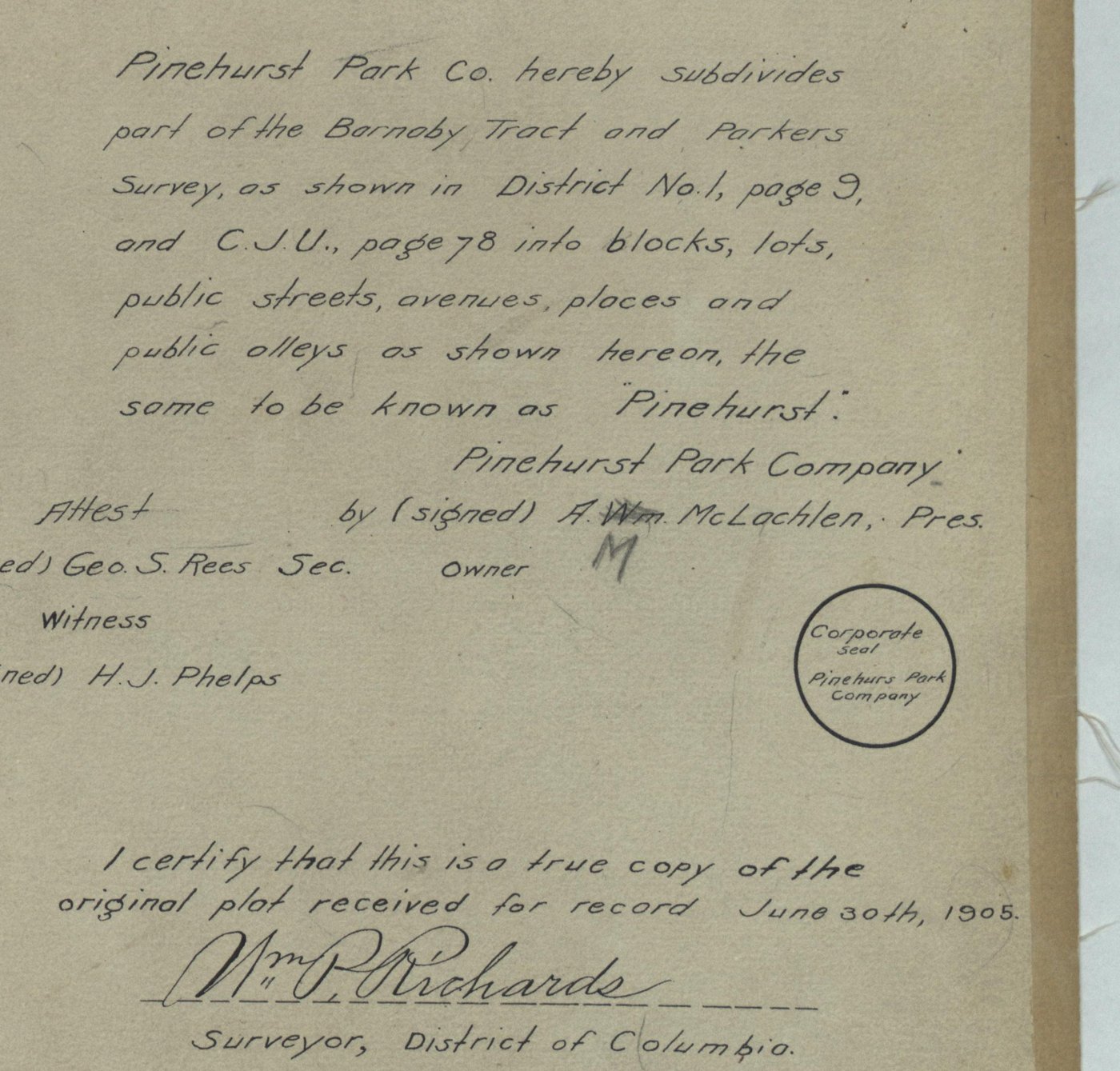
That plat is the earliest record we found tying the Barnaby name to this land. Who Barnaby was, we couldn’t find.
Pinehurst didn’t take off. According to the Chevy Chase historic district nomination, fewer than ten houses had been built in Pinehurst and its neighboring subdivisions by 1910, and development stalled for nearly two decades.
Carr’s 23 acres
Edward R. Carr had been building in northwest Washington since 1925, when he put up his first houses at Military and Reno roads. On December 22, 1925, Henry Gilbert Hadley and his wife, Anna Virginia Hadley, deeded him part of a tract called “New Seat,” on the southeast side of Barnaby Street.
On February 28, 1934, the Hadleys signed an option agreement with Carr, as trustee, for a New Seat tract with the same boundaries. The records we read don’t show how it came back to the Hadleys in between. Carr would buy at least ten lots a year, for $60,000 in all. Any dispute over the subdivision plan would go to the National Capital Park and Planning Commission.
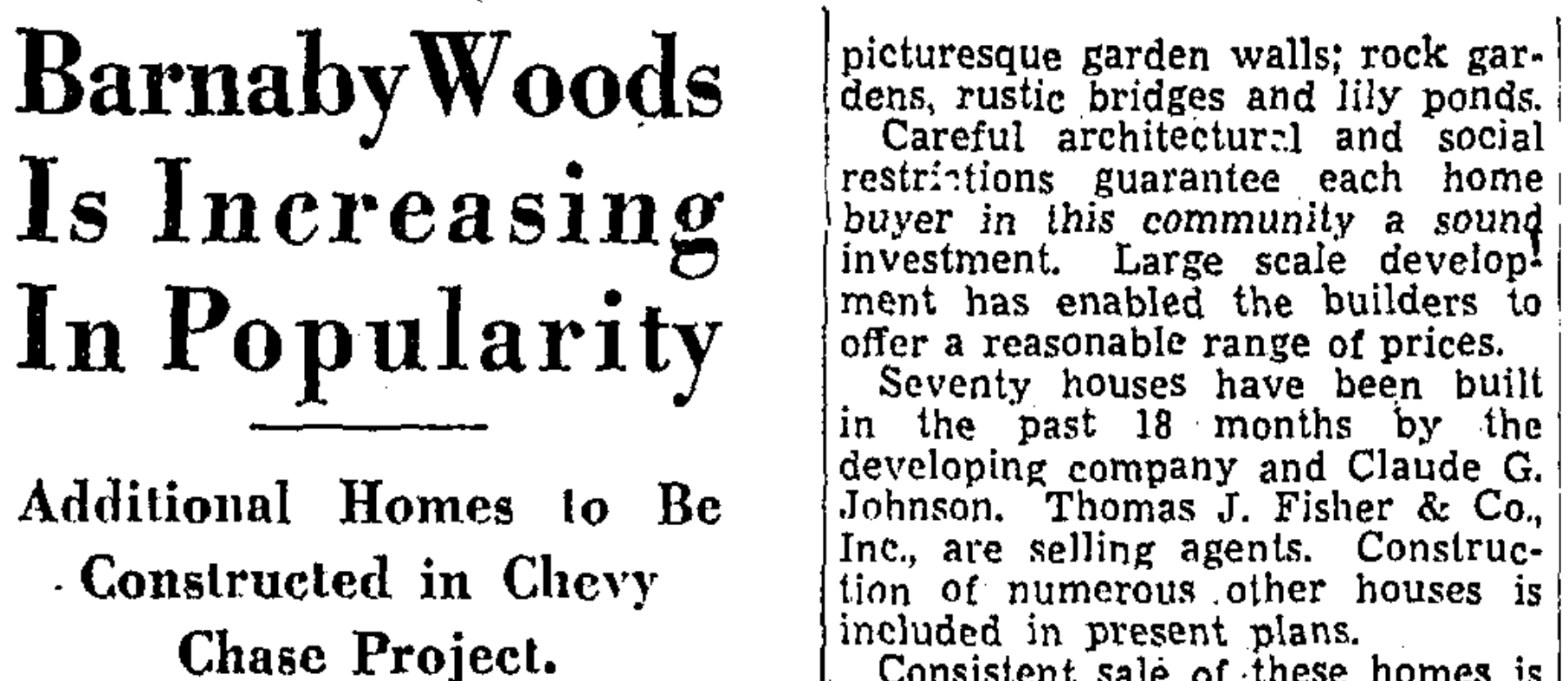
Later that year Carr formed the Barnaby Woods Development Company. The Post put it this way in 1937: he “purchased a tract of 23 acres in the center of what is now known as ‘Barnaby Woods.'”
The subdivision was laid out by Thomas C. Jeffers, an engineer and landscape architect with the park commission, according to the Post on November 7, 1937. The first five houses went on sale June 1, 1935. By nightfall, only one was left.
By November 1937, the Post counted 75 houses built and sold, worth “well more than $1,000,000.” It credited three men with the neighborhood’s “promotion and realization”: Carr, Claude G. Johnson and M. B. Swanson.
The same article said the planners knew their clients would want a place to live “in a region of natural attractiveness, with good and congenial neighbors in homes that would match the worth and sightliness of their own.”
A week later, on November 14, 1937, a full Post real estate page ran under a banner across the top: “Rigid Restrictions Protect Residents of Barnaby Woods.”
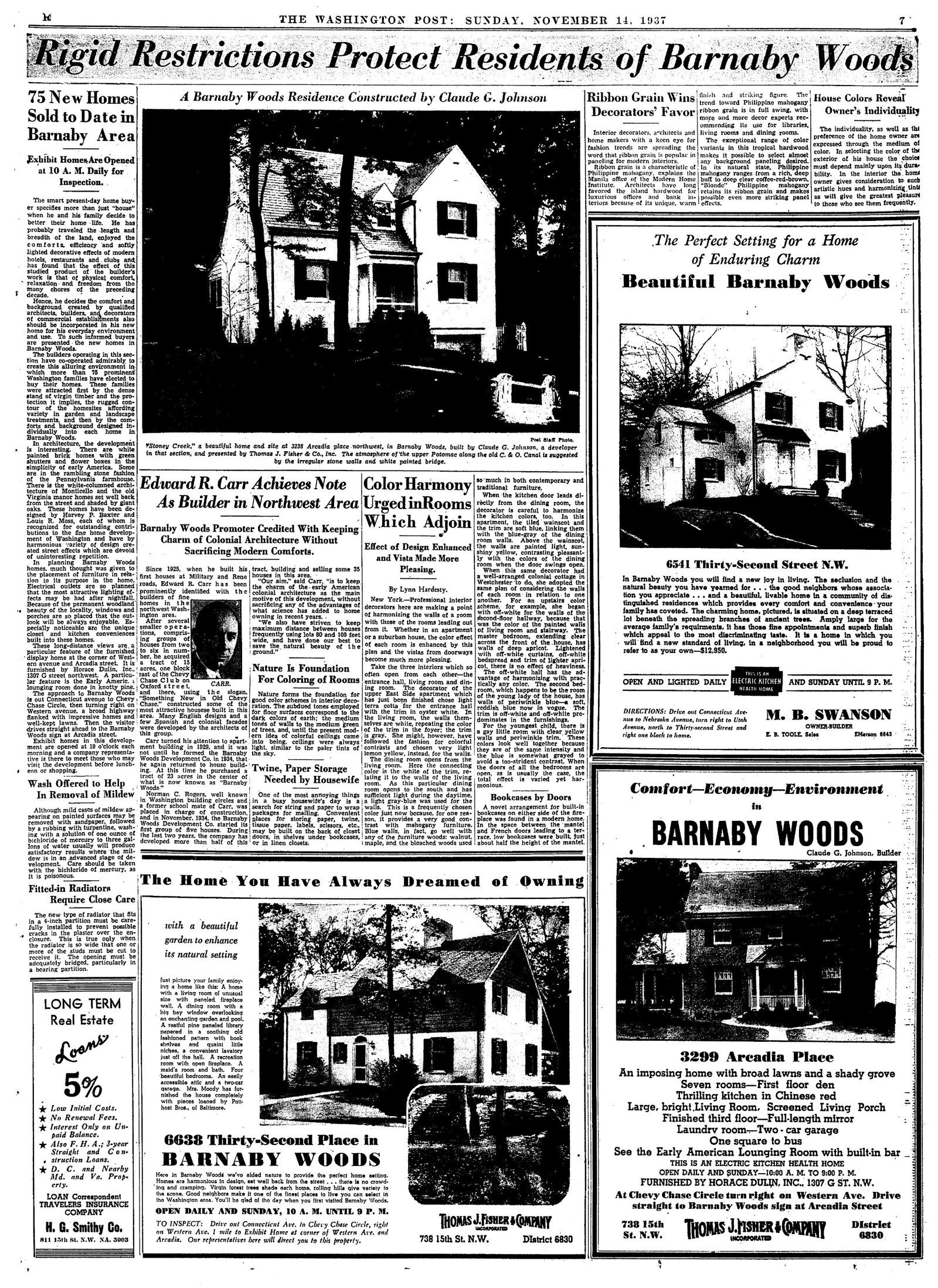
We read the page. None of the stories on it spells out what the rigid restrictions were. Swanson’s ad on the page offers “the good neighbors whose association you appreciate.”
What the deeds say
So we went to the land records. The DC Recorder of Deeds has scanned deeds going back to the 1920s. The DC Office of the Surveyor has the subdivision plats and dedications.
Hadley’s 1925 deed to Carr set three rules that ran with the land. No house could cost less than $2,500. No “spirituous or malt liquors” could be made or sold there. And no slaughterhouse. The 1934 option repeated them.
When the Barnaby Woods Development Company sold lot 2 in Square 2356 to Willard H. and Dorothy Walton Wright on October 21, 1936, the deed made the sale “subject to covenants of record.” Then it added one more:
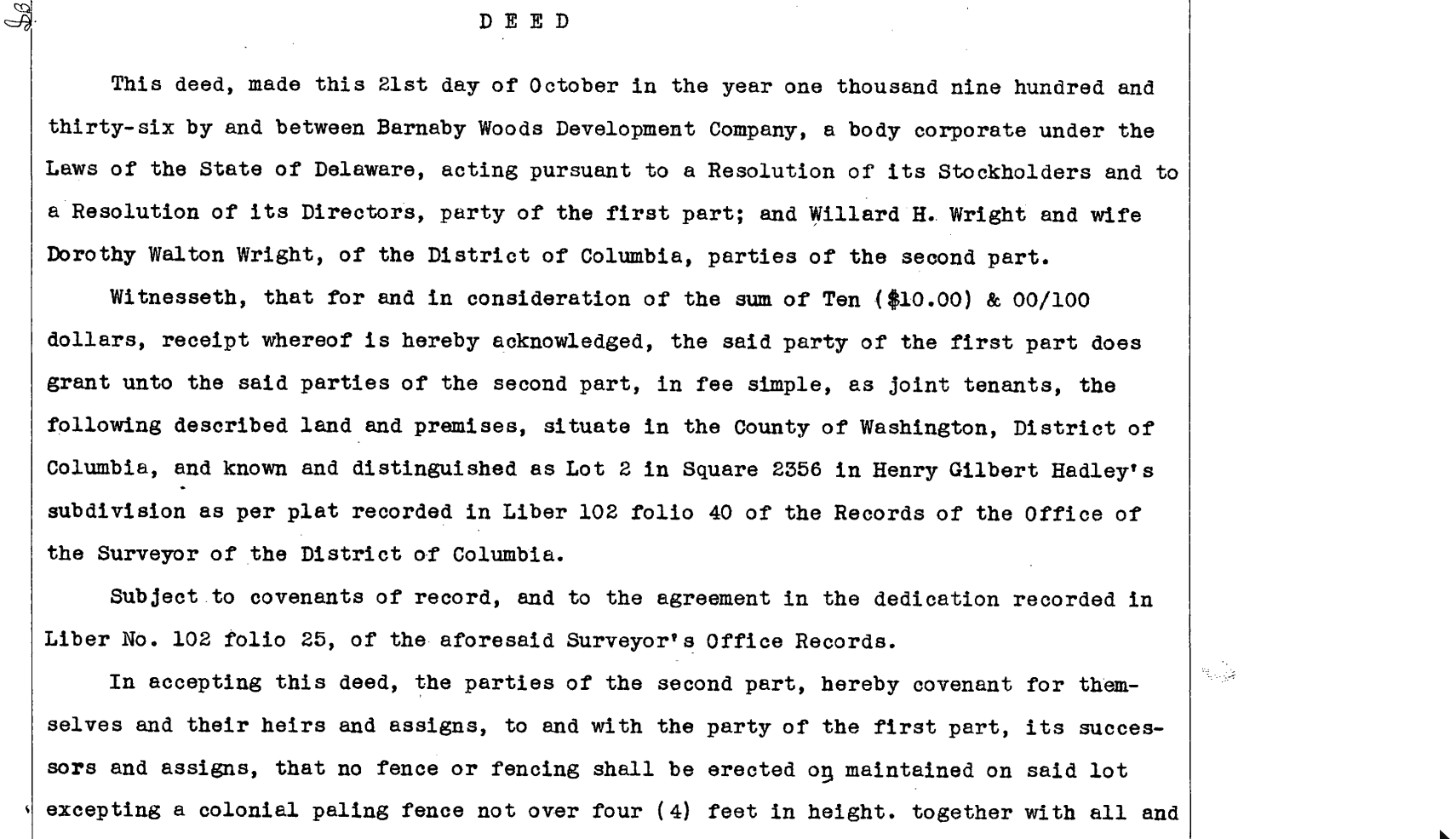
No fence, “excepting a colonial paling fence not over four (4) feet in height.”
That was the extra rule. Fences.
The company’s 1941 deed to Moulton H. and Cleo B. Balch, for a lot in Square 2357, has the same fence covenant. The street dedications Hadley signed in 1935 and 1938 give land for the streets and set building restriction lines, the setbacks between houses and the street. They add no other restrictions.
Swanson built in Barnaby Woods too. His September 1, 1939, deed to Ralph J. and Meta Duke Brown, for lot 28 in Square 2351, carries the same three covenants as Hadley’s 1925 deed and a building line. Nothing about race or religion.

In all, we read seven Barnaby Woods records from 1925 to 1941: four deeds, the option agreement and two dedications. None has a race or religion clause.
That’s a sample, not every deed in the neighborhood. And a clean deed doesn’t tell you who a builder was willing to sell to.
Older lots, a different rule
Next door, and in some of the same city squares, lots had been sold a decade before Carr’s company existed. Those deeds read differently.
On February 27, 1924, the Mathews Woods Corporation sold lots 38 and 39 in Square 2344 to Harley B. and Elizabeth H. Ashley. The lots were in Gertrude Van Hoesen’s subdivision of “the Mathews Tract.” Among the conditions:
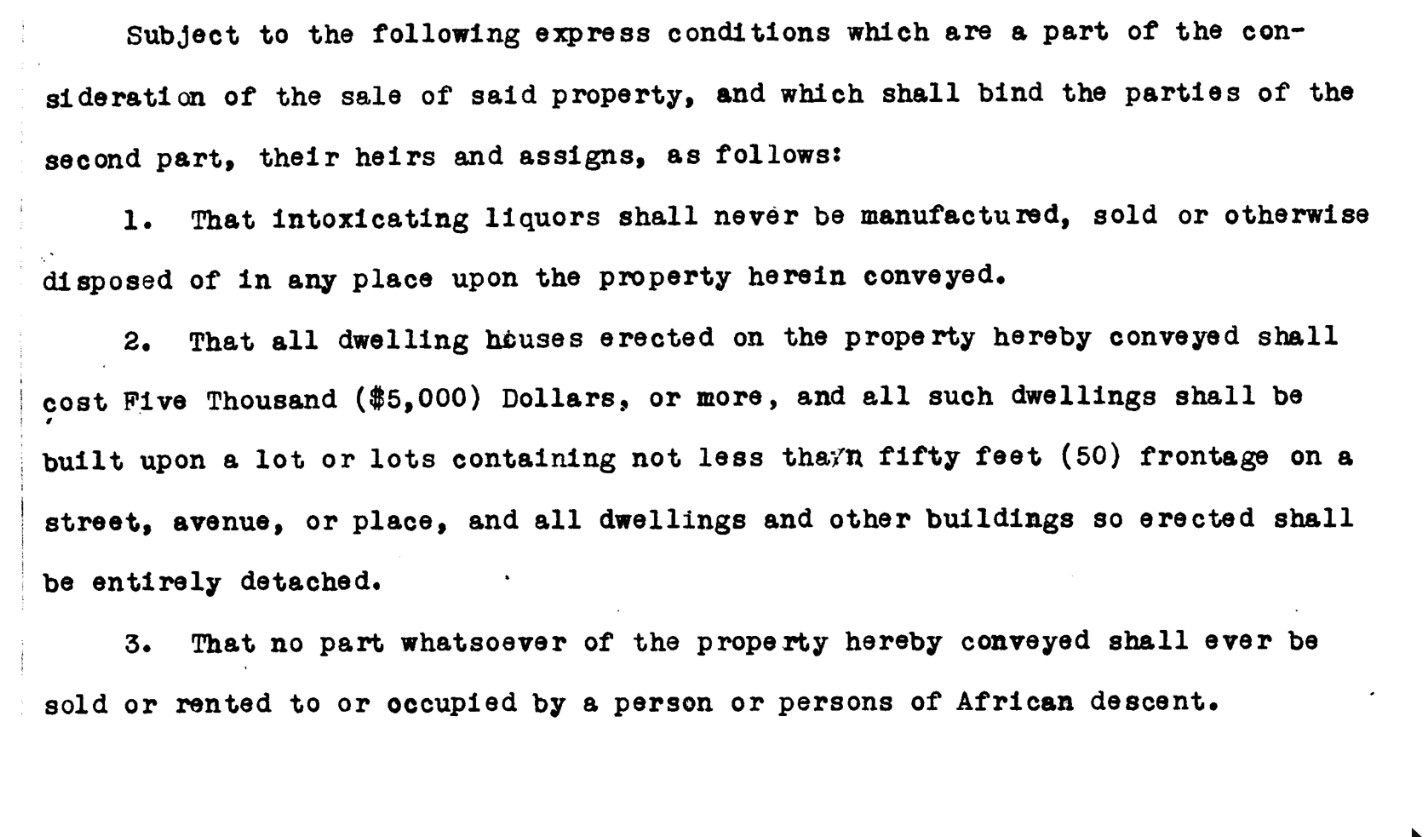
That no part whatsoever of the property hereby conveyed shall ever be sold or rented to or occupied by a person or persons of African descent.
Mathews Woods Corporation deed, February 27, 1924
That isn’t a one-off. The Mapping Segregation in Washington DC project lists dozens of racially restricted lots sold by the Mathews Woods Corporation, mostly in 1924 and 1925, in Squares 2344, 2349 and 2357. Other sellers on nearby squares used them in the 1920s, ’30s and ’40s.
Square 2357 is a good example. The Mathews Woods lots in it carry the race clause. The Barnaby Woods Development Company lot we read in the same square doesn’t.
Swanson’s Beech Street deeds
Now go a few blocks away, to Beech Street NW.
A plat recorded in July 1940 divided part of Swanson’s land there into lots 6 through 11 of a new Square 2363. On March 26, 1941, he and his wife, Virginia H. Swanson, sold lot 9 to Joseph T. King Jr. and Dorothy B. King.
The King deed set out “protective restrictions and covenants.” House plans had to be approved in writing by Swanson and The Equitable Life Insurance Company. One house per lot, and no subdividing without their consent. Then came the fourth covenant:
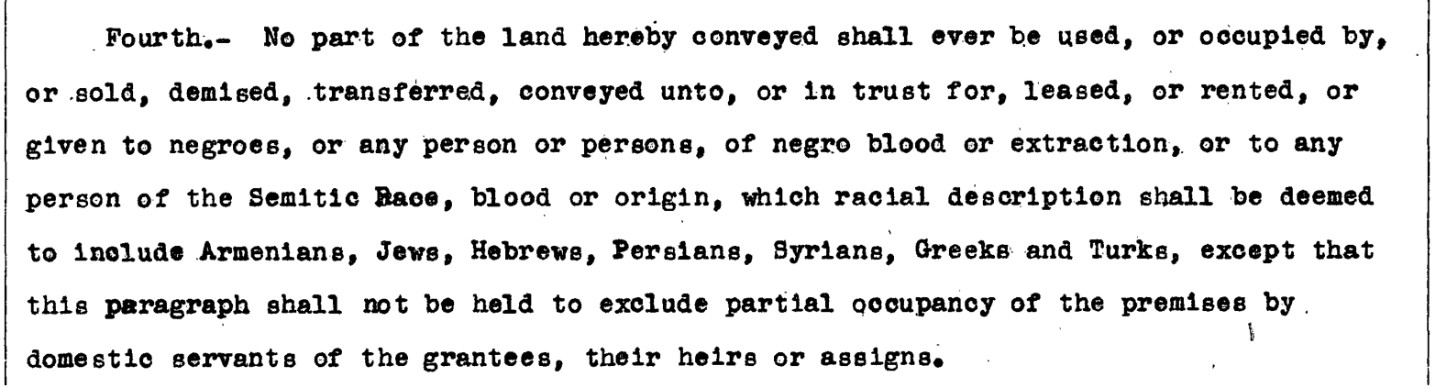
No part of the land hereby conveyed shall ever be used, or occupied by, or sold, demised, transferred, conveyed unto, or in trust for, leased, or rented, or given to negroes, or any person or persons, of negro blood or extraction, or to any person of the Semitic Race, blood or origin, which racial description shall be deemed to include Armenians, Jews, Hebrews, Persians, Syrians, Greeks and Turks, except that this paragraph shall not be held to exclude partial occupancy of the premises by domestic servants of the grantees, their heirs or assigns.
Swanson to King deed, March 26, 1941
The restrictions were set to run until September 1, 1965, and to continue after that unless the owners of all the land on both sides of the street, within the square, approved a change in writing.
Mapping Segregation lists Swanson lots marked “Semitic race” in Squares 2363 and 2381, from 1940 to 1949.
Same builder. Same wife on the deed. About a year and a half apart. The 1939 deed in Barnaby Woods has no such clause. The 1941 deed on Beech Street does. The records don’t say why.
Swanson’s wording wasn’t unique. According to the Afro-American in 1952, the covenant Richard Nixon signed for his house on Tilden Street in 1951 barred Black and Jewish buyers too, with the same exception for domestic servants.
Closer to home, in our look at Washington homes for sale in 1952, we noted a house on Birch Street NW, just north of Barnaby Woods, in what was then a restricted community.
Who lived there in 1940
The census taker, Robert S. Emery, worked 32nd Place NW in late April 1940. One of his sheets covers a stretch of 32nd Place and a house on Worthington Street.
The Wrights were there, the same family from the 1936 deed. Willard H. Wright, 45, born in Ohio, is listed as a zoologist. Dorothy, also 45, was born in Virginia. They had a daughter, Mary, 19, and a son, Robert, 15.
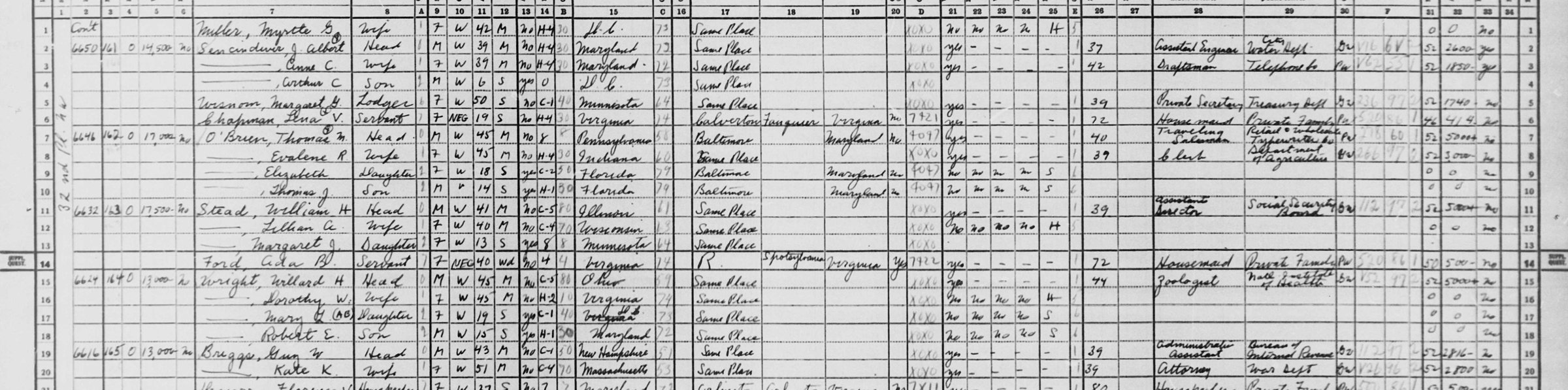
Their neighbors on the sheet included an assistant director at the Social Security Board, a bank vice president, an examiner at the Securities and Exchange Commission and an attorney at the War Department.
On the same sheet is James T. Berryman, 37, born in D.C., listed as a cartoonist for a daily newspaper. That’s almost certainly Jim Berryman of the Evening Star, son of the cartoonist Clifford Berryman. He’d win the Pulitzer Prize himself in 1950.
Every head of household on the sheet is listed as white. The only Black residents are three live-in servants, all born in Virginia: Lena V. Chapman, 19, Ada B. Ford, 40, and Bessie Thornton, 29.
One census sheet is a slice of one street, not a whole neighborhood. Swanson’s 1941 covenant made one exception to its ban: domestic servants.
How it ended
Covenants like Swanson’s stopped being enforceable in court on May 3, 1948. That day, the Supreme Court decided Shelley v. Kraemer and its Washington companion case, Hurd v. Hodge. The Fair Housing Act of 1968 later banned housing discrimination based on race, religion and national origin.
The ruling reshaped neighborhoods across the city. In LeDroit Park, Black professionals who had been shut out of much of Washington could finally buy elsewhere.
Barnaby Woods is still mostly 1930s colonials on wooded lots. We once found a June 1935 ad for 6431 Barnaby Street.
What the Post promised in 1937 never shows up in the Barnaby Woods deeds we read. A few blocks away, on Beech Street, it’s spelled out in full.
If you live nearby, there’s more Chevy Chase D.C. history in our stories on the Avalon Theatre and Broad Branch Market.