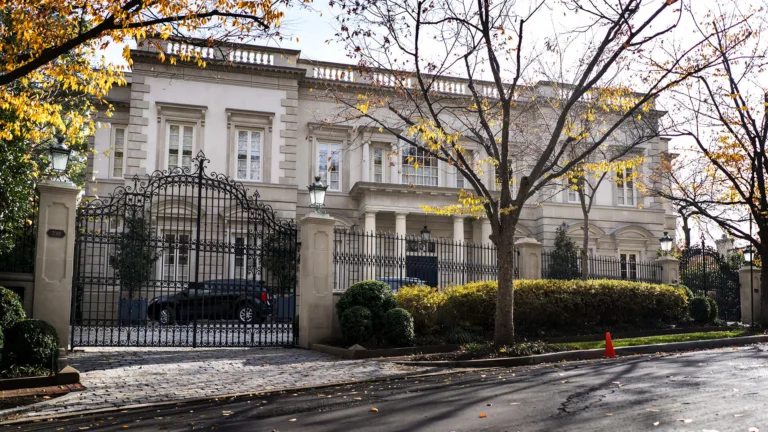


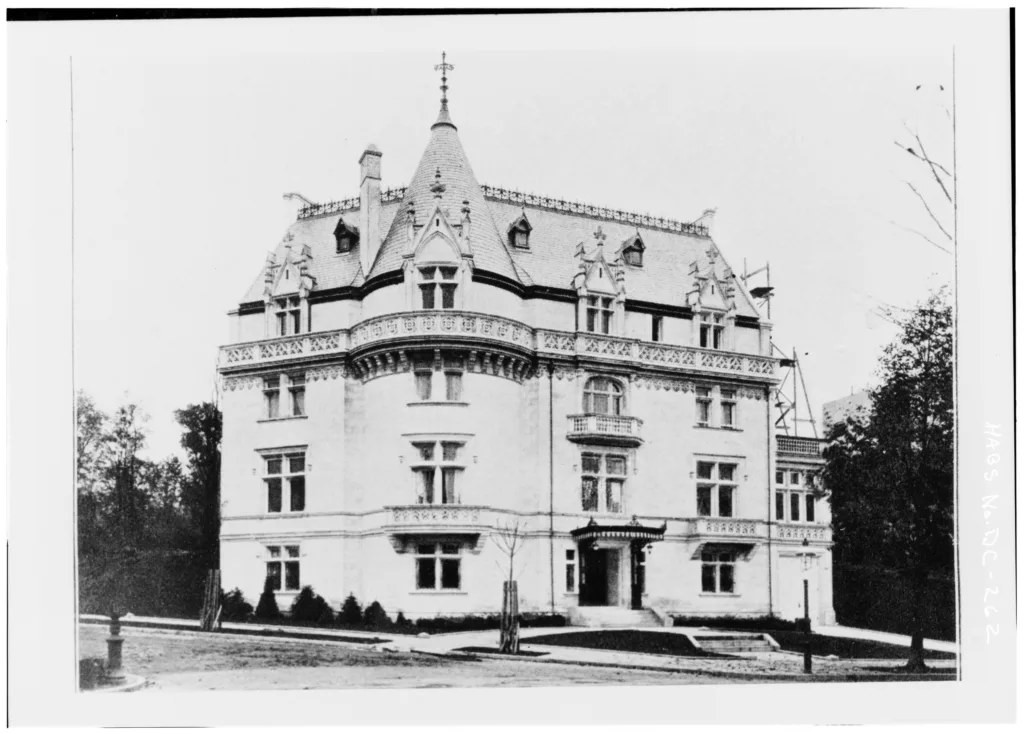
Walk up Massachusetts Avenue past Sheridan Circle and you can’t miss it. At 2349 Massachusetts Avenue NW, on the corner of 24th Street, stands a limestone château with a round tower, a steep slate roof and an iron finial. Today it’s the Embassy of Cameroon. The man who built it meant it to be Norway’s legation and his family’s home.
A château on Massachusetts Avenue
Norway and Sweden had shared a king and a legation in Washington. When the union dissolved in 1905, Christian Hauge, who had been secretary of the joint legation, became Norway’s chargé d’affaires. The Washington Post later gave March 21, 1906, as the date he was appointed minister.
Hauge had already bought the lot at Massachusetts Avenue and 24th Street. The Post reported in June 1906 that George Oakley Totten Jr. had drawn the plans for a four-story stone front and that local builder John McGregor had the contract. The projected cost was about $50,000.
In September 1906, the Post reported that Hauge and his wife, Louise, were staying at the Willard before sailing for Europe. Hauge owned the house himself. The 1907 Baist atlas labeled it “Norwegian Legation” anyway.
A suite in an unfinished house
The Hauges spent the summer of 1907 in Bar Harbor, where Louise’s son Frederick Joy died of typhoid fever.
In September, the Washington Times reported that she would sit out the social season and the house would stay closed until the couple returned from Europe. The Post reported the next day that a suite of rooms would be made ready for the couple to use temporarily while the rest of the house was unfinished.
Hauge signed his will on November 8, 1907. Four days later, he and Louise sailed from New York. They stopped in London and then went to Paris to choose furnishings and decorations before continuing to Norway. They expected to return to Washington in February.
On December 19, Hauge went out alone near Christiania, now Oslo. When he failed to return, a search party went looking for him. The Post’s front-page dispatch reported that doctors attributed his death to heart failure, probably brought on by exertion.
American dispatches described a snowshoeing trip. A 1912 Evening Star profile described him as skiing.

Washington lawyer Ellen Spencer Mussey filed Hauge’s will for probate in February 1908. By then, the Post put the cost of building the mansion at about $150,000, three times the estimate it had printed in 1906.
Louise Hauge makes it her home
Louise returned to the house in 1911. In a profile the following year, the Evening Star wrote that the associations of the unfinished rooms had kept her away and that she had taken possession the previous autumn. The house had an elevator, a library hung with sage green brocade and a portrait of her son.
Louise wanted the carved paneling from a chapter house in Surrey for her Washington dining room. According to the Evening Star, she bought the whole building to get it.

One of the letters that reached Louise in 1922 told her to leave $20,000 in $1,000 bills outside a church in Northwest Washington. If she didn’t, the writer threatened to make her “disappear from the scenery.”
On March 17, a grand jury charged George E. Long, a War Department clerk, with sending the letter to Louise and making similar demands of Mary Scott Townsend.
Louise died in Vichy, France, on August 4, 1927. The Post still listed 2349 Massachusetts Avenue as her Washington home.
Czechoslovakia moves in
In December 1928, the Washington Daily News reported that Alexander Smith Cochran had leased the house for the winter and taken an apartment at the Hay-Adams while he waited for it to be ready. At the time of the report, he had taken possession of neither.
On March 15, 1929, the Post reported that Czechoslovak minister Ferdinand Veverka and his wife would move that day to the former Hauge house. In July the paper credited two Washington real estate brokers, Mrs. Pendleton Mayo and Mrs. Henry Price Wright, with selling the house to the Veverkas. The Historic American Buildings Survey records an April 11 deed to the Czechoslovak Republic.
Norway took possession of its own purpose-built legation at 3401 Massachusetts Avenue in the early summer of 1931.
On January 28, 1933, a four-alarm fire broke out near a third-floor stairway. The Post reported that firefighters suspected an electrical short circuit. Two firefighters were injured, and Mme. Veverka and her children were taken to a nearby legation. The Post put the loss at $35,000. The Star estimated it at $50,000.
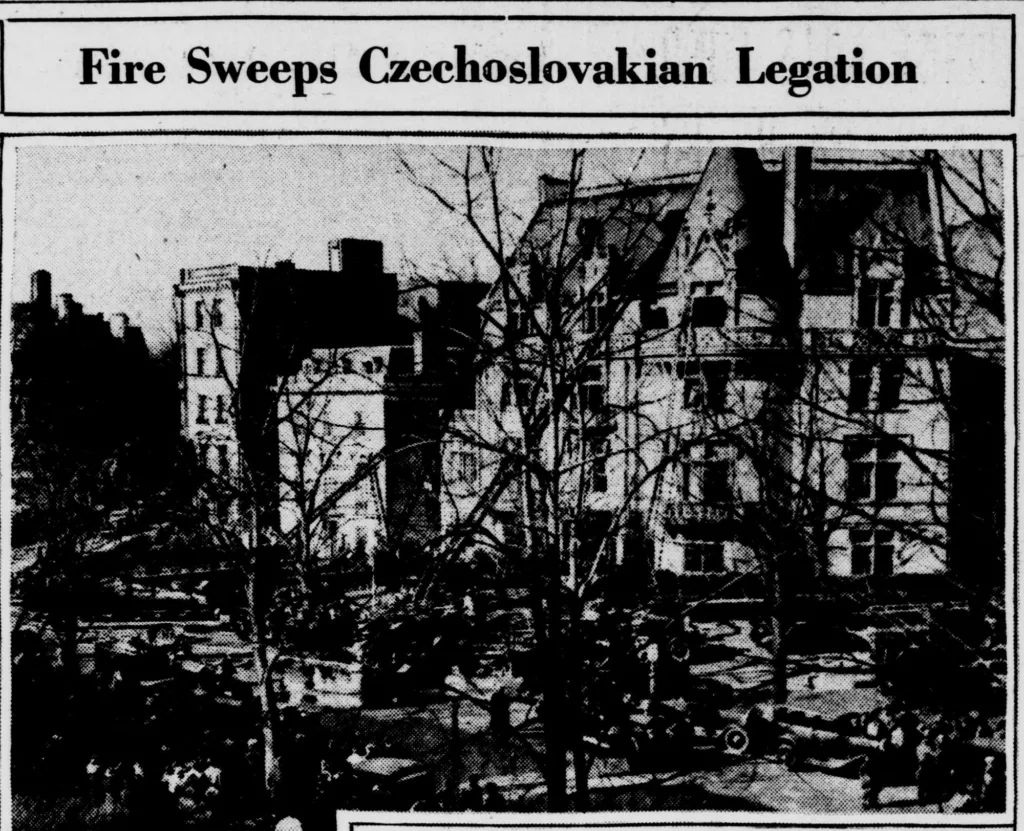
Totten, who had drawn the original plans, told the Post he had already been asked to restore the roof and the damaged part of the third floor. In April, the paper reported that the Veverkas planned a housewarming at the legation on Saturday, April 8, with tea and dancing.
The minister who refused to hand over the keys
When Hitler’s troops entered Prague in March 1939, Germany ordered its diplomats abroad to take over Czechoslovakia’s missions. A German Embassy official came to see Minister Vladimir Hurban about the Washington legation. On March 17, the Post put Hurban’s refusal on the front page.
Hurban said he would require a written order from President Emil Hácha stating that his government had voluntarily given up its authority. Until he had that letter, he was staying put.

Hurban kept the legation through the war and became ambassador in 1943. He left the United States for home in July 1946. His 1949 obituary said he had returned “to see the flag of the republic fly once more over Prague.”
The house remained Czechoslovakia’s embassy after the communist takeover in 1948. In September 1951, Ambassador Vladimir Prochazka held a two-hour press conference there. He suggested that easing American trade restrictions might open the way to talks about releasing Associated Press correspondent William Oatis, who had been sentenced to ten years in prison.
Cameroon opens the doors
Czechoslovakia held its opening reception at a new embassy on Linnean Avenue at Tilden Street on September 11, 1969. The Post reported that the offices were expected to finish moving from Massachusetts Avenue by October 1. When the Historic American Buildings Survey photographed the old house in 1970, the drawing room was empty.
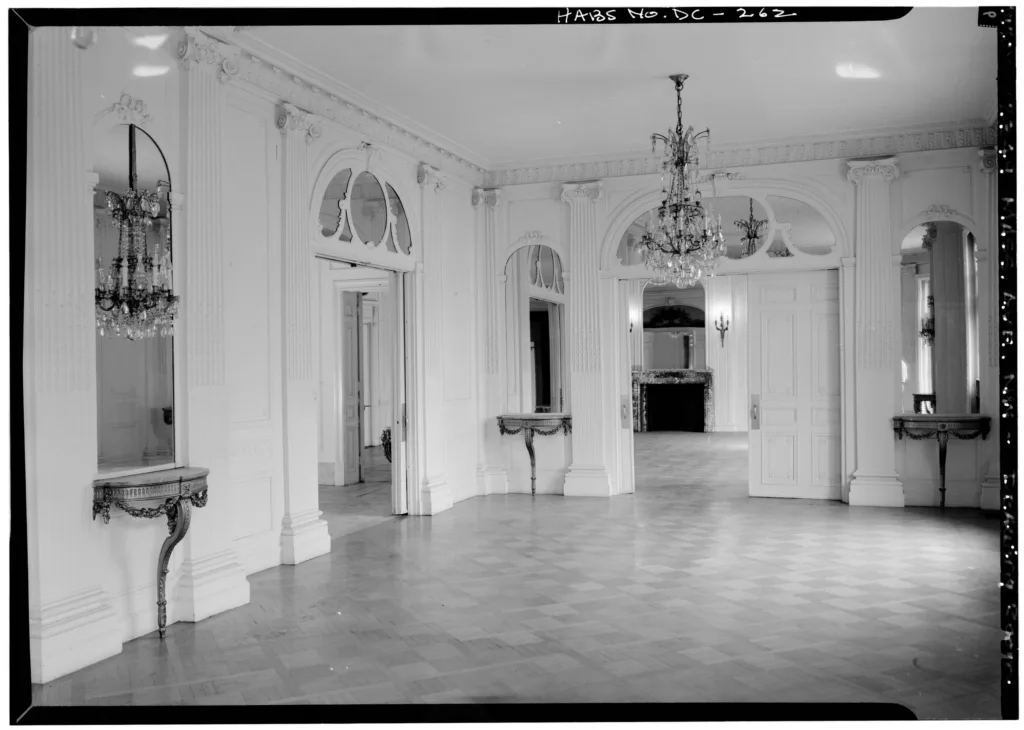
The Czechoslovak Socialist Republic sold the house to Cameroon on January 12, 1972, according to a deed abstract in the Historic American Buildings Survey. The survey says the chandeliers and canvas wall paintings were restored and a new heating system installed.
Ambassador François-Xavier Tchoungui gave a housewarming on March 24, 1972. The Post’s Jeannette Smyth described him gesturing toward the new carpeting, the staircases and the wrought-iron grilles in the front door. “If a country’s going to work, you have to have a nice place,” he told Smyth. About 500 guests came.
Liked this one? Get more tomorrow.
Lost Washington stories in your inbox most mornings: the newest, plus a few from the archive.
 This storyThe Embassy Row Château the Nazis Tried to Seize
 The Night Coolidge Came to the Fox: F Street’s Lost Movie Palaces
 Inside The Big Hunt: How a 1928 Dupont Storefront Became DC’s Weirdest Bar
Free. Unsubscribe anytime.
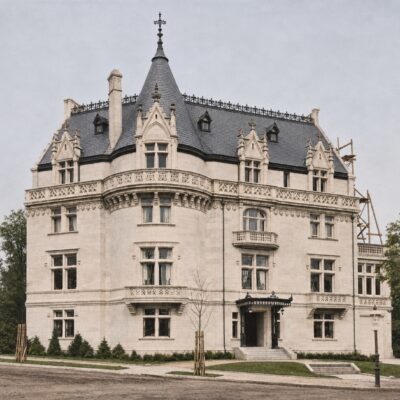
AI assisted with archival research and editing. The featured photograph was restored and colorized with AI. The original appears in the article. Here’s how we use AI.Suggest a correction