
Seventy-five years ago this week, on Friday, November 2, 1951, the Hecht Co. opened its new department store at Wilson Boulevard and Glebe Road in Arlington. The next morning the Washington Post put it on the front page:
The $6,500,000 Hecht Co. Parkington department store opened for business yesterday to an estimated 60,000 first-day shoppers.
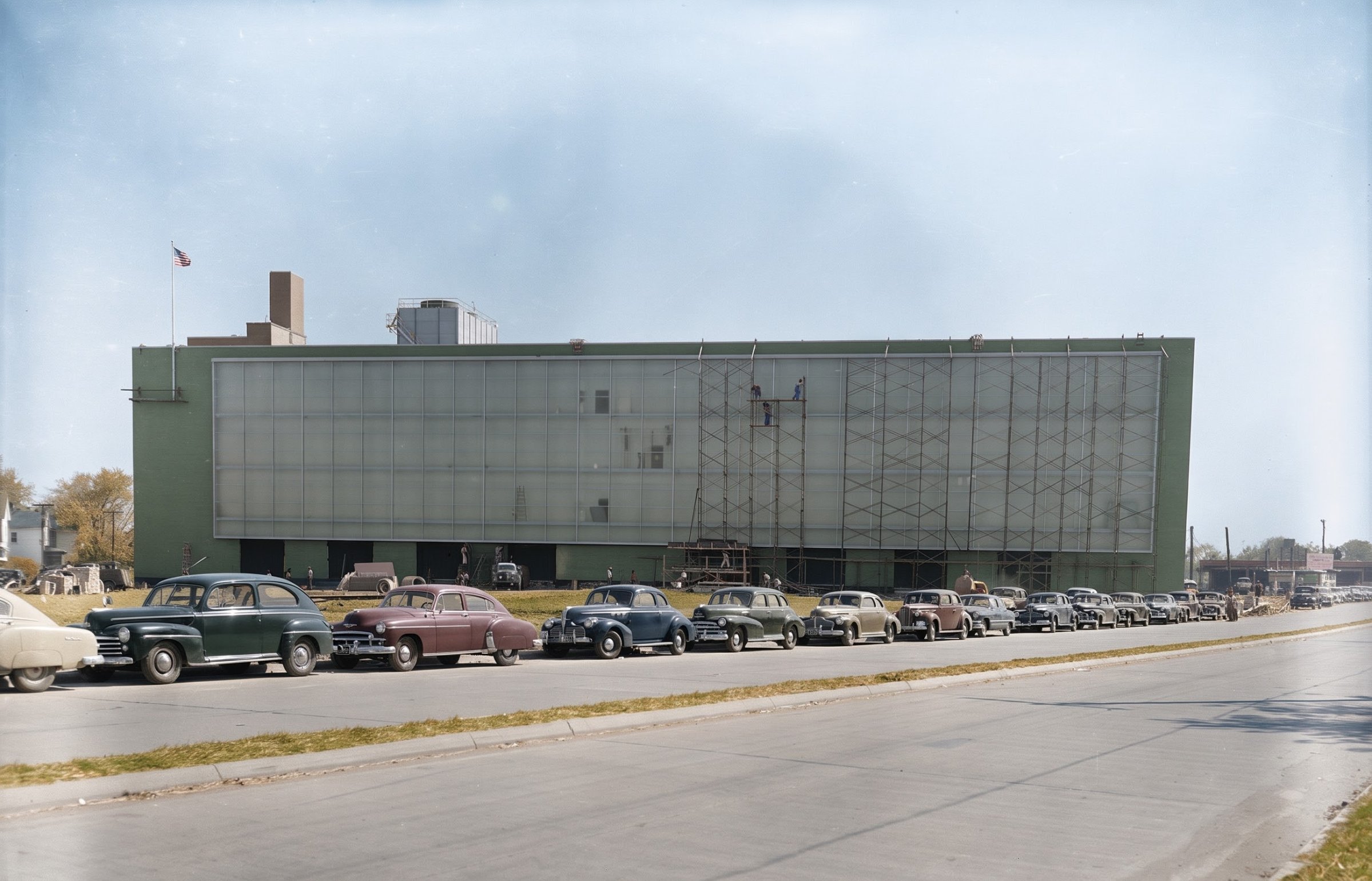
The mammoth green brick building, located at the intersection of Glebe rd. and Wilson blvd., Arlington, forms the hub of an incompleted one-stop shopping center which will include 30 smaller stores.
Sixty thousand people on day one! This was Parkington, the shopping center that later became Ballston Common and then Ballston Quarter, in the neighborhood named for the Ball family.
And it was only the first move in a race. Two weeks later, Kann’s opened a Virginia store of its own less than a mile down the road.
The Saturday exodus
In the early 1930s, if you lived in Arlington and needed a winter coat or a new sofa, you went into the city. In September 1951, with both stores going up, the Post looked back at how much had already changed:
Present-day Arlingtonians recall, less than 20 years ago, when there was a mass exodus from the county to Washington every Saturday. Housewives, and often the entire family, jammed buses, streetcars and private autos for their weekly shopping trips to the District. Today, few Arlingtonians find it necessary to step across the county line to solve their shopping problems.
A lot of that was thanks to Clarendon, which had picked up Sears, J.C. Penney, Murphy’s and a few other national chains. But the Post pointed out that Hecht’s and Kann’s were the first large Washington retailers to branch into Arlington, finishing what the chains had started. Hecht’s already had some practice, since it had opened a store in Silver Spring in 1947.
Twenty-six owners and a million bricks
According to the Post, Hecht’s spent five years planning the store. Vice president and general manager Charles B. Dulcan Sr. sent teams around the country to study the latest in one-stop shopping, and company researchers studied Arlington’s incomes, traffic, highway plans and new apartment buildings.
The goal, operating manager Milton P. Shlesinger explained, was a spot within 15 minutes’ drive of as many shoppers as possible. He figured about 300,000 people lived inside that circle, with Wilson and Glebe sitting right about in the middle of the county’s population.
Assembling the land was, in the Post’s words, “a slow, complicated process.” Hecht’s had to negotiate with 26 different owners to piece together a triangle of land, which took in the old Ballston Stadium, where neighborhood teams played football and the Redskins practiced in 1938. Depending on which day’s Post you read, the site came to 15 or 18 acres.
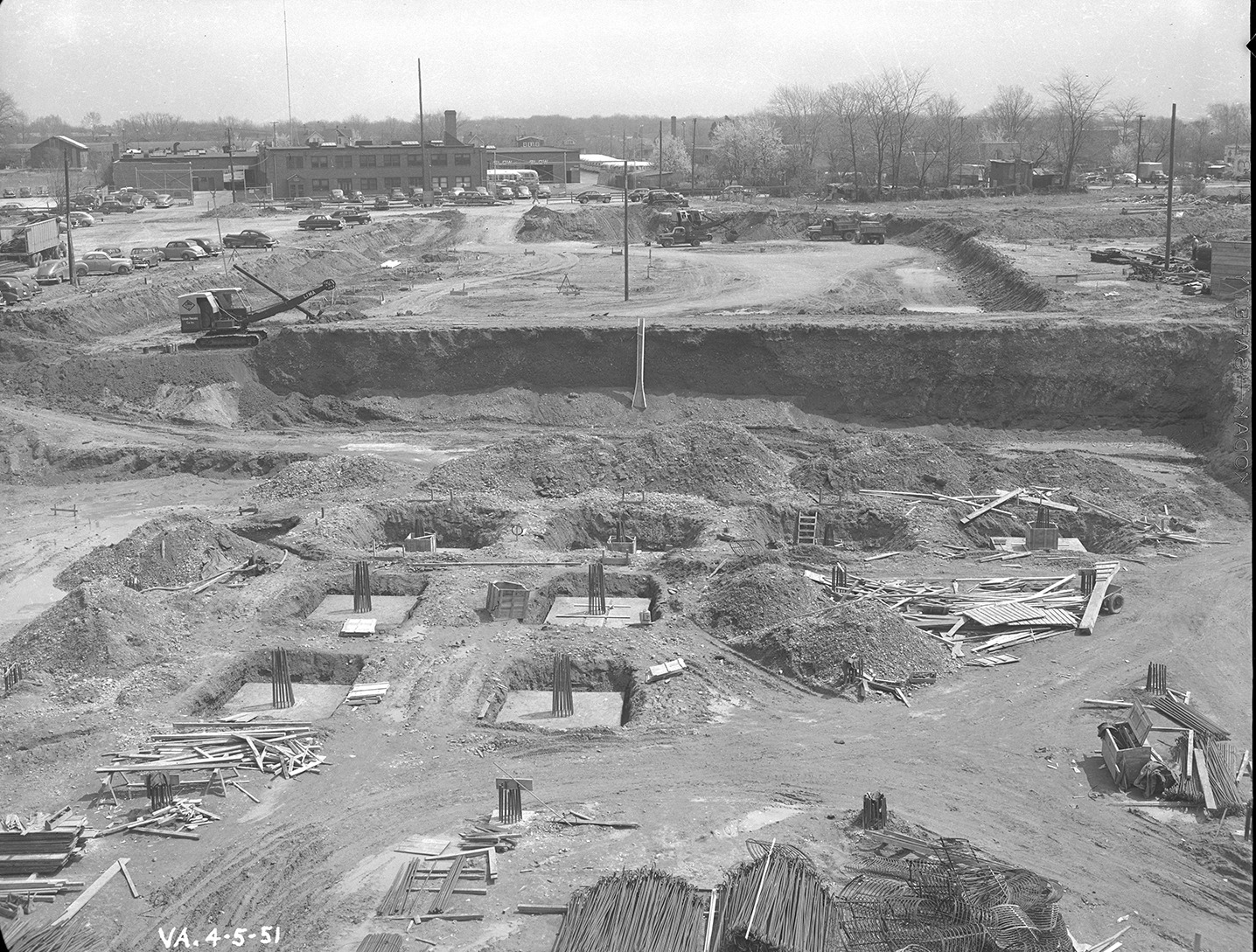
Dirt began to fly on July 31, 1950. (The Post’s November 3, 1951, story printed that date as 1951, but its own math, 459 days of construction and preparation, puts the start in 1950.)
The Prescott Construction Co. of Washington did the work with an average crew of 500 men a day. Its head, John G. Scharf, called it “an orthodox job that offered no serious complications but required a heck of a lot of men.” The buildings used about 35,000 cubic yards of concrete, which the Post figured was enough for roughly 50 miles of city sidewalk, and about a million bricks.
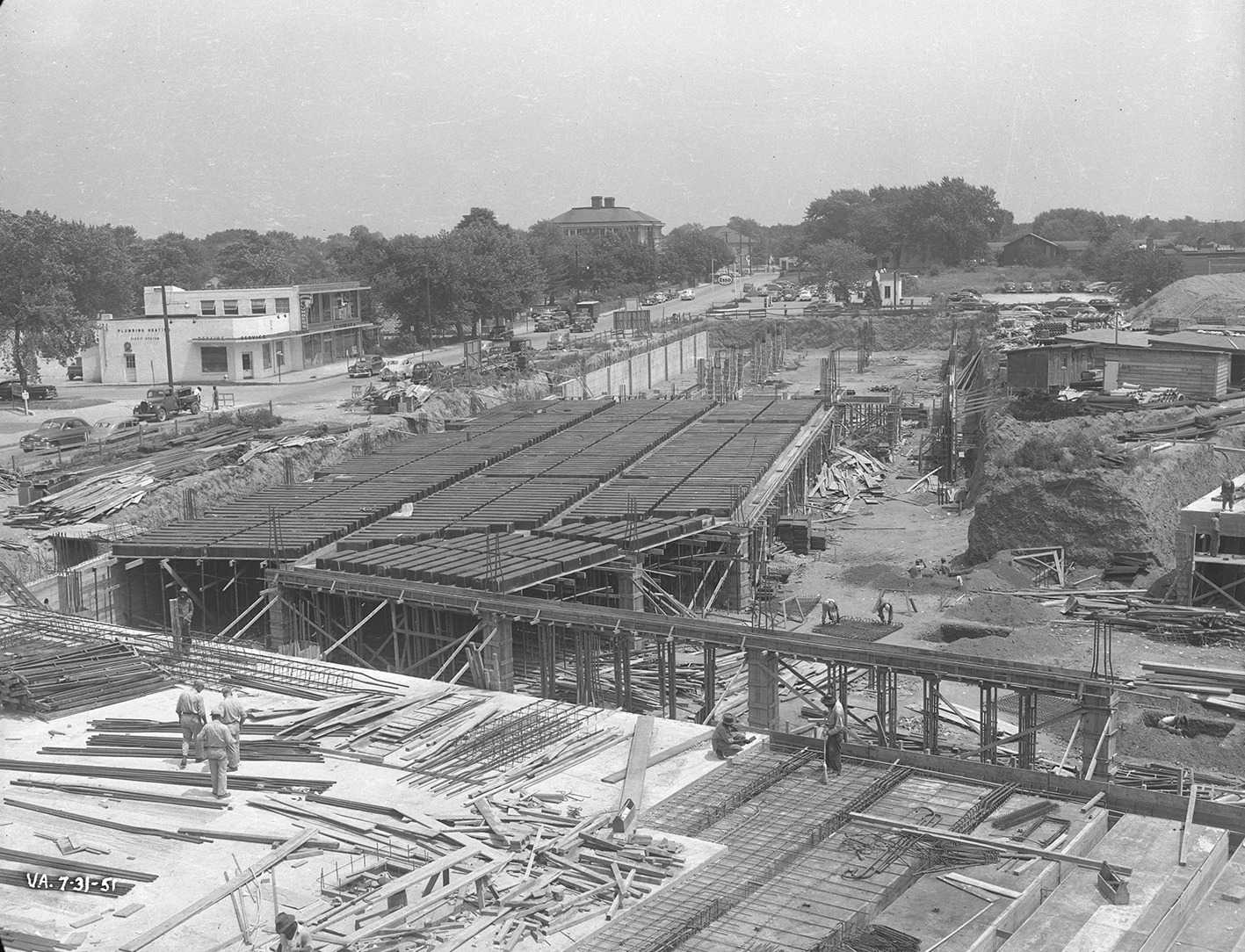
A shopping center named for its garage
The name told you exactly what Hecht’s was selling. Parkington was built around a 2,000-car parking building next to the store, plus surface lots, and the Post expected 10,000 cars to come and go every day. Anyone who had circled downtown looking for a space on a Saturday got the point right away.
The Post’s opening story described the parking as free. But a photo tells a slightly different story. It comes from a batch of old negatives Hecht’s threw out, which a Hecht’s color lab manager named Francis Copeland rescued and gave to the Arlington library. It shows a booth charging a nickel for three hours. We don’t know exactly when that sign went up, or how long it lasted.
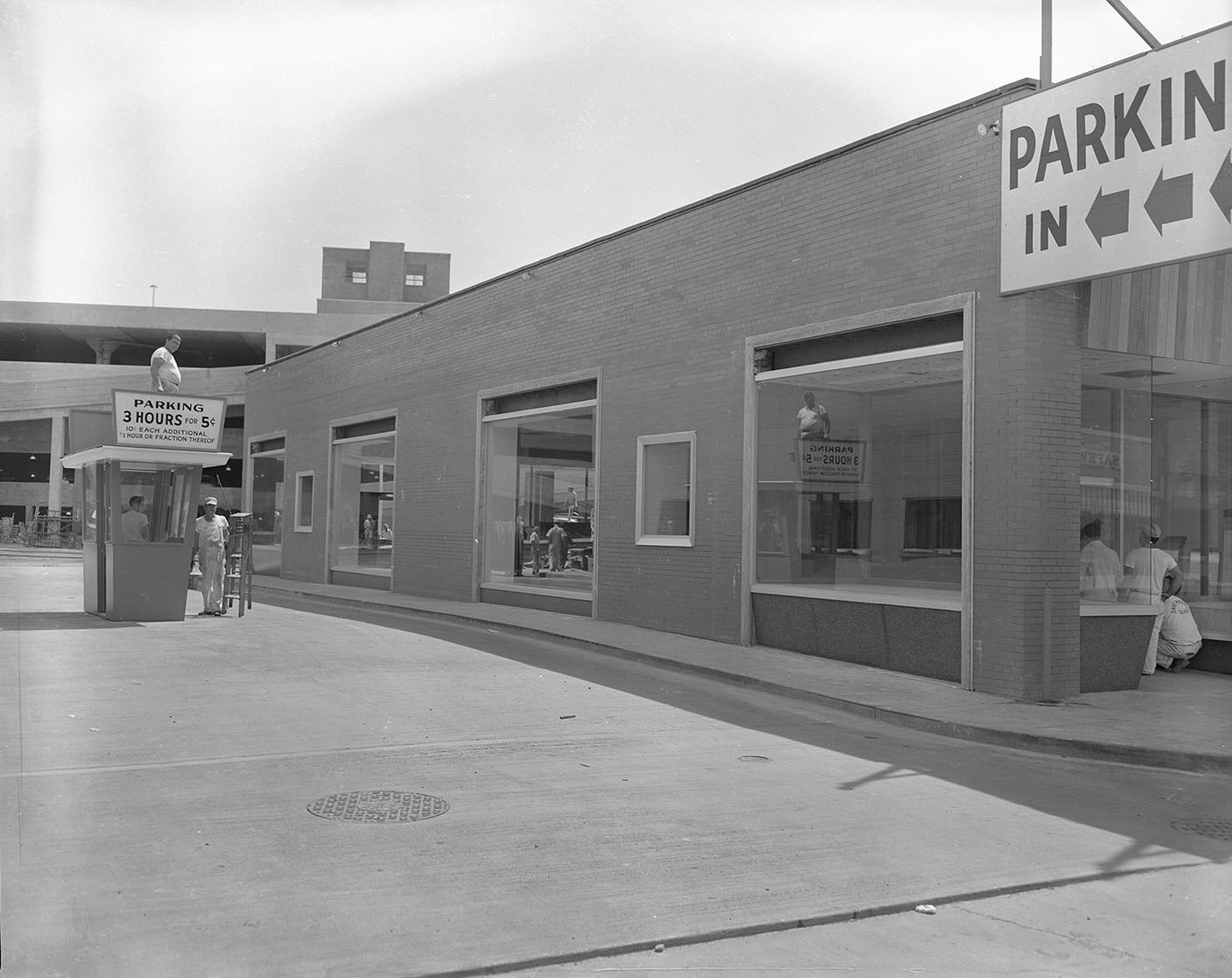
A glass wall you could repaint overnight
The store itself was a big green brick building with a front made almost entirely of glass: 279 panes, each 5 by 9 feet, reinforced with wire mesh and set in stainless steel. (The Post put the total at 15,000 square feet, although by our math it comes to about 12,500.) The Post called it the largest suburban department store in the East.
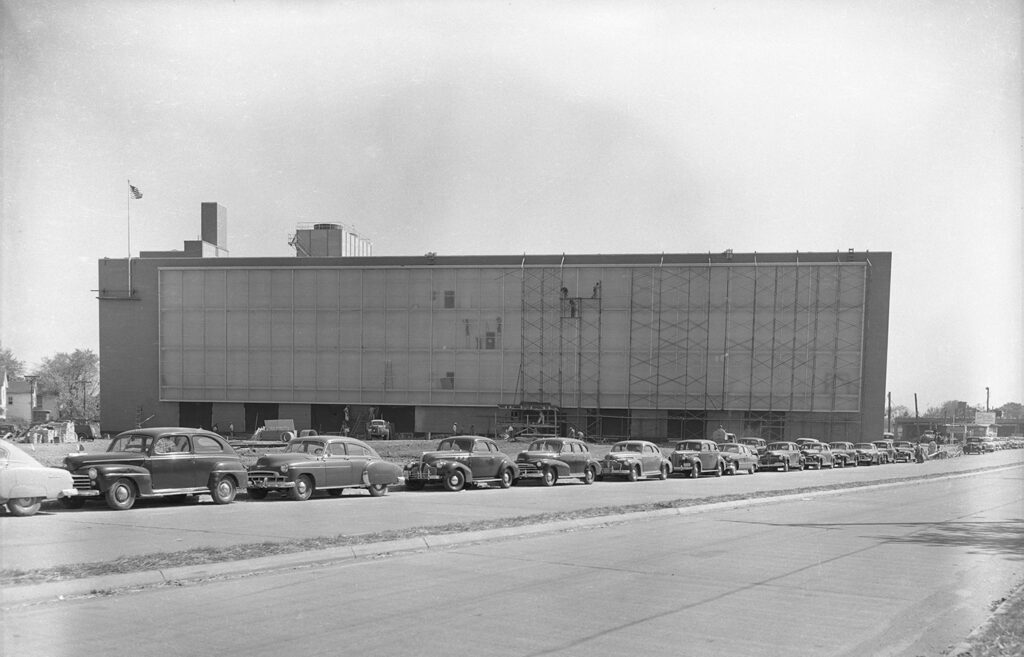
Robert Allan Jacobs, the New York architect the Post credited with designing Parkington, explained the thinking behind that glass front:
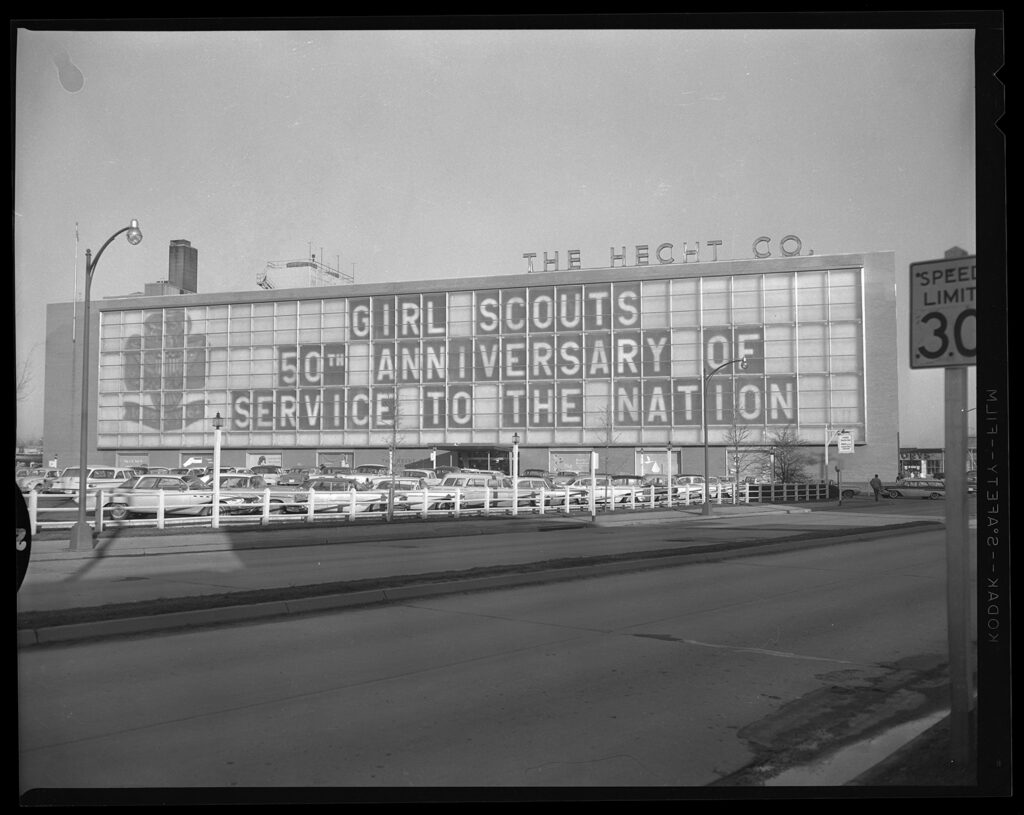
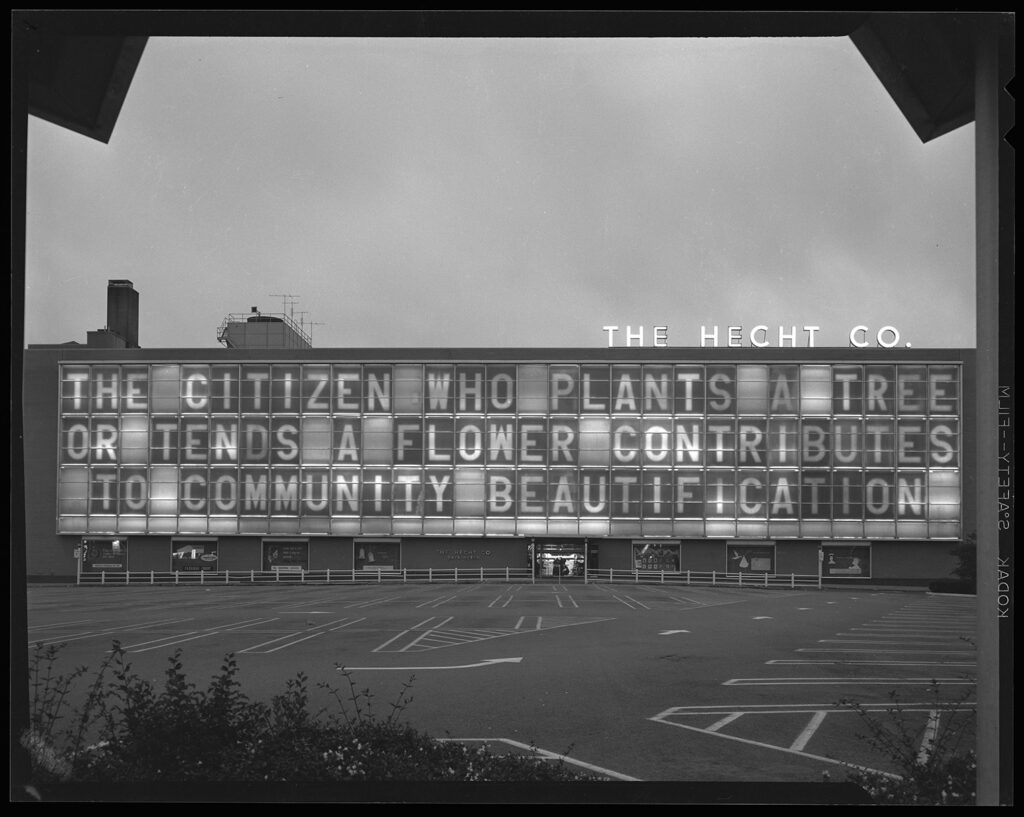
If there is a message the Hecht Co. wishes to get over to the people, it can be displayed in letters behind the facade. The theory here was not for display of merchandise but for display of color and light. Overnight the color of the facade can be changed by painting of [sic] hanging colored paper on the cinder block wall which is 2½ feet behind the glass skin.
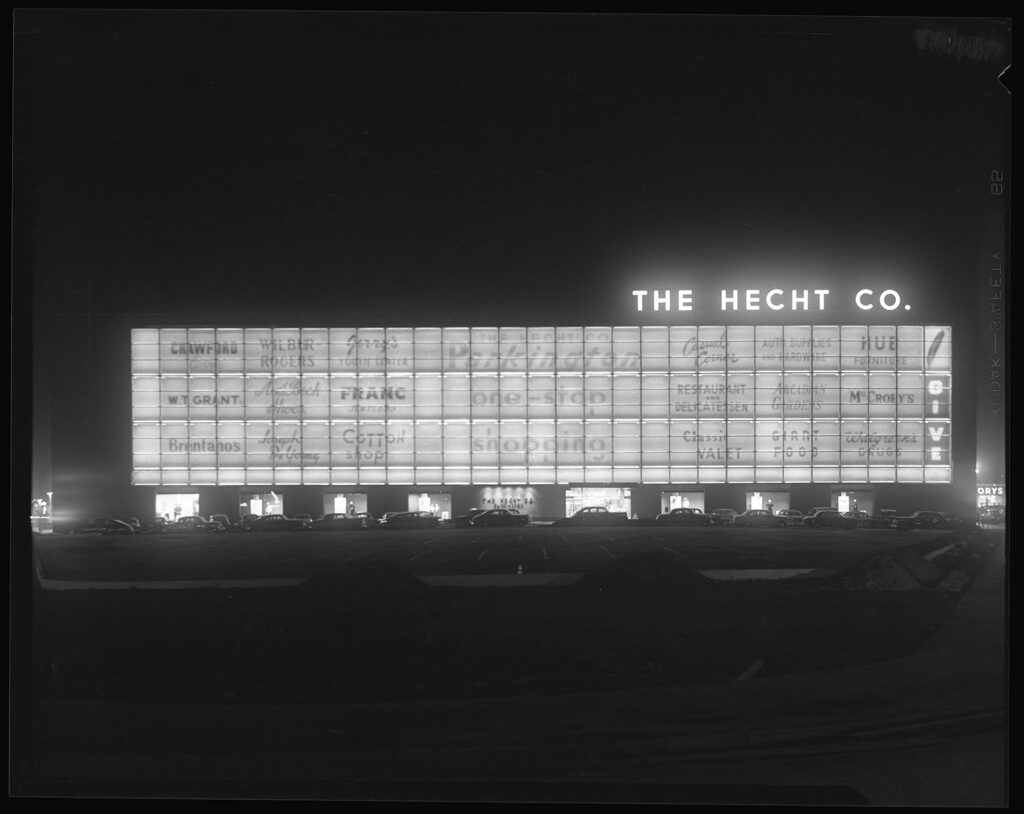
So basically, a billboard the size of a building. Over the years Hecht’s used it for holiday greetings and community causes like the Heart Fund, according to the Arlington Public Library.
Santa, reindeer and a key for the first customer
Opening day ran from 12:30 to 9:30 p.m. Hecht Co. officials handed a store key to the first woman shopper, cut a ribbon and declared the store open to the people, the Post reported.
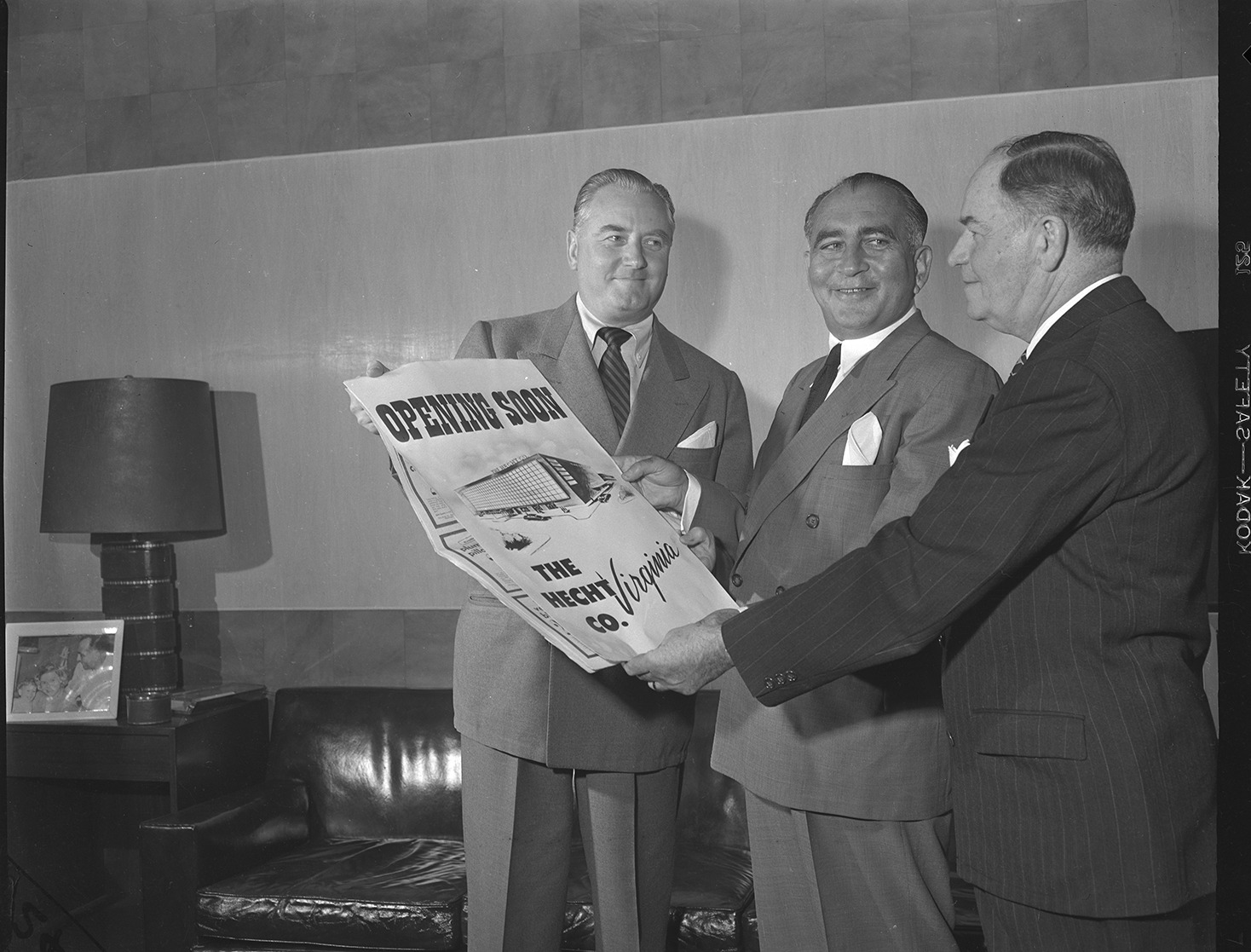
It was also, apparently, already Christmas. The store opened with carols, imported Australian trees and a display of reindeer dancing overhead, and Santa Claus was booked through December 25.
Hecht’s took out ads in the Evening Star that day too, and if you look closely at this one, the address says Parkington, Va., with no Arlington in sight.
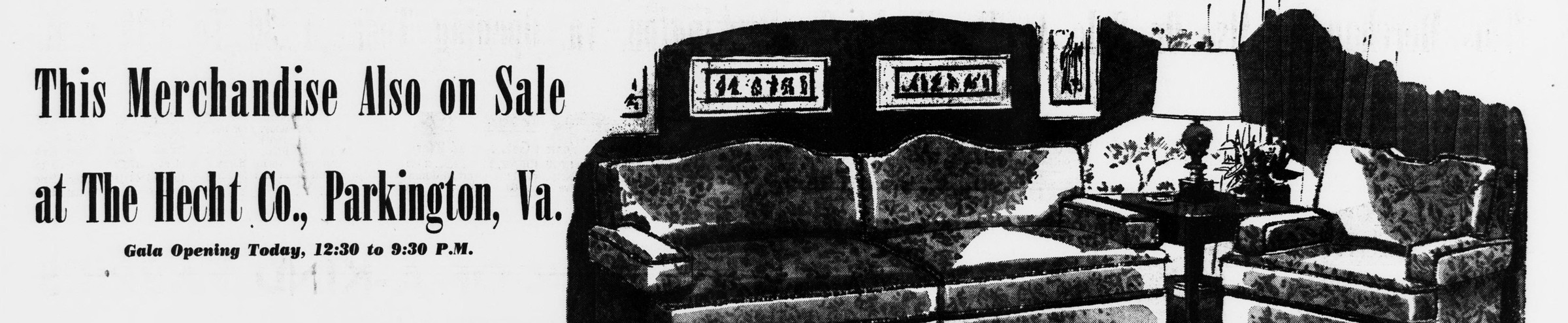
There’s no such place as Parkington
That address caused a small headache, because there was no such place, and Arlington noticed. The County Board took it up at its meeting on Saturday, November 17, 1951, and the Post reported the next day:
The abreviated [sic] reference, omitting Arlington, had nipped the county’s pride and caused official concern over the sudden existence of a brand-new community.
Board member Daniel A. Dugan told the meeting he had checked with the post office, and postal officials said some mail would be returned to the sender if it was addressed only to the Hecht Co. at Parkington, Va. The board’s clerk, Ruby Simpson, said her phone had been ringing all that week. Most callers didn’t mind the name Parkington, she said, they just wanted Arlington in there too.
Hecht’s attorney, Lawrence Douglas, told the board that from then on the store would be called “Parkington in Arlington.” The board was satisfied and let it go.
Kann’s, two weeks behind
For exactly two weeks, Hecht’s was the only big downtown Washington store with a branch in Arlington. On Friday, November 16, 1951, S. Kann Sons opened Kann’s Virginia on Fairfax Drive at Kirkwood Road, less than a mile east of Parkington, in what would become Virginia Square.
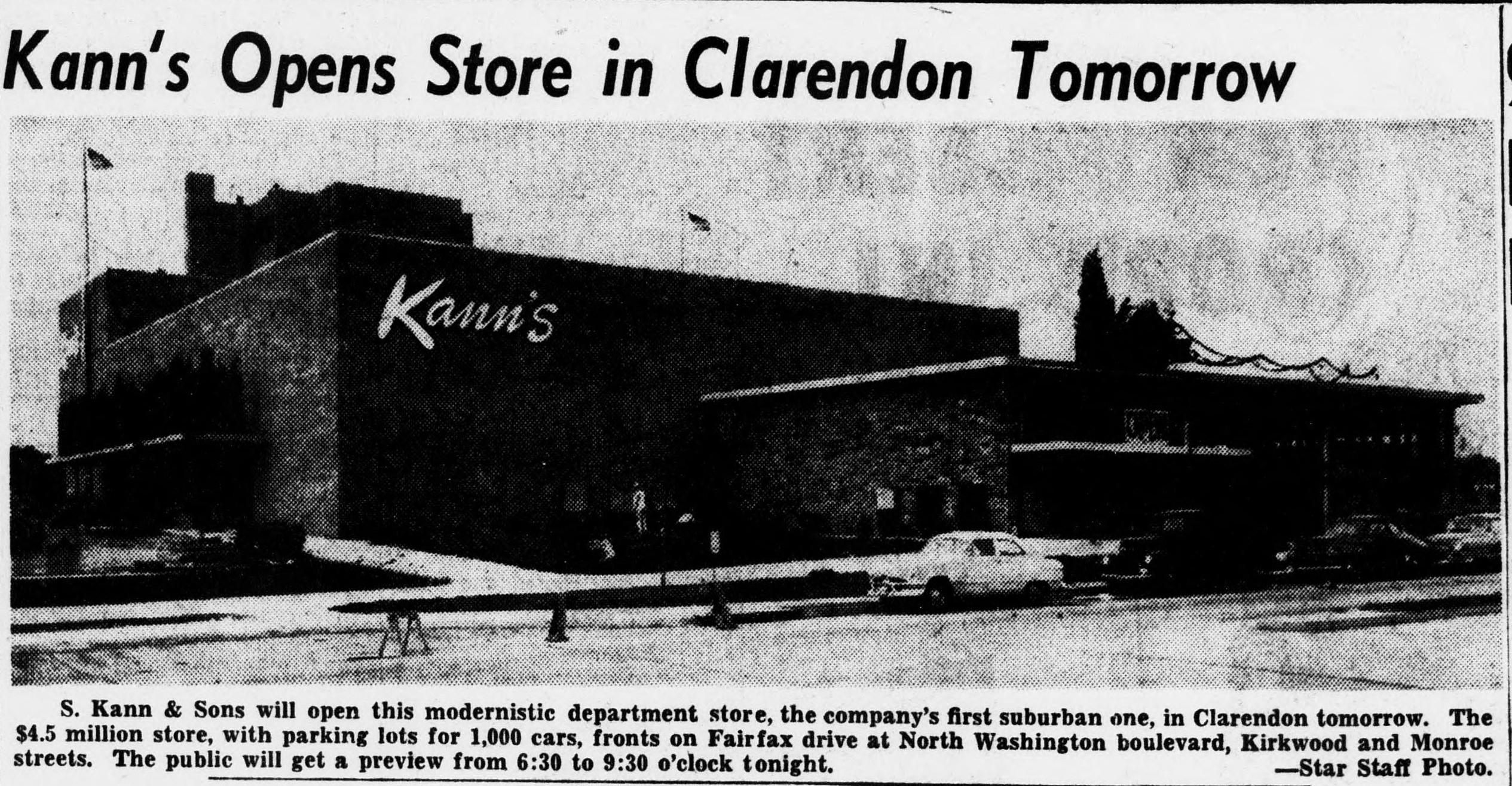
It was the company’s first suburban store after 58 years downtown, and the Evening Star put the cost at $4.5 million, with parking lots for 1,000 cars. Kann’s built it out of brick, crab-orchard stone, natural wood and glass, color-coded its departments, and installed a conveyor belt that carried purchases to a packaging room where you picked them up on your way out of the parking lot.
And then there were the monkeys. Here’s the Star, the day before the store opened:
And in the children’s shoe shop, youngsters will be amused by a quartet of Brazilian monkeys in a glassed-in cage circus-wagon, while mother and salesman struggle with the fitting.
Those monkeys stuck with a lot of kids who grew up shopping at Kann’s. Kann’s also put a display of Santa and a team of reindeer on the roof over the main entrance, so the Christmas competition between the two stores started right away.
What’s there now
Parkington had a good run, and Hecht’s kept following shoppers outward, eventually all the way to Tysons Corner. By the early 1980s the old center had gotten run down, and Arlington County put $13 million toward a rebuild that cleared away most of it but kept the Hecht’s store. The rebuilt center reopened in October 1986 as Ballston Common.
Hecht’s became a Macy’s in 2006, and Ballston Common was turned inside out into Ballston Quarter, which reopened in 2018. The Macy’s, in the old Hecht’s building, closed in March 2024 and came down in 2025.
As of August 2026, a 15-story building with 553 apartments and a grocery store was going up on the site of the old Hecht’s, at 685 N. Glebe Road, with the first residents expected in 2027.
Kann’s didn’t last as long. The company went out of business in May 1975, and George Mason University bought the Virginia Square building in 1979 for its law school. GMU started tearing it down in 2021. In its place now stands Fuse at Mason Square, home to the university’s Institute for Digital Innovation.
So both of the November 1951 stores are gone now. But the next time you pay to park in Ballston, remember that at one point it was a nickel for three hours.
We use AI to help research, write and edit stories across our sites. Here’s how we use AI.Suggest a correction
On the AtlasNewSee the 2 places in this story685 N Glebe Rd, Arlington · Kann's Virginia (1951)38.8787° N · 77.1122° W