
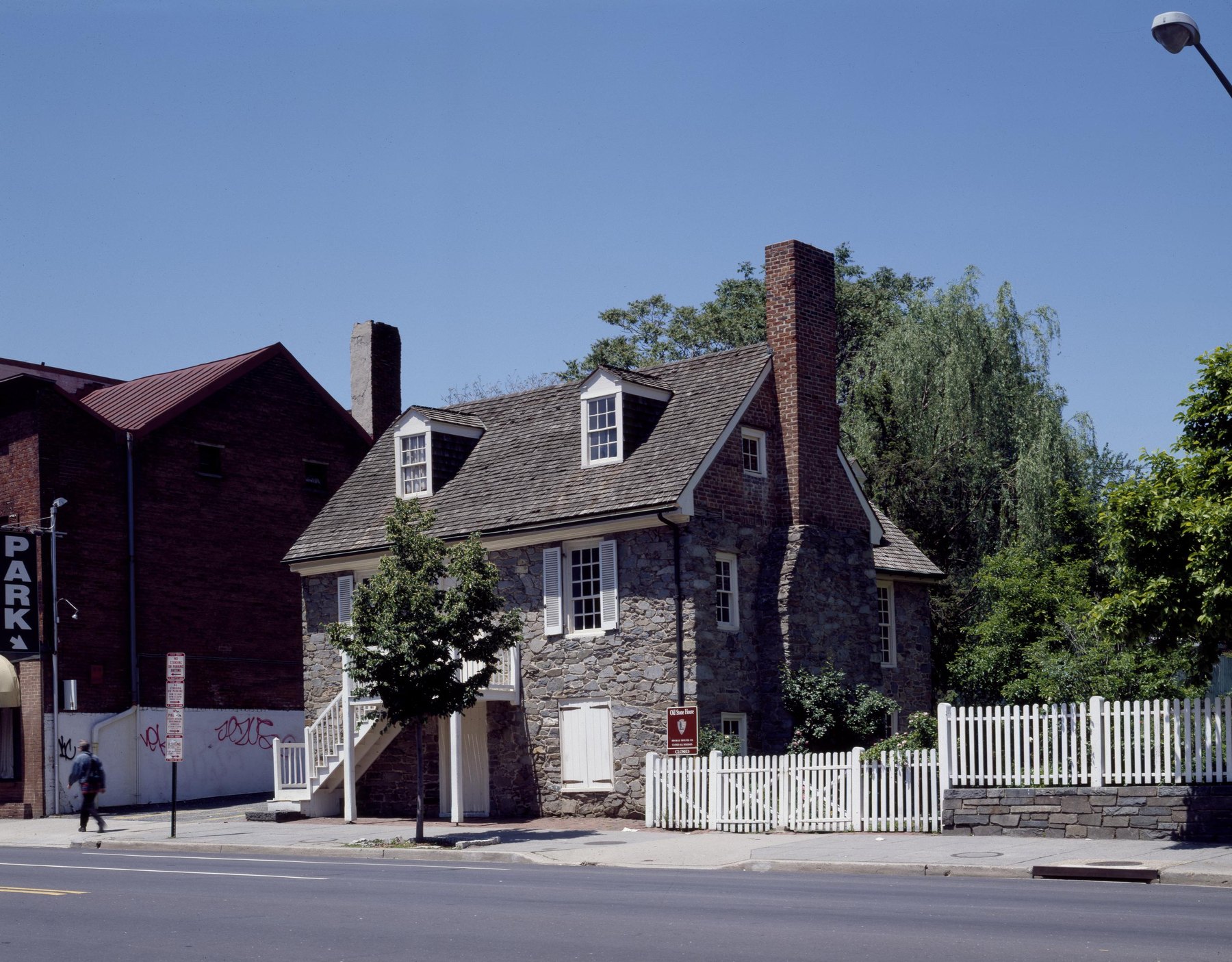
Ask a Georgetown ghost tour about the Old Stone House and you’ll hear about George. He supposedly lurks on the third floor, and in the best-known version of the story, he does not like women.
The real story is better. The house at 3051 M Street NW is “the oldest structure on its original foundation in Washington, D.C.,” according to the National Park Service. It was built in 1765.
And it’s still standing, in large part, because of a different George. One who, as far as anyone can prove, never set foot inside.
This is how a colonial stone house survived on a busy Georgetown commercial street: a legend on a sign, a used car lot, an act of Congress, a $90,000 check, and a Texas congressman who wanted to sell it.
Built by the Laymans, kept by the women
In 1764, Christopher and Rachael Layman came down from Pennsylvania with their two sons and bought Lot 3 on Bridge Street, today’s M Street. The price, per the Park Service: one pound, ten shillings.
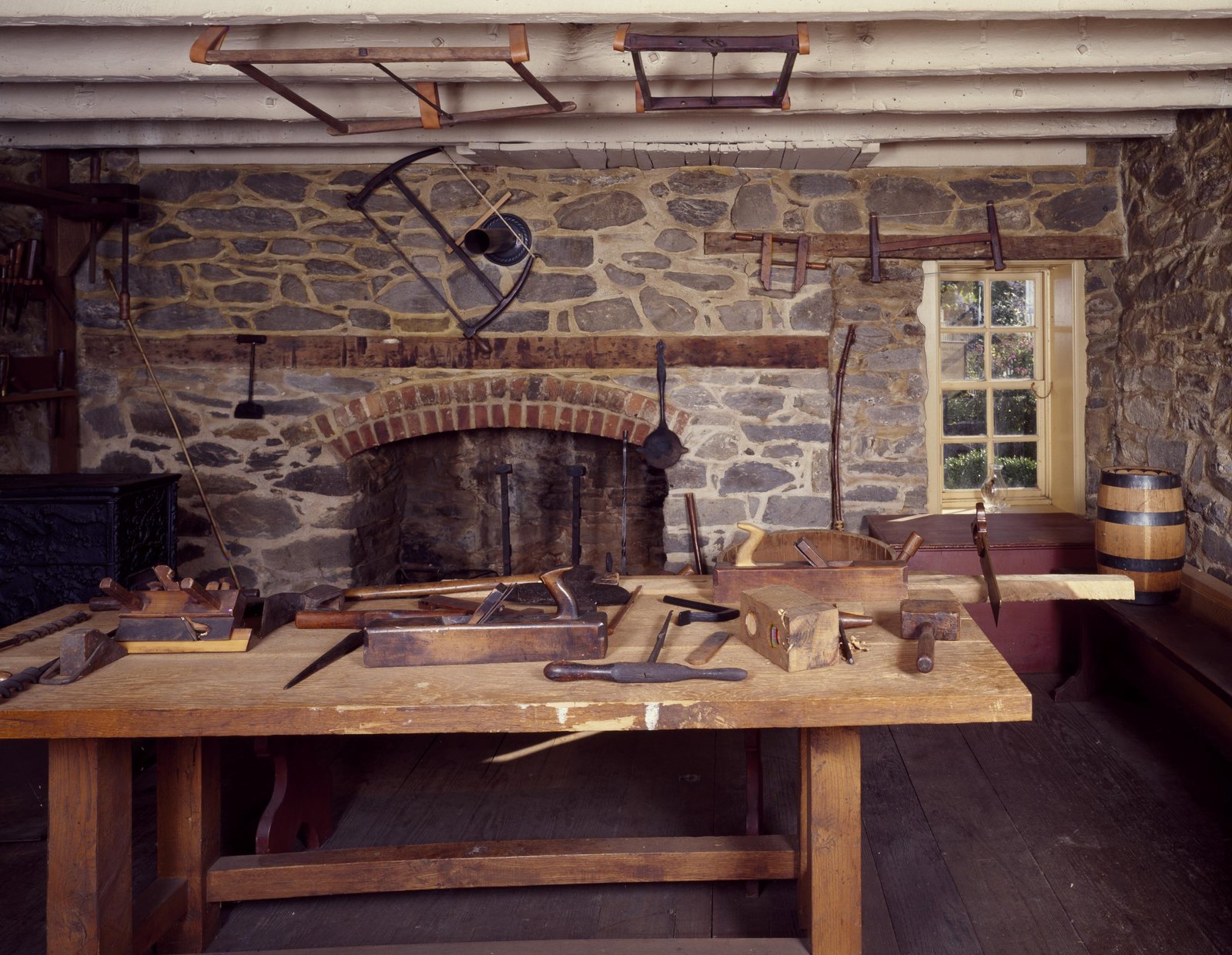
Christopher died in 1765. Rachael kept building. The walls are local blue fieldstone, quarried about two miles upriver, and the ceiling beams still carry the marks of a pit saw.
In 1767 she traded the lot to Cassandra Chew, a well-off Georgetown widow who paid for a rear kitchen and the upper floors over the next two decades. Chew herself lived elsewhere in town.
Chew and her descendants held the property for more than a century. Not until 1875 did two men, Richard Marcy and Calvin Payne, buy Lot 3.
The Park Service also notes that the women who owned the house in the 1800s were enslavers. One enslaved woman, Tabitha, held by Chew’s daughter Mary Brumley, worked in the house and eventually bought freedom for herself and her child. Whether enslaved people lived in the house itself isn’t known.
The sign that saved it
George Washington really did do business in Georgetown in 1791. As the federal city was being laid out, he met the local landowners at John Suter’s Fountain Inn, better known as Suter’s Tavern.
It was the same year Andrew Ellicott, with Benjamin Banneker’s help, began surveying the boundaries of the new District.
Suter’s son, a clockmaker named John Suter Jr., later ran his clock shop in the stone house on Bridge Street. Somewhere along the way, the Suters got blurred together, and so did their buildings. That’s the Park Service’s best explanation for how the stone house became Washington’s headquarters.
In February 1899, the Piram Ripley Society of the Children of the American Revolution made it official, at least in marble. Their sign read “General Washington’s Headquarters While Surveying Washington in 1791.”
The marble block eventually fell and cracked into pieces. A larger painted metal sign with the same words went up in its place.
By early July 1932, the owners had taken it down.
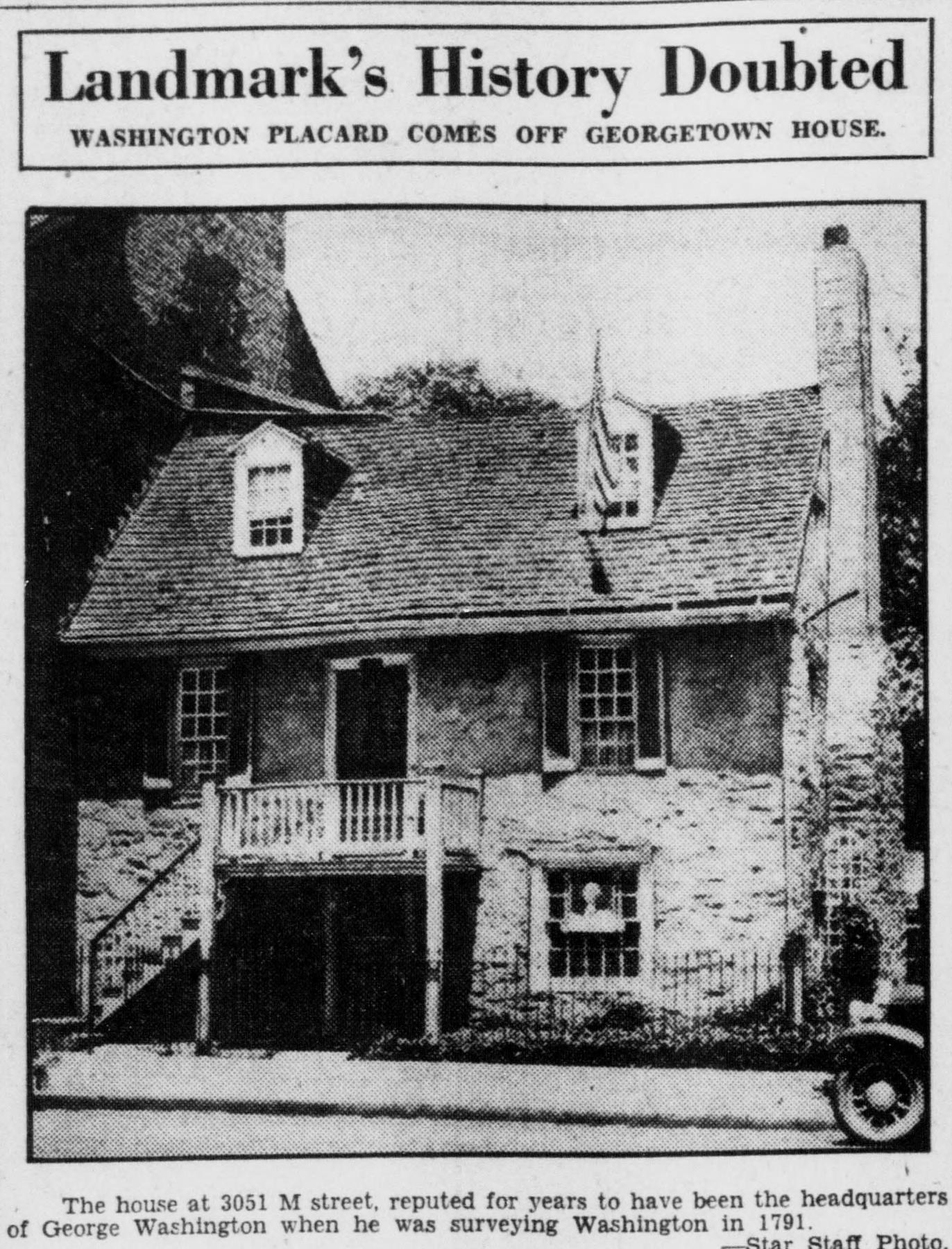
Alice Douglas Goddard and her brother, Frederick J. Goddard, had the records searched and found no proof. Neither could the Children of the American Revolution. The siblings planned a new sign, with real history from the land records and nothing about Washington. Mr. Goddard told the Evening Star:
It would be very pleasing if true, but since it is questioned, we feel we want on that sign only what is true.
Frederick J. Goddard, Evening Star, July 5, 1932
Honest landlords. Write that down.
At the time, C. H. Huddleston ran a slate roof shop on the ground floor and Mr. and Mrs. James R. Davis lived upstairs. The Washington story, though, had already done its work. The Park Service credits the legend with helping the house survive while the street changed around it.
The legend never fully went away, either. In December 1955, a Star columnist noted a plaque on the front saying George Washington had used the house as a headquarters.
Used cars on Lot 3
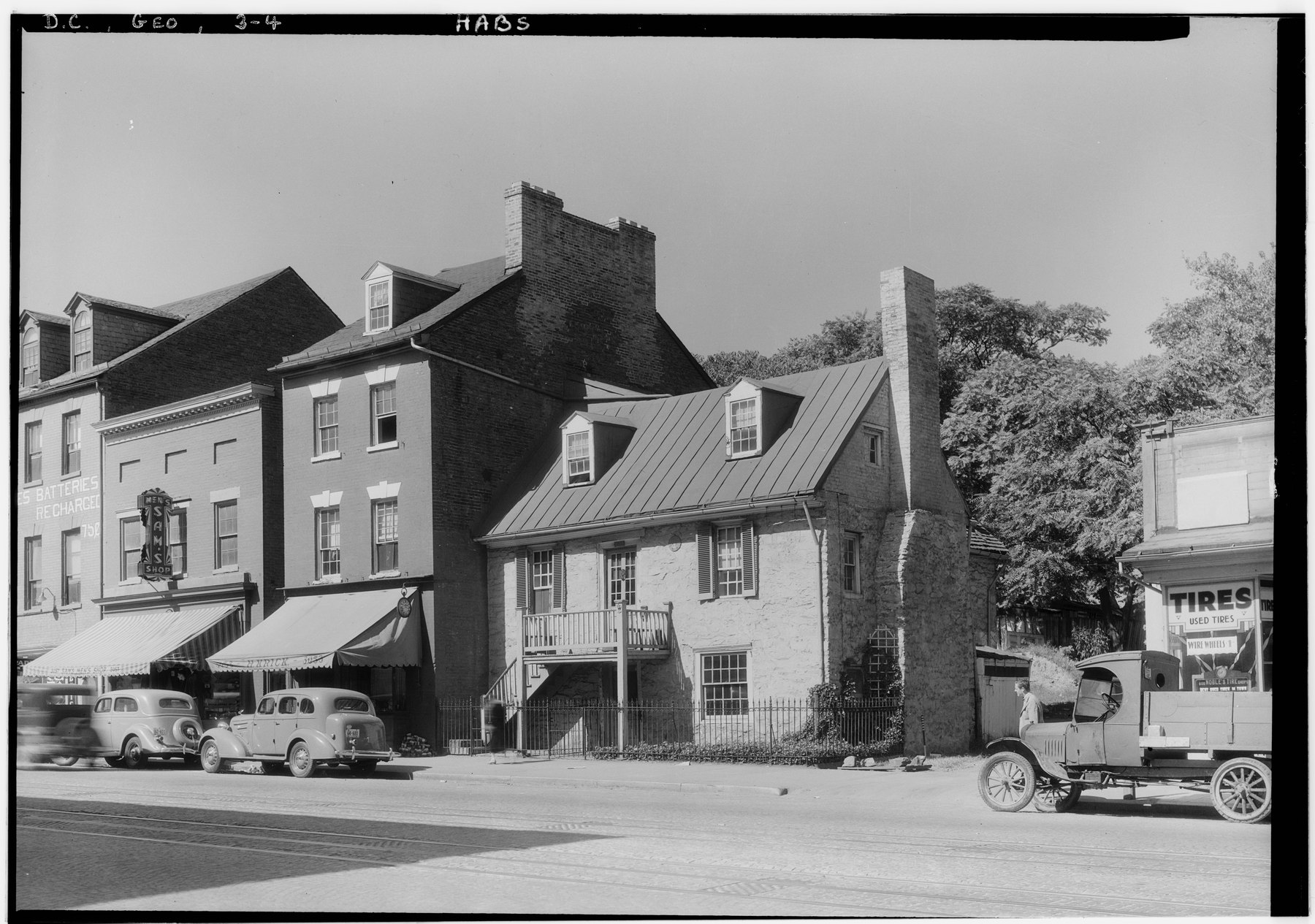
By 1950 the house had been in the car business for years. Parkway Motor Co. was advertising used cars from 3051 M Street by 1945. William Carter, one of its officers, and his brothers ran businesses in the building and on the parking lot next door.
In March 1950, Sen. Estes Kefauver of Tennessee introduced a bill for the federal government to buy the house as a museum. Georgetown’s citizens associations got behind it.
The owners did not. At a Senate subcommittee hearing on June 8, 1950, their attorney, Albert E. Arent, called the House bill’s $90,000 price cap “confiscatory” and warned of “a couple of years of litigation and turmoil.”
Then came the counteroffer. The owners would give the house to the government for free, Arent said, if the government moved it somewhere else and left them the M Street lot. Carter said the same thing, and added that his group would pay “far more” than $90,000 for the property.
A third witness, H. B. Swartwout, who ran a business on Thomas Jefferson Street, had a different complaint. The Star reported that he told the senators he thought it was
horrible that Senators have to take time to consider such a little house.
Evening Star, June 8, 1950
He wasn’t wrong about the size.
Congress went ahead anyway. Speaker Sam Rayburn had taken the House floor himself to push the bill, and President Truman signed it in September 1950. The government bought the property in 1953 for $90,000.
Parkway got six months’ notice to move out in 1954. The company left the house in July 1955 but kept using the lot for months after. That October, an Interior Department worker started sandblasting the whitewash off the stone.
A congressman tries to sell it back
The fight wasn’t over. In May 1956, Rep. Walter Rogers, a Texas Democrat, introduced a bill to make the government sell the house and bar the Interior Department from spending the $62,400 in restoration money then moving through Congress.
Rogers called its history dubious. He said he had nothing against restoration, but private groups should pay for it, and he called the project a raid on the Treasury.
At House hearings on June 14 and 15, 1956, about 20 defenders showed up. The Progressive Citizens Association of Georgetown, the National Trust for Historic Preservation, the American Institute of Architects and the Daughters of the American Revolution were among the groups lined up against it. Mrs. Harold B. Hinton, who had led the Georgetown campaign, told Rogers the citizens groups simply didn’t have the money.
Rogers ran out of session. He promised to try again the next January. The house stayed in federal hands.
Not Suter’s Tavern, not L’Enfant’s office
Meanwhile, the Park Service went looking for the truth. Its young historian, Cornelius W. Heine, got the research assignment in 1953 and quickly ruled out Suter’s Tavern. In 1955 he announced where he believed the tavern had stood: what is now 31st and K streets.
Even that answer didn’t hold. According to John DeFerrari of Streets of Washington, a 1986 archaeological study found that corner wasn’t occupied until about 1810.
The digging at the stone house turned up its own clues. By December 1956, under six or seven layers of basement flooring, crews had found old bottles, china, two coins and some unidentified bones. The Park Service’s chief archeologist, Dr. John M. Corbett, posed with an 18th century wine bottle pulled from beneath the floor.
In April 1959, Heine, by then a division chief at National Capital Parks, told the Association of Oldest Inhabitants that pieces of old printing type had turned up in the house, raising the question of an early Georgetown newspaper. He also told them, flatly, what the house was not. Not Washington’s headquarters. Not L’Enfant’s office. Not Suter’s Tavern.
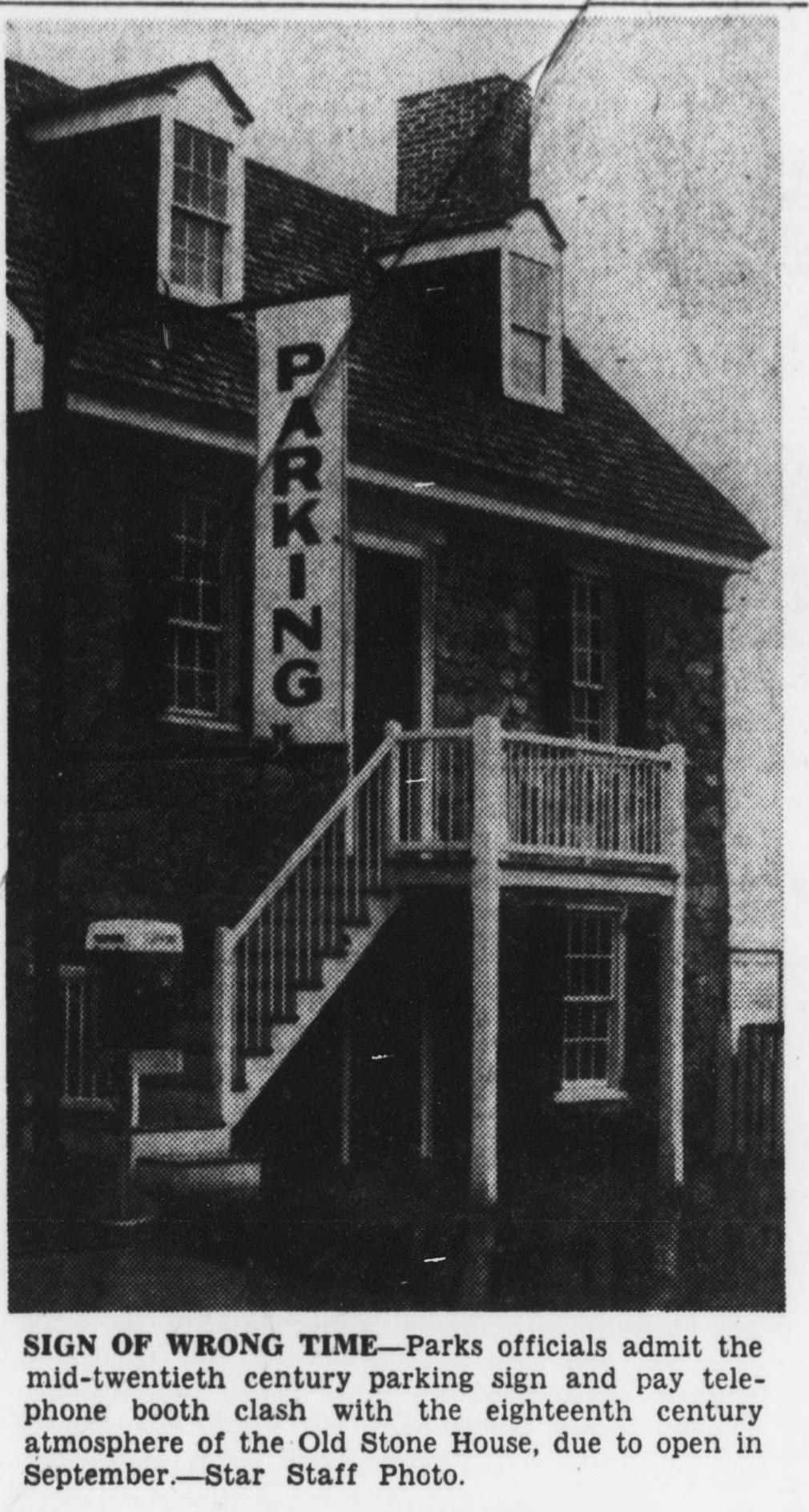
Opening day, 1960
At 3 p.m. on January 24, 1960, National Park Service director Conrad L. Wirth turned a five-inch iron key in the old box lock. More than 300 people came through that first day. Cedar logs smoked in the dining room fireplace, and Georgetown women in 18th century dress greeted the guests.
The Star‘s John W. Stepp gave it a refreshingly honest review:
Old Stone House has little of distinction to offer except itself. That is to say, it is just about unique among 18th century Washington area buildings in that neither George Washington nor Thomas Jefferson nor the Marquis de Lafayette slept or wassailed there so far as anyone knows.
John W. Stepp, Evening Star, January 25, 1960
That’s the whole pitch. It’s old, and it’s real.
So, is the Old Stone House haunted?
The ghost stories are modern lore. A 2018 WTOP Halloween feature, drawing on a published directory of haunted places, listed 11 alleged spirits in the house, from a woman in 1700s dress by the fireplace to a boy on the third floor. The worst of them is George, accused of shoving and choking women. WTOP itself noted that most of it has little or no sourcing.
We pulled dozens of Evening Star stories about the house, from 1905 through 1963. We found no mention of a ghost.
If you want a DC ghost story, try the Octagon House or the White House. At the Old Stone House, the only George with a documented hold on the place is Washington, and as far as anyone can prove, he never set foot inside.
What’s there now
The National Park Service still runs the house and its garden at 3051 M Street NW, between 30th and 31st streets.
The Washington sign is long gone. The house it was wrong about is still standing.