

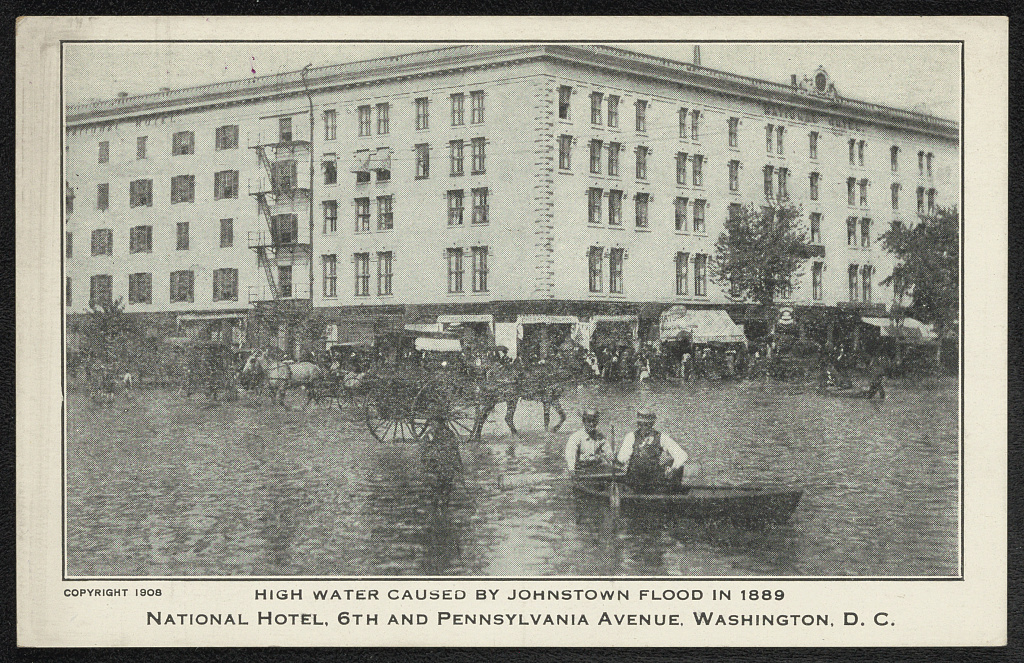
Check out the photo up top. Those two men are rowing a boat down Pennsylvania Avenue, right past the front door of the National Hotel, which stood on the northeast corner of 6th Street and Pennsylvania Avenue NW.
The photo comes from a postcard printed in 1908. Its printed caption blames the high water on the Johnstown Flood of 1889, which isn’t quite how it happened, but the scene is pure Washington.
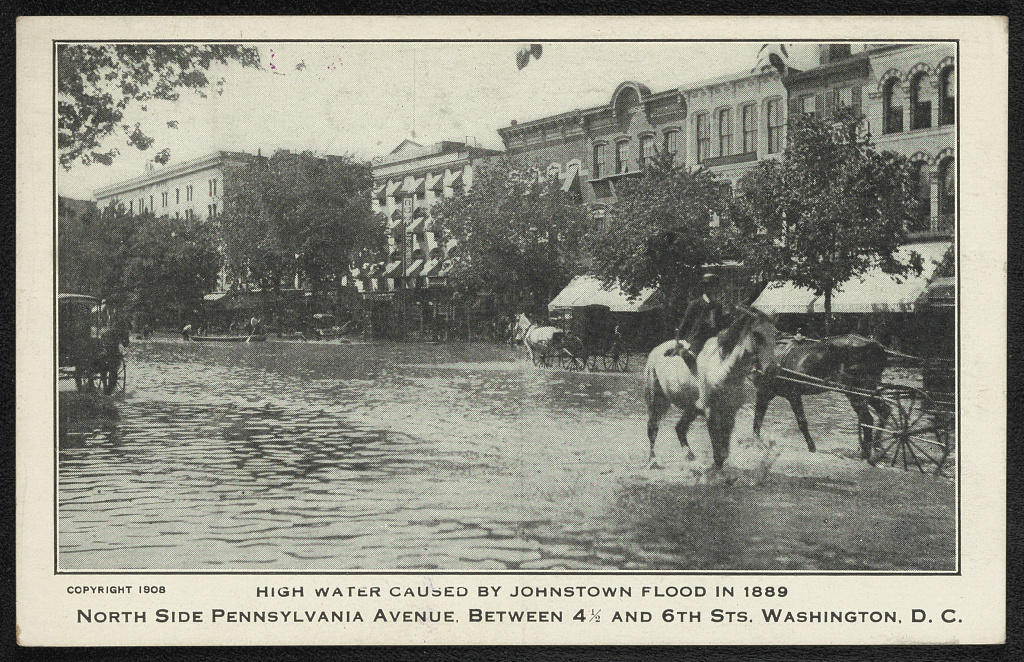
According to the Evening Star, the Potomac rose higher on Sunday, June 2, 1889, than the oldest inhabitant of Washington had ever known. Pennsylvania Avenue NW itself went under from 2nd Street to 7th Street, and again near 9th Street.
The Washington Post called it “a novel spectacle,” with “row boats dashing up and down the Avenue.” The boats dropped people off on the Avenue’s north sidewalk, especially by the National Hotel and around the Baltimore and Potomac Depot, a short block south.
South of the Avenue, the Star reported flooding all the way from the Capitol to 15th Street. It said the market house, Center Market, “stood in the center of a great lake.”
Three inches of rain and a river up the old canal
The Star reported that Washington’s rain gauge measured 3.10 inches on Friday, May 31, 1889, bringing the month’s rainfall to about 11.75 inches.
Washington wasn’t the only place under water that weekend, either. The same storm system brought the Johnstown Flood in Pennsylvania. On Saturday, June 1, the Washington Post’s front page carried the first word from Johnstown under the headline “HUNDREDS LOST.”
So the postcard up top has it a little tangled, since Johnstown didn’t flood Washington; the two floods simply shared a storm.
The Star explained that the water came up along the line of the old canal and flooded the low ground south of Pennsylvania Avenue until it reached the Avenue itself. That was the old Washington City Canal, which followed the line of Tiber Creek and once ran along the south side of the Avenue.
Cellars south of the Avenue filled early Saturday evening, and by midnight, the Star reported, the low ground in the center of the city there had begun to overflow. Nearly every business between the Avenue and B Street flooded that night.
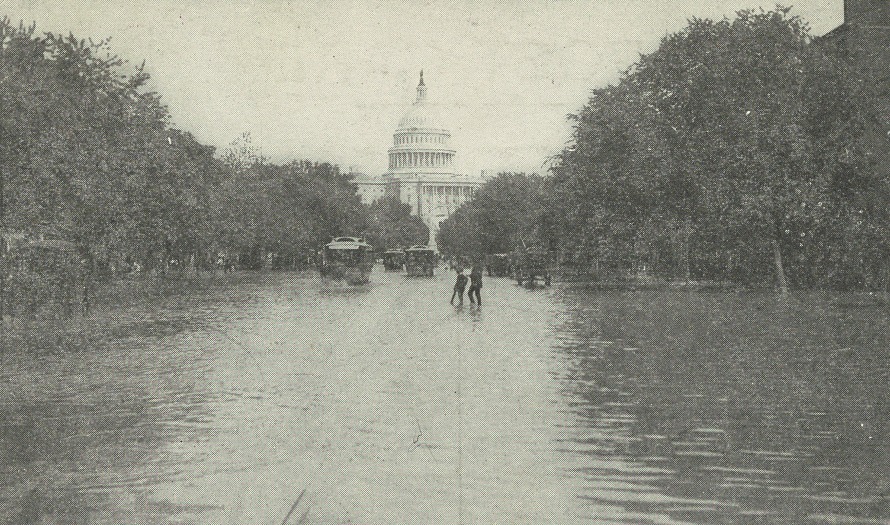
Boats on Pennsylvania Avenue
When Washingtonians woke up on Sunday, June 2, every street running south from the Avenue between the Botanic Garden and the Treasury had turned into a canal. Here’s how the Star described the scene the next day:
On some parts of Pennsylvania avenue the water rose nearly to the floor of the street cars, which continued to run. Venturesome persons in carriages and wagons drove through water hub deep and shared the thoroughfare with wading boys, men on rafts and gondolas improvised from boards, which their owners poled along. Boats also appeared on the streets.
On 7th Street, the streetcars couldn’t get through at all. The Star reported that from the Avenue to a point 200 or 300 yards south of the market house, the water stood a foot above the car floors. So the owners of high-bodied omnibuses, or ‘busses as the Star wrote it, went into the ferry business at 10 cents a head.
A skiff through the depot door
The wildest scene of the whole flood happened at the Baltimore and Potomac railroad depot, on the southwest corner of 6th and B Streets NW. The Post caught the moment:
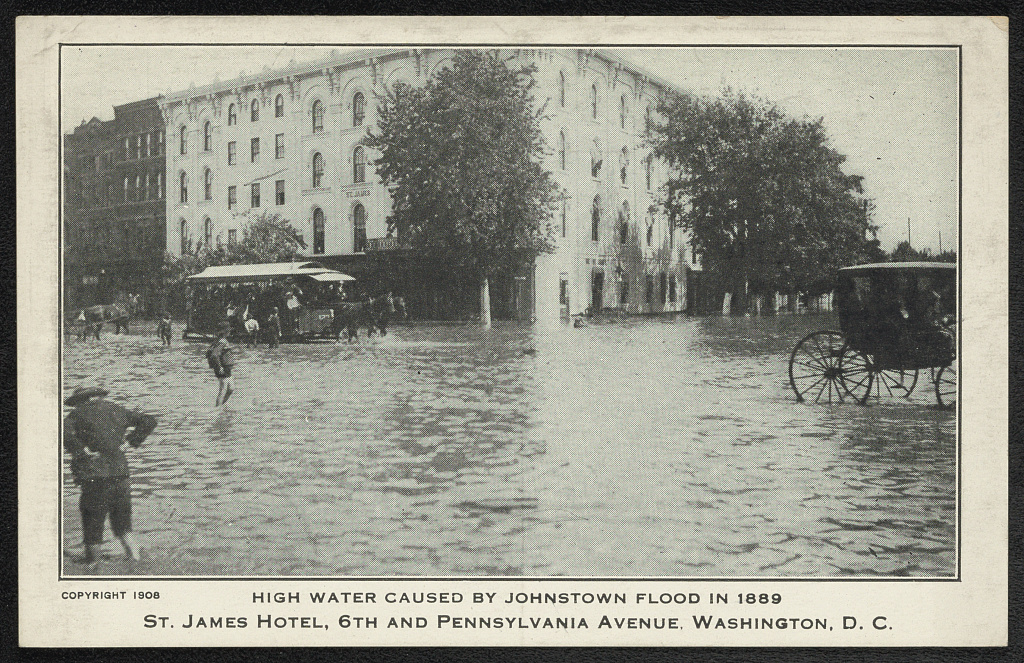
On the depot floor the water registered sixteen inches, and one daring individual who had business at the baggage room propelled a skiff through the Sixth street entrance, amid the plaudits of an enthusiastic crowd in the windows of the St. James Hotel, opposite the depot.
Talk about having the best seats in the house.
The St. James stood across the Avenue from the National Hotel, on the southeast corner of that same intersection, with the depot a block down 6th Street on the other side. It wasn’t exactly dry itself. The Star reported that the water covered its first floor, so nobody could do business in the office, and guests were driven to and from the hotel in carriages.
The barbershop under the hotel was so far underwater that a signboard reading “Severson & Bush” was all that showed where it was.
Right across 6th Street from the St. James, on the Avenue’s southwest corner, stood the Howard House. According to the Star, it “was not quite so badly flooded.” Its office floor stayed dry, but guests still had to cross a little bridge or come by boat.
Turtles loose in Center Market
Center Market, the city’s big public market on the south side of the Avenue between 7th and 9th Streets, was cut off by 9 p.m. Saturday. By Monday the Star could report what happened to some of the merchandise:
In the market the water had reached the top of many of the benches and had thus set free crates of crabs, diamond-back terrapin and a number of enormous turtles, and only a few of the latter were saved.
Turtles or no turtles, the market opened for business as usual on Monday morning, June 3. The building stood there until 1931, when it was torn down to make way for the National Archives Building.
One grocer saw it coming. N. H. Shea had a grocery on Pennsylvania Avenue between 6th and 7th Streets. According to the Star, he saved his stock by piling his barrels out on a little patch of parking.
That’s not a parking space, by the way. Back then, “parking” meant the strip of public land beside the sidewalk, set aside as a little landscaped park.
The flood reached the Division, too, the red-light district south of the Avenue, between it and B Street from 9th to 15th Streets. The Star found at least one resident there making the best of it: “At one window on 11th street a woman was fishing from a second-story window.” Why not?
The crest and the cheers
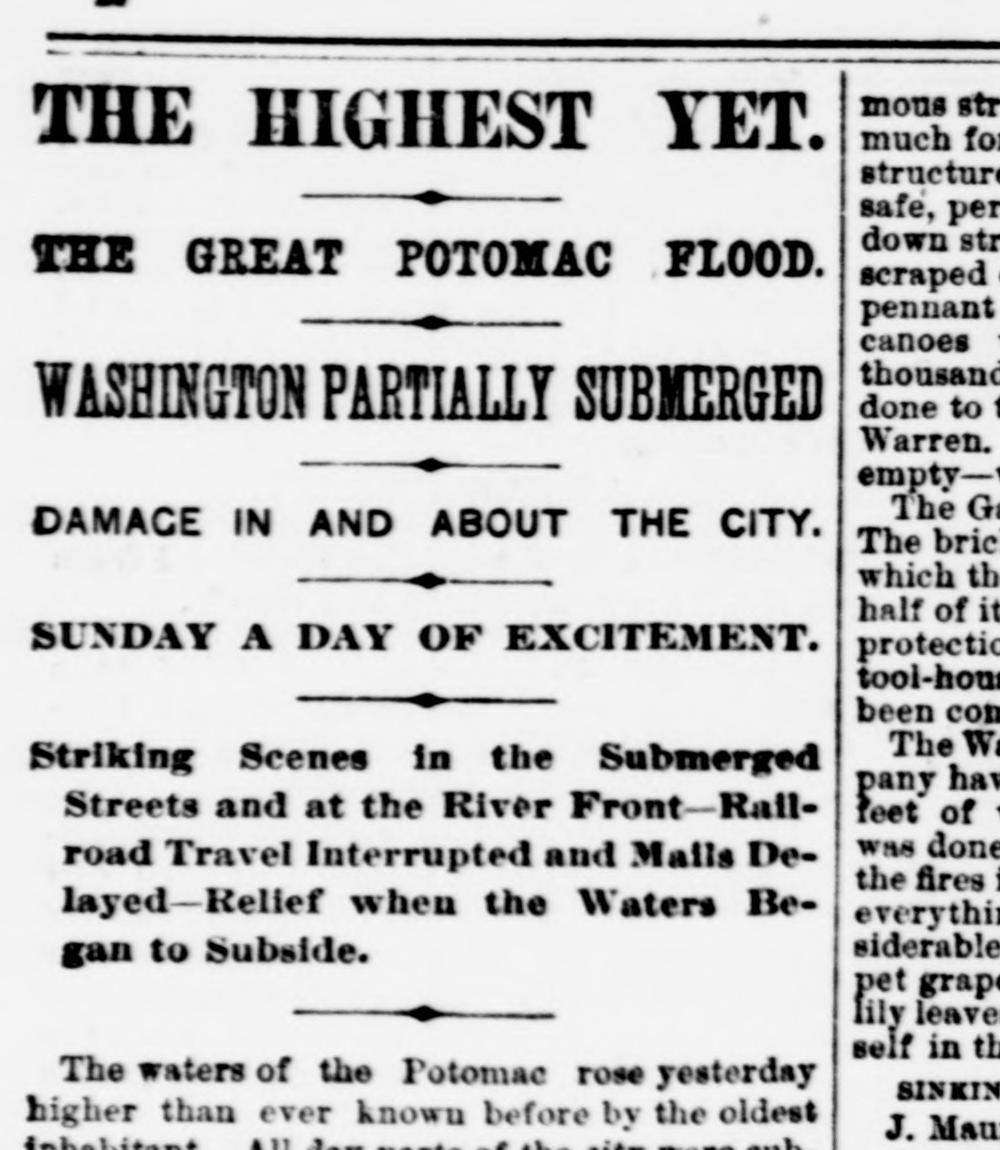
So how did it measure up against earlier floods? The Post said the water peaked at the Gas Wharf, the gas company’s wharf on the river, at about 9 a.m. on Sunday, June 2. Somebody had cut the high-water mark of the 1877 flood into the wall of a house in the gas works yard. The 1889 water came three feet six inches higher.
The Star’s figures agreed: the water that reached the Ellipse also stood 3 feet 6 inches above the 1877 mark.
For the big picture, you wanted to be up on the roof of the State, War and Navy Building. From up there, the flooded stretch the Post saw ran even farther west than the Star’s 15th Street. Everything from the Avenue to B Street and from 17th Street to the Capitol was “a vast lake,” the Post wrote, dotted with “canoes, ducking skiffs, and yawl boats.”
Back up on the Avenue, the water started to drop around noon on Sunday. As the pavement came back into view, the Star reported, “cheer after cheer went up from the crowds who followed the receding flood.”
A million dollars and a little Venice
The Post’s June 3, 1889 report tried to put a price on it all. Counting the damage to the government’s reclamation work on the Potomac flats, the paper figured that “it cannot be less than $1,000,000.” That reclamation work was the Army’s river improvement project, which dredged the Potomac and dumped the material onto the flats to make new land.
The million-dollar figure had staying power, and it was still being quoted when the Potomac flooded Washington again in 1936.
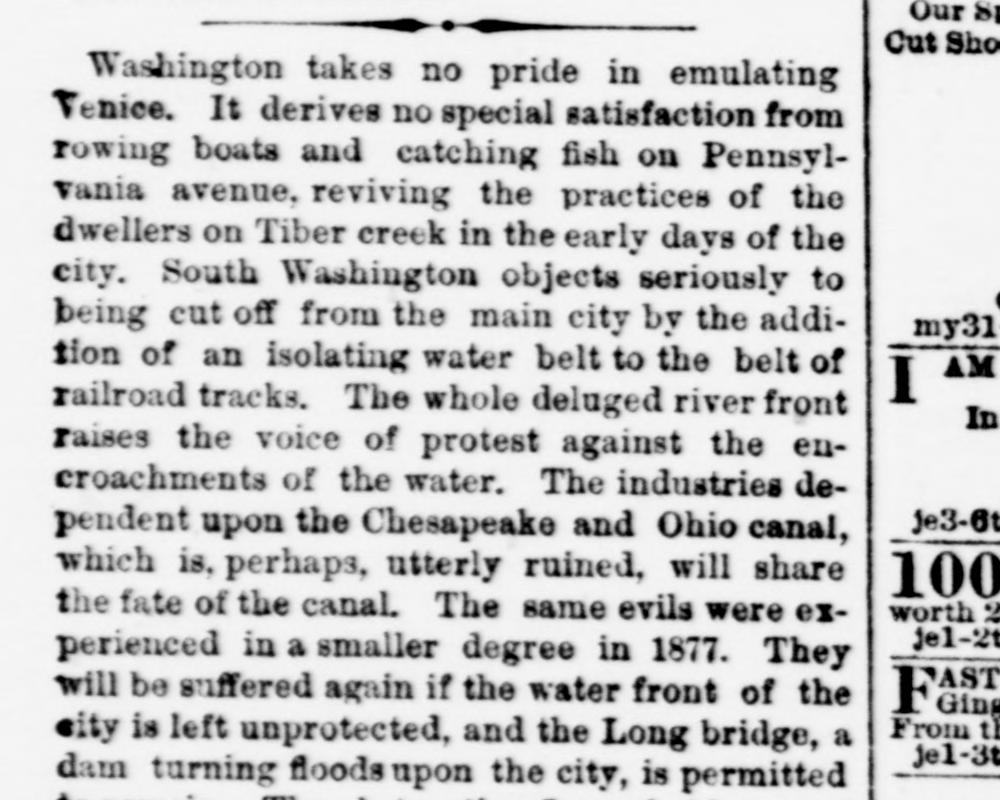
The Star wasn’t amused by any of it. Its editorial page put it this way on June 3, 1889:
Washington takes no pride in emulating Venice. It derives no special satisfaction from rowing boats and catching fish on Pennsylvania avenue, reviving the practices of the dwellers on Tiber creek in the early days of the city.
Speak for yourself, Evening Star. Here’s the full postcard behind the photo up top, and those two boatmen don’t look too put out about it.
Liked this one? Get more tomorrow.
Lost Washington stories in your inbox most mornings: the newest, plus a few from the archive.
 This storyWhen Boats Rowed Down Pennsylvania Avenue: The Potomac Flood of 1889
 The Embassy Row Château the Nazis Tried to Seize
 The Wright Brothers at Fort Myer: The 1908 Selfridge Crash and Orville’s 1909 Return
Free. Unsubscribe anytime.
AI helped research and write this story. Here’s how we use AI.Suggest a correction