
It is 2:18 p.m. on Friday, March 2, 1973, and the top floors of a 26-story apartment building at Bailey’s Crossroads are about to fall floor by floor. Fifty-five men are working on the tower and in the parking garage below. Fourteen of them will not go home.
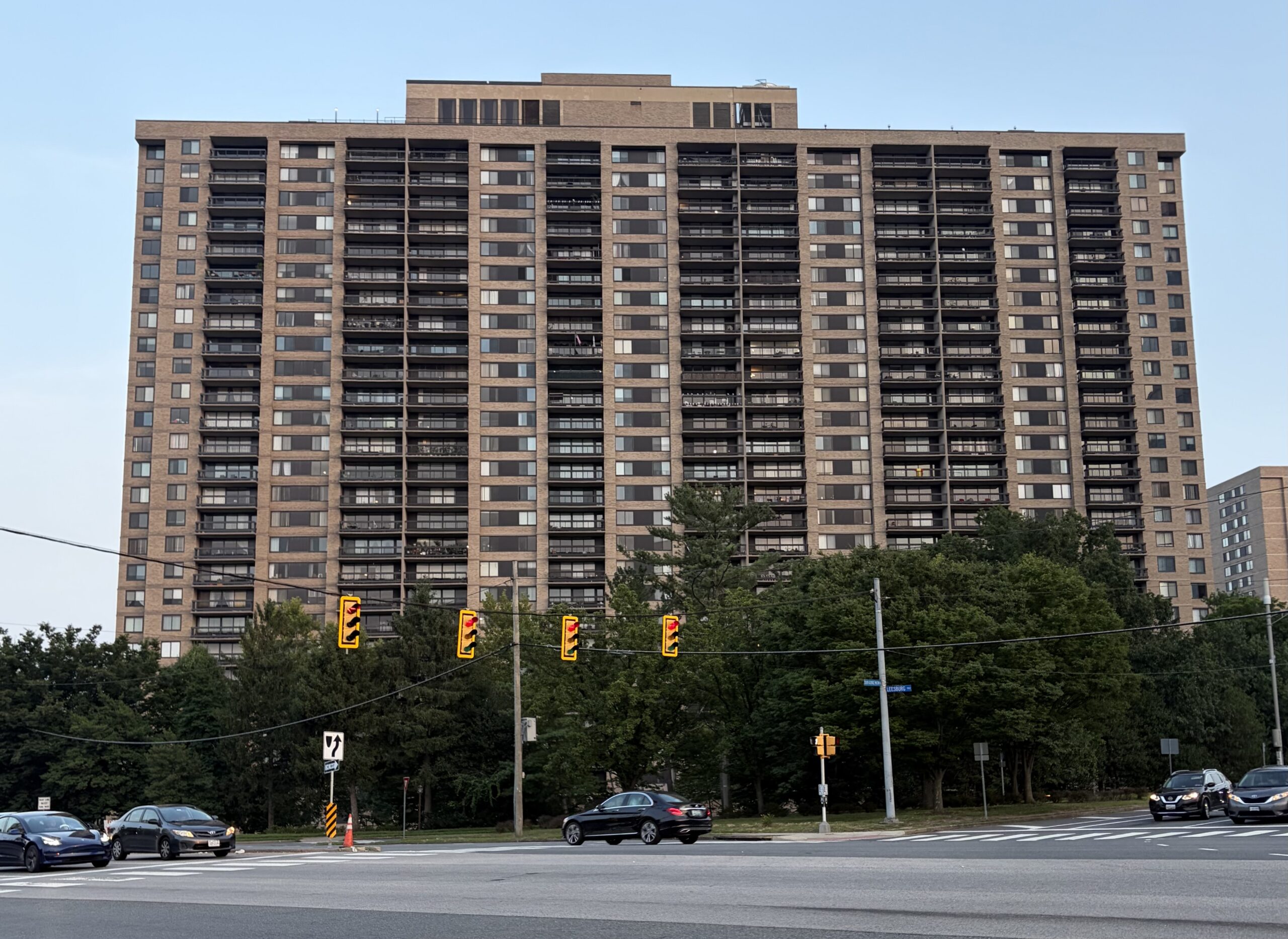
The building is the under-construction Skyline Plaza, the first tower of the massive Skyline Center rising over Route 7 in Fairfax County. It is easy to confuse with the separate Skyline Towers around the corner, which stood then and still stand today. This is the tower still climbing skyward, still curing concrete on its top floors, when the whole crown pancakes down through itself in about twenty seconds and opens a 60-foot-wide gap that runs from the roof to the basement.
Before the tower: a private airport at Bailey’s Crossroads
The 106 acres where Skyline Plaza rose had been the Washington-Virginia Airport, a private commercial and general-aviation field the Benn brothers opened after buying it in 1946. Well over 100 aircraft eventually crowded its two gravel runways. A 42-foot drive-in movie screen sat directly across Route 7 in the path of Runway 17, and pilots learned to skim it on final approach. One tail-dragger reportedly left tire marks on top of the screen. In roughly 25 years of operation, the airport never had a fatal accident.
John D. Benn Sr., the airport’s longtime owner, died at the field on December 1, 1967. His son took over. Within a year, John D. Benn Jr. was in talks with a Washington developer who had already reshaped a similar stretch of Arlington. The Washington Post on October 21, 1969 announced the deal: a $200 million office, retail, and residential complex on the airport site, to include eight apartment buildings and underground parking for over 11,000 cars. The airport closed for good on October 18, 1970.
What Charles E. Smith was building
The developer was Charles E. Smith Co., the same firm that had converted an underused stretch of Arlington into Crystal City. Skyline Center would do the same at Bailey’s Crossroads: high-rises, offices, a hotel, and retail on a suburban Fairfax field. When completed it would fill Route 7’s skyline exactly the way the plans promised.
Skyline Plaza was the first tower to go up. Designated Building A-4 in the federal filings, it was a 26-story apartment and condominium tower designed for 468 units, scheduled to open in August 1973. Every unit had already been sold, at prices from $23,000 to $62,000. Miller & Long was pouring the concrete.
Skyline was not Charles E. Smith Co.’s first fatal shoring failure. On June 6, 1968, at a Crystal City office building the firm was developing, an estimated 100 tons of wet concrete crashed through the plywood decking above and crumpled the four-by-four temporary supports beneath it. Three men were killed and 29 injured. Arlington County traced the cause to insufficient wooden shoring. That was five years before Bailey’s Crossroads.
How it failed
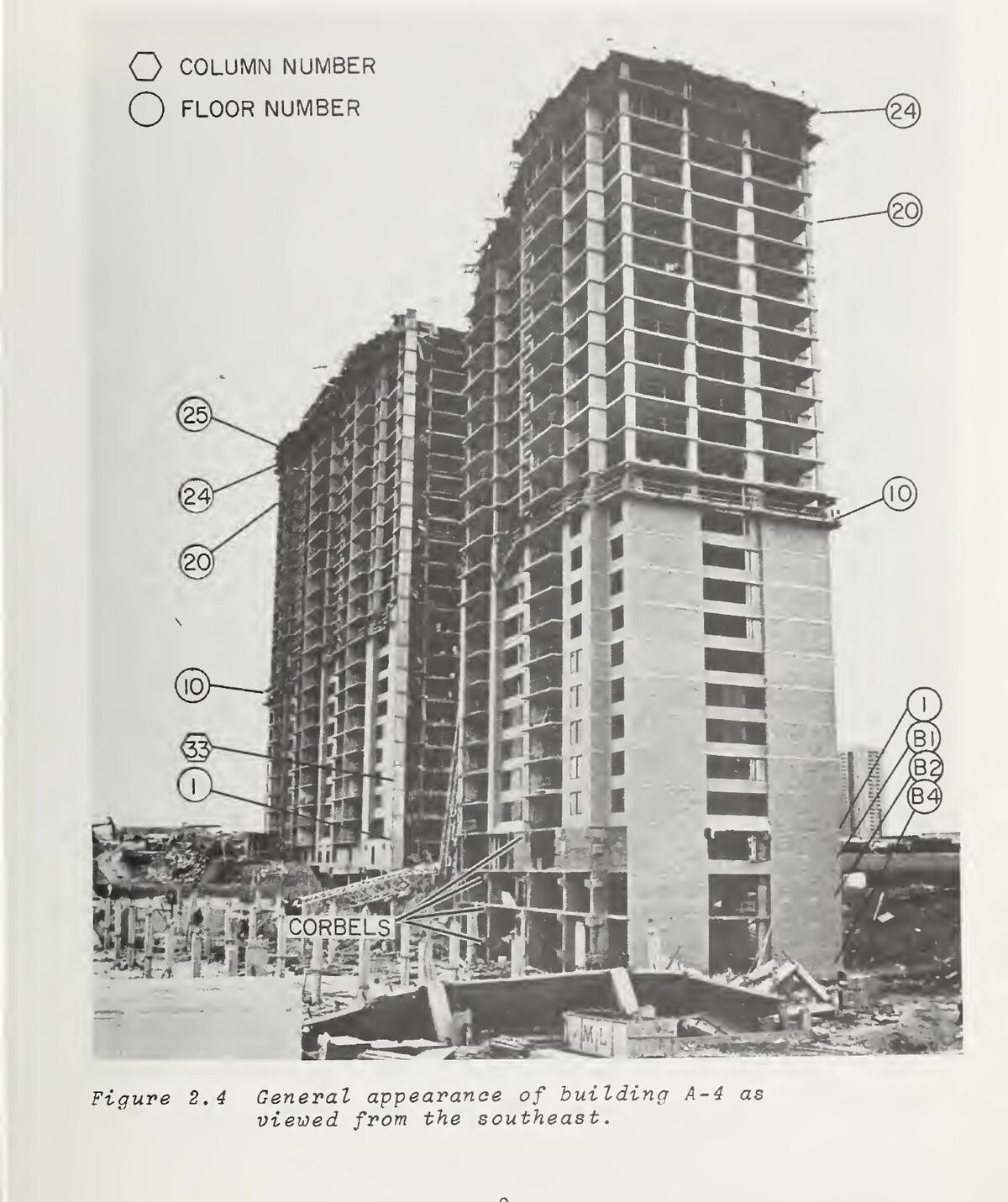
Three days after the collapse, on March 5, 1973, the Center for Building Technology at the National Bureau of Standards was called in to investigate. Fairfax County retained its own consulting engineer, Professor Ingvar Schousboe of the University of Illinois. Both investigations pointed at the same failure. NBS ran a three-dimensional finite-element analysis on the 22nd and 23rd floors and published its findings as NBS BSS 94.
The specified design strength for the concrete was 3,000 psi. NBS calculated that when the shoring was pulled, the 23rd-floor slab actually stood at about 1,200 psi. In plain terms: crews had stripped the wooden shoring out from under freshly poured concrete on the 22nd and 23rd levels before that concrete was strong enough to carry itself. At the same time, another crew above was pouring the 24th floor, adding hundreds of tons more weight.
The 23rd floor punched through around its columns. The roof came down onto the 22nd, and the 22nd onto the 21st, and so on. The climbing crane on the 24th floor rode the wave down. Investigators later found that the engineer’s drawings called for two full stories of shoring plus one story of reshoring while a slab cured. That schedule had not been followed on 22 and 23.
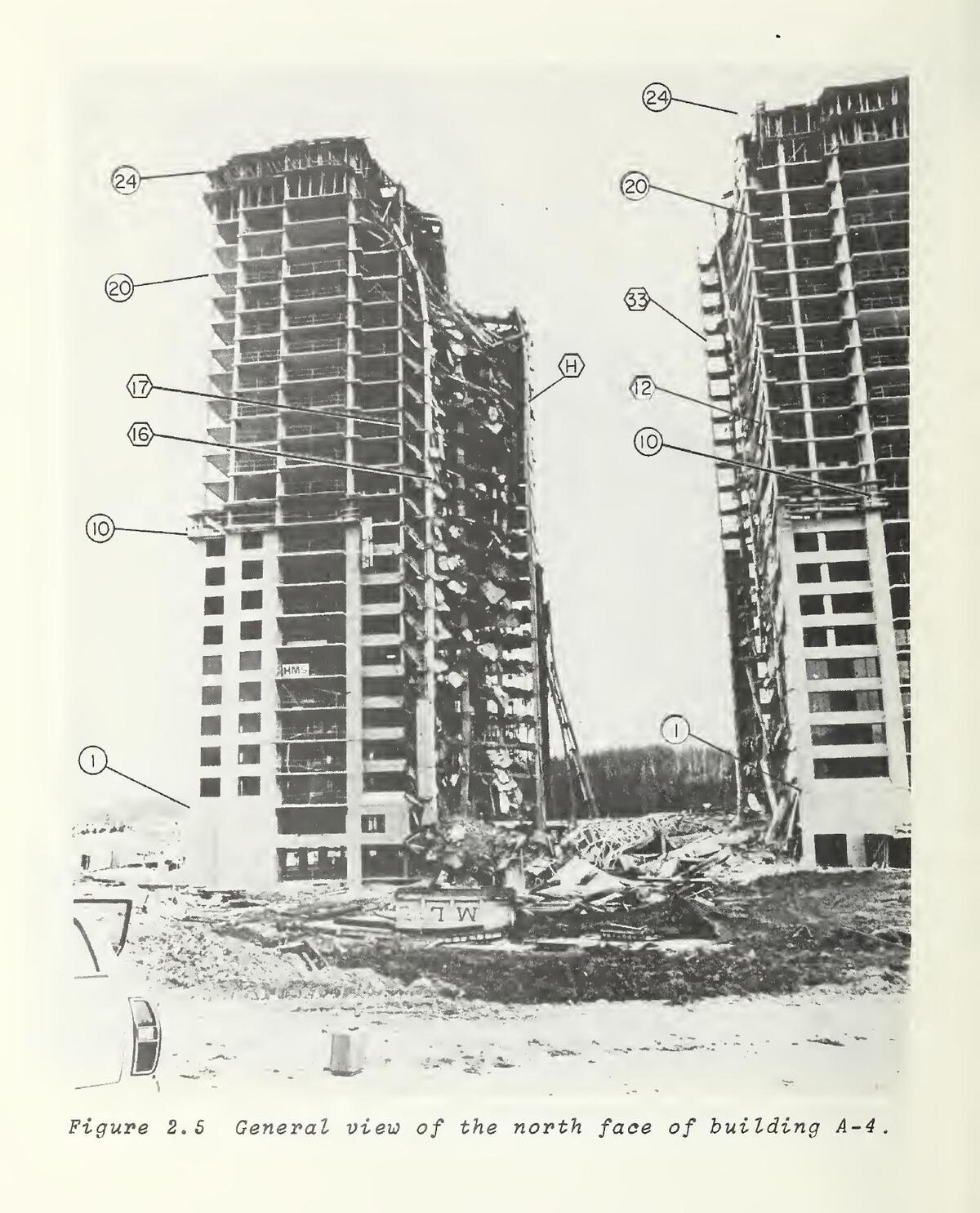
The collapse produced a concussive boom and threw up a dust cloud so thick it filled the stadium at Wakefield High School, a half-mile away. A Fairfax County police officer watching from Route 7 called it in to the Emergency Operations Center at 2:18 p.m.
Fifty-five men were on the tower
The next morning’s front page in the Washington Post led with “5 Dead, 12 Missing in Collapse of High-Rise,” a count that would climb through the weekend. Rescuers from Fairfax, Arlington, and Alexandria worked the pile through the night. Fairfax fire Lt. Harry Diezel had to worry about propane leaking from tanks buried in the collapsed parking garage. The final toll landed at 14 workers killed and about 35 injured.
The names of the survivors began appearing before the numbers of the dead. Michael Hill, 31, told a Post reporter he was on the 23rd floor when the ceiling started to crack. He said he ran for his life, looked back, and saw four of his buddies being crushed by the concrete. Larry Rivers, working in the basement, said the noise was “a rumbling sound like Niagara Falls.”
Martin Lowton, 56, of Alexandria, rode the fall out huddled under a fourth-floor staircase and dug himself out of knee-deep rubble. Lowton told reporters he had also been on the crew at the 1968 Crystal City collapse. He was one of the very few men in America who survived being inside two of Charles E. Smith Co.’s major concrete failures.
The warning inside the story
One quiet detail sat in the March 3 companion piece and never fully left the record. Robert Taylor, 22, was the hoist operator that afternoon. Taylor told the Post that a supervisor stepped off the hoist about two minutes before the collapse, and that on the ride down the supervisor mentioned the top two floors did not look right to him.
Nobody stopped the pour on 24. Nobody cleared the tower. Two minutes later Taylor was screaming into his radio for the elevator so his men could get down.
The reckoning that wasn’t
By September 1973, Miller & Long job superintendent Roger Gilbert Arnold was on trial in Fairfax County Circuit Court on 14 counts of involuntary manslaughter. The prosecution had built the indictment around three of the dead workers by name: Danny Ray White, Clemons Riley Holcomb, and Daniel R. Wilhite. A company witness testified, in the Post‘s summary, that Arnold had hurried the pouring of concrete during construction of the building to make a name for himself in the building industry.
The jury deadlocked. Prosecutors declined to retry the case. The maximum penalty on a Virginia felony involuntary-manslaughter count at the time was one to five years in prison.
The regulatory hit was smaller still. Miller & Long was fined $300 for inadequate shoring under Virginia’s building code. OSHA cited the company for roughly $13,000 in federal safety-code violations. A judge ruled that Charles E. Smith Co., the owner and developer, could not be held criminally responsible for the actions of its subcontractor.
The civil side was no more satisfying. Writing in Arlington Magazine on the 50th anniversary of the collapse, Kim O’Connell reported that “after several protracted legal battles, most families of those injured and killed received nominal compensation or none at all.”
Fourteen men died. No one went to prison. The total criminal and regulatory penalty against the concrete company came to less than $14,000, or about a thousand dollars a life.
What stands there now
Property damage came to about $12.5 million of the $24 million building. Construction stopped for 16 months, resumed in July 1974, and finished in 1977. The rebuilt tower stands today at 3701 South George Mason Drive, occupied, its top floors the same top floors that once fell. The Skyline Plaza condominium association still uses the name.
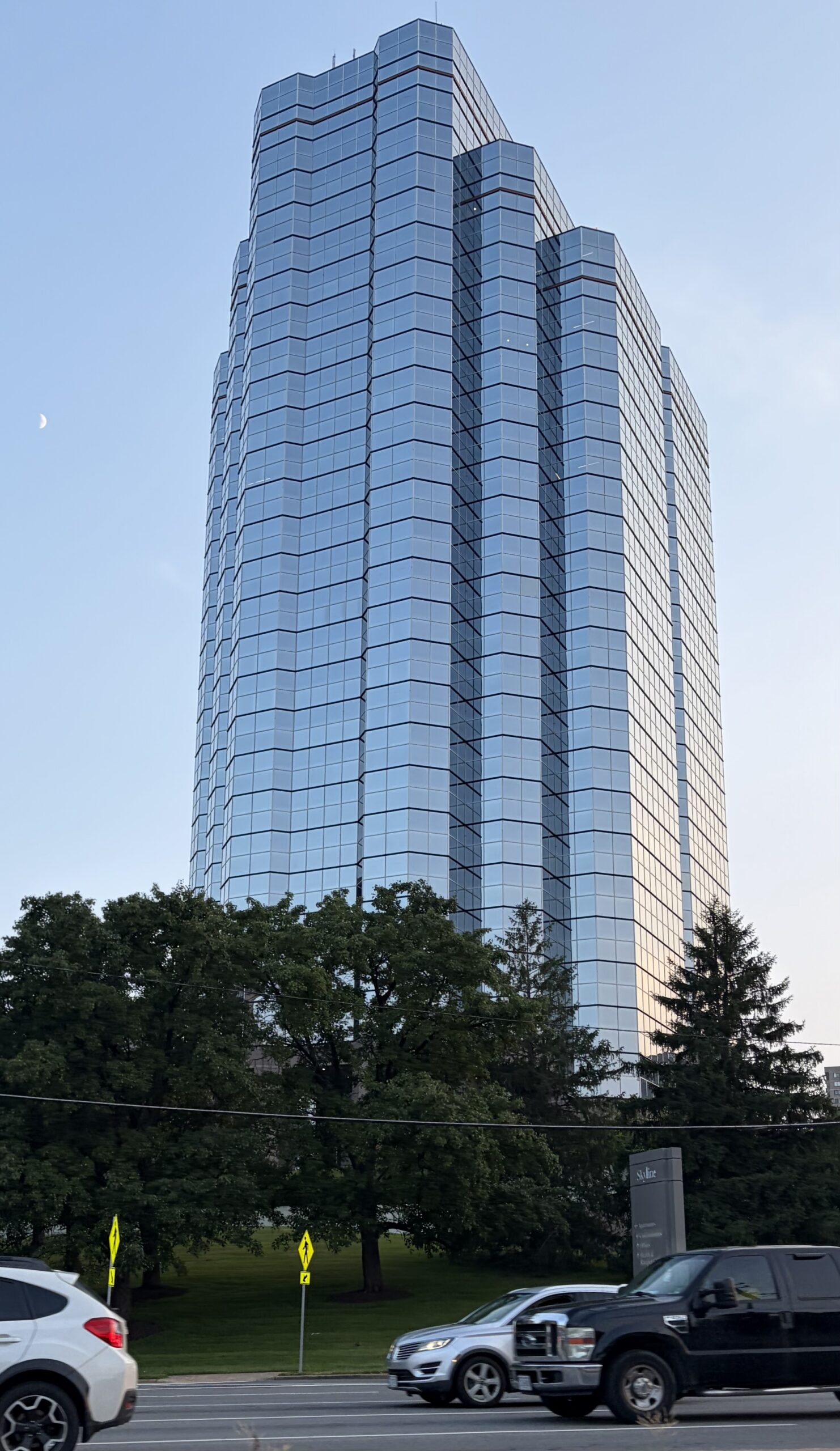
Down the road, the rest of Charles E. Smith’s Skyline Center fills the horizon over Route 7. Vornado/Charles E. Smith’s eight-building office portfolio, at its peak assessed at $680 million, was gutted by post-BRAC vacancies and has changed hands more than once since 2016. Skyline Towers, the two 26-story apartment buildings across the property, sold to Los Angeles-based CIM Group in December 2019.
It was part of the same wave of Fairfax County high-rise condo development that produced the Rotonda in McLean.
Miller & Long is still in business, based in Bethesda, still pouring concrete on high-rises across the region. The company marked its 75th anniversary in 2022.
The Bailey’s Crossroads collapse became one of the standard case studies in American engineering education on formwork and shoring safety, cited in decades of ASCE and NIST teaching material. When the Champlain Towers South condominium failed at Surfside, Florida in 2021, structural engineers reached back to March 2, 1973 in the first days of coverage. It is one of the earliest modern collapses caught, investigated, and published in enough detail to be argued over.
That is a bleak kind of legacy. But for the 14 men killed on a peaceful March afternoon in Fairfax County, it is what remains.
We dug this one up with help from AI and checked it against the original records below. Here’s how we use AI.