

In May 1954, a 12-year-old girl named Linda Bowman stood at her kitchen window near Fairfax Station, looking out at a farm field. The Army was about to put guided missiles in it.
Every Nike missile site came in two halves, radar on one piece of land and missiles on another. The Bowmans’ 100-acre farm sat right between them.
The Sunday Star sent a reporter and a photographer out to Pope’s Head Road, and the neighbors had plenty to say. Our favorite line came from a carpenter named Warren Jenkins, who lived about 200 yards from the radar site: “At least folks will know where Pope’s Head road is located.”
Well, here we are.
“We’re really caught in the middle”
The Army was building Nike missile batteries all around Washington, and one was headed for Pope’s Head Road. According to the Star on May 9, 1954, the government had gone to federal court in Alexandria to condemn 12 acres for the radar. The launchers would go on a little more than 13 acres it was buying from Mr. and Mrs. Lewis K. Mattingly.
Thomas L. Watson owned a corner of the land being condemned, and his house would sit just 700 feet from the radar. He wasn’t thrilled:
“I wish they had taken all of my property so I could move further away… I just don’t like the idea of living so close to something like that. Suppose one of those things went out of control and dropped down.”
His 8-year-old son, Rodger, felt differently. The Star found him waving a small American flag, thrilled to have so much excitement in his own backyard.
Linda’s mother, Mrs. Moir Bowman, pointed out the window at the Mattingly farm. “We’re really caught in the middle,” she said. The Bowmans had moved out from Arlington County four years earlier to get away from the city.
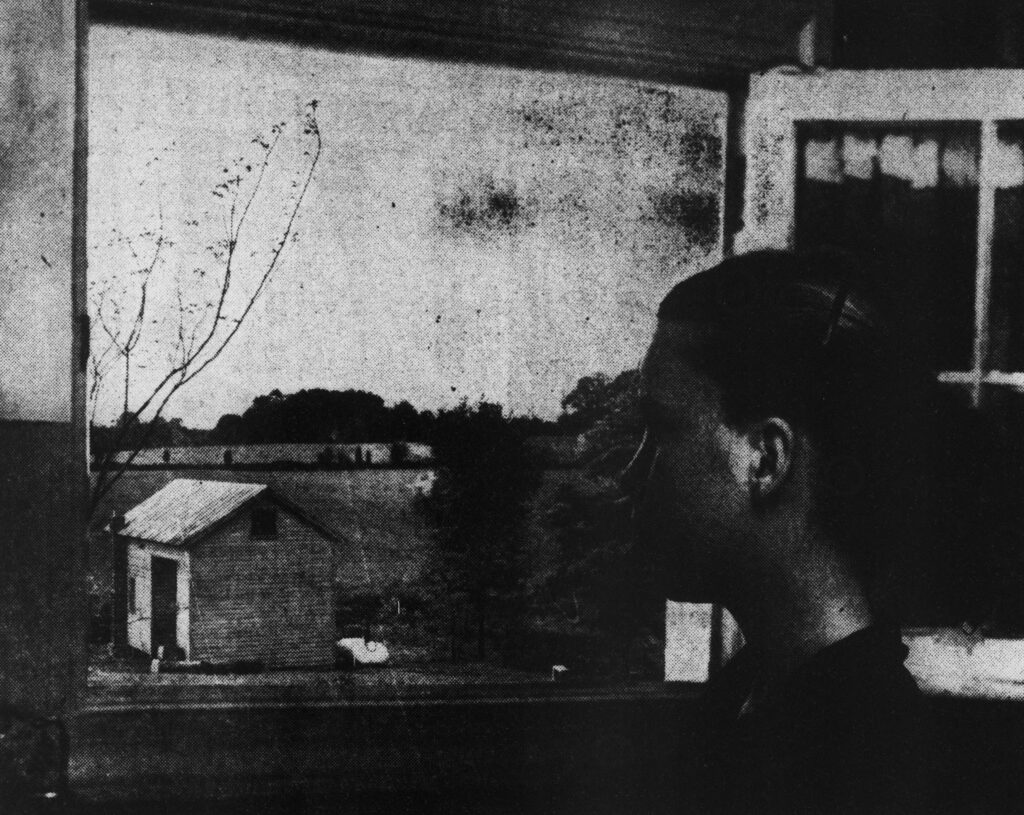
She said Army officers and surveyors had been poking around since the summer before, but nobody would tell them anything “for security reasons.” A neighbor told her Pope’s Head Road would be the safest place around Washington. She wasn’t buying it.
The Lambs, whose farm adjoined the Bowmans’, were mostly worried about TV reception. Alexander Lamb, a retired Navy lieutenant, figured the missiles would fly too high to bother anybody. He just hoped the radar wouldn’t mess with the set, “our only recreation out here on the farm.”
The neighbors in the 1950 census
We wanted to know more about these folks, so we went looking in the 1950 census. Sure enough, they’re all there. That spring a census taker named Guy Berry worked his way west along Pope’s Head Road, also known as Route 654, knocking on doors.
The Bowmans had just arrived. Dr. Moir Bowman was 35, and the census says what kind of doctor he was: a chiropractor. A year earlier, the family had been living in Arlington.
He and his wife, Genevieve, had four kids. Linda was 8 (the census taker spelled it Lynda), and she had three little brothers, ages 5, 4 and 1.

Lewis K. Mattingly, the farmer who sold the Army its launch site, lived a couple of houses down. He was 53 and born in Maryland. Thomas L. Watson was 50 and worked as a laborer at a cemetery, and little Rodger was 4.
Alexander Lamb was 48. The census lists no job for him and checks the box for World War II service, which fits the Star’s retired Navy lieutenant.
And Warren Jenkins, the carpenter with the great line? In 1950 the census has him as a 34-year-old grocery clerk. His wife worked as a typist for the Internal Revenue.
A ring around Washington
So what was a Nike, anyway?
It was the Army’s new anti-aircraft missile, named for the Greek goddess of victory and later renamed the Nike Ajax. Its job was to knock Soviet bombers out of the sky before they reached the city. The Star described it in 1955 as a 20-foot, “pencil-shaped” missile that could hit a plane 25 miles away at up to 50,000 feet.
Washington was already jumpy about its skies. Back in July 1952, jets were scrambled over the Capitol to chase mystery blips on the radar.
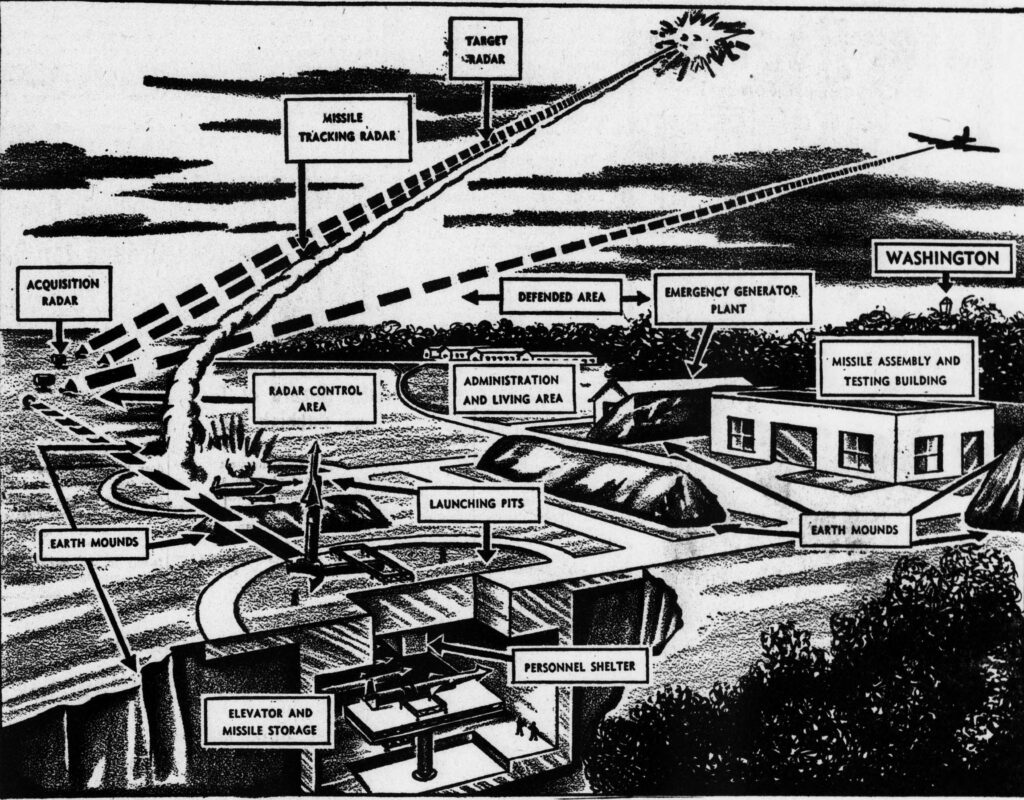
One half of every battery held the radars and the “brains.” The other held the missiles, stored underground and lifted to the surface on an elevator to fire. The two halves usually sat about a mile apart, but on Pope’s Head Road it was more like a quarter mile.
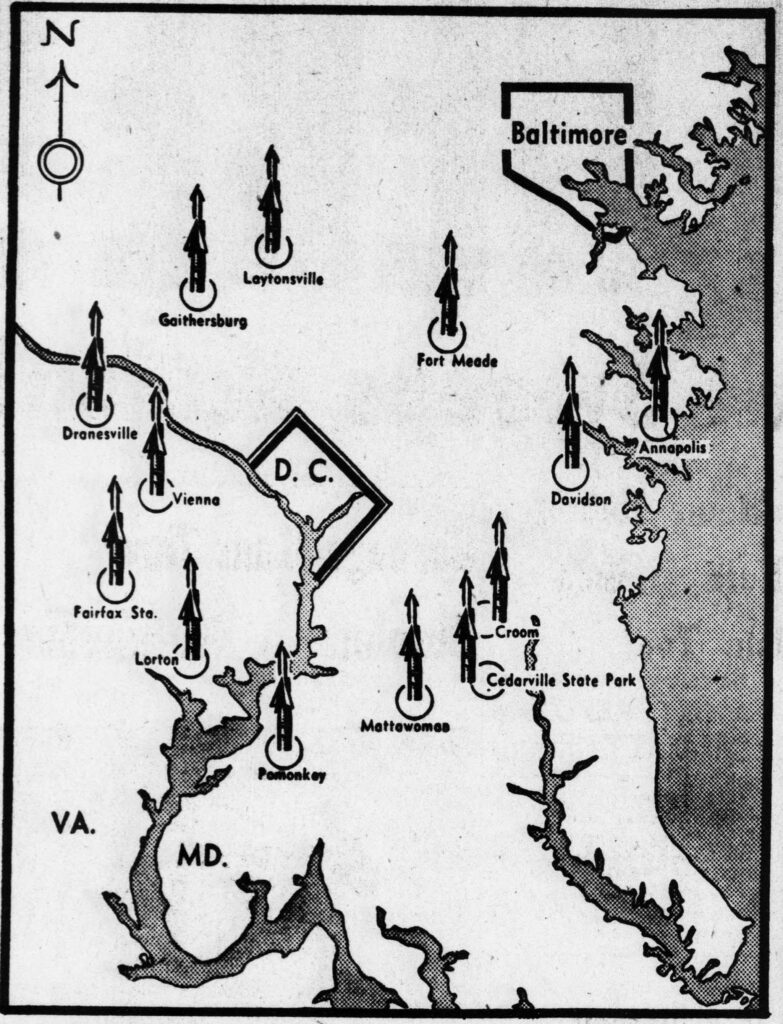
The batteries went up in a ring around Washington and Baltimore. Northern Virginia got three: Lorton, Pope’s Head Road near Fairfax Station, and one on the line between Herndon and Great Falls.
Before the missiles, there were guns
Here’s the part most folks don’t know. Before Nike, and for a while alongside it, the Army ringed Washington with anti-aircraft gun batteries. These were 90 mm and 120 mm guns, and a bunch of them were in Fairfax County.
Fairfax historian Christopher Bright laid it out at a library talk in the City of Fairfax in May 2016. Gun sites sat at Langley, Franconia, Hybla Valley, Vienna, McLean and Fort Belvoir.
Some of those spots are now Key Middle School, Huntley Meadows Park and the playing field at Walt Whitman Middle School. Another is land shared by the CIA and the Federal Highway Administration at Langley.
There was one in Annandale too, along Gallows Road. The Annandale Chamber of Commerce says that gun site ran from 1951 to 1957. The Broyhill Crest neighborhood grew up around it while the guns were still there, and after the land was sold in 1959, houses went up on it too.
So if your kid plays soccer at one of these schools … well, now you know.
“As safe as gasoline stations”
Lorton came first in Virginia. The Army took over 30 acres of the D.C. prison complex at Lorton in October 1953, and work began in March 1954, according to Fairfax County’s history of the site.
Yes, the missiles went in next to a prison, the same complex where suffragists were jailed at the Occoquan Workhouse in 1917.
On January 4, 1955, the Army said it wanted four more Nike sites around Washington and Baltimore and bigger batteries at four others, including Lorton. Lorton became a “double site,” with six underground magazines instead of the usual three, and the Army’s showpiece.
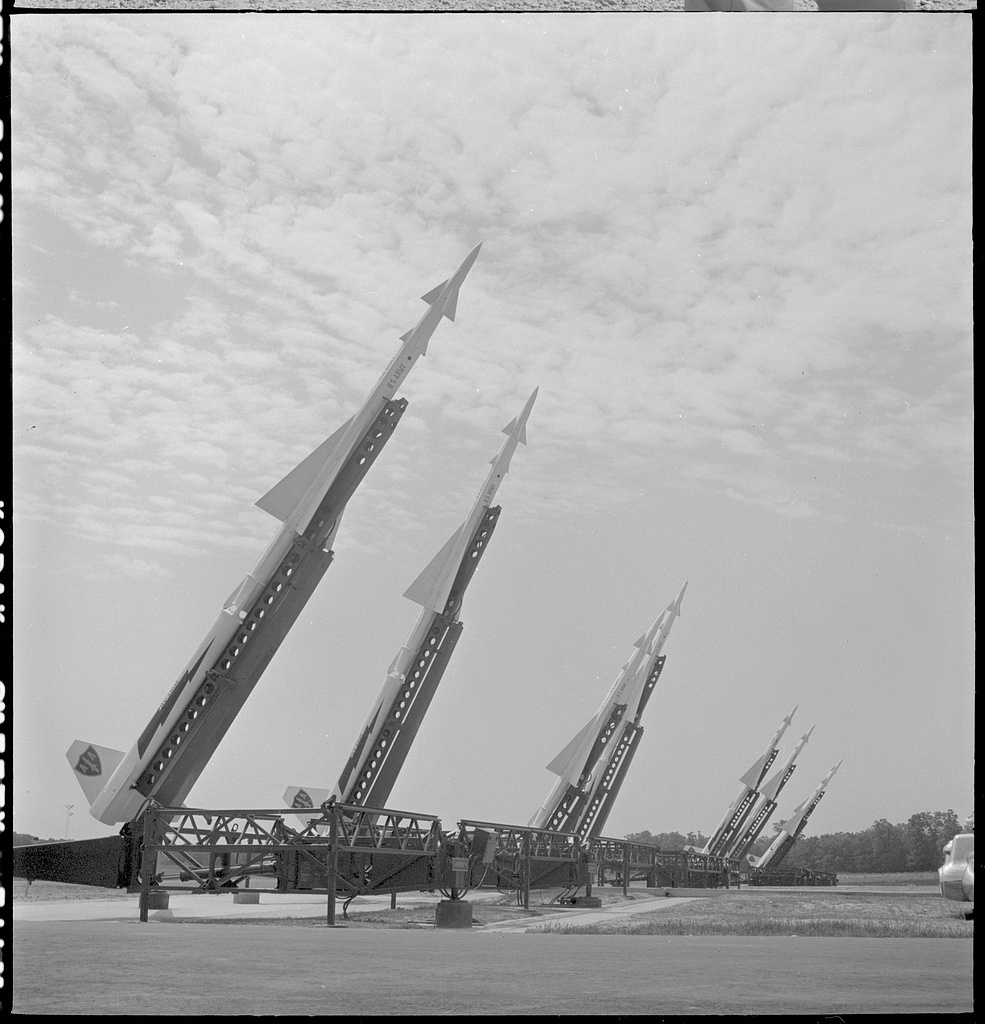
On May 16, 1955, the Army finally let newsmen, photographers and newsreel cameras into Lorton. The Star’s John A. Giles noted the battery was just 16 air miles from downtown Washington, with eight Nikes stored underground. The Army’s pitch to the neighbors: its Nike sites were as safe as gasoline stations.
Then the Star admitted the real problem:
From the first the Army has had extreme difficulty overcoming the fears of civilians who sometimes appeared to feel that an enemy attack might be preferable to having parts of a Nike falling in their backyards.
How about that for a sales problem? It didn’t help that a Nike had been accidentally fired at Fort Meade in Maryland shortly before. The Star said that one came down to human error.
Atomic missiles at Lorton
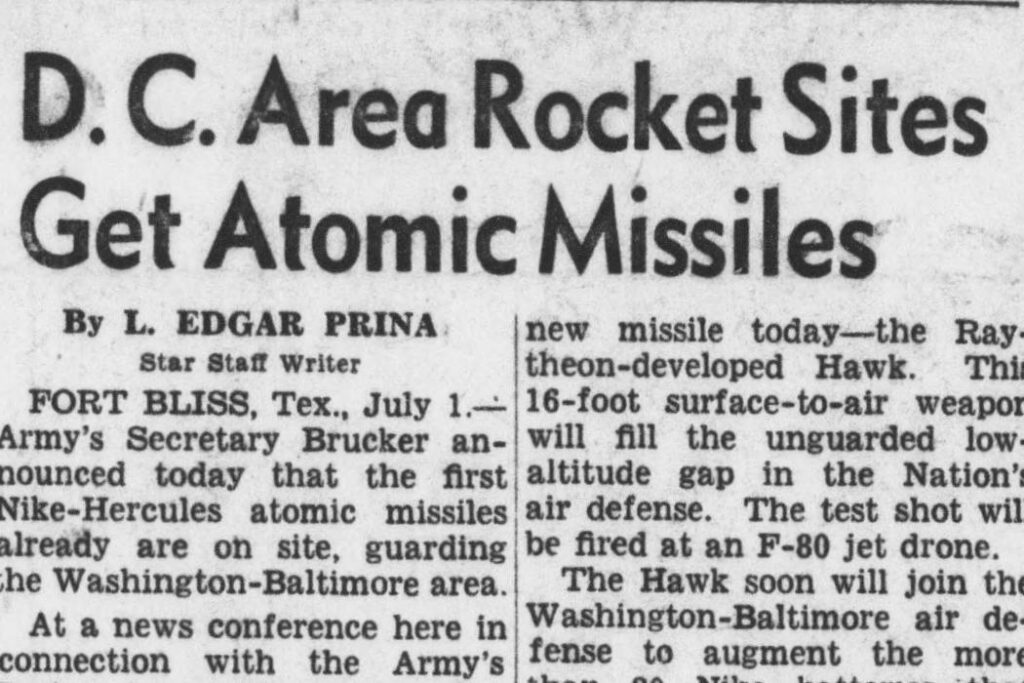
By the summer of 1958, the Star counted more than 20 Nike batteries ringing Washington and Baltimore. Then came July 1, 1958, and this headline across the Evening Star’s front page: “D.C. Area Rocket Sites Get Atomic Missiles.”
Army Secretary Wilber M. Brucker announced at Fort Bliss, Texas, that the first Nike-Hercules missiles were already guarding the Washington-Baltimore area. Hercules was the bigger successor to Ajax, built to carry an atomic warhead. The Star also reported that Lorton was being converted to handle them.
According to the county, Lorton was the Army’s test case for switching a site over to Hercules. It was the only one of the three Northern Virginia batteries to get them, and they brought fences, alarms and military police with German shepherds. No more inviting the press in.
Did Lorton actually have nuclear warheads? The state historical marker on Furnace Road says flatly that it did.
The county’s history is more careful. It says nobody knows for sure, since the Hercules could carry a regular warhead too. Some analysts think the nukes arrived after the U-2 incident in 1960.
The ring shuts down
The Nike era didn’t last long. Hercules sites cost a fortune to build and run, so the Army started handing older batteries to the National Guard. Around 1960, it started closing the old Ajax sites altogether.
Herndon went first, in 1961 by the county’s count or 1962 by the state marker at the site. The Pope’s Head battery went to the Guard in 1959 and closed in 1963.
Lorton lasted the longest. The National Guard took it over on August 30, 1963, and it started shutting down in April 1974. Before the land changed hands, the government agreed to tear down the radar towers and weld the launchers shut.
What’s there now
Today all three sites are Fairfax County parks, and you can still find traces of them.
Great Falls. The Herndon launch area is Great Falls Nike Park on Utterback Store Road, with ball fields where the missiles used to be. Forestville Elementary School sits right next door, on five acres handed over to the school system in 1979.
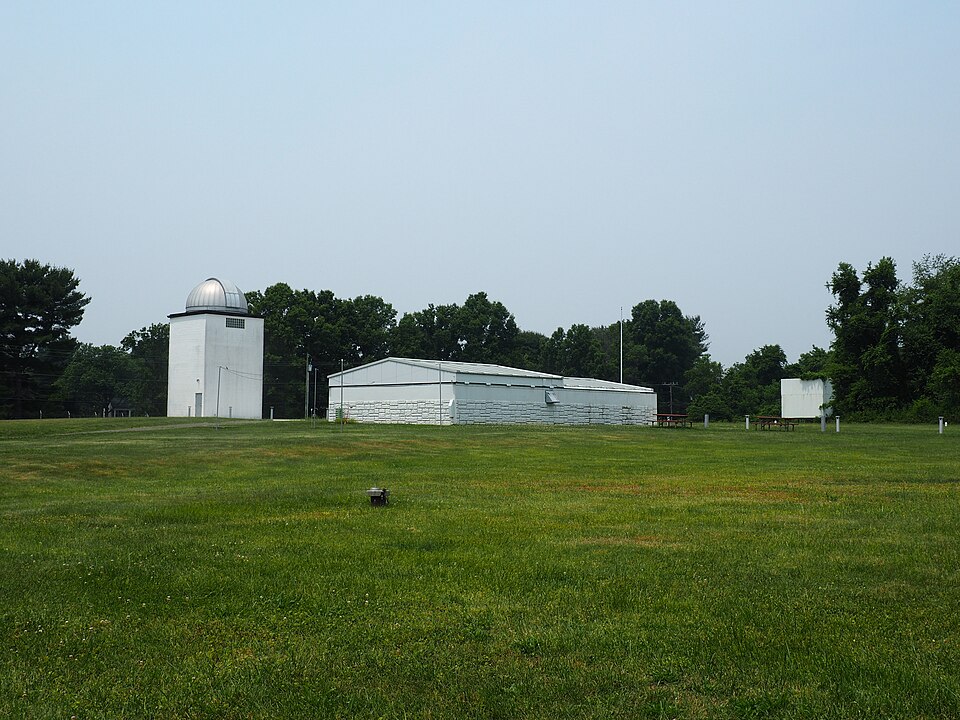
The radar side is just down the road at Turner Farm Park, where an old radar tower now holds a telescope. In 1961 the Army turned it over to the Army Map Service, which started tracking satellites there in 1963. The state’s historical marker says that work “contributed fundamentally” to GPS.
Pope’s Head. The launch site near Fairfax Station is now part of Popes Head Park (the county drops the apostrophe). The county’s plan for the park says everything above ground was torn down and the debris was left behind. It’s a short drive from Bunny Man Bridge, if you’re collecting Fairfax County legends.
Lorton. The old Nike site is now part of Laurel Hill Park, off Hooes Road, and some of it is community garden plots.
The underground missile magazines have never been opened. They’re welded shut. As the county’s David Buchta put it in 2021: “We actually don’t know what is underneath all of the missile staging areas.”
So, Warren Jenkins was half right. Folks did learn where Pope’s Head Road was. Most of the people driving past it today just have no idea why.
We use AI to help research, write and edit stories across our sites. Here’s how we use AI.Suggest a correction
On the AtlasNewSee the 4 places in this storyPope's Head Nike launch site · Lorton Nike site · 1199 Utterback Store Rd, Great Falls38.8156° N · 77.3530° W