

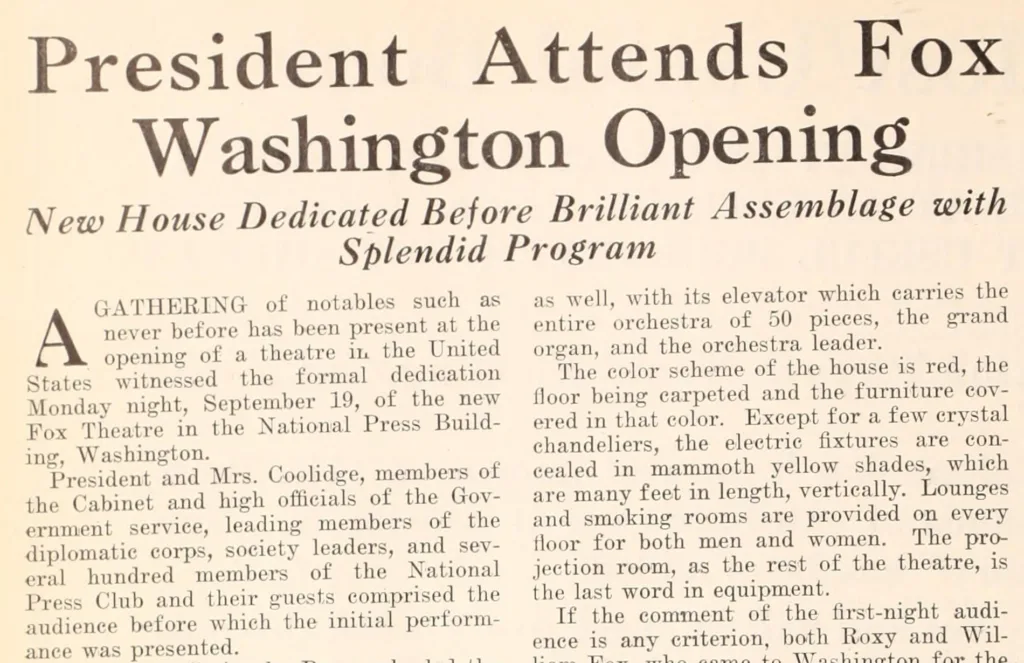
At precisely 8:40 on Monday night, Sept. 19, 1927, President and Mrs. Coolidge took their seats in a flag-draped box at a brand-new movie palace in Washington. Their guests were Treasury Secretary Andrew W. Mellon and Sen. Charles Curtis of Kansas. Then the lights dimmed and the show began.
This was opening night at the Fox, a giant theater built right inside the new National Press Building, and the Washington Post said it “stopped traffic at Fourteenth and F streets.”
Thanks to reader Bruce for the tip that sent me digging into F Street’s old theater row. I’ve already written about one of the four houses he named, Crandall’s Metropolitan, so this story sticks with the other three: the Fox, Loew’s Palace and Loew’s Columbia.
Loew’s Columbia came down first, in 1959. The Fox, renamed Loew’s Capitol along the way, went dark in 1963, and the Palace hung on until 1978. Here’s how all three lived and how they went.
A theater inside the Press Building
Coolidge already had a connection to the place. In April 1926 he laid the cornerstone of the National Press Club’s new building at 14th and F Streets NW.
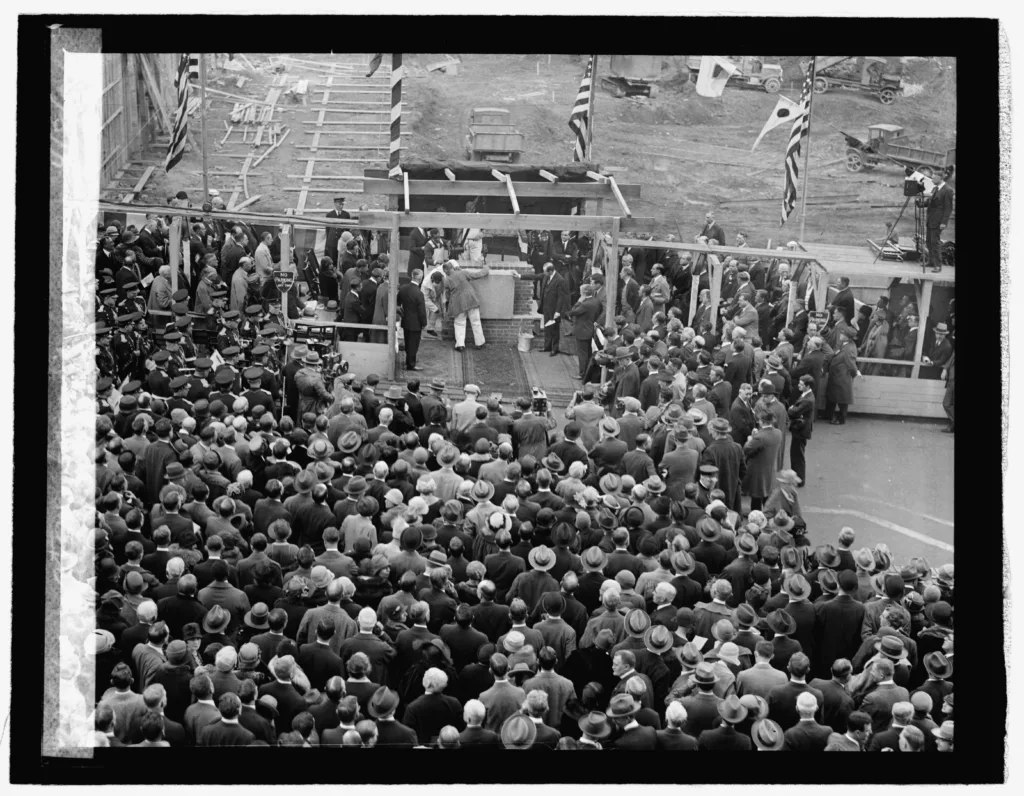
Besides the theater, the new building held the offices of newspaper correspondents from all over the world.
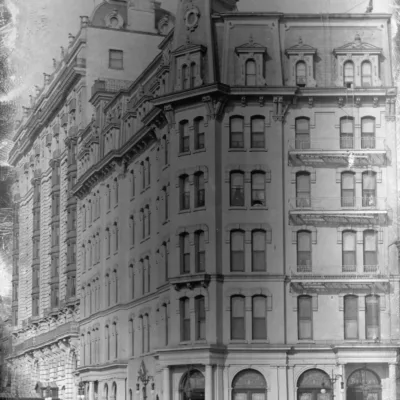
The site had a past of its own. Exhibitors Herald noted that the theater went up where the old Ebbitt House had stood, the hotel where William McKinley lived while he served in Congress.
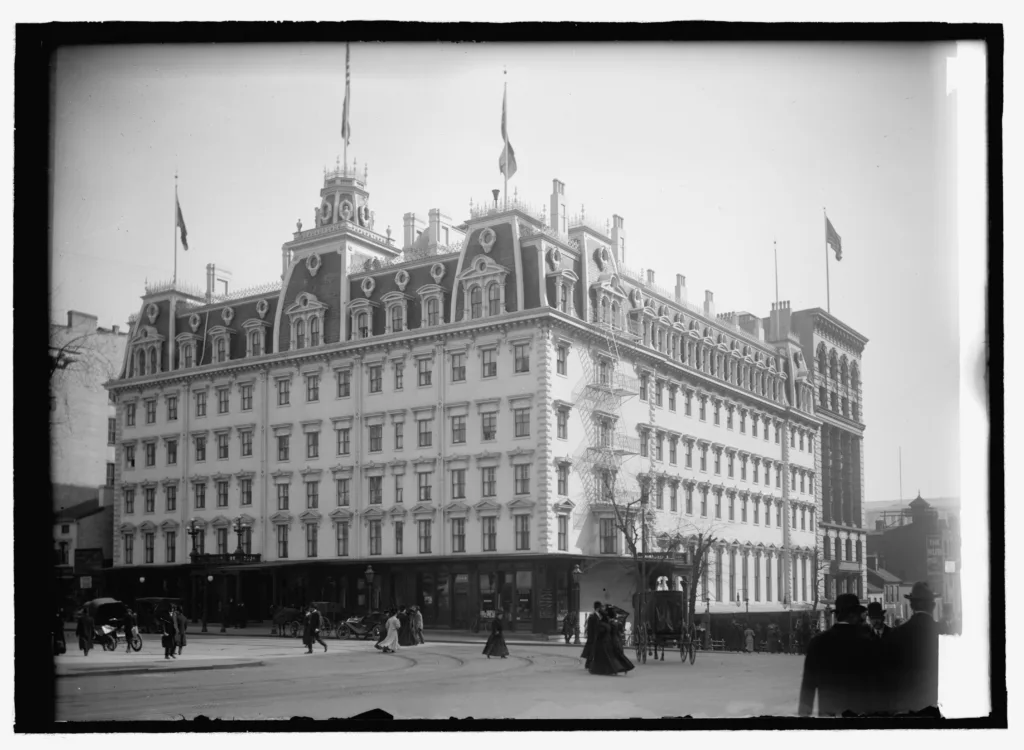
Opening night, Sept. 19, 1927
So many big names were coming that the Press Club’s officers had the State Department arrange the seating in proper order of diplomatic precedence. A special detachment of police handled the crowd.
Inside were Commerce Secretary Herbert Hoover, Secretary of War Dwight F. Davis and other cabinet members, along with William Fox himself and his wife. The Post‘s reporter got a little carried away describing the room:
Resplendent in its new laid leaves of gold and ivory, decked out like a maiden at the bridal altar, all flowers and flurry, the new theater elicited gasps from those who attended.
A maiden at the bridal altar! Motion Picture News was just as smitten, declaring that “Nothing has ever been seen in Washington to parallel the Fox Theatre.”
The house was done in red, from the carpet to the furniture. The whole orchestra of about 50 players rode up and down on an elevator, along with the grand organ and the conductor, Adolphe Kornspan. Jacques Wallace played the organ.
The showman S. L. “Roxy” Rothafel staged the program, which opened with an invocation and a patriotic tableau of Fort McHenry and “The Star-Spangled Banner.” Roxy even took the baton himself for one number, as Motion Picture News reported:
The initial offering by Roxy, who led the orchestra during the “Glow Worm” scene, was received with enthusiasm, although the film, “Paid to Love,” did not rouse the local critics to cheers, but, anyway, the performance, excellent though it was, proved secondary to the theatre itself.
So the movie was the least of it. For Coolidge the night was a first, at least according to the trade paper Moving Picture World, which called it “his first attendance in what might be termed a motion picture palace.”
Loew’s Fox, then Loew’s Capitol
How big was the Fox? In December 1928 the Post threw a Santa Claus party there for Washington kids, and the tickets went fast:
The 3,600 tickets, representing the seating capacity of the theater, have been gobbled up by the boys and girls who want to meet Santa
Loew’s, which already owned the Palace and the Columbia in Washington, took over the Fox’s 20-year lease on April 29, 1932, the Post reported the next morning. You’ll get their stories in a minute.
Under Loew’s it became Loew’s Fox, and that was the name out front when Jack Benny and Mary Livingstone came to town for a week of stage shows in March 1936.
Later that year the theater let the public pick a new name, and “Loew’s Capitol” won the vote. The new name went up in mid-August 1936.
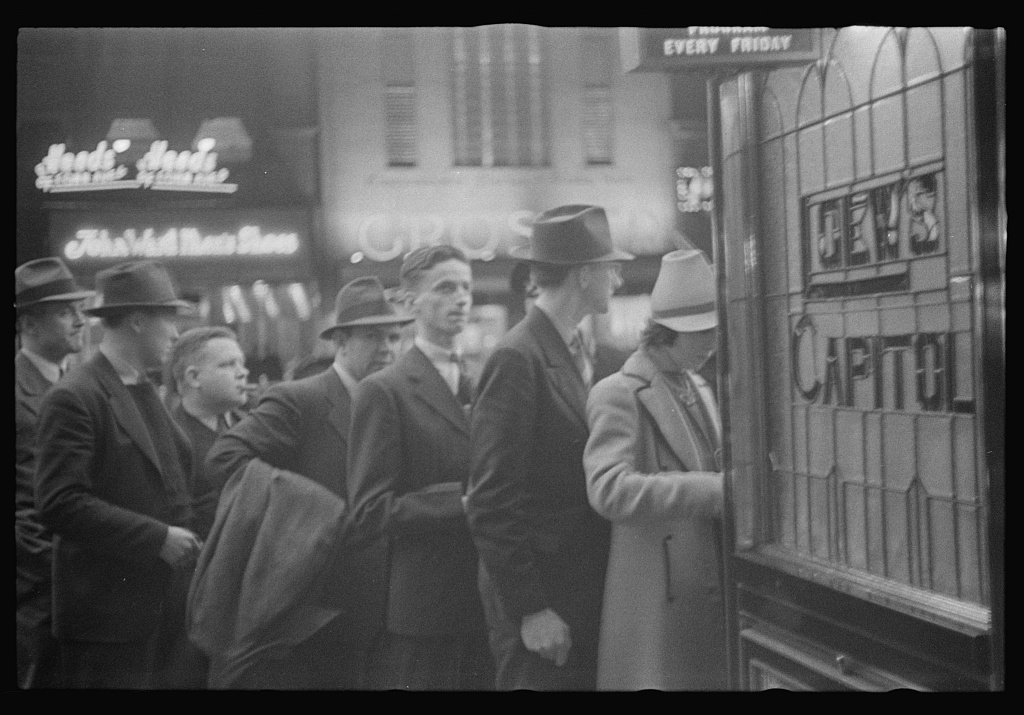
Down the block: the Palace and the Columbia
Back up to 1918, because Loew’s was on F Street years before the Fox came along. Loew’s Palace opened at F and 13th Streets NW on Nov. 4, 1918, a week before the World War I armistice. According to a 1978 look back in the Post, the first movie on the screen was a patriotic “wiggle picture,” Mary Pickford in “Johanna Enlists.”
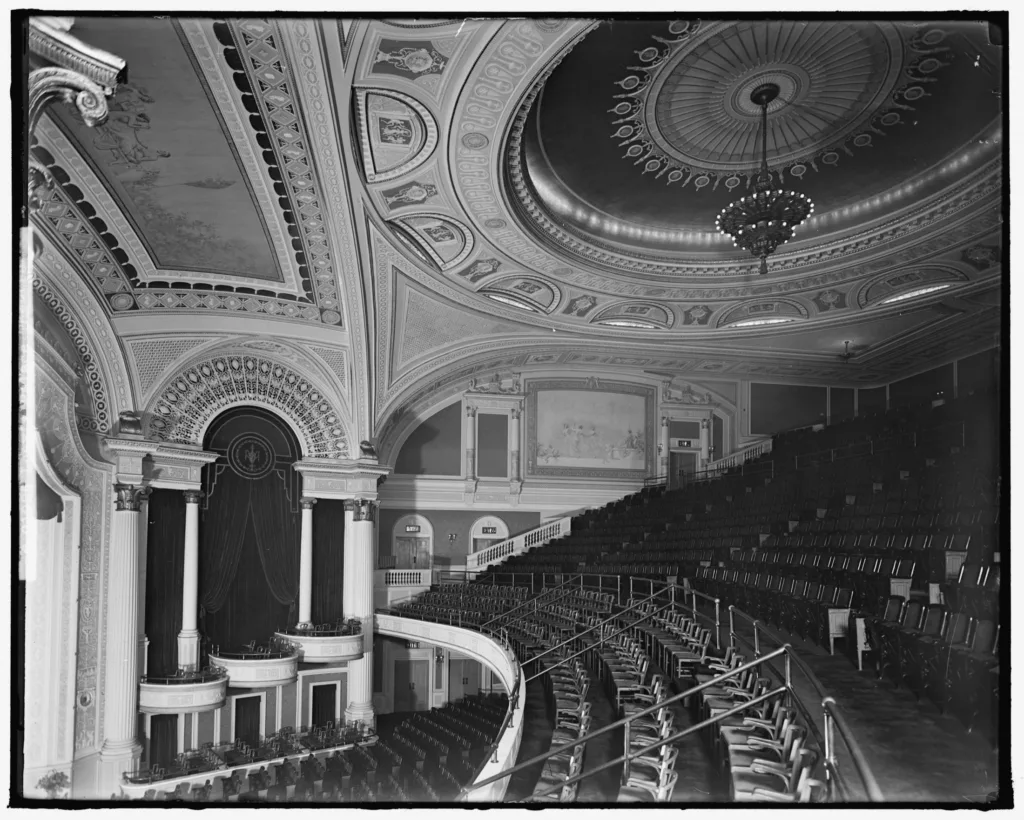
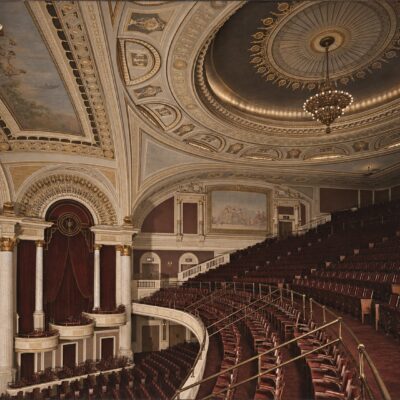
Moving Picture World called it the largest theater in the city, with 3,000 seats, and described a dome in the main ceiling with a chandelier hanging from it. That’s the dome in the photograph below, the black-and-white original of the featured image. The decoration was a modified Adam style, with a mahogany-paneled promenade around the mezzanine.
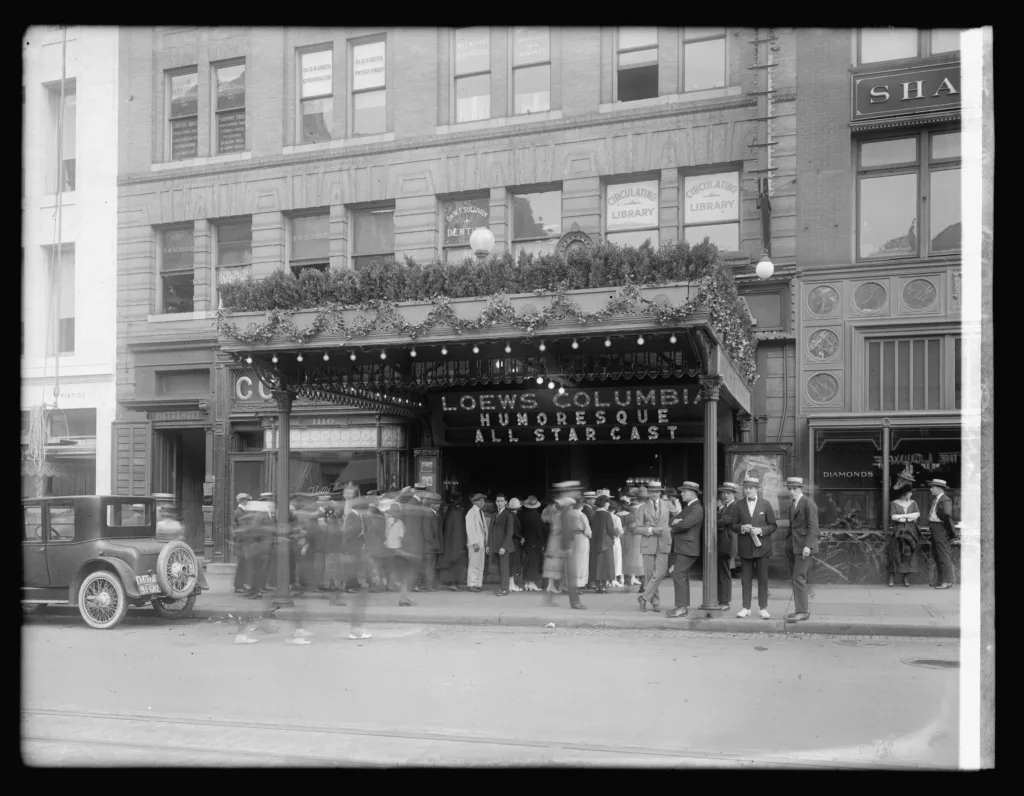
The Columbia stood at 1112 F Street NW, near 12th Street. A National Photo Company picture from 1920 shows a crowd under its marquee for “Humoresque.”
When the wreckers were finishing it off in October 1959, a Post photo caption looked back on its life. It opened in 1891 as the Metzerott Music Hall, became the Columbia around 1900 and turned into a Loew’s movie house in 1914, the caption said.
That same fall the Post reported that Helen Hayes, who was born in Washington, made her stage debut at the Columbia at the age of 7.
The gilded lady’s last act
By 1963 the old Fox, now Loew’s Capitol, was the largest theater in Washington, according to the House District Committee. It was also the only one with “stage facilities large enough to accommodate ballet and grand opera productions.”
The National Press Building Corp. wanted more revenue than the theater provided, so it decided to turn the space into offices. The furnishings were sold off.
The House tried to save it. In August 1963 it passed a bill, without debate, to delay the conversion and have the D.C. Commissioners plan to run the Capitol and Keith’s as municipal theaters. Keith’s stood at 619 15th Street NW, near G Street.
The Post put it bluntly: “And the wreckers ball is already aimed at the Capitol.” It was aimed at the theater, though, not the building around it.
On Sept. 2, 1963, Philip Kopper of the Post wrote her send-off:
Her debut, which was “Paid to Love,” was witnessed by Cal Coolidge and Andrew Mellon. And she went on to become the toast of the Thirties. But now, perhaps a little stale and middle-aged, she can’t pay the rent.
The Commissioners opposed the plan. On Sept. 5, Sen. Paul Douglas introduced a Senate version that added compensation for the owners during the proposed delay. But the rescue effort was still underway as the Capitol prepared to close.
The last picture was MGM’s “A Ticklish Affair,” and the Capitol closed on Sunday, Sept. 8, 1963. That came almost exactly 36 years after the Coolidges took their box.
In early 1964 workers were tearing out the old Capitol to make room for stores and offices, a UPI story in the New York Times reported. The theater took up nearly a third of the building. The same story blamed television and the neighborhood theaters for draining the Capitol’s business.
The Palace’s final dawn
On Saturday, April 15, 1978, Wolf Von Eckardt of the Post said goodbye to the Palace, calling it Washington’s “last grand movie and vaudeville house.” The Palace was set to close at dawn the next morning, Sunday, April 16, when the last show of an all-night binge of mostly exploitation movies let out. That gave it a run of about 59 and a half years.
The auditorium and the entrance lobby had different endings. By July 9, the Post reported that the theater had been demolished and work was starting on new headquarters for the National League of Cities at 13th and E Streets NW.
The new headquarters building, at 1301 Pennsylvania Avenue NW, dates to 1982, according to the architectural guide Buildings of the District of Columbia.
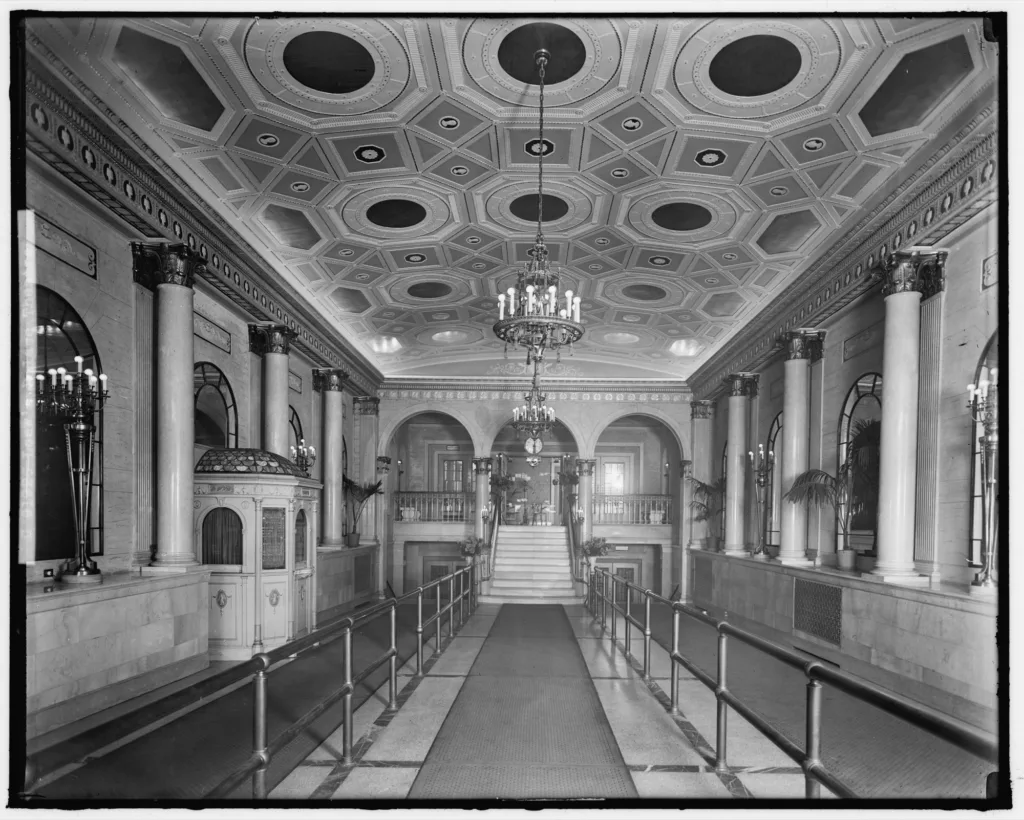
The F Street entrance lobby outlasted the auditorium. When the Historic American Buildings Survey documented the site in December 1979, the lobby was still standing, with its doors boarded and the wall behind it filled with concrete blocks.
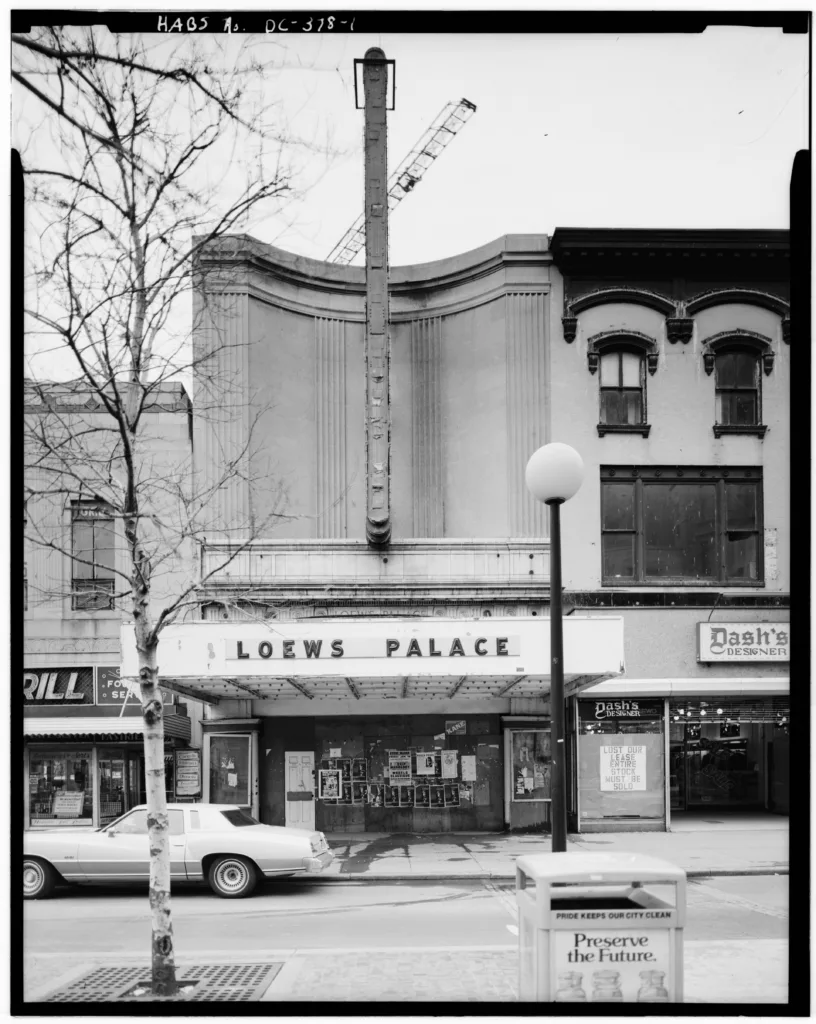
Inside, the survey still found marble columns, a vaulted ceiling and the stairway toward the former auditorium.
The National Press Club is still in the building at 529 14th Street NW, where Coolidge laid the cornerstone. The theater where he took his flag-draped box is long gone.
Liked this one? Get more tomorrow.
Lost Washington stories in your inbox most mornings: the newest, plus a few from the archive.
 This storyThe Night Coolidge Came to the Fox: F Street’s Lost Movie Palaces
 What Was a Herdic Cab? An 1881 Race Down Pennsylvania Avenue
 Langley, the Wright Brothers, and the Fight Over First Flight
Free. Unsubscribe anytime.
AI helped research, write and edit this story. The featured photograph was colorized with AI; its colors are interpretive. The original black-and-white photograph is included in the article. Here’s how we use AI.Suggest a correction