
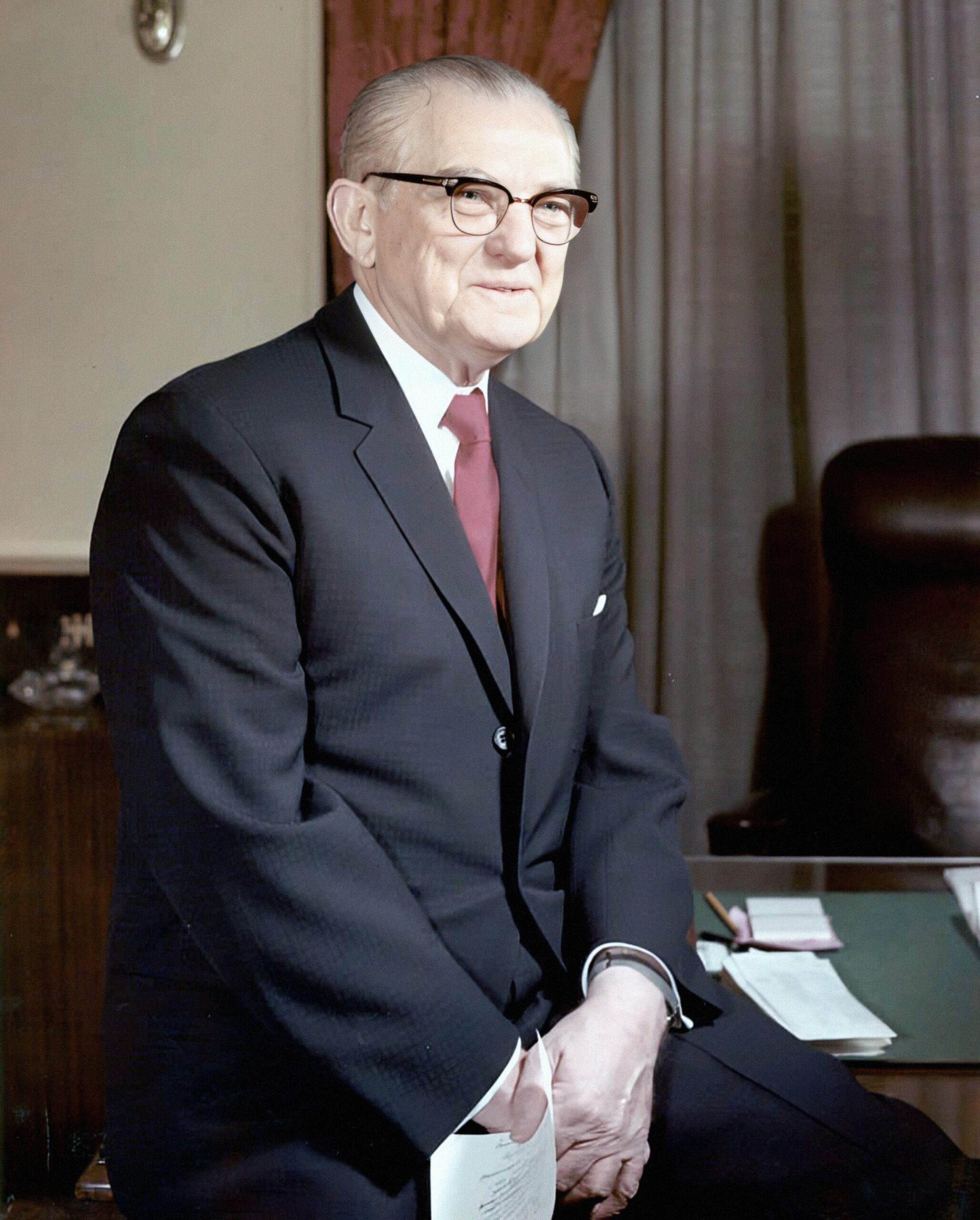
It was already dark when the senator pulled up to his house. The white car, the parking spot at the curb in front of 3609 Cumberland Street NW. All routine. He did this most nights after work at the Capitol. He was 71 years old. He chaired the Senate Armed Services Committee. And on January 30, 1973, at roughly 7:40 in the evening, two teenagers stepped out of the dark and shot him twice.
Senator John C. Stennis was not supposed to survive the night. He served sixteen more years.
A senator, a routine, and a parking spot
Stennis liked driving himself. He was a Mississippi farmer’s son who had won his Senate seat in a 1947 special election and never lost another one. By January 1973 he was 41 years into a career that would run another 16. He chaired the Armed Services Committee, was recognized in the Senate chamber as the body’s preeminent voice on defense matters, and could make a hush fall when he rose to speak.
His house at 3609 Cumberland Street, on a quiet block of upper Northwest Washington just north of Cleveland Park, was an unremarkable choice for a senator of his stature. He’d drive home alone, park at the curb, and walk the fifty feet to his front door. That was his custom. The two young men who watched him do it that Tuesday evening had been waiting.
“Get ’em up”
The Washington Post reconstructed the encounter from police accounts the morning after:
After driving home alone and parking in front of his house, as was his custom, he stepped out of the auto and was approached by two youths in their late teens, according to police accounts. While he was standing in the roadway, the youths demanded money. “Get ’em up,” one demanded.
Offering no resistance, the senator turned over what he had on him. His wallet held credit cards and a driver’s license. The rest was a gold pocket watch, his Phi Beta Kappa key from the University of Virginia law school class of 1928, and a 25-cent piece. That was the entire haul.
What happened next is the line every retelling of the story has fixed on:
“Now we’re going to shoot you anyway,” the youths were quoted by the senator. Or, the police reported, it might have been “We ought to shoot you anyway.”
One of them fired twice. A .22 caliber pistol, by contemporary reporting. One bullet struck the senator in the left thigh and shattered the bone. The other entered his chest just below the breast pocket of his suit and missed his heart by a margin no one cared to measure.
The two men ran. Stennis, somehow, did not go down. By one account he crawled the fifty feet to his front door. Wife Coy Stennis called the police. By another, he staggered inside and lowered himself onto the living-room couch, bleeding through his suit. Both can be true. The ambulance was dispatched from the Adams Morgan firehouse three miles south. The Post identified the two attendants who answered the call as Pvt. William Taylor and Pvt. Robert Adams. They did not know whose home they were heading to until they were a few blocks out.
A 1971 law, a presidential phone call
Before the ambulance reached Walter Reed Army Medical Center, three things had already happened in Washington. The White House had been notified. The FBI had been told to assist. And a statute that almost no one outside the federal courts had heard of was suddenly the spine of the case.
The American Forces Vietnam Network read the story at the top of its 5 p.m. broadcast that day, with the surgery already underway:
White House News Secretary Ronald Ziegler says that President Nixon has been informed of the shooting, and has instructed the FBI to assist in every possible way. A 1971 law makes it a federal crime to assault or kidnap or kill a member of Congress.
That law was 18 U.S.C. § 351, enacted on January 2, 1971, in the long aftermath of the 1968 assassination of Robert F. Kennedy and the broader question of how exposed federal officials were to ordinary street crime. It had been on the books for two years. The Stennis case was an early high-profile test.
The reach of the statute is why Tyrone Marshall and his brother John would eventually face a federal indictment for attempted murder of a member of Congress, not just the District of Columbia charges of armed robbery and assault.
Six and a half hours at Walter Reed
A team of military surgeons opened the senator up shortly after he arrived at Walter Reed and stayed at the table for six and a half hours. The bullet in his torso had ripped through part of his stomach, his pancreas, and a major vein draining into the intestines, according to the Washington Post’s reporting the following day. They did not remove it. The surgical priority was patching, not extracting.
The leg wound was the easier of the two and still serious. The bullet had struck bone.
A press conference the next day described his chances as “guarded.”
President Nixon visited Walter Reed eight days later. The exchange he gave reporters outside the center on February 7 is in the public record:
Well, I just talked to the doctors, and they say that he is considerably improved over what he was yesterday. As you know, the situation was considered to be quite grave yesterday morning and yesterday afternoon, and late last night, at midnight, I called Dr. Tkach, our doctor, and had him check with the doctors here, and they said he had had a very good night.
He kept going:
They make the point, for example, that his tissues are much younger than a man of 72 would normally have. Now, I judge it by another thing, his handshake. He has always had a grip of steel, and I reached out and I thought after what he had been through that, you know, he would sort of be limp, but that handshake just came on as strong as it ever was.
That is the kind of detail period reporting almost never delivers in real time. Nixon was at the hospital. He had shaken the man’s hand. Stennis was conscious eight days after taking a bullet through his pancreas.
The Republican at the switchboard
One of the smaller stories from that night took years to be reliably retold. It involves Senator Mark Hatfield, the Oregon Republican who had spent the previous several years sparring with Stennis on Vietnam policy.
By one widely retold account, Hatfield heard about the shooting on his car radio while driving home from the Capitol that night. He turned around, drove to Walter Reed, found the hospital switchboard buried under press and constituent calls, and sat down to help. He worked the phones without identifying himself until daylight, then stood up, put on his coat, told the operators his name on the way out, and left. He had no medical skills to offer Stennis. The phone calls were the thing he could do.
Most contemporary newspaper coverage focused on the surgery. The Hatfield switchboard story circulated mostly through later retellings by Stennis himself.
Tyrone and John Marshall
Two Washington teenagers, brothers, were charged in the shooting. Tyrone Marshall and his brother John Marshall. A third man, Derrick Holloway, was also charged but received immunity in exchange for testifying against the brothers. John pleaded guilty.
Tyrone took his case to trial. After four days of testimony, he entered an Alford plea to the full indictment. An Alford plea is a guilty plea in which the defendant maintains his innocence but acknowledges that the government’s evidence would likely produce a conviction. The federal appeals court that later reviewed the plea, in United States v. Marshall, 510 F.2d 792 (D.C. Cir. 1975), summarized his reasoning in words that carry the weight of a teenager faced with the federal government and an unwinnable case:
[W]hile he had not committed the offenses charged, he recognized that the strength of the Government’s case thus far presented minimized his chances of acquittal.
The plea was not negotiated. He entered it mid-trial, over the prosecution’s objections, after the case had run hard against him. Judge Waddy declined to invoke the federal Youth Corrections Act, which would have allowed a reduced or sealed sentence, and instead handed down adult terms: ten to thirty years, the terms to run concurrently. John Marshall, by period reporting, received a sentence of fifteen years.
When Tyrone Marshall later moved to withdraw the plea on appeal, the D.C. Circuit refused. The opinion concluded that the trial judge’s denial of an eleventh-hour withdrawal was not improper.
The 1971 federal congressional-assault statute had been tested.
DC in the winter of 1973
The shooting landed in a city already arguing about crime. The early 1970s had pushed street violence in Washington into national talking-point territory, and a sitting senator getting shot in front of his own door in upper Northwest gave the conversation a face. The Stennis case ran beside other 1973 stories that fit the same dread: in the summer of that year, Colonel Yosef Alon, an Israeli air attaché, was assassinated in his driveway in Bethesda, a case the FBI never closed.
For the well-to-do streets of upper Northwest, the shooting punctured a particular kind of comfortable assumption: the blocks above Massachusetts Avenue had always been the Washington a senator chose they were safe. After January 30, that was a harder claim to make.
Inside the Senate, the shooting accelerated long-running conversations about member security.
August 3, 1973
The shooting removed Stennis from the Senate for six months and three days. He returned to the floor on August 3, his 72nd birthday. He had spent the spring at Walter Reed drafting legislation; one of the statements he sent over to the floor while still recovering called for legislation that would prevent the President from restoring American troops in Vietnam without congressional approval. The War Powers Resolution, of which Stennis was a principal sponsor, passed the Senate in July of that year. He had been a hawk on Vietnam. He came out of his hospital bed worried about the precedent.
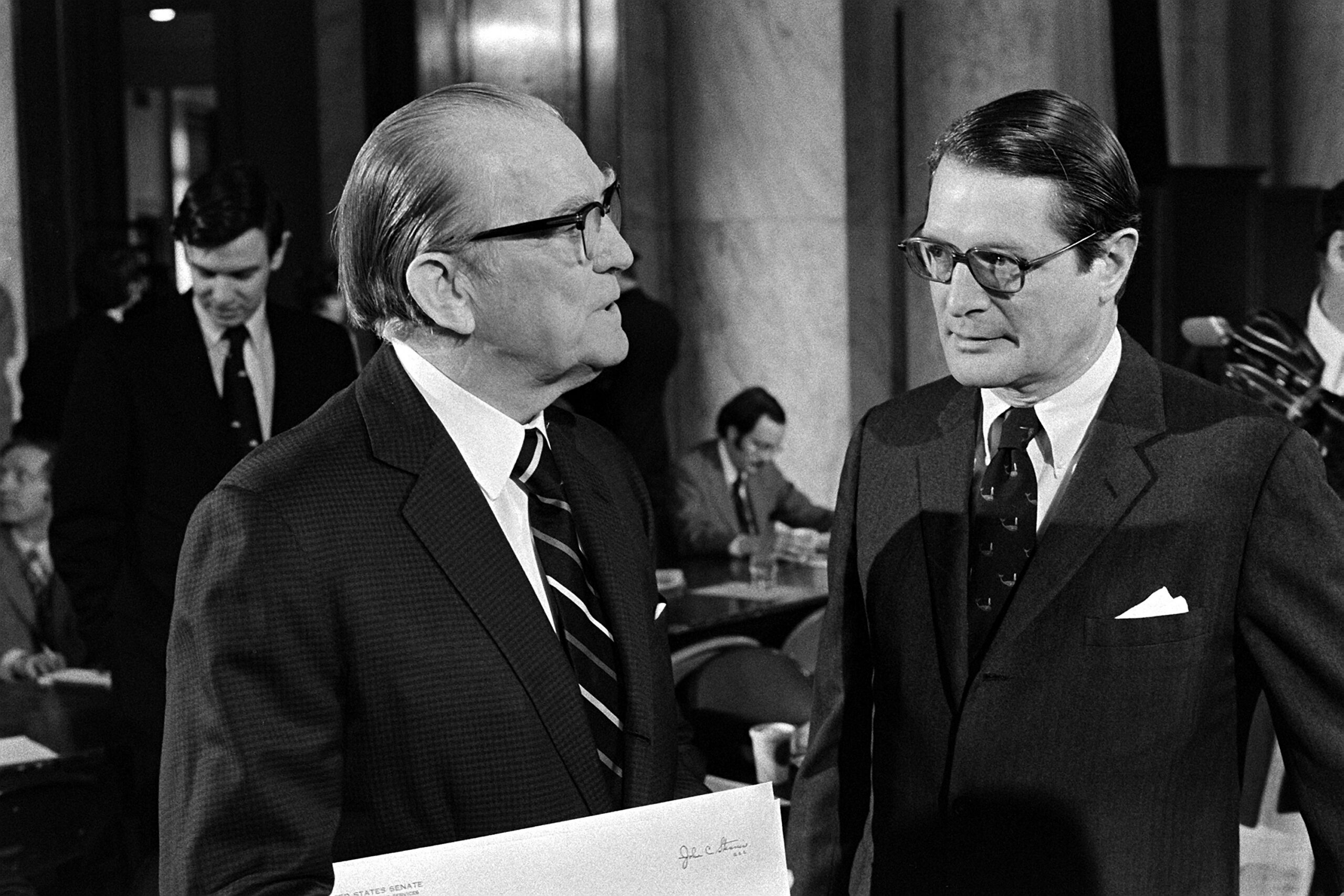
The Watergate hearings were running simultaneously. Within months, Nixon would propose the so-called Stennis Compromise, under which the famously hard-of-hearing senator would listen to the White House tapes and authenticate a written summary of them rather than turning the recordings over to the Special Prosecutor. The deal fell apart. That a cast of characters this combustible was willing to bet on the senator from Mississippi is a measure of the credibility Stennis had reclaimed in the seven months since two teenagers had shot him for a quarter.
What the senator did with the next sixteen years
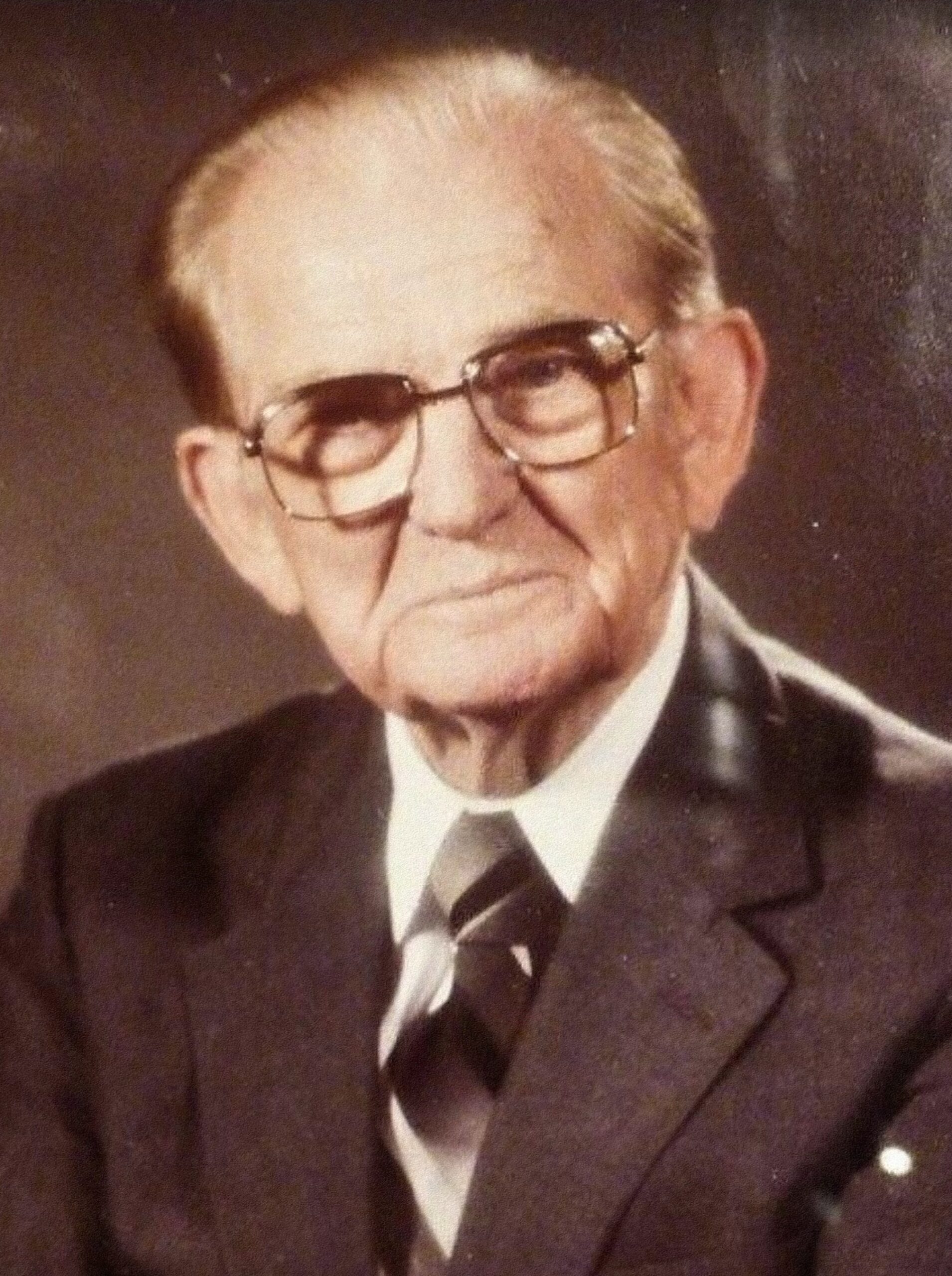
Stennis stayed in the Senate until January 3, 1989. He chaired Armed Services until 1981, then chaired Appropriations under a Democratic majority and served as President pro tempore from 1987 to 1989. He lost his left leg to cancer in 1984 and finished his career in a wheelchair. By the time he left office he had served forty-one years, one month, and twenty-nine days, longer than any Mississippi senator in history, and the last Democrat his state would send to the Senate to date.
He died at 93 in Mississippi in April 1995.
The bullet they didn’t remove stayed with him.
A shooting in Van Ness? A 14th Street Red Light District?
This and the article you posted yesterday about 14th Street makes me think you could do an entire blog dedicated to the events in DC over the past 40 years that would seem out of place today.
There have actually been a few armed robberies in the Tenleytown area over the past year or so. At least that’s what I read on a local triathlon club forum. They posted a note about it.
Clumsy phrasing on my part. I didn’t mean to imply that no crime was going on in DC. But that’s still a far cry from a Senator getting shot or an Italian Ambassador getting mugged at Meridian Hill Park.
This happened in 1973.
One wonders how much of their sentence the perps of this crime actually served.
More ’70s crime facts: There were muggings at the Iwo Jima Memorial (so common that the Arlington County Board discussed the problem at a meeting in 1976). Unthinkable in 2015, even if crime is rising somewhat.
I lived in that house from 1992 until 2014. Although there had been several intervening owners, the fuse box still had a marking for “Senator’s bedroom.” Soon after we moved in, on a very high shelf in a bedroom closet I found a diary, and I peeked at a page and determined that it had belonged to a teenager, apparently Senator Stennis’s daughter. I sent it down to Mississippi.