
On September 2, 1906, the Washington Post published a troubling tally from Columbia Heights. It counted nine deaths in twelve months among people connected to the blocks around 14th and Monroe streets NW: seven suicides, one accident, and one person found dead. The paper gathered the cases into a story about a neighborhood wondering what would happen next.
Two days earlier, on Friday, August 31, the Evening Star had reported the death of Dr. James Donald Wilson at 1329 Park Road NW. Wilson, 39, was a physician from Andrews, North Carolina, who had been staying with his father for two months. His death prompted the Post to revisit other tragedies associated with the neighborhood.
A physician’s death on Park Road
The Evening Star account described Wilson as “a sufferer for years” and reported that he had been troubled by chronic insomnia. His father, Ebenezer Wilson, had shared his room the night before.
Coroner Nevitt ruled the death a suicide. Wilson’s body was sent to the family burial plot in Oxford, Pennsylvania, with no services held in Washington. The Post then placed his death alongside others involving residents of the surrounding streets.
The Post’s tally on September 2
That Sunday the Washington Post ran the longer piece. Wilson’s death, the paper wrote, “adds one more horror to the list of persons who have met sudden or violent death in that immediate vicinity in the last year.” It then drew an imaginary geometry that became the spine of the article, with the corner of 14th and Monroe as the center point.
Using the corner of Fourteenth and Monroe streets as a pivot and drawing an imaginary circle two blocks in circumference, there have been within this circle in the last twelve months, seven deaths by suicide, one by accident and one person found dead.
The neighborhood is becoming aroused over the constantly recurring tragedies, and when Dr. Wilson’s death was announced, the question was, “Who or what will be next?”
The cases the Post went on to list ranged beyond that stated period and area. A contractor named McCormick walked out of the Stratford Hotel at 14th and Monroe in January, kissed his family goodbye, boarded a Norfolk steamer, and was never seen again. His coat was found in the stateroom when the boat docked.
Around the corner on Monroe Street, Mrs. Du Bois, wife of a government official, took her own life with poison after months of grief over the death of an only child. At the Berwick Flats apartment house at 14th and Park Road, a tenant the Post identified as Mrs. Hempson took her life in October 1905 in the presence of her two young children, after, the paper said, her husband had left her.
The Post also named Miss Kitzmiller, niece of Gen. Swain, who had died in a fire at the Berwick apartments two years earlier; P. A. Carr, a streetcar conductor; Benjamin Parkhurst, a former city post office clerk killed in Chester, Pennsylvania; Mrs. Ida Squires, who died at the Truitt house at 16th and Monroe; Thomas Haines, a Park Road butler found in a vacant lot; and Pickney Smith, found dead at 1428 Newton Street on March 10.
The accident in the tally involved the young son of John Barry, a grocer at 1438 Newton Street. The boy was killed in an accident involving a pony cart on the White Lot, south of the White House. The “found dead” entry referred to Smith.
The Berwick Flats and a near-miss in February
The Post closed with another incident, this time a rescue. In February 1906, a fire at the Berwick Flats at 14th and Park Road cut off the stairways. Firemen raised ladders to the third floor, but one broke as residents climbed down. An awning below broke their fall. Among those injured was the mother of Nan Patterson, the former Florodora chorus girl tried in connection with a New York gambler’s death in 1904. Her mother suffered lasting foot injuries.
What 14th and Monroe was in 1906
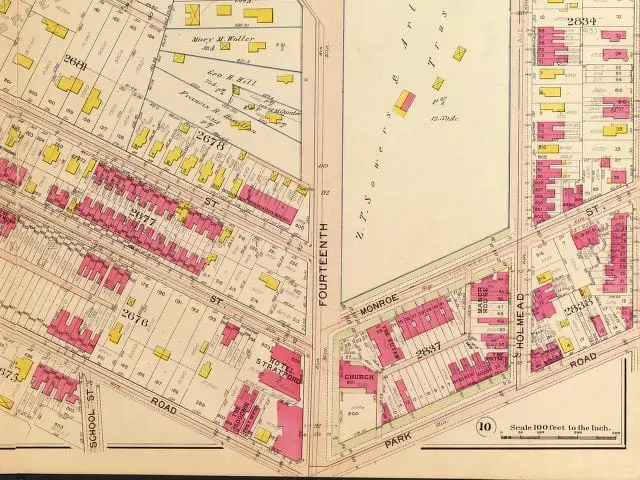
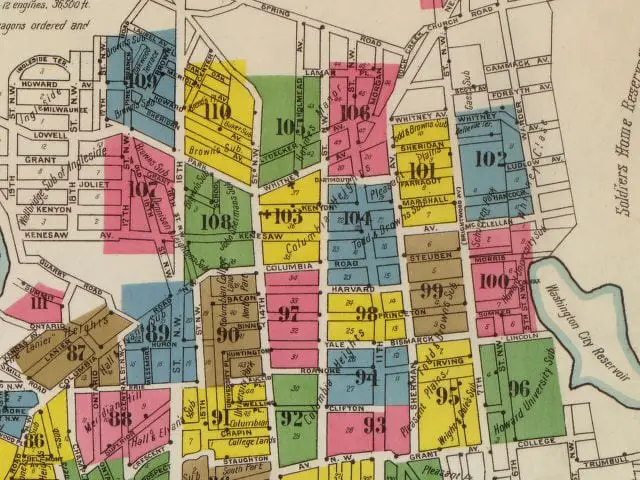
In 1906, Columbia Heights was still growing along the 14th Street streetcar line. Real estate advertisements show the houses being offered to buyers, while the 1903 map of Columbia Heights shows how much land remained undeveloped. The newspaper stories give us a different view of those same blocks, through the lives of residents including a physician, a conductor, a clerk, and a butler.
The Stratford Hotel stood at the southwest corner of 14th and Monroe. A December 1921 Evening Star notice described its replacement by a commercial building built by Charles H. Tompkins and designed by George N. Ray. The Berwick Flats also disappeared; the Riggs Bank development replaced them at 14th and Park Road. Across 14th Street, the Tivoli Theater opened at 14th and Park Road in 1924. Our look at Columbia Heights’ old street names helps explain why earlier maps can be difficult to follow.
Reading 1906 newspaper coverage today
The Post‘s tally needs to be read with some care. Its opening count was nine deaths in twelve months, but its list ranged more widely: the Berwick fire death was two years earlier, and several incidents happened outside Columbia Heights. The paper was grouping people by their connection to the neighborhood, rather than giving a consistent count of deaths within the circle it described.
The article records the neighbors’ alarm, but it does not establish a common cause linking these deaths. That distinction matters when reading the question it left hanging: “Who or what will be next?”
Liked this one? Get more tomorrow.
Lost Washington stories in your inbox most mornings: the newest, plus a few from the archive.
 Senator John Stennis Shot in Northwest Washington in 1973
 Chateau Bonaparte: The Bonaparte Family’s K Street Home
 Japan’s First Embassy to America Arrives in 1860
Free. Unsubscribe anytime.
We use AI to help research, write and edit stories across our sites. Here’s how we use AI.Suggest a correction