
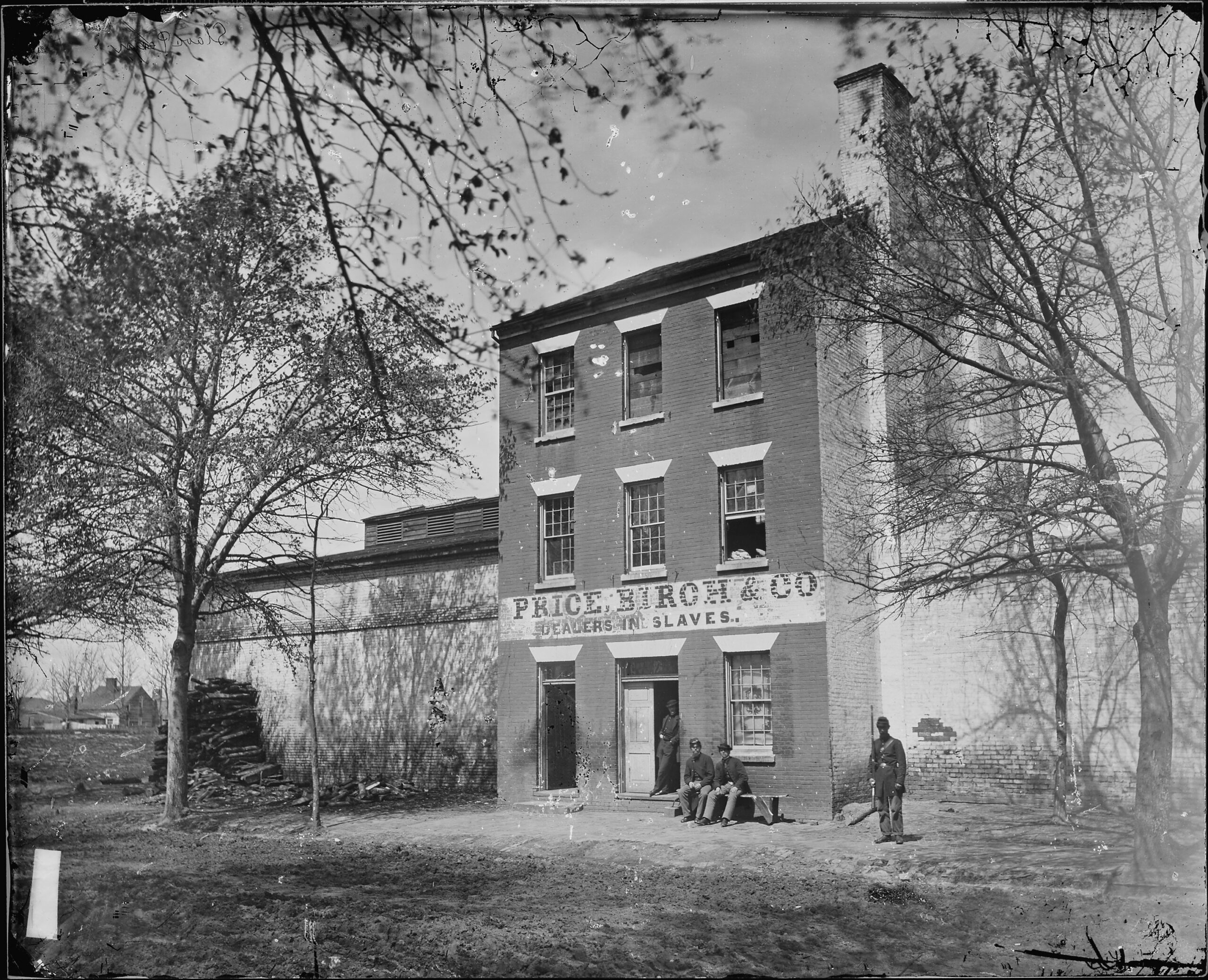
A Union soldier stands at parade rest on the brick sidewalk, rifle at his shoulder. Behind him, four white-painted columns frame a doorway. Above the doorway, a long wooden signboard runs the width of the building. The lettering is plain and businesslike. It reads:
PRICE, BIRCH & CO. DEALERS IN SLAVES.
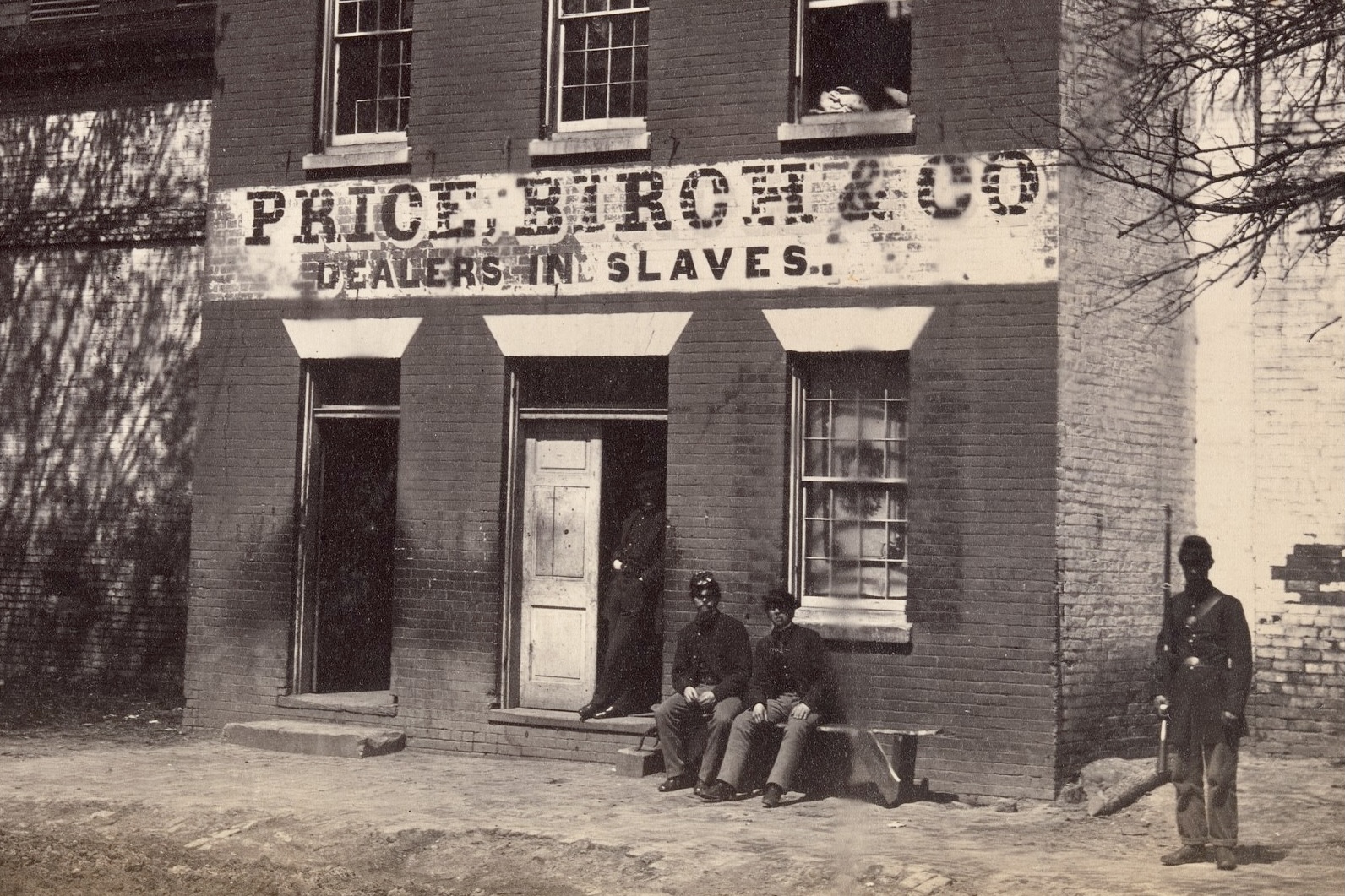
That is the Andrew J. Russell photograph. He took it in occupied Alexandria, Virginia, sometime between 1861 and 1865, most likely in 1863, after Russell had set up the U.S. Military Railroad’s photographic department in the rail yards north of Old Town. By then the slave dealers were gone. The building was a Union prison. But the sign was still up.
That sign, and that building, are the reason this photograph exists at all. They are also the reason 1315 Duke Street, which is a quiet brick rowhouse at the western edge of Old Town Alexandria, is one of the most consequential addresses in American history.
1315 Duke Street, the Building That Did Not Disappear
The building is still there. That is the first thing to know.
It was constructed sometime between 1810 and 1820 as the private residence of Robert Young, a brigadier general in the District of Columbia militia. Federal-style, four stories, three bays wide. From the street it looks like any number of early-republic townhouses you can walk past in Old Town in an afternoon.
In 1828 it was leased by two slave traders named Isaac Franklin and John Armfield. They bought it outright in 1832. Within a few years, the address would become the headquarters of the largest slave-trading firm in the history of the United States.
After the Civil War the building was sliced into apartments. It served at various points as offices, as a halfway house, and as the headquarters of the Northern Virginia Urban League. The basement, where enslaved people had been held, was eventually opened as a small museum in 2008. In March 2020, the City of Alexandria purchased the property from the Urban League for $1.8 million. Today it operates as the Freedom House Museum, and in 2025 the building’s exterior was restored to its original Federal appearance, undoing the later Empire-style renovation that had partly disguised it.
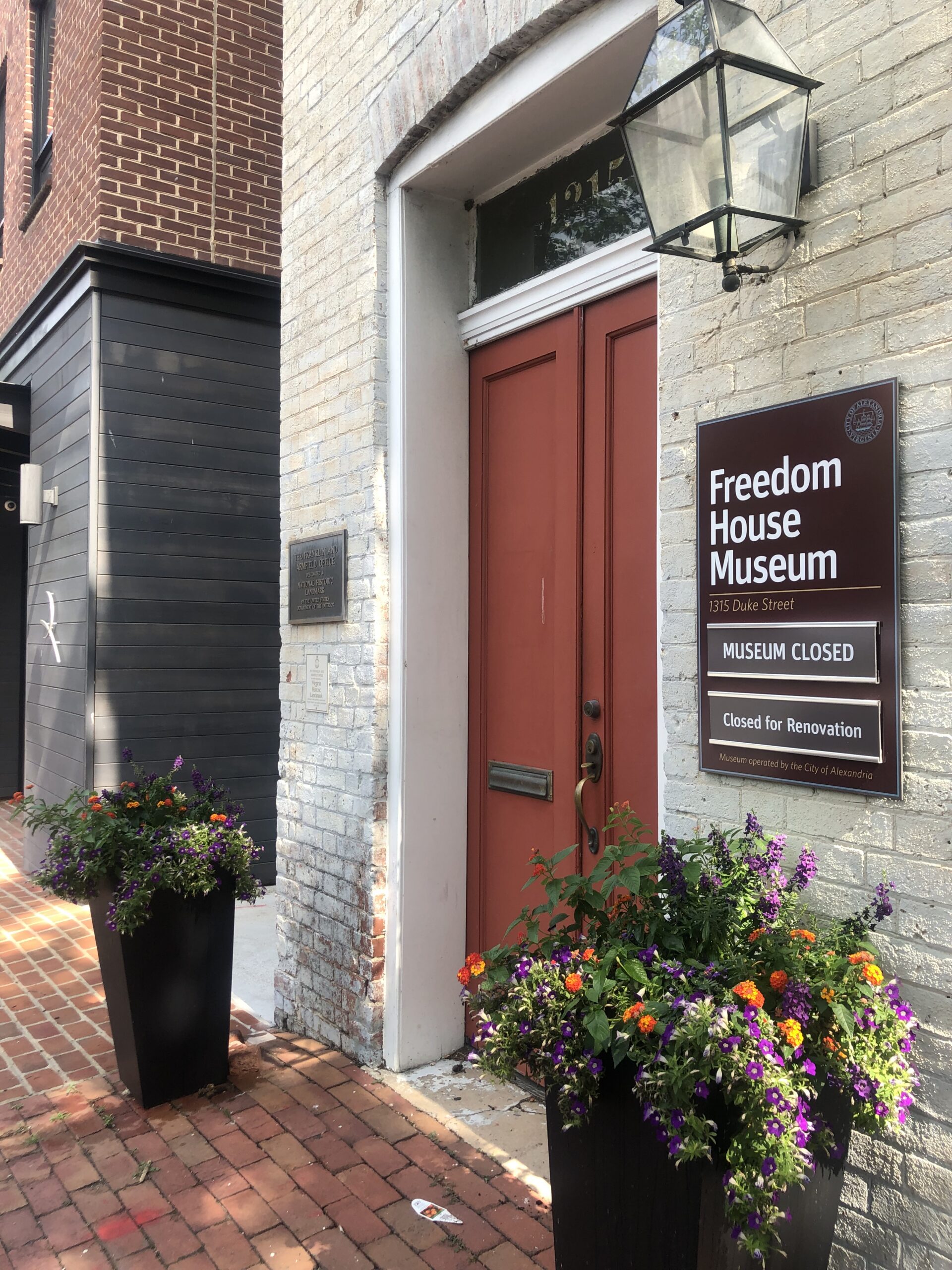
You can walk in. You can stand in the room where, in May of 1861, Union soldiers found a single elderly man chained to the floor by his leg.
But to understand what that scene meant, you have to start in 1828.
Franklin & Armfield: The Largest Slave-Trading Firm in U.S. History
Isaac Franklin was a Tennessee planter. John Armfield was his nephew by marriage. The two of them designed an interstate slave-trading operation that was, in scale, unprecedented.
The model was simple. Cotton was booming in the Deep South. Sugar plantations in Louisiana and cotton plantations in Mississippi needed labor. In Virginia and Maryland, where tobacco had exhausted the soil, planters were carrying surplus enslaved people on their books. Buy low in the Upper South. Sell high in the Lower South. The arbitrage was brutal and it was enormous.
Armfield ran the Alexandria end. He bought enslaved people across northern Virginia and held them at Duke Street. Franklin worked the New Orleans and Natchez markets. Between them they exported, by the official City of Alexandria estimate, more than 3,750 enslaved people from this single building between 1828 and 1836. Some scholars put the number higher. By the 1830s the firm was moving close to 1,000 to 1,500 people a year.
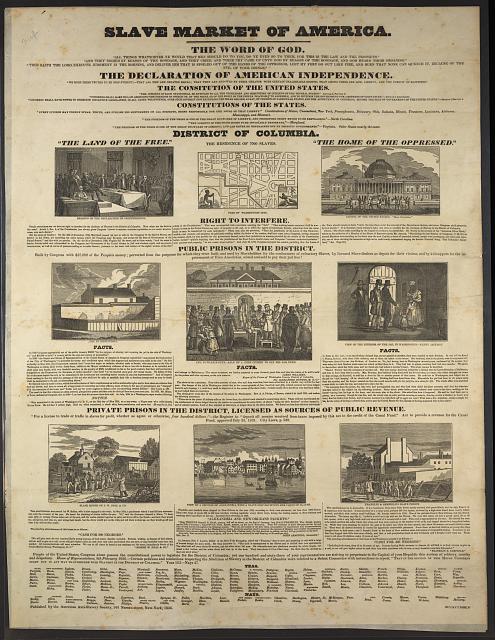
To do that volume they needed ships. Franklin & Armfield commissioned a small fleet of brigs purpose-built for the trade: the Tribune, the Uncas, and the Isaac Franklin. The Uncas cost them $7,250 to build, roughly a quarter of a million dollars in modern terms. Eighty feet long, twenty-three feet wide, fitted out below deck to carry human beings as cargo on a three-week voyage from the Potomac to New Orleans.
The ships ran twice a month at peak. When the ships could not move enough people fast enough, Armfield sent coffles overland: lines of chained men and women marching south on foot, sometimes for hundreds of miles, to be sold at the start of the Lower South’s autumn buying season.
In January 1834 a New York abolitionist editor named Joshua Leavitt visited the Duke Street pen. He described a tidy three-story brick house, neatly painted, green blinds at the windows, sign over the door. Behind the building was a large yard, perhaps three hundred feet square, surrounded by a whitewashed board fence. One of the partners showed him in.
They were first taken into a paved yard, 40 or 50 feet square, with a very high brick wall, and about half of it covered with a roof, appropriated to the men. The men were called out from the cellar where they slept, numbering 50 or 60. About 50 women and small children were then called out.
Joshua Leavitt, January 1834
The neatness, the polite invitation, the whitewash. That is the part of this story that is hardest to sit with. It was a business. It kept ledgers. It hosted visitors.
Isaac Franklin retired from the trade in 1836, immensely wealthy. He moved to a 2,000-acre Tennessee estate called Fairvue and married Adelicia Hayes, the daughter of a Nashville lawyer and minister. When he died in 1846 his widow inherited Fairvue, six Louisiana cotton plantations totaling roughly 8,700 acres, more than 50,000 acres of undeveloped Texas land, and 750 enslaved people. Adelicia Acklen, as she became after her remarriage, was for a time the wealthiest woman in the state of Tennessee.
That fortune started at 1315 Duke Street.
Alexandria Was Part of the District Until 1846
Here is a fact that surprises a lot of people. For most of the years Franklin & Armfield was running the largest slave-trading firm in the country out of Duke Street, that street was in Washington, D.C.
The original boundary of the District of Columbia, surveyed in the 1790s, included Alexandria on the south bank of the Potomac. Alexandria was retroceded to Virginia in 1846. Three years later, in the Compromise of 1850, Congress abolished the slave trade in what remained of the District. White political leaders in Alexandria had pushed for retrocession in part because they feared exactly that outcome. We’ve written before about the long history of Alexandria’s retrocession to Virginia and what Washington looked like before that western portion was returned.
So when you look at the Russell photograph, you are looking at a building that operated as a federal-district slave market for the first eight years of its life as a slave pen. It was, technically and inescapably, a Washington story.
Solomon Northup and James H. Birch
In April 1841, a free Black violinist from Saratoga, New York, named Solomon Northup was drugged and kidnapped in Washington City. He woke up chained to the floor of a private prison called Williams’ Slave Pen, in a brick building on what is now Independence Avenue SW, within sight of the Capitol.
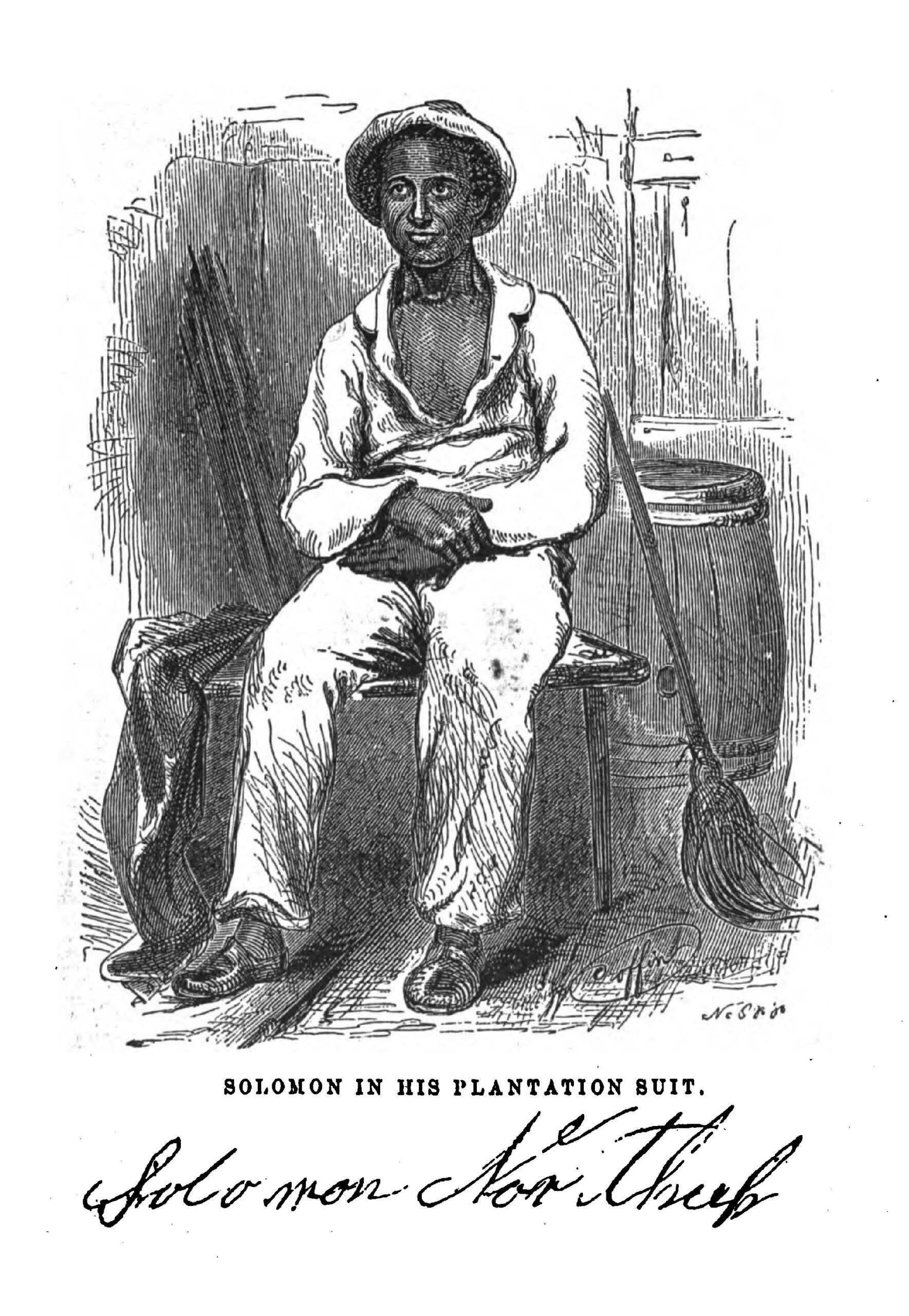
The man who put him there was a slave dealer named James H. Birch. Northup recorded the name in his memoir as “Burch.” He described Birch summoning a man named Ebenezer Rodbury to hold him down across a bench while Birch beat him with a wooden paddle until the paddle broke, and then with a cat-o’-nine-tails. Northup was sold south. He spent the next twelve years in Louisiana before he was eventually located and freed in 1853. The memoir he wrote afterward, Twelve Years a Slave, is one of the foundational documents of American slavery, and the basis of Steve McQueen’s 2013 film.
That same James H. Birch, seventeen years later, would become the senior partner at the slave-trading firm operating out of 1315 Duke Street. Charles M. Price and John Cook acquired the building from George Kephart in 1858. Cook left the partnership soon after. Birch took his place. The new sign went up:
PRICE, BIRCH & CO. DEALERS IN SLAVES.
The same man who had chained Solomon Northup to the floor in Washington was now running the pen in Alexandria. There is no single fact about this address that lands harder than that one.
For a wider sense of how common these private prisons were across the city in this era, see our post on the slave pens that were everywhere in Washington in the 1860s.
May 24, 1861
Virginia voted to ratify its ordinance of secession on May 23, 1861. Federal troops crossed the Potomac before dawn the next morning.
May 24 is the day Alexandria fell. It is also the day Colonel Elmer Ellsworth was shot dead on the staircase of the Marshall House, a few blocks east of Duke Street, after he climbed to the roof to pull down a Confederate flag. Ellsworth, 24 years old, was a friend of Lincoln’s and the first Union officer killed in the war. We’ve covered the Marshall House and Ellsworth’s death at length.
While that was happening, other Union regiments were fanning out across Old Town and securing the docks, the rail yards, and the slave pen on Duke Street. The proprietors had already cleared out. Most of the people they had been holding for sale had been moved south or sold off ahead of the Union advance. According to multiple later accounts, the soldiers who entered the pen found one elderly man left behind, chained to the basement floor.
A drawing of the surrender, captioned “Company of Secession Cavalry Surrendering to Colonel Wilcox, of the First Michigan Regiment, in Front of the Slave-Pen at Alexandria, Virginia,” ran in Harper’s Weekly on June 15, 1861. The pen was already a landmark.
The Union Army held the building until February 1866. They used it as a military prison for deserters and Confederate soldiers, then as the L’Ouverture Hospital for African American soldiers, and finally as housing for what the army called “contrabands,” self-emancipated men and women who crossed Union lines.
The Russell Photograph
This is where Andrew J. Russell comes in.
Russell was a captain in the 141st New York Volunteers. He had been a landscape painter before the war. In early 1863 he taught himself the wet-plate collodion process, paid the photographer Egbert Guy Fowx three hundred dollars for the lessons, and was detached from his regiment to photograph for the U.S. Military Railroad. He set up shop in Alexandria, in the rail yards just north of Old Town. He was the only Union officer assigned to photograph for the War Department.
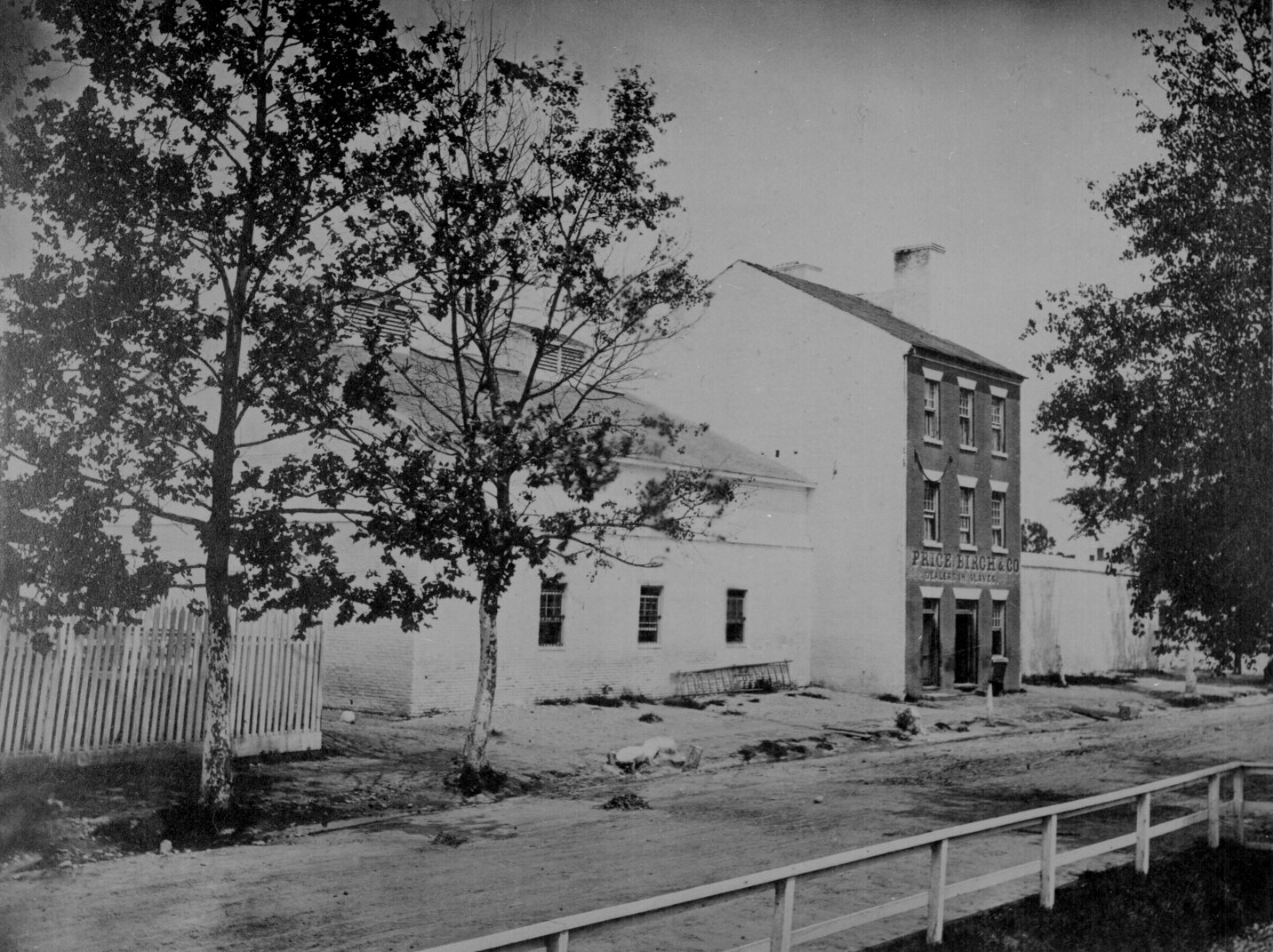
Russell’s image of the Price, Birch & Co. building is plate 99 in his post-war Civil War portfolio. The Library of Congress dates it to between 1861 and 1865. The Metropolitan Museum of Art catalogs the print as 1863. It is not the only photograph of the pen. William R. Pywell shot it in August 1863 for Alexander Gardner’s Photographic Sketch Book of the War. Mathew Brady’s studio took at least one exterior view as well. But Russell’s frame, the soldier on the sidewalk, the sign in plain capitals, has done more work in American memory than any of the others.
For most of the twentieth century the photograph drifted. It appeared in textbooks. It was reprinted as a Taylor & Huntington stereograph card. The original glass-plate negative ended up in the National Archives. Lantern-slide prints and a stereoview card of the building today live in the collection of the Smithsonian’s National Museum of African American History and Culture.
What the Russell image does, that words struggle to do, is render the matter-of-factness of the trade. There is no auction in progress. No coffle. Just a brick building with a sign over the door, the way a hardware store has a sign over the door. That is the part of the trade the photograph fixes in place. The American slave economy was not a metaphor. It had a storefront.
The Building Today
The Freedom House Museum at 1315 Duke Street is operated by the City of Alexandria’s Office of Historic Alexandria. It reopened in May 2022 with three floors of exhibits across the building. The basement, where the holding cells were, is part of the tour. So is the rear courtyard, the same paved yard Joshua Leavitt walked into in 1834.
Other Alexandria addresses from this period have aged into ordinary commercial life. We’ve written about the city’s 1858 Custom House and Post Office at Prince and St. Asaph, and about the African American laborers photographed on the Alexandria wharf in the 1860s, whose lives ran on the same waterfront where Franklin & Armfield’s brigs once tied up.
Duke Street is different. The sign is gone. The dealers are gone. The building stands.
If you go, the Freedom House Museum is open Wednesday through Saturday. Admission is free. The Library of Congress holds the Russell photograph and several related views, and the Encyclopedia Virginia entry on Franklin and Armfield is a good place to keep reading.
The man chained in the basement on May 24, 1861, has no name in the surviving record. We don’t know what happened to him after Union soldiers found him. We don’t know if he survived the war.
That is part of what Duke Street is now.
Birch (spelled Burch in Northup’s book) was the dealer who kidnapped Solomon Northup and sold him into slavery in the Deep South. In 1853, Northup wrote a stirring account of his kidnapping and captivity. “12 Years a Slave” is the movie. In real life and the movie, the slave pen was in D.C.
The slave traders in Alexandria made a fortune in their business. They would march the enslaved persons down Duke to the waterfront. They were so rich, they could afford two big ships for the trip to New Orleans. Believe it or not, they also made some slaves walk all the way to the Deep South.
If you get a chance, visit the museum downstairs. I’ve never been so moved in my life.
The museum on this site is well worth seeing, and is as moving and poignant as you will ever encounter. It is beautifully done. This is less than a 5 minute walk from the King Street Metro Station.