
Franklin Square has lived several lives. Its natural springs supplied drinking water to the White House for most of the 19th century, the Union Army covered it with wooden barracks in 1861, and in 1924 the District flirted with turning the whole park into a parking lot.
At 4.79 acres, the square bounded by 13th, 14th, I and K Streets NW is one of the largest downtown parks in Washington. And here is the kicker: nobody can prove it is actually named after Benjamin Franklin. The National Park Service’s own history admits the origin of the name is unknown.
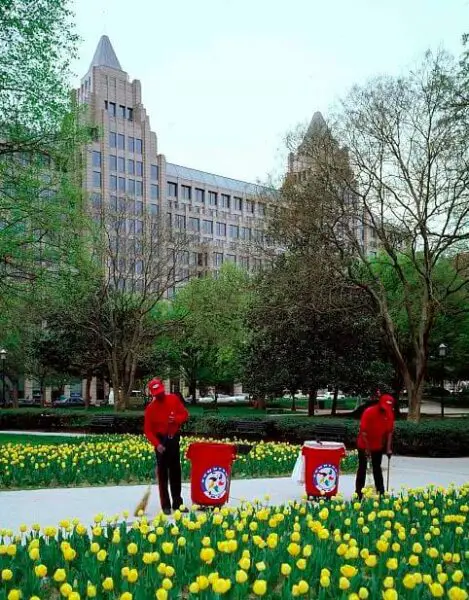
1. Natural spring water supplies the White House
Before it was Franklin Square, it was Fountain Square. The land was a low, marshy corner of John Davidson’s farm, part of a tract called Port Royal that stretched north to Massachusetts Avenue. On the L’Enfant Plan it was nothing special, just Square 249, ordinary private building lots.
The square had one precious resource: a powerful natural spring. Newcomers to the Federal City hauled drinking water out of it for years, and on March 3rd, 1819, Congress authorized piping that water to the White House and the federal buildings nearby.
The water first traveled through bored wooden logs. Columbia Historical Society records, quoted in the Evening Star, note that wooden pipes carried water “down to the houses on F street about Fourteenth,” and that cast iron pipes began replacing them as early as 1820. By 1824 the spring’s flow was estimated at two barrels per minute.
Accounts differ on exactly which president poured the first glass, but the Evening Star of March 2nd, 1928, told the story with a flourish.
Nearly a century ago President Madison and his household in “the Palace” mixed their refreshing drinks with cooling waters piped from a brick-lined spring reservoir in Franklin Park. A historian asserts that “Mr. Madison found its waters gave no impairment to the flavor of his toddy.”
Congress liked the arrangement enough to buy the whole square. An appropriation of $8,000 for the “purchase and enclosure” of the land came in 1828, with the purchase completed by 1832, plus another $5,700 for new pipes, reservoirs and water hydrants. In 1830, Fountain Square became Franklin Square.
When we first published this post in 2013, we repeated a claim that the White House stopped drinking Franklin Square water in 1832. The National Park Service says the opposite: the springs supplied every president from Andrew Jackson through William McKinley.
The flow weakened in the 1880s, likely cut off by the deep foundations dug for the grand hotels rising south of the park. Then came 1897. On the eve of the Spanish-American War, amid fears that Spanish sympathizers could contaminate the open springs and poison President McKinley, the government sealed them for good.
The spring had one last cameo. In March 1928, workmen widening 13th Street just below K uncovered a buried brick-lined reservoir, 30 feet long, 15 feet wide and 10 feet deep. The Star’s headline: “Believe Spring Was Source of President’s Water Supply.”
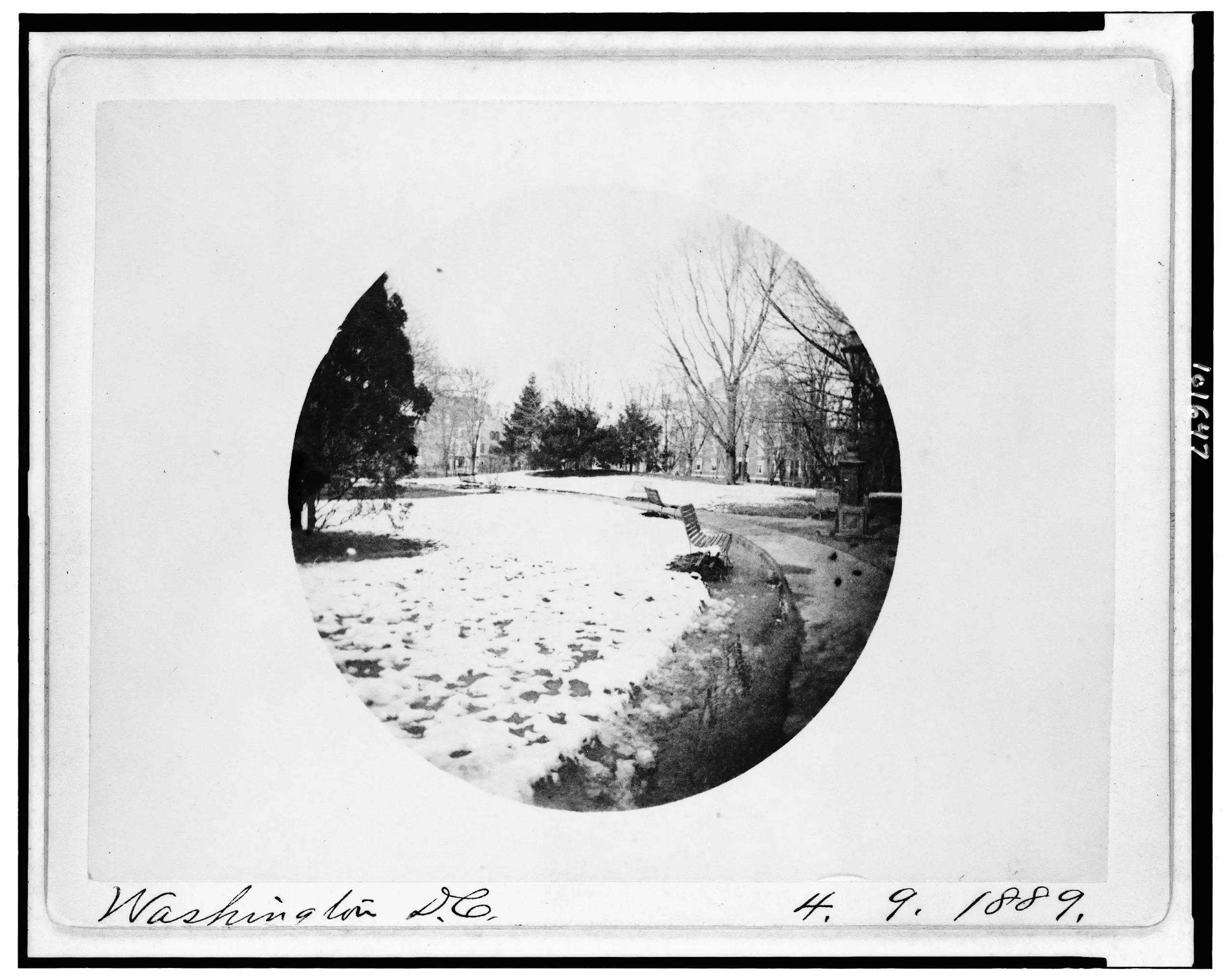
2. Franklin Square nearly becomes a parking lot
This sounds like a 1960s urban renewal story. It is from 1924.
That August, the District Commissioners were weighing a plan to remake K Street for the automobile age. The road would be widened to 97 1/2 feet, with a concrete strip 37 1/2 feet wide running down the middle, reserved for parking. The Washington Post’s August 6th, 1924, headline laid it out: “Widening K Street, Franklin Square as Auto Park Planned.”
The plan’s most alarming feature was using the entire center of Franklin Square to park cars. Inspector Albert J. Headley, chief of the Police Traffic Bureau, was credited with the idea, complete with waist-high shrubs planted around the edges so passersby would not see the automobiles.
The backlash was immediate. The Evening Star’s front page that same day carried the headline “Park Conversion Report Is Denied,” with the city’s leadership running from the idea as fast as it could.
“I certainly am opposed to using Franklin Square for the parking of automobiles,” was the comment of Commissioner Rudolph, chairman of the board.
“Such a proposal has never been brought to my attention and I am not convinced that it would be an advisable move,” said Engineer Commissioner Bell, who is also a member of the newly created National Capital Park Commission.
Even Headley backpedaled, telling the Star he had “merely suggested it as a possible way of providing parking space” and had no intention of recommending it.
The Post printed a blistering response on August 7th, 1924.
Motor car congestion in downtown areas has become so serious a problem that the authorities are compelled to devise some means of relief. The recommendation has been made that Franklin square be rearranged to permit the parking of cars in the center, with sufficient shrubbery around the sides to keep up the pretense of a park.
This recommendation should be promptly turned down, and all other suggestions looking to the gobbling of public breathing spaces be rejected. The destruction of the city’s downtown park spaces is not the right solution in any sense. Those spaces are all too few. There should be more small downtown parks. The obliteration of those that have survived would be a blow at the city’s health, and the suggestion can not be entertained.
…
Underground and roof garages are required. The spaces under the streets could be utilized without becoming a public nuisance, as the use of the parks would prove to be. Enterprising downtown builders hereafter should include generous parking spaces in their construction plans. Three floors for parking could be compressed into the space occupied by two ordinary floors. Subbasements and roofs could be used as garages.
By August 7th the Post was already running the plan’s obituary: “Protests Kill Plan to Make Auto Park of Franklin Square.” A day later the city floated a downtown storage garage instead. The 1924 letter writer got the last laugh too, since underground garages now sit beneath half the buildings ringing the square.
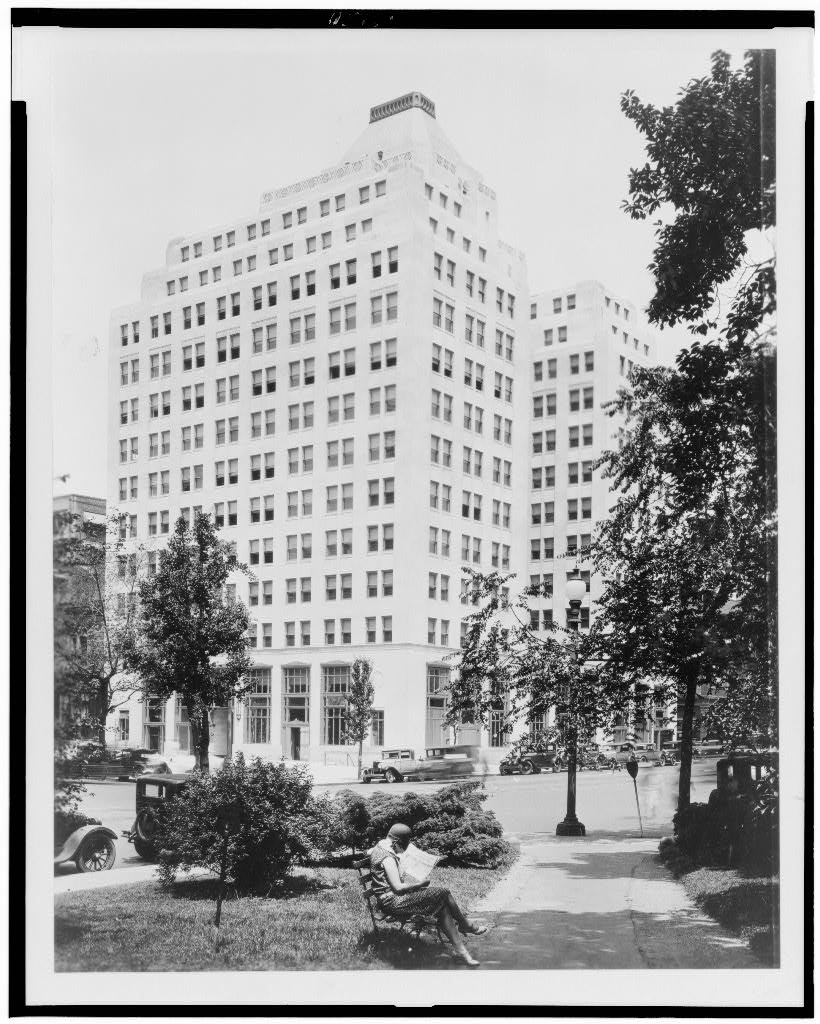
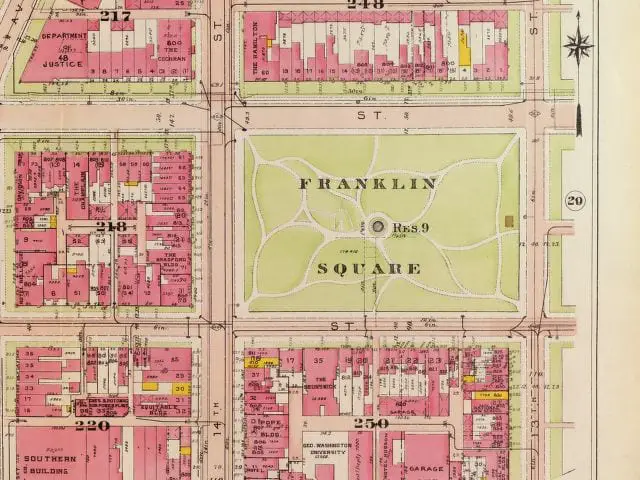
3. Civil War barracks cover the square
In 1861, at the start of the Civil War, the still-unimproved square filled with soldiers rushing to defend Washington. Dozens of wooden barracks went up, and among the first units to quarter there was the Twelfth New York State Militia, commanded by Colonel Daniel Butterfield.
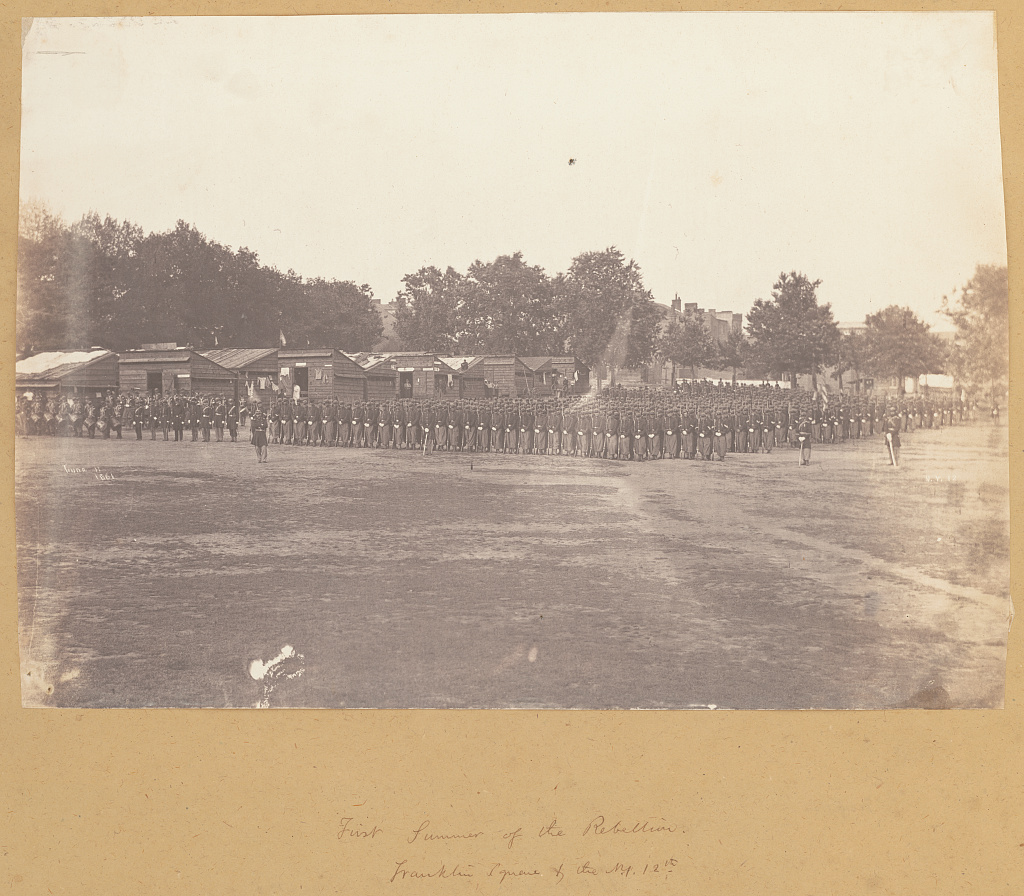
This is an awesome find. The Library of Congress holds an albumen photograph labeled “First summer of the rebellion, Franklin Square, ‘The N.Y. 12th’,” showing the regiment in formation with the rough barracks lining the square behind them. Butterfield went on to be credited with composing “Taps” the following year.
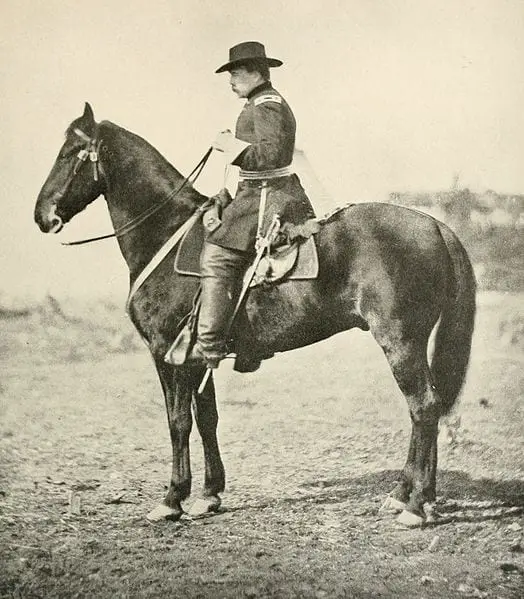
The 27th New York camped on the square as well, after their rout at First Manassas in July 1861. The soldiers were not gentle guests. They used the “fine trees” along K Street as hitching posts and ruined most of them.
The square was even picked as the site for the public execution of Private Michael Lanahan, convicted of killing his sergeant. The location was changed at the last minute, and Lanahan was marched up to Iowa Circle, the one we now call Logan Circle, where a large crowd watched the hanging.
Our 2013 version said the square began taking on the appearance of a park in 1864. The National Park Service’s research dates the transformation just after the war: by 1866, a lush Victorian garden had been laid out following a plan by Col. Benjamin B. French of the Office of Public Buildings and Grounds.
That same year, 1866, Black Washingtonians held the city’s first post-Civil War Emancipation Day celebration in Franklin Square, beginning the park’s long history as a gathering place for the city’s Black community.
Also, check out this nice series of photos of the park from 1943.
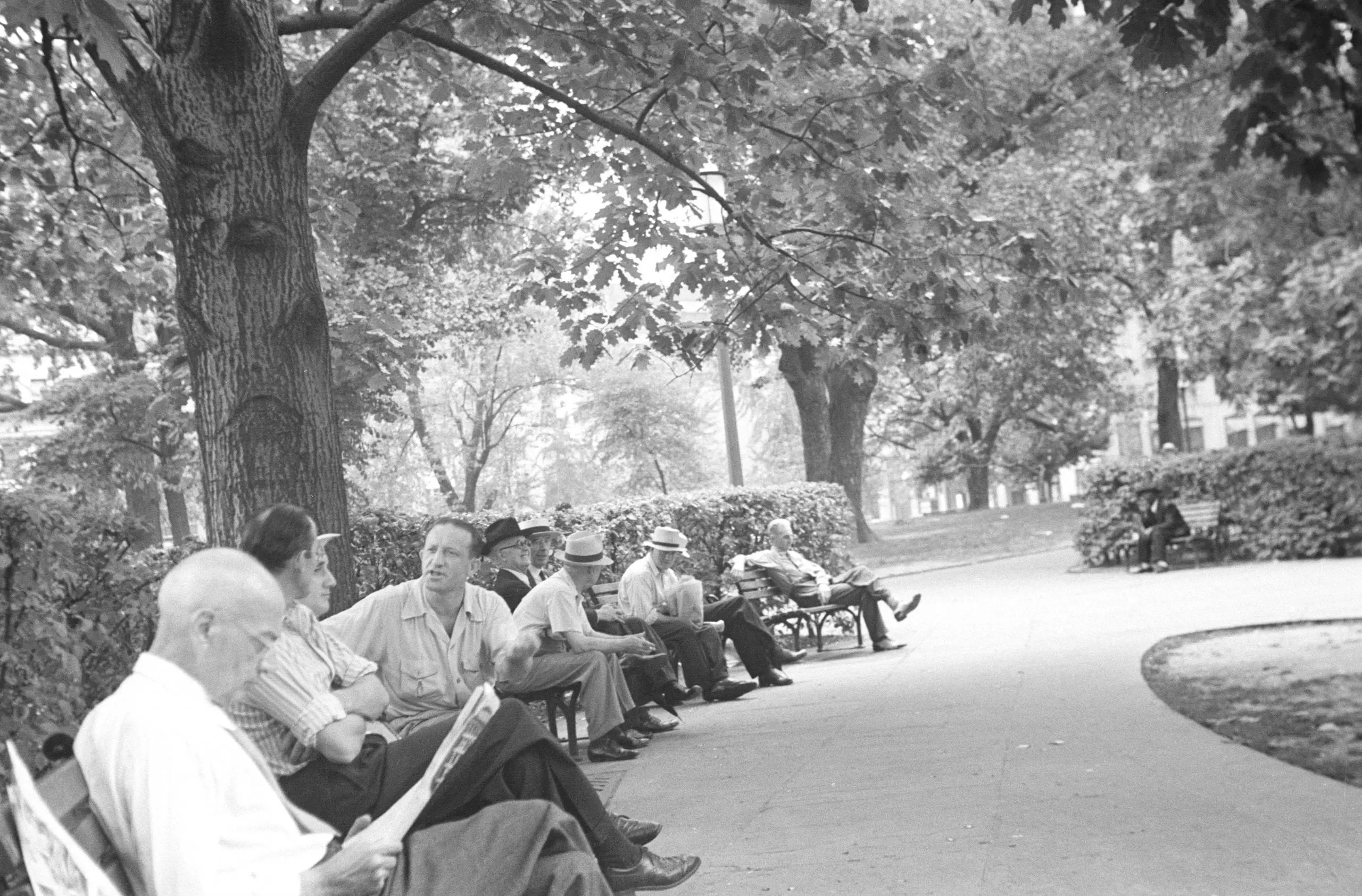
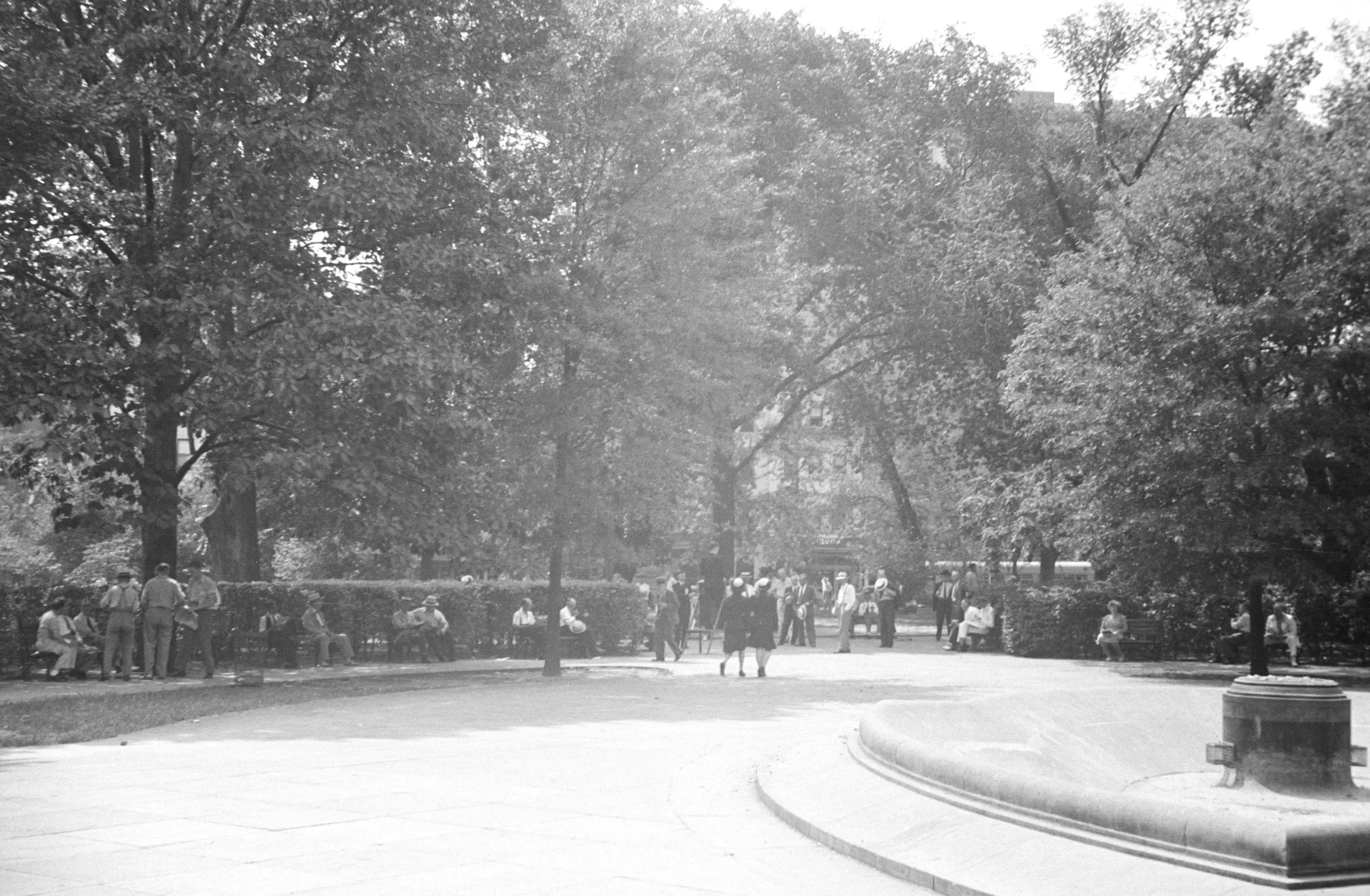
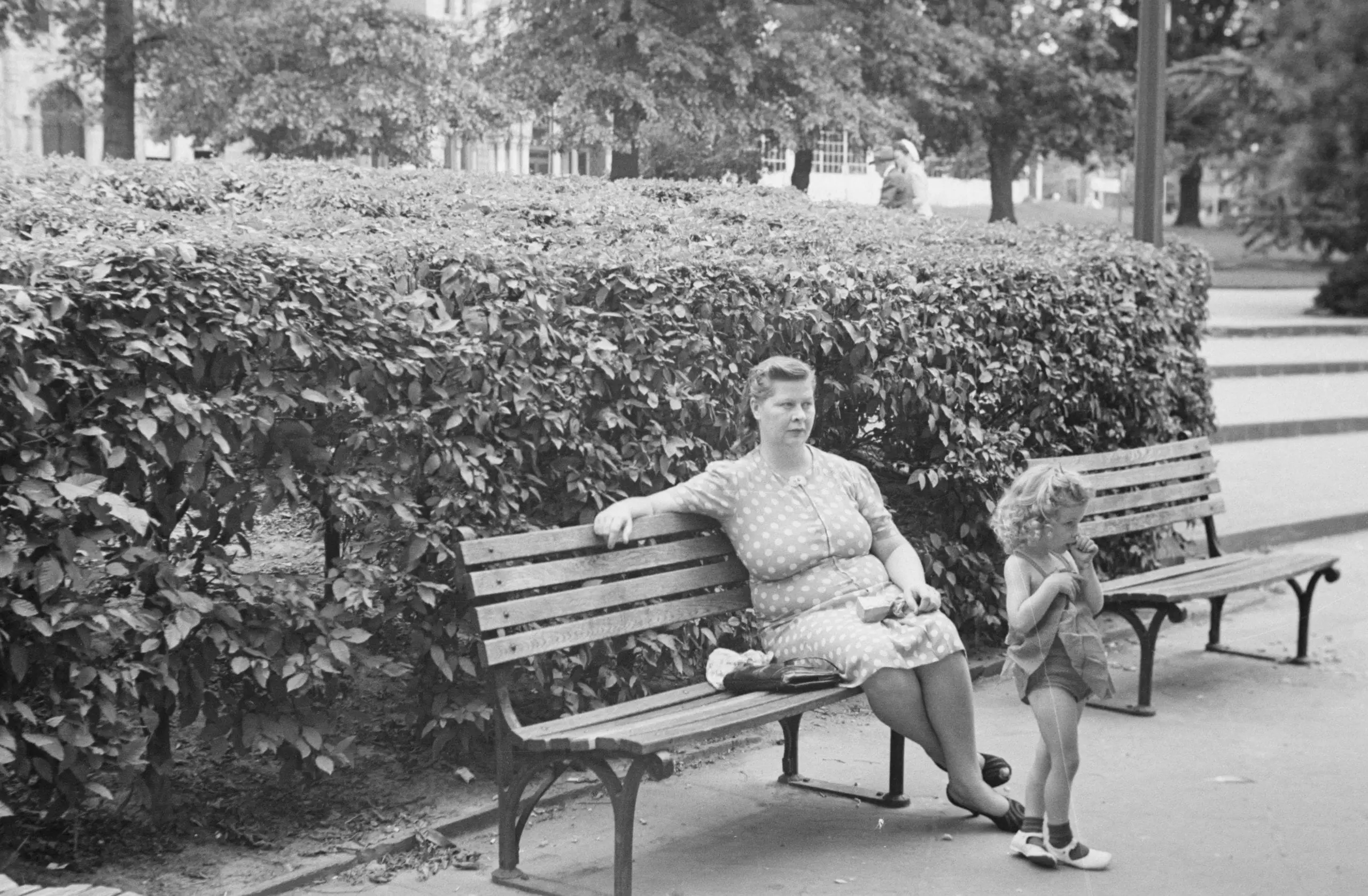
The park has been through a few more chapters since: the Commodore John Barry statue arrived on the 14th Street side in May 1914, with President Wilson speaking at the dedication, and a $21 million renovation gave the square its current look when it reopened in 2021.
Next time you cut through on a lunch break, remember you are walking over the spring that filled presidential water glasses for the better part of a century.
There is a statue of Commodore John Barry on the west side of Franklin Square, facing 14th Street. Commodore Barry was an Irish immigrant and the May 1914 unveiling of the statue was a big deal to the local Irish community. My great-grandfather was part of the Ancient Order of Hibernians committee that planned the ceremony. President Wilson spoke at the unveiling.