George Washington actually tried to build a university in Washington, D.C. Not in spirit. Literally, in his will.
When he died in 1799, Washington left 50 shares of the Potomac Company, an organization devoted to improving navigation on the river bearing his name, “towards the endowment of a University to be established within the limits of the District of Columbia, under the auspices of the General Government, if that government should incline to extend a fostering hand towards it.”
Congress never extended that hand. The Potomac Company folded. Washington’s bequest became worthless.
He wanted his university on the banks of the Potomac. He wanted students from every state to converge in the new federal city, where they’d shed their regional prejudices and learn firsthand how a republic actually worked. The country had other ideas.
Baptists on the Hill
More than twenty years after Washington’s death, a group of Baptist ministers decided to take a run at it themselves. They weren’t honoring Washington’s vision, exactly. Their motivations were more theological than civic. They needed a school to train clergy. But they wanted it in the capital, and they wanted it open to everyone.
The key figure was the Reverend Luther Rice, a missionary organizer who had been raising funds for Baptist causes across the country. Rice and three colleagues (Obadiah B. Brown, Spencer H. Cone, and Enoch Reynolds) spent two years petitioning Congress for a charter. On February 9, 1821, President James Monroe signed it.
The founding document included a clause that was quietly remarkable for its time: “persons of every religious denomination shall be capable of being elected Trustees; nor shall any person, either as President, Professor, Tutor or pupil, be refused admittance into said College, or denied any of the privileges, immunities, or advantages thereof, for or on account of his sentiments in matters of religion.”
This was a Baptist school that legally couldn’t discriminate by religion. The founders called it Columbian College, after the poetic name for the country itself.
They found a site just outside the city limits: a 46-acre parcel of land north of Boundary Street (now Florida Avenue) between 14th and 15th Streets. The purchase price was $7,000. That hilltop, known as College Hill, is what you now know as Meridian Hill.
The Campus That Became a Neighborhood
For the next four decades, Columbian College sat on that hill. The medical school operated downtown, but the main campus stayed put in its quiet stretch north of the city.
Then the Civil War arrived.
The college’s buildings and grounds were taken over as a military hospital. Tents spread across the hillside. You can see it in a photograph held by the Library of Congress: the Columbian College building rising behind a sea of canvas, with the name CAMP CARVER stenciled on a sign at the entrance. Nurses like Rebecca Pomroy arrived to care for the wounded. The school essentially stopped being a school.
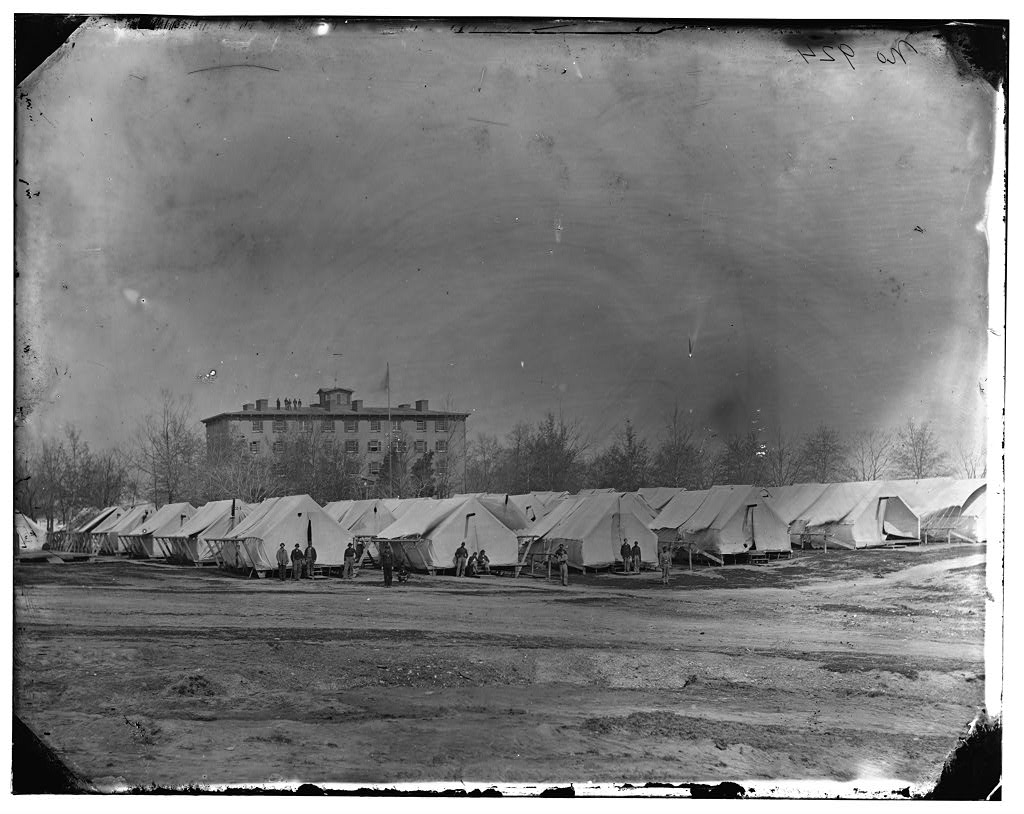
We’ve written before about the Carver Barracks on Meridian Hill — that photograph captures the scene better than any description can.
The college never fully recovered its footing on the hill after the war. By 1873, the school had reorganized, amended its charter, and adopted a new name: Columbian University. The campus moved downtown, to buildings along H Street between 13th and 15th Streets, close to the White House. The old College Hill neighborhood was carved up and developed. You know it today as Columbia Heights.
A President’s Gamble
In 1902, a lawyer named Charles Willis Needham became president of Columbian University. He had ambitions.
Needham looked at the school, modestly situated and modest in reputation, and saw a path to something much larger. Washington, D.C. was growing into a true national capital. Other institutions were staking claims to that identity. Needham wanted Columbian University to be the preeminent university of the federal city. He just needed the right hook.
He found one in the George Washington Memorial Association, a group devoted to honoring the country’s first president. The Association had money, or at least pledged money: $500,000 to the right cause. Needham struck a deal. Rename the university after Washington, and the Association would fund an ambitious new campus near the National Mall.
Half a million dollars. A new campus. A famous name. It all seemed, as these things tend to, like a sure thing.
In June 1904, the trustees of Columbian University voted unanimously to proceed. Congress formalized it with an Act approved on January 29, 1904.
Here is the Washington Post’s account from September 2nd, 1904, reporting on the official changeover the day before:
What was Columbian University is now the George Washington University. In compliance with an act of Congress and plans adopted by the board of trustees of the Columbian University, the new name was assumed yesterday morning. With a name memorializing the Father of His Country, the institution will broaden its scope to the end that there may be brought into reality the desire of Washington to have established here a national University.
Needham issued his own announcement that day:
Columbian University, organized under a special charter granted by the Congress of the United States of America February 9, 1821, has, by virtue of a special act of Congress approved January 29, 1904, changed its name to the George Washington University, by which name, under its national charter, the university will continue to carry on its work of higher education in the city of Washington, in the District of Columbia.
CHARLES WILLIS NEEDHAM, LL. D.,
September 1, 1904 President.
One of the trustees who signed off on the change was Dr. Edward M. Gallaudet — son of Thomas Hopkins Gallaudet, the man whose name his own university carries.
The $500,000 That Wasn’t
The name change happened. The money did not.
The George Washington Memorial Association was unable to raise the $500,000 it had promised. The real estate near the National Mall that had been acquired in anticipation of the new campus had to be sold off. Needham’s grand plan for a university anchored to the Mall quietly collapsed.
The school retreated to a more modest situation: Foggy Bottom, that stretch of the old First Ward running between 19th and 24th Streets south of Pennsylvania Avenue.
A Strange Kind of Homecoming
Here is the part that makes you blink.
George Washington, when he imagined his university, apparently had a specific address in mind. According to GWU’s own institutional records, Washington selected 23rd and E Streets as the site of the national university he hoped to see established.
The George Washington University’s Foggy Bottom campus sits between 19th and 24th Streets. The intersection of 23rd and E is right in the middle of it.
James Monroe, who signed the original 1821 charter into law, lived at 2017 I Street — now deep inside the same neighborhood. Obadiah B. Brown, the first president of the Board of Trustees, served as pastor of a church at 19th and I Streets for fifty years.
Washington died in 1799. His money never built anything. But a Baptist college, a collapsed fundraising deal, and a succession of moves that felt like failure each time they happened — they all somehow deposited the school carrying his name on the ground he had in mind all along.
If you’re keeping score: Congress ignored Washington’s bequest. The Baptists built a school instead. The Civil War wrecked the original campus. The promised half-million dollars never arrived. And George Washington University ended up in almost exactly the spot George Washington wanted it.
Actually. I think the Columbian College grounds were east of 15th and extended to 14th, not on the site of the park. There is an interesting curb opposite Meridian Hill Park on 15th, and then you have “University Place”, which is parallel to 14th. It should show on the RE maps.
Elizabeth is correct – the original GW/Columbian campus was bounded by 15th St., 14th St., Boundary Road (now Florida) Avenue and Columbia Road.