
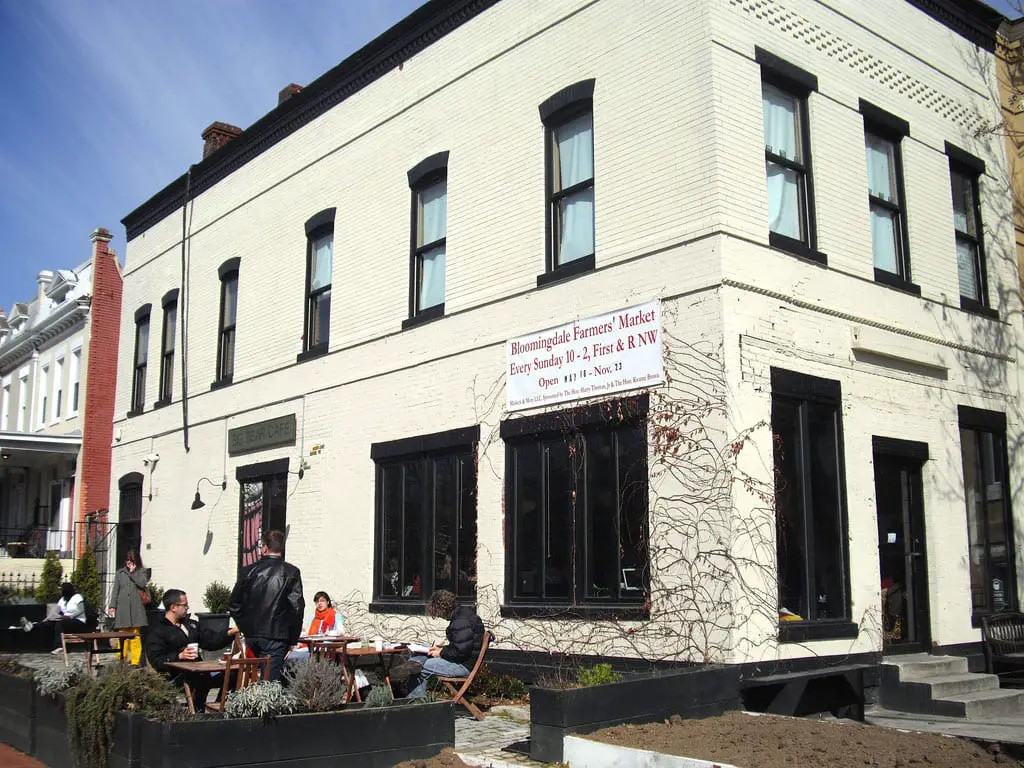
Big Bear Cafe has anchored the corner of 1st and R Street NW in Bloomingdale since the summer of 2007, but the storefront it occupies is well past its 120th birthday and the corner has been a neighborhood grocery for most of that time. Long before the pour-over coffee, the wood-fired pizza, and the Sunday farmers market in the lot next door, 1700 1st Street NW was the scene of a runaway horse that ran two miles through the city, a court-ordered grocery auction, an afternoon mugging of a market manager, and a decades-long quieter story of immigrant grocers who let their neighbors buy on credit.
This is what the building has seen.
Today: Big Bear Cafe and the Bloomingdale anchor
Big Bear Cafe opened in July 2007, the project of Stuart Davenport and Lana Labermeier, in a Victorian commercial storefront that had been everything from a corner grocery to a Korean-owned market to, briefly in the 2000s, vacant. DCist’s “First Look” piece that summer caught Davenport and Labermeier sitting outside an unfinished space, plotting out what would become one of the catalysts of Bloomingdale’s transformation from quiet residential pocket to brunch-and-coffee neighborhood.
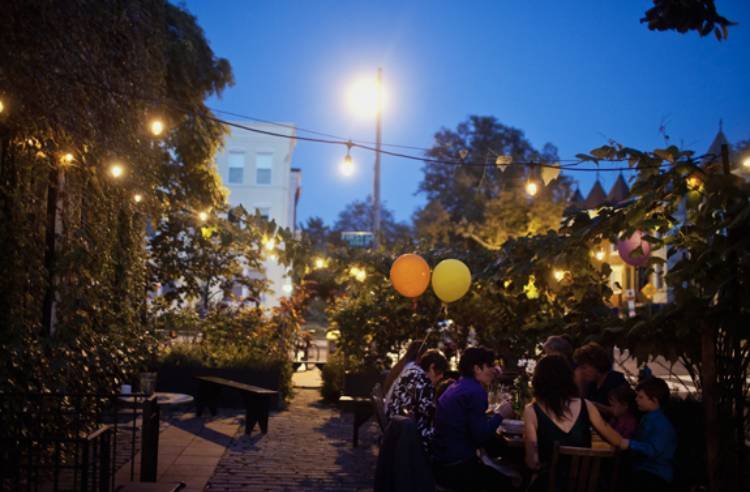
The cafe expanded in 2017, adding a second floor and a rooftop and quadrupling capacity from 49 seats to nearly 200. During the pandemic, when the cafe was at risk, Big Bear ran a community investment push called “Invest in Big Bear” that raised capital through small-business bonds. That same period produced the wood-fired pizza program in the basement, which Washington City Paper called “some of D.C.’s best pizza”, baked in an oven of French clay bricks.
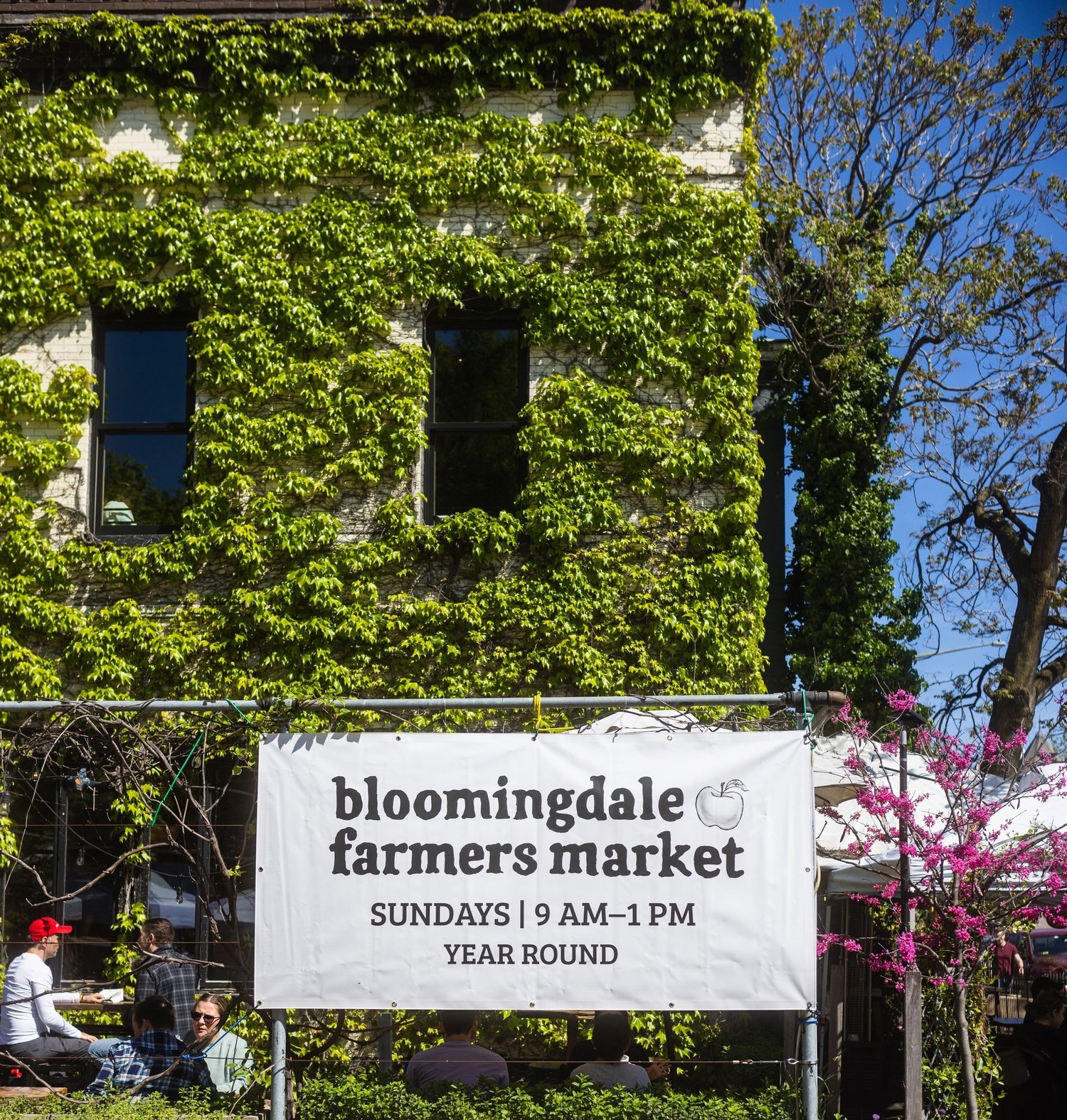
The Sunday Bloomingdale Farmers Market sets up year-round in the lot next door, 9 a.m. to 1 p.m., and has been a defining institution of the neighborhood since 2007. Davenport helped launch it the same summer the cafe opened.
The building: a Bloomingdale Victorian on a streetcar corner
1700 1st Street NW sits inside the Bloomingdale Historic District, designated locally in 2017 and listed on the National Register in 2018, with a period of significance running 1891 to 1948. Big Bear’s own building dates to roughly the turn of the twentieth century, part of the speculative rowhouse and corner-store buildout that followed the arrival of the streetcar.
The neighborhood was shaped as much by its geography as by its architecture. Two blocks east of the cafe sits McMillan Reservoir, completed in 1902, the sand-filtration plant that supplied clean water to a growing city and defined Bloomingdale’s eastern edge.
A stolen harness and a grand jury (1894)
The earliest mention of 1700 1st Street NW in the Washington Post we’ve turned up comes from December 16th, 1894.
John Russell, colored, was brought before Judge Miller yesterday on the charge of grand larceny of a set of harness [sic] worth $50 from the stable of William J. Holtman, of 1700 First street northwest, on July 12 last. Officer Foley found the harness in the possession of William Hancock, of Fourth and Wilson streets, who said he brought it from Douglas Chicester, living at 342 Pomeroy street. From the latter, the harness was traced to Russell. The court sent the case to the grand jury, remanding Russell in default of $300 bonds.
Wilson and Pomeroy streets (between 6th and 7th NW) are long gone, but they were in the neighborhoods around Howard University. And $300 sounds awfully steep bail on a $50 harness.
Stop that horse! (1910)
This is a wild story, which probably wasn’t that rare when it happened. On July 21st, 1910, John Schamil of 1700 1st Street NW was the owner of a horse that went crazy and bolted through the city for two miles, dragging a buggy behind it.
Aresta, aged 5 years, the daughter of John O’Regan, an automobile merchant of 1354 Girard street northwest, had a narrow escape from death, four persons were thrown to the pavement, receiving slight injuries, and two policemen had a struggle with a maddened horse, which had traversed 2 miles of the city’s streets last night in a wild dash.
…
Samuel Posey, a clerk, of the Olympia apartment house, Fourteenth and Euclid streets northwest, was the first person struck by the horse. This happened at Fourteenth and Fairmont streets. Mr. Posey was thrown to the street with great force, and was treated by a physician. His injuries are not serious.
At Fourteenth and Euclid streets, Mrs. O’Regan was crossing Fourteenth street with her baby. The mother, in an attempt to keep the horse from striking the little girl, shoved the baby carriage across the car tracks. A front wheel of the buggy struck the baby carriage, throwing the occupant out. Mrs. O’Regan, was struck by the horse, and received slight injuries. The child, apparently, was not hurt.
…
With one shaft dangling at its side, the animal was captured at Fifteenth and Pennsylvania avenue northwest, as it was about to dash into the windows of the Regent Hotel, by Bicycle Policemen Nolan and Cullinane, of the First precinct. It was turned over to its owner, John D. Schamil, of 1700 First street northwest.
Mark this down as something you’ll never see in Washington today. Imagine a giant steed thundering down the 14th Street hill from Columbia Heights to U Street, shocked onlookers leaping out of the way. It reads almost like the Columbia Heights fire-run story from a decade earlier.
Everything must go (1910)
The September 7th, 1910 Washington Post ran a notice of an auction of everything in the grocery store at 1700 1st Street NW. This was clearly not good news for the proprietor. The auction involved the same Schamel from the runaway-horse story.
By virtue of a decree passed in the Supreme Court of the District of Columbia in the case of Edith B. Fenton vs. John D. Schamel, Equity No. 29563, we will sell at public auction, in front of premises No. 1700 First street northwest, on FRIDAY, THE 9TH DAY OF SEPTEMBER, 1910, at 4:30 o’clock p.m., the following, namely: The stock of goods, fixtures, two wagons, one horse, harness, and good will of the grocery business heretofore conducted on said premises under the name of Schamel & Co., together with the unexpired portion of the lease of said premises, except as to the apartment on the second floor thereof, and a rental agreement to a stable in Reeves court heretofore used and occupied by said firm.
TERMS OF SALE: All the purchase money to be paid in cash. $100 deposit required upon acceptance of bid. All conveyancing, notary fees, and recording at purchaser’s cost. Terms to be complied with [sic] within 10 days, or receivers may advertise and sell at the purchaser’s risk and cost after five days’ previous advertisement of such resale published in some newspaper of Washington, D.C.
WM. J. BACON, Jr.,
HARRY G. KIMBALL
Receivers
Ouch. Things were really looking bleak for John Schamel (same person as the earlier horse-story John Schamil, different spelling). Digging through the papers, it looks as if Schamel and Fenton were business partners and their partnership was being dissolved in court.
This wasn’t the end of John’s bad luck. In the police blotter from February 3rd, 1916, his bicycle (valued at $10) was reported stolen from the Columbia Heights Arcade, which stood where DC USA is now. His run ended on July 25th of that year when he died at 35, leaving behind his wife of 15 years, Elizabeth. She would live another 24 years.
It turns out John’s premature death was the result of asphyxiation by escaping ammonia fumes at work. At the time he was the superintendent of the Old Dutch Market at 7th and Florida Ave NW, and Elizabeth filed a wrongful-death suit against the market for $10,000.
Below is a photo of one of the Old Dutch Markets (there were a few in the city), this one at 20th and P NW. Greater Greater Washington did a then-and-now on this particular one, kitty-corner from Pizzeria Paradiso. The building on the left (with the car in front) is now the CVS on Dupont Circle.

Ernest bought a Ford (1917)
In the good old days, the paper would print the names of people who had recently licensed an automobile in the District. The whole city would know your name, where you lived, and what kind of car you’d just purchased. On October 24th, 1917, with the world embroiled in global war, license number 60958 was granted to Ernest D. Thorne for his recently purchased Ford. That automobile was likely a great source of pride for Ernest, his wife, and three sons, and likely his ride to a job as supply clerk at a local bakery.
Another story about Ernest: his grocery store at 1700 1st Street NW was ransacked on December 5th, 1925 when robbers forced the front door and stole the bronze cash register, valued at an astounding $250.
Three youths rob a grocer and his wife (1952)
The September 11th, 1952 edition of the Post ran a short item on a robbery in front of what is now Big Bear Cafe.
A grocer at 1700 1st st. nw. reported to police Tuesday that, he and his wife were about to enter their parked car after closing the store when three youths robbed them of about $150.
Carl Kaplan, 53, said one youth held and choked him while the second went through his pockets and found $120, the day’s receipts. The third bandit knocked down Mrs. Kaplan and, as she screamed, the took her purse containing $30, Kaplan said.
Sounds very similar to the muggings you hear of in DC today, except now there are often guns involved and the bounty is usually a phone and a wallet.
Robber gets $200 (1967)
The corner was a hotbed for robbery, almost certainly because the grocery was a cash business and any manager closing up alone was an attractive target. From December 23rd, 1967:
Jack Mehlman, 35, manager of the Big Bear Market, 1700 1st st. nw., was forced to give an armed bandit $200 shortly after 1 p.m. yesterday, police reported.
Two things. First, an afternoon mugging. Second, “Big Bear Market.” A good number of readers probably did not know that today’s name is a callback to the grocery that stood here at least as far back as the 1960s. It’s a nice acknowledgment of continuity by the current owners.
Filling in some gaps
A handful of shorter mentions across the decades.
In a July 1928 article on the real estate boom, the Post noted that Oscar Diskin had purchased the commercial property.
In 1943, David Gilbert was running the grocery at 1700 1st Street NW. He was fined $25 when he failed to appear in municipal court to answer charges of having flies on fruit, cakes, pies, and meat. This was part of a Health Department crackdown on dirty groceries across the city.
On March 25th, 1951, the District Selective Service System ordered 89 regular draftees and 56 delinquents to report for induction. Neal McClain Jr. of 1700 1st Street NW was on the list (the paper doesn’t say which group).
A short November 10th, 1994 notice in the Post said that the owners of Big Bear Market, Sang In Lee and Sung Nyun Lee, were banned by the U.S. Department of Agriculture from accepting food stamps for a year. They had been accepting food stamps as payment for sandwich bags, toilet paper, and household cleaning products, which the USDA doesn’t allow. That said, it was probably a product of their willingness to help out their neighbors. A long article in November 1995 described Mr. Lee as a beloved figure who let local kids buy on credit while their parents were at work, and let people who ran out of cash settle up at the end of the month. The food stamps were going through the door the same way.
The building before the cafe
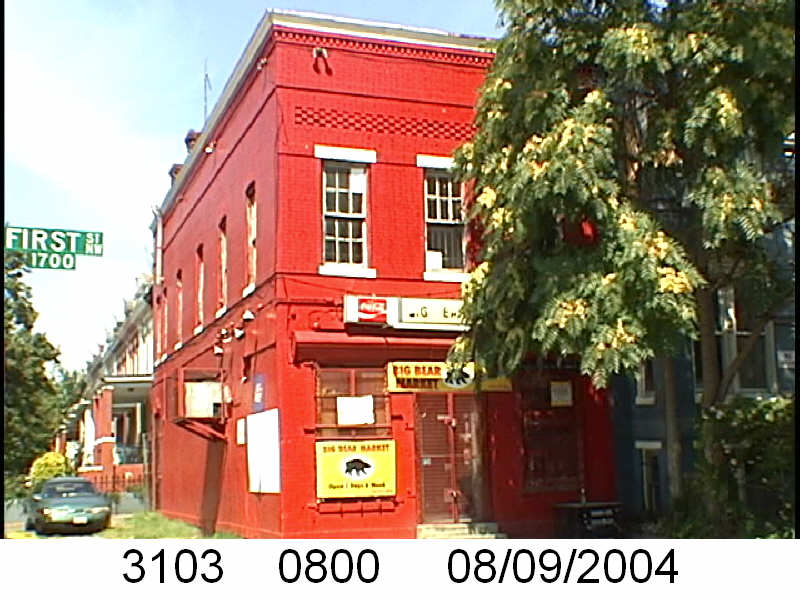
Three years before Big Bear opened, the DC Citizen Atlas oblique-aerial program captured 1700 1st Street NW in August 2004. The corner storefront is there, recognizable, with a different sign and a different awning. The market era had ended; the cafe era hadn’t started.
The Sunday market in the lot next door
Every Sunday from 9 a.m. to 1 p.m., year-round, the lot adjacent to Big Bear fills with farmers, bakers, butchers, and prepared-food vendors. The market launched in 2007, the same summer the cafe opened, and Davenport rounded up the original vendors. It is now run by a community nonprofit.
A note on the 1916 Shorpy photo
An earlier version of this post embedded the 1916 Harris & Ewing photograph below, captioned as 1st Street and Florida Avenue NW. Readers in the comments at the time pointed out that the photo is more likely on the Eckington side of the line, near the B&O freight tracks, not at the corner where Big Bear sits. We’ve left the image because it captures the streetcar-era feel of the corridor, but the precise corner is in dispute.
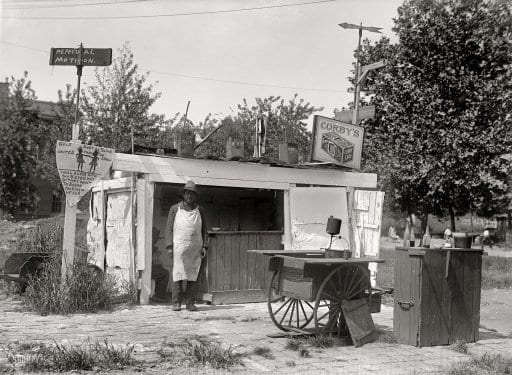
Very interesting article and love the picture of Keitt S. Although I have to question, is it 1st and Florida NW or NE? The Shorpy link is conflicting. One article says it is NE and near the Baltimore & Ohio freight lines. And the petition was signed by NE residents. Maybe I am not reading this clearly, but I don’t think this was at the corner of 1st and FL NW. Looking at the Baist Maps would also confirm if there was a “structure” similar to this FairView Hotel. The 1913 Baist Map shows most of the lots in Bloomingdale are already developed.
I also don’t believe the last photo was at first and florida nw. it doesn’t add up. it seems more like this was taken in eckington, 2 long blocks away, if the 1st and florida designation is accurate.