
In September 1906 the Washington Post sat down and counted. Within two blocks of 14th and Monroe streets NW, in what was then the new streetcar suburb of Columbia Heights, nine people had died in the previous twelve months. Seven by suicide, one by accident, one simply found dead. The paper laid each case out side by side, recorded the neighborhood asking the obvious question, and admitted that no one had an answer.
The piece that triggered the tally ran in the Evening Star two days earlier, on Friday, August 31. Dr. James Donald Wilson, a physician from Andrews, North Carolina, who had been visiting his elderly father for two months, had been found dead that morning in his second-floor room at 1329 Park Road NW. The cause was a self-inflicted gunshot. He was 39 and had told his family he might end his life some day.
A physician’s death on Park Road
The Evening Star account is careful in the way the period allowed. Wilson had been “a sufferer for years,” it reported, and had recently been troubled by chronic insomnia that kept him from going to bed at night. His father, Ebenezer Wilson, had retired in the same room the night before and slept through the shot, which a neighbor downstairs heard around ten o’clock and assumed was a passing automobile.
Coroner Nevitt ruled the death a suicide. The body was prepared for burial by Undertaker Zurhorst and sent home to the family plot in Oxford, Pennsylvania, with no services held in Washington. The story would have been small local news on a Friday morning. What made it different was the address. Ebenezer Wilson’s rented room sat inside a stretch of Columbia Heights that, by the summer of 1906, had developed a quiet reputation.
The Post’s tally on September 2
That Sunday the Washington Post ran the longer piece. Wilson’s death, the paper wrote, “adds one more horror to the list of persons who have met sudden or violent death in that immediate vicinity in the last year.” It then drew an imaginary geometry that became the spine of the article, with the corner of 14th and Monroe as the center point.
Using the corner of Fourteenth and Monroe streets as a pivot and drawing an imaginary circle two blocks in circumference, there have been within this circle in the last twelve months, seven deaths by suicide, one by accident and one person found dead.
The neighborhood is becoming aroused over the constantly recurring tragedies, and when Dr. Wilson’s death was announced, the question was, “Who or what will be next?”
The cases the Post went on to list read, today, as a cross-section of what could go wrong in a turn-of-the-century American household. A contractor named McCormick walked out of the Stratford Hotel at 14th and Monroe in January, kissed his family goodbye, boarded a Norfolk steamer, and was never seen again. His coat was found in the stateroom when the boat docked.
Around the corner on Monroe Street, Mrs. Du Bois, wife of a government official, took her own life with poison after months of grief over the death of an only child. At the Berwick Flats apartment house at 14th and Park Road, a tenant the Post identified as Mrs. Hempson took her life in October 1905 in the presence of her two young children, after, the paper said, her husband had left her.
The Post continued through six more cases: a Miss Kitzmiller, niece of Gen. Swain, who had died in a fire at the same Berwick apartments two years earlier; P. A. Carr, a 14th Street streetcar conductor, who shot himself; Benjamin Parkhurst, a former city post office clerk, killed in a street brawl in Chester, Pennsylvania; Mrs. Ida Squires, who jumped from a second-story window at the Truitt house at 16th and Monroe; Thomas Haines, a Park Road butler, found in a vacant lot; and Pickney Smith, a former district militia officer, found dead at 1428 Newton Street on March 10.
The accident in the tally was the young son of John Barry, a grocer at 1438 Newton Street, who was killed while trying to jump into the back of a moving pony cart on the White Lot. He died in the arms of a policeman carrying him to the Emergency Hospital. The “found dead” line referred to Smith.
The Berwick Flats and a near-miss in February
The Post closed with a tenth incident the editors clearly felt belonged in the run. In February 1906 a fire broke out in the Berwick Flats at 14th and Park Road and cut off the stairways. Firemen ran ladders to the third floor and rescued the residents. As nine people were climbing down one ladder it broke, and only the awning below kept the entire group from falling. One of the women on that ladder was the mother of Nan Patterson, the former Florodora chorus girl who had been tried for the murder of a New York gambler in 1904. The broken bones in her foot left her a semi-invalid.
What 14th and Monroe was in 1906
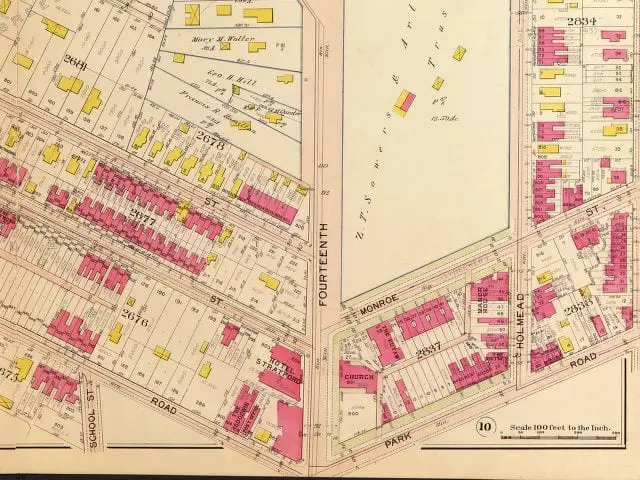
The geography matters here. In 1906 Columbia Heights was the kind of neighborhood that real estate ads sold as new, healthful, and convenient to the 14th Street line. The Baist atlas plate above shows the corner already platted and built up with rowhouses, the Stratford Hotel anchoring the southwest corner of 14th and Monroe, and the Berwick Flats a block north at 14th and Park Road. Many of the named victims, including a streetcar conductor, a clerk, and a butler, were middle- or working-class residents of exactly that kind of address. A few years earlier the area looked very different, as the 1903 plat map of undeveloped Columbia Heights shows.
None of it is still there. The Stratford Hotel came down around 1921 and Charles H. Tompkins built a fireproof commercial building on the site, according to a later Evening Star notice. The Tivoli Theater rose at 14th and Park Road in 1924, on or near the Berwick site. The block today reads as DC Metro and Target and the Tivoli, not as the cluster of 1900s flats and hotels the Post was writing about. Many of the streets the Post named had also been renamed by then, as our look at old Columbia Heights street names lays out.
Reading 1906 newspaper coverage today
I want to be careful with the Post‘s framing. The 1906 piece names the victims, describes the means, and frames the cluster as a kind of urban mystery. Modern reporting guidance, from the American Foundation for Suicide Prevention and others, recommends the opposite on every one of those points, because evidence shows that detailed coverage can drive further harm. I have kept the names and addresses that are already in the historical record, and have softened the rest. If you are reading this and struggling, the 988 Suicide and Crisis Lifeline is reachable any time by call or text.
The Post‘s own answer to its own question, “Who or what will be next?”, was nothing. The cluster did not continue in any documented way after September 1906. What the article actually captured is a snapshot of a still-young neighborhood in which a lot of recent arrivals were going through hard private years in adjacent buildings, and a city editor decided to draw a circle around the coincidence.
Frequently asked questions
Where exactly was the Stratford Hotel in Columbia Heights?
The Stratford Hotel stood at the southwest corner of 14th and Monroe streets NW, on the block now occupied by the commercial building that replaced it after 1921. A 1921 Evening Star notice records that Charles H. Tompkins purchased the site and built a fireproof commercial structure designed by architect George M. Ray.
Was Dr. James Donald Wilson a Washington resident?
No. According to the August 31, 1906 Evening Star, Wilson was a physician from Andrews, North Carolina, who had moved to Washington only two months before his death and was rooming with his father, Ebenezer Wilson, at 1329 Park Road NW. His body was sent home to Oxford, Pennsylvania, the family burial site.
How many deaths did the Washington Post actually count?
Nine, in twelve months, within a two-block radius of 14th and Monroe streets NW. The Post broke the count into seven suicides, one accident (a child killed on the White Lot), and one person found dead. A tenth case, the broken-ladder injury during the February 1906 Berwick Flats fire, was listed as a near miss rather than counted in the nine.
Was Nan Patterson involved?
Not directly. Nan Patterson was a former Florodora chorus girl who had been tried in New York for the 1904 shooting death of gambler Caesar Young. Her mother was a resident of the Berwick Flats at 14th and Park Road and was one of the residents on the ladder that broke during the February 1906 fire there. She suffered foot fractures that left her, the Post wrote, a semi-invalid.
Is the Stratford Hotel or the Berwick Flats still standing?
Neither building survives. The Stratford was demolished around 1921 and replaced by a commercial structure at 14th and Monroe. The Berwick Flats at 14th and Park Road were gone by the time the Tivoli Theater opened on that corner in 1924. The Tivoli still stands and houses the GALA Hispanic Theatre today.
Awesome! I live on this block!
Creepy, this sounds like Final Destination.
Eh, still not as bad as the 90’s.