The neighborhood that Washingtonians have been mispronouncing and misspelling for over two centuries takes its name from a man who could not spell his own name.
That is not a figure of speech. John Tennally ran a tavern at the fork of River Road and the Georgetown-Rockville Turnpike (now Wisconsin Avenue) starting around 1790, and he was illiterate. He signed his name with an X every time. The scribes, surveyors, and deed recorders who wrote down his name were entirely on their own, and they produced: John Tennely, John Tennoly, John Tennally, John Tenally, John Tennerly, John Tennelly, John Tenerley, and John Tenalley.
Eight distinct spellings. None of them authoritative.
The village that grew around Tennally’s tavern inherited the confusion wholesale.
A Tavern at the Top of the Road
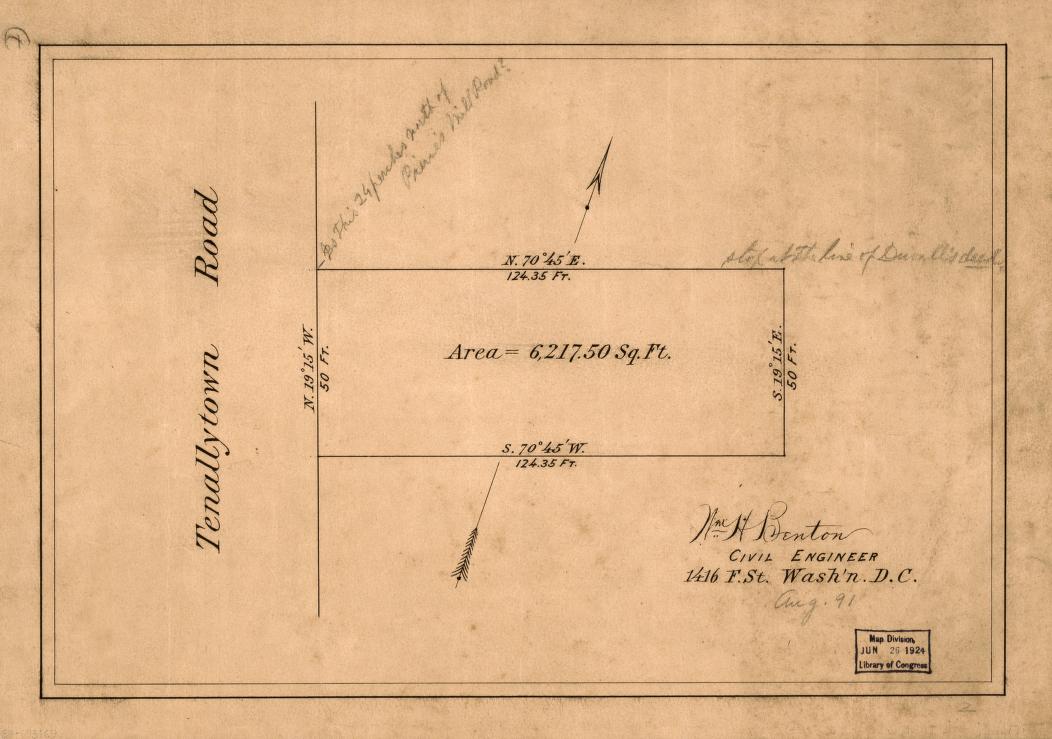
Tennally had moved from Prince George’s County to this crossroads when the land was still known as “Friendship,” a name that honored the way Charles Calvert had bequeathed a large tract to Thomas Addison and James Stoddert back in 1711. The location was ideal: wagon traffic from outlying farms in Maryland funneled down toward Georgetown’s port via the Georgetown-Rockville Turnpike, and stagecoaches ran the same road hauling tobacco, wheat, and produce.
Tennally’s tavern stood right at that fork, servicing travelers heading in and out of the capital region. A small village grew up around it, with a few stores, a blacksmith’s shop, and a church. People started calling it “Tennally’s Town,” though of course they could never agree on exactly how to write that down.
The spelling chaos only deepened over the following decades. In 1814, after American troops retreated through the area following the disaster at Bladensburg, Mrs. William Thornton recorded the place in her diary as Tennely Town. Colonel Beall, who was there at the same time, wrote Tenly Town.
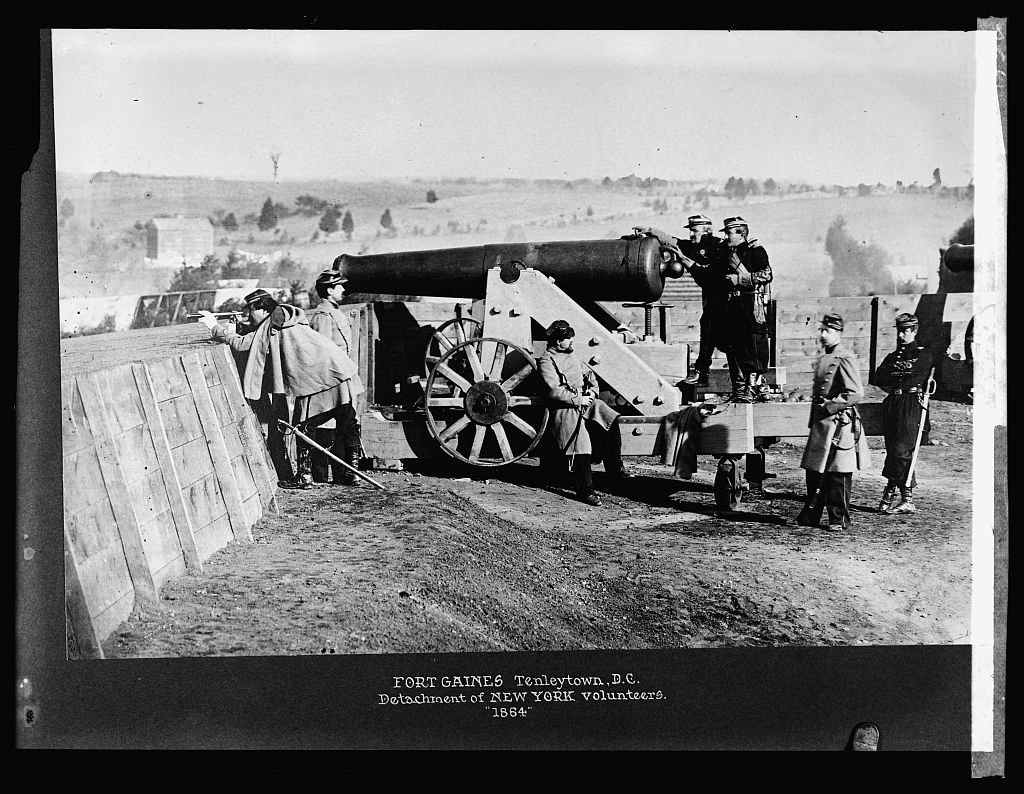
During the Civil War, the Union Army fortified the high ground here, and Oliver Wendell Holmes passed through with fellow soldiers. Holmes wrote it down as Ten Alley Town, apparently having heard soldiers pronounce it that way and concluded the village consisted of ten alleys.
The Great Spelling Debate of 1886
By the 1880s the neighborhood was settled enough that people actually cared which spelling won. In October 1886, a man named Charles M. Tenley, of 5 Myrtle Street, wrote to the Postmaster General requesting that the post office, then known as “Tennallytown,” be officially renamed “Tenleytown.” His argument: the place was settled by his ancestors and the spelling had been corrupted over the years.
The Washington Post covered the resulting investigation on November 15th, 1886.
The question of changing the orthography of Tennallytown, a postoffice in the District, to “Tenleytown,” has been before the Postoffice Department since the latter part of October. During that month Charles M. Tenley, 5 Myrtle street, addressed a letter to the Postmaster General on the subject, in which he requested that the name of a postoffice known as “Tennallytown” be altered to Tenleytown. Among other things he said: “From information obtained from my father (now deceased) I was led to believe that the place was settled by his ancestors and that the orthography of its name had been corrupted.” A visit to the place and interviews with its oldest inhabitants “corroborated his impressions.” A petition was circulated and twenty-nine citizens requested that the change be made.
On October 27, Fred W. Jones, lawyer at 472-8 Louisiana avenue, addressed the following letter to the Postmaster General in relation to the matter:
SIR: It is unimportant whether the name of the postoffice at “Tenallytown,” D.C., be changed to “Tenleytown” or not, but the reason given for such change by the petitioners is a perversion of historic truth. In all the records of deeds of property in that neighborhood, which I have seen (and they are many) the name is given “Tenally,” and the will of the last survivor of the family living there, dated March 2, 1822, and recorded in Will Book No. 3 at folio 224, is of “Sarah Tenally,” who devises her “half acre lot” to Sarah Robey,” in consideration of the many good offices performed” by her.
A second letter from Mr. Jones was sent on October 29 to First Assistant Postmaster General A. E. Stevenson which runs as follows:
DEAR SIR: Responding to favor of yesterday from Mr. Haynie, confidential clerk, concerning “Tenallytown,” I would say I find no deed on record here to or from a “Tenley” from 1793 to 1830 (period of examination). As stated in my letter of the 27th, Sarah Tenally, by her will, March 2, 1822, devised her half-acre lot to Sarah Robey. This lot was deeded by Dr. John Weems to “Sarah Tenally,” August 10, 1795, for “five pounds and five shillings.” Dr. Weems was a scholar, and undoubtedly spelled the name correctly. In numerous deeds recorded here of property in that locality the name is invariably spelled “Tenallytown.” The instances are : “Road leading from Georgetown to Tenallytown,” about “half a mile from Tenallytown,” or “the turnpike near Tenallytown,” and “just above Tenallytown;” and I have but once encountered a deed in which it is spelled otherwise, and then it was spelled “Tenleytown,” evidently the work of an illiterate scribe.
Ha! What a zinger. It continues.
Mr. Hanie, of the Postoffice Department, has made a personal investigation of the records, and in liber B, No. 2, page 398, he finds a deed which reads, “Dr. John Weemes, of the Corporation of Georgetown, to Sarah tennally, for five pounds five shillings, conveys one-half acres of Mt. Airy, in Montgomery County, August 10, 1795.” The deed is indexed Jno. Weemes to Sarah Tenally,” evidently a clerical error, as one n is missing.
In the field notes of Lewis Carbery, dated October 6, 1834-5, page 3, Mr. Haynie finds the following: “Part of Terra Firma, sold by C. Smith to Mr. Nathaniel Mulligan, surveyed this 20th October, 1834. Beginning for the same at the end of 22 links on a course north 78 1/4 east from a marked whit oak, standing on the west side of the main road from Georgetown to Tennallytown,” etc. It is admitted that both Dr. Weems and Mr. Carbery, were scholarly men, who undoubtedly knew how to spell the name.
As for Sarah tennaly herself, who is supposed to hav ebeen a spinster, since she left no heirs, she always made a mark for her name.
There appears to have been another family, named Tenley, also illiterate since they signed with a mark. In 1828, in Will Book No. 23, page 342, there is record of Theodore Tenley, who bought of Thomas Jenkins, of Washington County. He sells property for $150 and signs with a mark. In 1830, book No. 30, page 242, there is record of Eliza Tenley to Henry Nayler, who sells $5 worth of real estate in Washington County.
From all of which we conclude that there was a Sarah Tennally, after whom the town was named, and that later a family of Tenleys appeared, the descendants of which now seek to have their name immortalized.
The Post Office Department did not grant Tenley’s petition. The historical record pointed firmly to “Tenally” as the original family name. The Tenleys, the investigators concluded, were a different family altogether who had arrived later and happened to have a similar surname.
The Fight That Would Not Die
The 1886 ruling did not settle anything. By 1904, the Board of Geographic Names had weighed in, declaring that the correct name was “Tenley” rather than “Tennallytown.” Residents were not persuaded.
In April 1907, the Evening Star ran a story with a headline that tells you everything: “Old Dispute Settled. Spelling of ‘Tenallytown’ the Issue Involved. Post Office Investigation. Many Records of the Tenally Family Produced. ‘Tenley’ Declared Incorrect.” After another round of digging through deeds and will books, “Tenley” as a standalone name was rejected.
But “Tenleytown” remained in common use regardless, because by then the two factions had been fighting for so long that the hybrid had simply taken root in common usage.
Meanwhile, the Tennallytown streetcars were still running up what would eventually become Wisconsin Avenue, carrying that old spelling into the 20th century. Then around 1900, the name “Friendship Heights” was revived for a new subdivision up the road, named for the 1711 “Friendship” land grant.
The streetcar lines were gradually rebranded, the Tennallytown cars becoming Friendship Heights cars, and the local post office became Friendship Station. For a stretch, it looked like “Tennallytown” might simply be absorbed and forgotten. You can see what that era looked like in this look back at Friendship Heights shopping circa 1959.
Tenley Circle, and the Metro Settles It
In 1927, when the District proposed a traffic circle at the junction of Nebraska and Wisconsin Avenues, the naming fight reignited one more time. Some residents wanted “Friendship Circle.” But the descendants of the original tavern keeper pushed for “Tenley Circle,” and the Commissioners sided with them.
When Metro planners in the 1970s designated a station for that location, they initially called it “Tenley Circle” as well. Then in 1979, in response to strong local preference, it was redesignated “Tenleytown.” If you want to know what Metro construction looked like along Wisconsin Avenue in the 1970s, we have photographs that show exactly what the neighborhood went through to get its station.
The Tenleytown station opened on August 25, 1984, as part of the Red Line extension that also brought stations to Friendship Heights, Bethesda, and Grosvenor. Nearly 200 years after John Tennally opened his tavern on the turnpike, the spelling “Tenleytown” was finally cast in the signage of a major transit system.
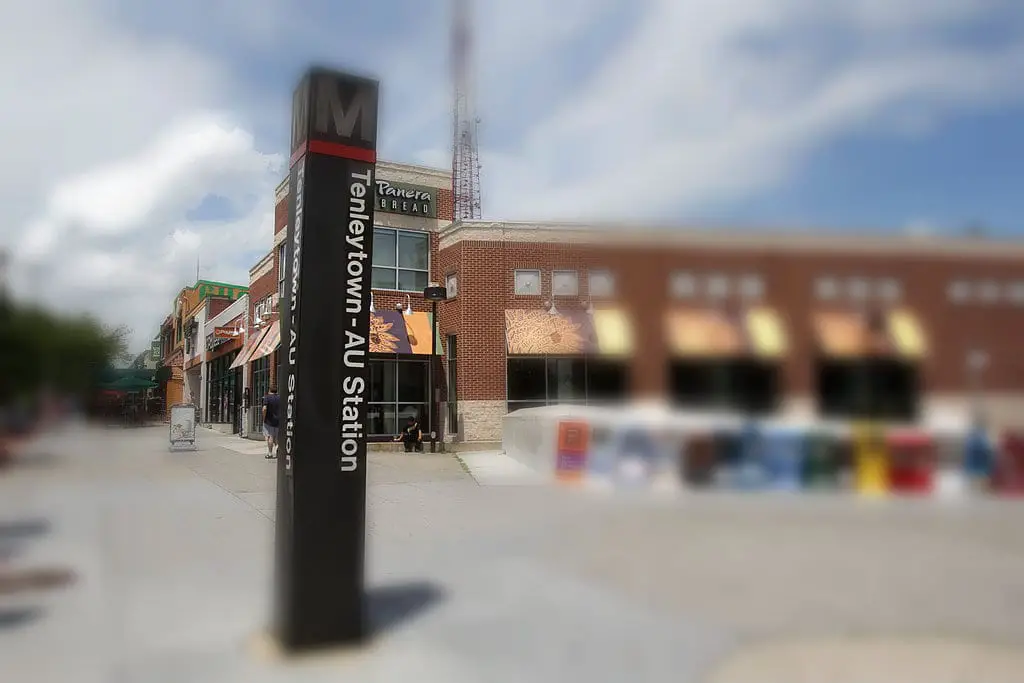
In May 1989, the Metro Board changed the name one final time, to “Tenleytown-AU,” acknowledging the proximity of American University. The District government paid $63,500 to update every sign, pylon, and system map in the network.
So the man who started all of this never spelled his own name twice the same way, because he never spelled it at all. An illiterate tavern keeper at a crossroads in 1790 left behind a place name that generated 200 years of lawsuits, petitions, Post Office investigations, Board of Geographic Names rulings, newspaper editorials, traffic circle fights, and a $63,500 Metro sign replacement.
If you’ve ever wondered why D.C. neighborhood naming debates seem to run forever, the Tenally family history is a pretty good explanation. And if you’re curious about how other places got their names, check out our post on why Reston is named Reston.
As a former AU student, I loved the history, thanks. That said, at this point might as well stick with Tenley.
I’ve picked Tenleytown to find out how traces of the past of Tenleytown persist, even where the original buildings have disappeared. Thought it might be of interest to some people here.
That did not seem to embed! http://tsarchitect.nsflanagan.net/?p=2832
I have a book specifically on Tennallytown, a rare eBay find, a few hundred pages, sort of a documented history and reference w/ entries from historical record. Tennallytown Tavern was one of the primary features of the area (together with Fort Reno) for those traveling along the route now known as Wisconsin Ave/Rockville Pike/Frederick Road/355 (not to forget Hungerford Dr.). I’ll have to dig out that old book.
The existence of multiple spellings for the Tenley family should surprise no one. This happened all the time in the old days. While doing family history research, I have found three different spellings of my surname. My branch of the family did not adopt the current spelling until the 1850s.