Before anyone called it Wisconsin Avenue, this road had been an ancient Indian trail, Georgetown’s main commercial artery, a country pike running north toward Maryland, and the subject of a bitter naming battle that dragged on for decades. The name “Wisconsin Avenue” is barely more than a century old. The road itself is ancient.
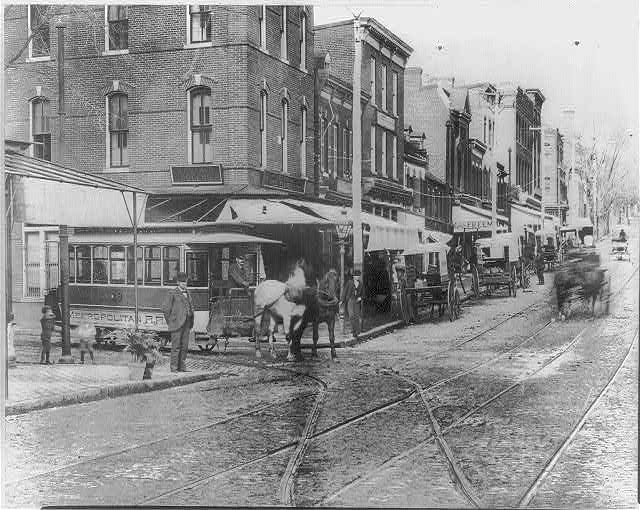
High Street: Georgetown’s Commercial Spine, 1755-1895
The earliest European name for the road was “High Street.” The term came straight from English tradition, where “High Street” just means the main street of commerce in a town. Georgetown deeds from the era described it as “Commerce or High street.”
The name appeared in documented use by at least 1755, when Colonel Dunbar’s Regiment set out from Georgetown northward along it on the way to join General Braddock’s campaign. By 1770, Georgetown’s town expansion, called the Beatty and Hawkins’ Addition, had spread northward on both sides of High Street.
Four decades after that, on June 30, 1791, George Washington rode up High Street on his way to Frederick, Maryland. He’d just met with the commissioners who were laying out the new federal city. When President Adams arrived in Washington on June 3, 1800, he came down the same road and caught his first view of the unfinished Capitol and the unfinished Presidential Mansion from the heights above Georgetown.
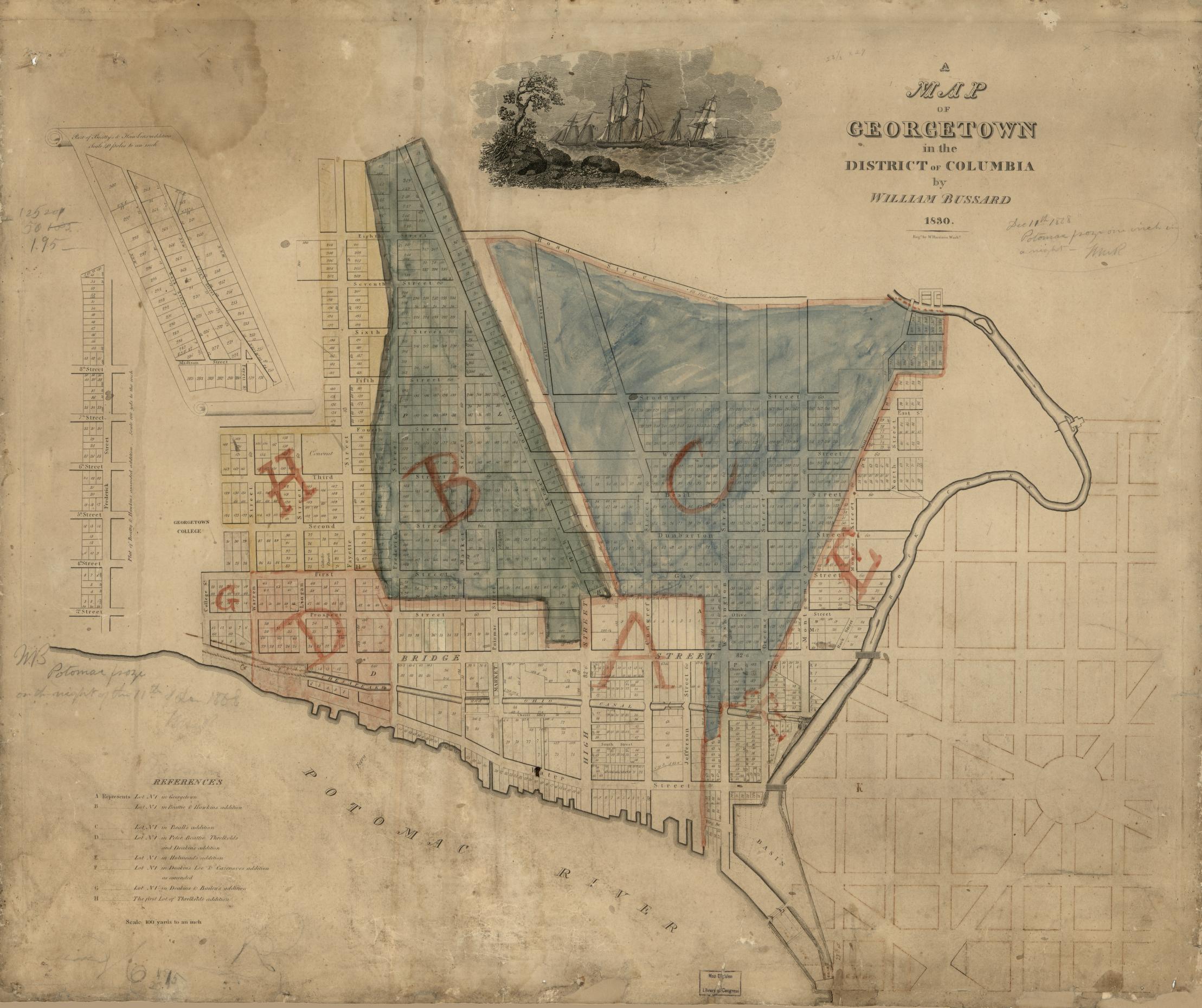
You can see the name plainly on this 1830 map of Georgetown. “High St.” runs right up the center of the city. An 1874 map shows it still labeled that way more than a century after the name first appeared in the records.
Tennallytown Road: The Same Road, A Different Name
But “High Street” only covered the Georgetown portion. Once you traveled north past the Georgetown town limits, the road went by a completely different name: Tenallytown Road, or Tennallytown Road, depending on who was writing it down. That section took its name from the small settlement that had grown up around a tavern at what is now Wisconsin Avenue and River Road NW. (If you want the full story of how that community’s name shifted from Tennallytown to Tenleytown, we covered that separately.) The road also went by a third name for the full route from Georgetown to Rockville, Maryland: the Georgetown and Rockville Pike. One road. Three names. The name you used depended entirely on where you were standing.
The Battle Over the Name (1881-1905)
By 1881, the District took its first crack at rationalizing Georgetown’s street names. The plan was to fold them into Washington’s numbered-street grid, which would have turned High Street into 32nd Street. The effort stalled. Old names die hard in Georgetown.
The real change came from Congress. In 1895, an act of Congress formally absorbed Georgetown into Washington, D.C., and forced Georgetown’s street names to fall in line with the rest of the city. High Street had to go. The replacement was Wisconsin Avenue, which the District Commissioners had already picked in their Annual Report of July 22, 1890 for the northern section of the road. Maps continued to show “High Street” as late as 1899.
None of this settled the question for the stretch north of Georgetown, though. In 1904, residents along the Tennallytown Road section were still pushing back hard against the Wisconsin Avenue name. We came across this remarkable article in the Washington Post from June 3rd, 1904:
Tennallytown road will remain Tennallytown road for the immediate future, but it will be spelled officially “Tenleytown.” Such was the decision of the District Commissioners yesterday, taken upon the recommendation of Engineer Commissioner Biddle, who recently moved to designate the thoroughfare “Wisconsin avenue.” The reconsideration is to give people living along the road opportunity to be heard.
When Col. Biddle first moved to designate the thoroughfare Wisconsin avenue, he thought he was meeting a popular demand, but numerous protests convinced him of his mistake. What the ultimate preference of the people will be is a much mooted question. Names varying widely in some instances and in others distinguished only by a single letter have been suggested, and applied to the thoroughfare. Among the entries are Georgetown and Rockville road, Tennallytown road, Tenallytown road, Tenleytown road, Tenley road, High street, Thirty-second street, and Wisconsin avenue. In favor of each name there are staunch supporters.
Eight different names proposed for one road. Engineer Commissioner Biddle had thought Wisconsin Avenue would be welcomed. Instead, he got an earful. The commissioners pumped the brakes and gave residents more time to weigh in.
By 1905, the commissioners settled it. They extended Wisconsin Avenue south all the way to the Potomac River, and for the first time in recorded history, the road carried one name from Georgetown to the Maryland line.
Streetcars had already been running the road since 1890, linking Georgetown to Tenleytown and Bethesda. Horse cars at Wisconsin and O Street in Georgetown were a fixture of the neighborhood by the 1890s, and by 1900 the track reached all the way to Rockville. Those streetcars on Wisconsin Avenue ran until January 3, 1960, when the last car made the trip.
One address on that Georgetown stretch, 1420 Wisconsin Avenue, later became Commander Salamander.
Today, Wisconsin Avenue connects Georgetown’s historic commercial district to Friendship Heights and Chevy Chase and on into Maryland. It runs along the same ancient ridgeline that bison herds, native traders, tobacco farmers, and George Washington all traveled before the road ever had a name at all.
We dug this one up with help from AI and checked it against the original records below. Here’s how we use AI.