
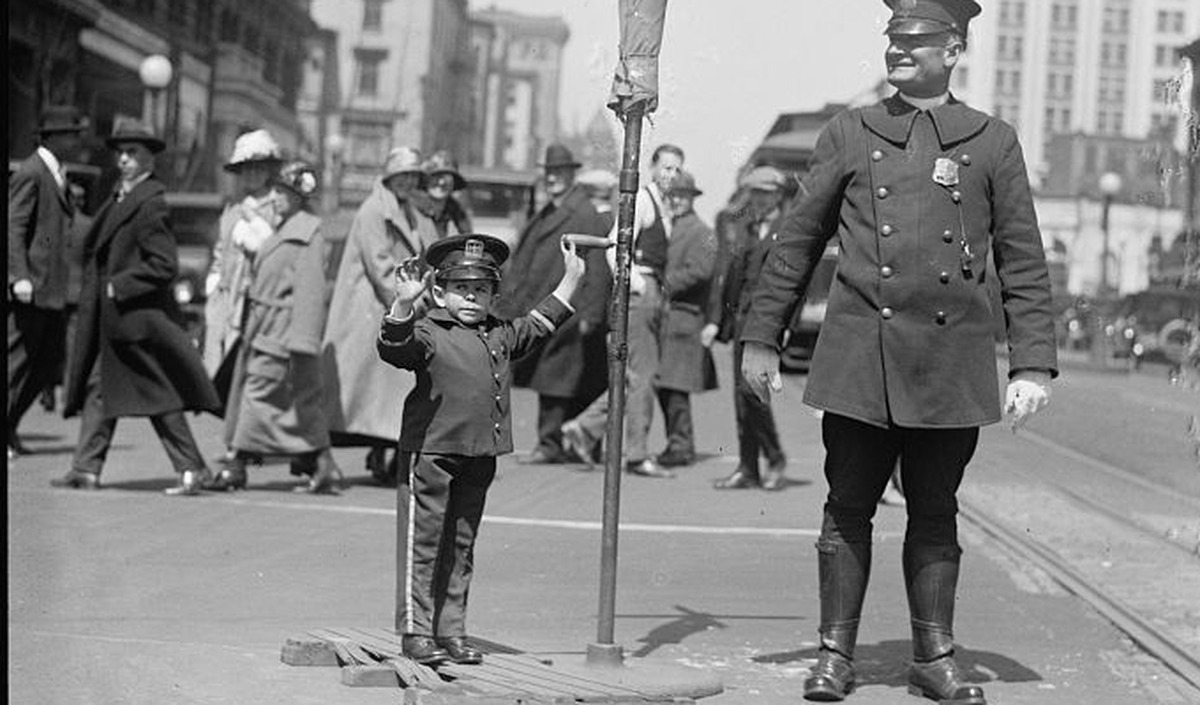
We have an outstanding photograph to share with you. It was taken on June 8th, 1924, at 14th and G Streets NW in Washington, DC. The police officer directing traffic is Julius Daranyi, a star performer with Singer’s Midgets, the world-famous vaudeville troupe that was in the middle of a week-long engagement at B.F. Keith’s theater.

The Washington Post reported the assignment the morning it happened:
Julius Daranyi, one of the stars with Singer’s midgets playing at B. F. Keith’s theater this week, will become a member of the District of Columbia’s police force today and take up his first detail at Fourteenth and G streets, at 12:30 o’clock, where he will direct traffic.
B.F. Keith’s theater stood at the corner of 15th and G Streets NW, in the Riggs Building, one block from the intersection where Daranyi took up his post. The theater had opened in 1912 as Chase’s Polite Vaudeville Theatre before being renamed for the vaudeville circuit’s founder. By 1924 it was one of Washington’s premier entertainment venues. Keith’s wouldn’t fully convert to a motion-picture-only program until 1932, the last major theater in Washington to hold out on regular vaudeville performances.
A Week of Stunts
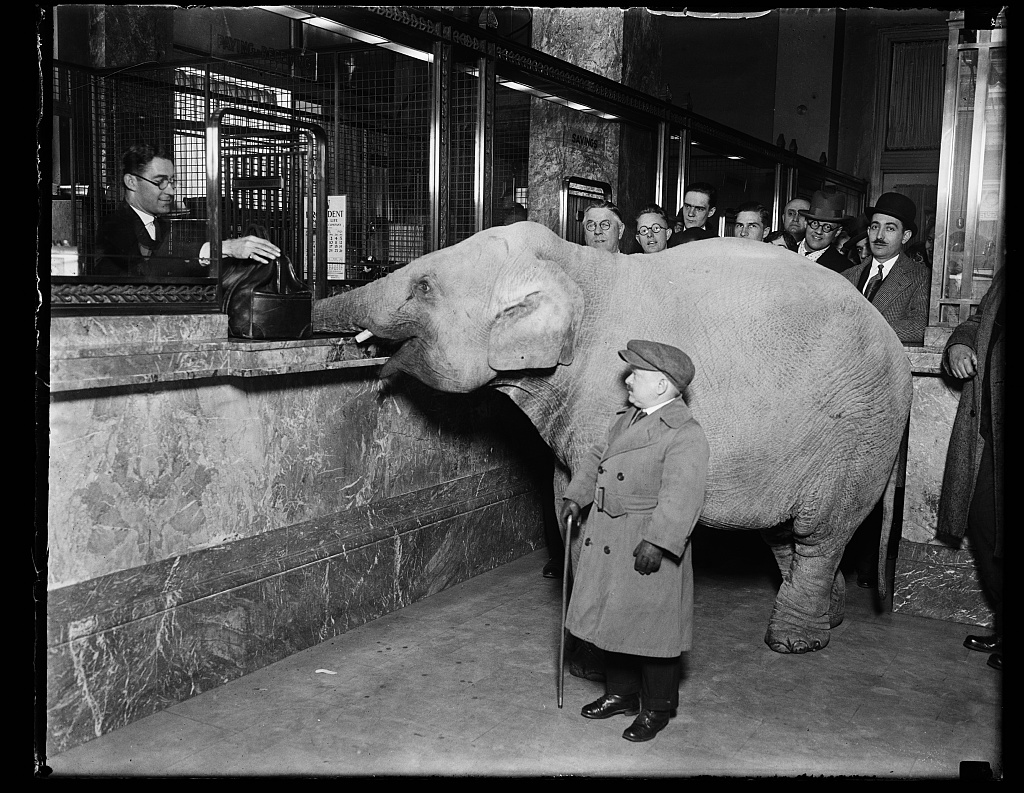
Daranyi directing traffic wasn’t the only spectacle Singer’s Midgets staged in Washington that week. Two photographers from competing agencies were both dispatched to document the troupe’s antics around the city, and the stunts they captured are just as good.
Charlie Becker, a midget trainer with the troupe, walked the smallest elephant from Singer’s animal act down a Washington street to Merchant’s Bank, where he made a cash deposit on behalf of Keith’s Theatre. The elephant delivered the money satchel directly to the teller.
At some point during the same Washington run, the troupe also headed to the Y.M.C.A. for a round of bowling. The National Photo Company was there too.

This is what a vaudeville publicity campaign looked like in 1924. Get the performers in front of photographers. Put them somewhere unexpected. Let the newspapers do the rest.
Singer’s Midgets: A Troupe Built in Vienna
The company behind all of this was Singer’s Midgets, organized around 1912 by Viennese impresario Leo Singer. Singer built a Liliputstadt, a ‘midget city,’ at an amusement park in Vienna, where the troupe performed and trained as singers, dancers, wrestlers, and acrobats. When World War I broke out, Singer brought the act to the United States, and the troupe remained there, working the vaudeville circuit, for the rest of the act’s existence. By the early 1920s, they had performed in nearly every country in the world.
Singer’s Midgets had already made headlines in Washington earlier that same year. On April 7th, 1924, the entire company was received at the White House by President Calvin Coolidge, accompanied by Roland Robbins, the manager of B.F. Keith’s. That visit is the subject of our post on Singer’s Midgets and the Coolidge White House.
From Washington Traffic to the Wizard of Oz
Fifteen years after Daranyi directed traffic on G Street, Leo Singer signed a contract with Metro-Goldwyn-Mayer. In 1938, he agreed to provide 124 actors and stand-ins to play Munchkins in The Wizard of Oz, which opened in 1939. Singer’s Midgets were not named because they could sing. Most of the Munchkin voices in the film had to be dubbed. The name came from Leo Singer, who organized and managed the troupe.